Comments, observations and thoughts from two bloggers on applied statistics, higher education and epidemiology. Joseph is an associate professor. Mark is a professional statistician and former math teacher.
On January 1, 2020, works from 1924 will enter the US public domain,1 where they will be free for all to use and build upon, without permission or fee. These works include George Gershwin’s Rhapsody in Blue, silent films by Buster Keaton and Harold Lloyd, and books such as Thomas Mann’s The Magic Mountain, E. M. Forster’s A Passage to India, and A. A. Milne’s When We Were Very Young.
These works were supposed to go into the public domain in 2000, after
being copyrighted for 75 years. But before this could happen, Congress
hit a 20-year pause button and extended their copyright term to 95
years.2
Now the wait is over. How will people celebrate this trove of cultural material? The Internet Archive will add books, movies, music, and more to its online library. HathiTrust will make tens of thousands of titles from 1924 available in its digital library. Google Books
will offer the full text of books from that year, instead of showing
only snippet views or authorized previews. Community theaters can screen
the films. Youth orchestras can afford to publicly perform the music.
Educators and historians can share the full cultural record. Creators
can legally build on the past—reimagining the books, making them into
films, adapting the songs.
A New Year's tweet got me poking Audrey Watters blog and finding all sorts of good things (more on that coming soon). One post I'll definitely be putting away for reference is this list quotes on the potential of educational technology.
I've been arguing for a while that the broad outlines of our concept of the future were mostly established in the late 19th/early 20th Centuries and put in its current form in the Postwar Period. Here are a few more data points for the file.
“Books will soon be obsolete in schools” — Thomas Edison (1913)
“If, by a miracle of mechanical ingenuity, a book could be so arranged that only to him who had done what was directed on page one would page two become visible, and so on, much that now requires personal instruction could be managed by print.” — Edward Thorndike (1912)
“The central and dominant aim of education by radio is to bring the world to the classroom, to make universally available the services of the finest teachers, the inspiration of the greatest leaders … and unfolding events which through the radio may come as a vibrant and challenging textbook of the air.” — Benjamin Darrow (1932)
“Will machines replace teachers? On the contrary, they are capital equipment to be used by teachers to save time and labor. In assigning certain mechanizable functions to machines, the teacher emerges in his proper role as an indispensable human being. He may teach more students than heretofore—this is probably inevitable if the world-wide demand for education is to be satisfied—but he will do so in fewer hours and with fewer burdensome chores. In return for his greater productivity he can ask society to improve his economic condition.” — B. F. Skinner (1958)
“I believe that the motion picture is destined to revolutionize our educational system and that in a few years it will supplant largely, if not entirely, the use of textbooks. …I should say that on the average we get about two percent efficiency out of schoolbooks as they are written today. The education of the future, as I see it, will be conducted through the medium of the motion picture… where it should be possible to obtain one hundred percent efficiency.” — Thomas Edison (1922)
“At our universities we will take the people who are the faculty leaders in research or in teaching. We are not going to ask them to give the same lectures over and over each year from their curriculum cards, finding themselves confronted with another roomful of people and asking themselves, ‘What was it I said last year?’ This is a routine which deadens the faculty member. We are going to select instead the people who are authorities on various subjects — the people who are most respected within their respective departments and fields. They will give their basic lecture course just once to a group of human beings, including both the experts of their own subject and bright children and adults without special training in their field. These lectures will be recorded as Southern Illinois University did my last lecture series of fifty-two hours in October 1960. They will make moving-picture footage of the lectures as well as hi-fi tape recording. Then the professors and and their faculty associates will listen to the recordings time and again” — R. Buckminster Fuller (1962)
“The machine itself, of course, does not teach. It simply brings the student into contact with the person who composed the material it presents. It is a laborsaving device because it can bring one programmer into contact with an indefinite number of students. This may suggest mass production, but the effect upon each student is surprisingly like that of a private tutor.” — B. F. Skinner (1958)
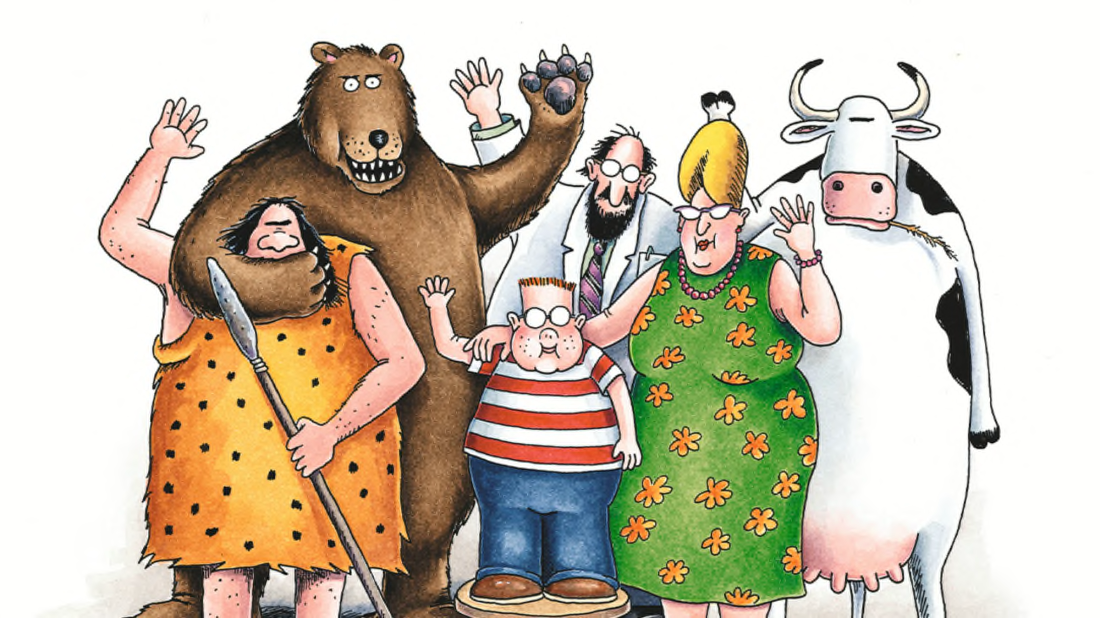
In September, a cryptic update to cartoonist Gary Larson’s The Far Sidewebsite
hinted that something new might be in store for fans of the popular
single-panel comic strip. This week, Larson and his syndicate, Andrews
McMeel Universal, made it official. The irreverent cartoon,
which originally ran from 1980 to 1995 and explored the perils of
anthropomorphic cows and science run amok, will now be available online
for the first time. But it won’t be strictly archival material: Larson
plans to periodically revisit his bizarre world with new art.
"Little Haiti’s elevation is 7 feet above sea level with pockets in the neighborhood that go as high as 14 feet above sea level. By comparison, Miami Beach is about 4 feet above sea level."
In many parts of
the US black communities were pushed to low-lying flood prone
areas.
In Miami, the opposite is true. Black
communities were built on high elevation away from the coast. Now
because of sea level rise that high land is in demand. (THREAD)https://t.co/3nFgtjzR7v
Which Democratic
voters are potentially the most disloyal? Here's the percentage
of each candidate's base who say they'll vote Dem in the
 2020 general:
Warren: 97 Steyer:
96 Biden: 94 Klobuchar: 93 Buttigieg:
92 Sanders: 87 Bloomberg: 82 Booker:
80 Yang: 73 ... Gabbard:
15
Klein is making a tremendously important point here
The media thinks
the power it has is covering things positively or negatively. If that
was ever true, it's not now.
The media is an
amplification machine. Our biggest impact is in choosing what to cover.
If we amplify lies — even to fact check them — they often gain power.
https://t.co/jHVKycMV3r
The Infinite Gift
 🎁
This is an interesting object where the side of
the nth box is 1/√n. As n→+∞, the gift has infinite surface area and
length but finite volume! Learn more about this
interesting paradox here: https://t.co/jbWbg6iqFZpic.twitter.com/kxO20PTGti
"Journalist Napp Nazworth, who has worked for the
Christian Post website since 2011, said he quit his job Monday because
the website was planning to publish a pro-Trump editorial that would
slam Christianity Today." https://t.co/N3TmhL7WHp
Kanefield has become the essential legal commentator for the Trump years. For those who lack the patience for really long threads, she also has blog versions.
(thread) How
California Turned Blue
Alternate title: California
shows the way California used to be Republican. We
gave the nation Nixon and Reagan. Republican
candidates won CA in every presidential election between 1952 and 1988
except one⤵️ pic.twitter.com/d6YvnCrMsr
This remains one of the best indications of real expertise in all fields.
My year as an MIT
 fellow taught me that truly smart people, real experts, can make
complicated concepts understandable to non-experts, in tight simple
language. Poseurs have a problem with that. https://t.co/054pq6DSTu
I've never been a beach person. There are (or at least used to be) some
exceptions but most of these towns are for me nice places to visit but a
little too bland and way too pricey to want to live there.
I know people, however, who have trouble imagining living anywhere else.
One of them, a long time Venice resident, described it like this. He
had lived in other parts of the city when he first came here but said he
never felt he was truly in LA until he made it all the way west. He
compared the feeling to that of a pioneer crossing the continent in a
covered wagon only to die of thirst in the desert just short of
California.
Venice Beach used to have a seedy, bohemian reputation, just the sort of
place you'd expect Jim Morrison to hang out. These days, the feel is
definitely upscale, the rough edges have largely been worn away, and the
crime you encounter is less likely to involve gangs and drugs and more
likely to involve Silicon Beach Ponzi schemes.
One of the last holdouts of old Venice was Abbott's Habit, a decidedly
non-corporate coffeehouse that long held a corner of Abbott Kinney, the
street now known for pop-up shops, trendy restaurants, and places where
you can get bone marrow ice cream (no, really).
I happened to be in Venice the day that Abbott's Habit closed. It was
packed with regulars as a long list of local musicians played short sets
to say goodbye. One song in particular captured the mood of the event
(I'm sure it's out there somewhere on the Internet but I haven't been
able to find it). The chorus went something like this, "when I get east
of Lincoln, my heart starts sinkin'."
The Lincoln in question is the stretch of the Pacific Coast Highway that
runs north and south through that part of town and informally divides
the "beach" community from the "non-beach" areas. To live west of
Lincoln means to have cool ocean breezes throughout the summer, to be
able to walk down to the boardwalk, and generally to feel yourself part
of the vibe.
Every time the singer got the chorus, the crowd nodded in melancholy
appreciation. This was a big part of how they had defined their
community and, to a degree, themselves. Now, many were being priced out
of the area and, more importantly, those who stayed or returned for a
visit knew that their Venice was gone regardless.
While it certainly lacks the emotional resonance for the new residents,
"west of Lincoln" has never had more economic importance and perhaps
never more social value. Venice Beach has become one of those places
where well-off people want to live and, more to the point, one of those
places where well-off people want to brag about living. There's nothing
especially objectionable about this (most non-native born Angelenos have
at least occasionally taken a certain pleasure in telling friends back
east stories of beautiful weather and celebrity encounters), but it can
have important implications for our urban planning discussion.
Many of the arguments we hear about density and transportation are
strongly dependent on some rather simplistic assumptions about linear
relationships and fixed demand. Why people live where they live is
almost always complicated and seldom monocausal. If the discussion
doesn't start reflecting some of that complexity, we are in danger of
making some very big mistakes.
(And, yes, the bone marrow ice cream wasn't that bad.)
One of the good things to come out of the past few years was that events have forced journalists to finally start facing some ugly truths about the profession, that they had abdicated their responsibility to inform, that they had used self-serving definitions of fairness as an excuse for caving in to pressure, that they not only tended to reduce complex stories to simplistic narratives but often let those narratives be dictated to them.
While we still have a ways to go, things have improved greatly. The conversation used to be lead by hacks like Howard Kurtz and tribalists like JackShafer. Now, the leading voices are arguably Margaret Sullivan and Jay Rosen, both of whom spent years playing Cassandra, having their prescient warnings ignored as things kept getting worse.
I'm sure there are exceptions, but every mainstream press institution I can think of at the moment has improved from its low point. I routinely find myself impressed by a piece of reporting or analysis from CNN (something that never used to happen). Even the Chuck Todds are starting to stand up on their hind legs.
This process of acknowledging and correct flaws has proved most difficult for the New York Times and NPR. The first is held back by compulsive self-congratulation and the axiomatic belief that is it is the world's best newspaper. The second has almost convinced itself that its now instinctive submissive crouch is a sign of maturity rather than cowardice.
Nonetheless, both are showing progress. This NYT piece represents a big step forward in acknowledging the situation, if not the gray lady's role in it.
"Centrist bias, as I see it, confuses the idea of
centrism (which is very much an ideology) with objectivity and
fairness." https://t.co/8CTknh59UU
Better still is this interview by Steve Inskeep, where he calmly but forcefully deals with the disinformation.
"Gotta
stop you there." Invite Pam Bondi on your program for some of
that good both sides feeling, you're going to receive made-up
facts. Listen to what happens starting at 3:10. She is corrected, but
keeps going. Inskeep decides to turn down her mic. https://t.co/YAHFzCRkCJ
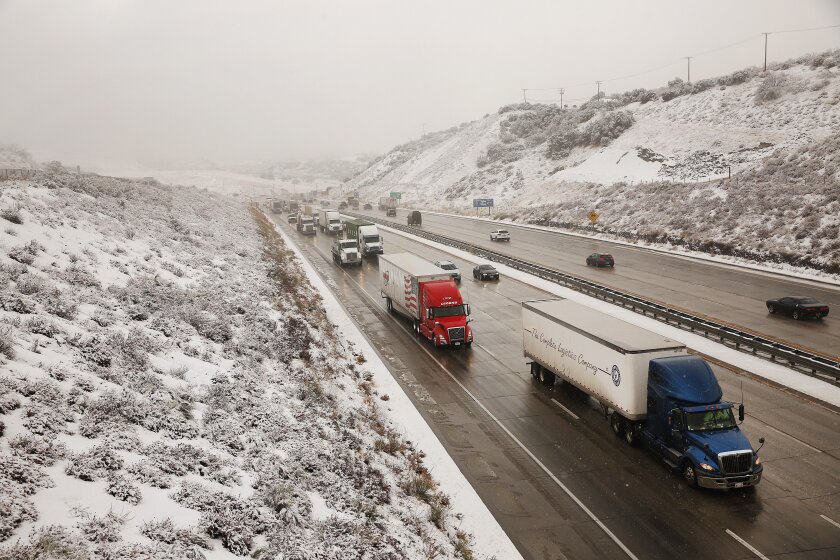
One of the many things I didn't expect when I moved to LA early in the 2000s was that I would still have to adjust my travel plans for winter storms.
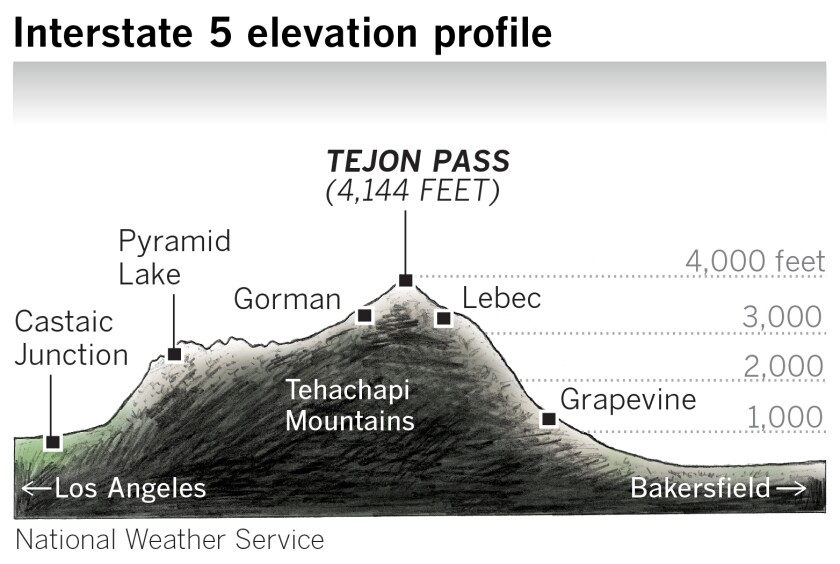
A cold winter storm will bring widespread rain and mountain snow to Southern California late Wednesday into Thursday, the National Weather Service said.
Snow levels will dip as low as 2,500 feet, and up to 8 inches could accumulate in the Antelope Valley. The Cuyama Valley could receive 3 inches of snow. Higher elevations of the L.A. and Ventura county mountains could see up to 2 feet of snow, especially above 6,000 feet.
I realized that now when I hear the word "unicorn," I think of a tech bro pitching a 21st Century Ponzi scheme to some clueless venture capitalists. Here's something to wash the taste of all of those WeWorks and Pelotons out of your mind.
Recent events have got me thinking about this point from four years ago.
I've been arguing for quite a while now that we need to pay more attention to the catharsis in politics (such as with the reaction to the first Obama/Romney debate),
particularly with the Tea Party. Conservative media has long been
focused on feeding the anger and the outrage of the base while promising
victory just around the corner. This has produced considerable partisan
payoff but at the cost of considerable anxiety and considerable
disappointment, both of which produce stress and a need for emotional
release.
There's a tendency to think of trading political capital for catharsis
as being irrational, but it's not. There is nothing irrational about
doing something that makes you feel better. That's the real problem for
the GOP leaders: shutting down the government would be cathartic for
many members of the base. It would be difficult to get the base to defer
their catharsis, even if the base trusted the leaders to make good on
their promise that things will get better.
The difference now is that the head of the party is one of the base.
This recent TPM post about the looming government shut-down ties in with a couple of ideas we've discussed before. [Emphasis added]
Facing a Sept. 30 deadline to fund the government, GOP leaders in both
chambers decided they would fast-track standalone anti-abortion bills in
an effort to allow conservative Republicans to express their anger over a series of “sting” videos
claiming to show that Planned Parenthood is illegally harvesting the
tissue of aborted fetuses. The leadership hoped that with those votes
out of the way, the path would be clear for long-delayed bills to fund
the government in the new fiscal year, even if those bills contained
money for Planned Parenthood.
But anti-abortion groups and conservative House members are not backing
down from their hard line. They are reiterating that they will not vote
for bills that include Planned Parenthood funding under any
circumstances, despite the maneuvering by leaders to vent their outrage over the videos. If anything, anti-abortion groups are amping up the pressure on lawmakers not to back down from the fight.
Here's what we had to say about the GOP reaction to those videos a month ago.
Fetal
tissue research will make most people uncomfortable, even those who
support it. If you were a Republican marketer, the ideal target for
these Planned Parenthood stories would be opponents and persuadables. By
contrast, you would want the videos to get as little play as possible
among your supporters. With that group, you have already maxed out the
potential gains – – both their votes and their money are reliably
committed – – and you run a serious risk of pushing them to the level
where they start demanding more extreme action.
With all of the
normal caveats -- I have no special expertise. I only know what I read
in the papers. There's a fundamental silliness comparing a political
movement to a business -- it seems to me that in marketing terms, the PP
tapes have been badly mistargeted. They have had the biggest viewership
and impact in the segment of the voting market where they would do the
least good and the most damage (such as pushing for a government
shutdown on the eve of a presidential election).
[I really should have said "causing supporters to push," but it's too late to worry about that now.]
I haven't followed the press coverage that closely, but based on what
I've come across from NPR and the few political sites I frequent, I get
the feeling that the center-left media is more likely to discuss the
doctoring of the tapes than to focus on the gory specifics of harvesting
fetal tissue. I'd need to check sources like CNN before making a
definitive statement, but it appears that the videos are having
exceptionally little effect on what should have been their target
audience.
Instead, their main impact seems to have been on the far right. The
result has been to widen what was already a dangerous rift. The
pragmatic wing looks at defunding as a futile gesture with almost no
chance of success and large potential costs. The true believers are
approaching this on an entirely different level. It has become an article of faith
for them that, as we speak, babies are being killed, dismembered and
sold for parts. They demand action, even if it's costly and merely
symbolic, as long as it's cathartic.
I've been arguing for quite a while now that we need to pay more attention to the catharsis in politics (such as with the reaction to the first Obama/Romney debate),
particularly with the Tea Party. Conservative media has long been
focused on feeding the anger and the outrage of the base while promising
victory just around the corner. This has produced considerable partisan
payoff but at the cost of considerable anxiety and considerable
disappointment, both of which produce stress and a need for emotional
release.
There's a tendency to think of trading political capital for catharsis
as being irrational, but it's not. There is nothing irrational about
doing something that makes you feel better. That's the real problem for
the GOP leaders: shutting down the government would be cathartic for
many members of the base. It would be difficult to get the base to defer
their catharsis, even if the base trusted the leaders to make good on
their promise that things will get better.
For now, the Tea Party is inclined to do what feels good, whether it's
supporting an unelectable candidate or making a grandstanding play. It's
not entirely clear what Boehner and McConnell can do about that.




.jpg)


.jpg)
.jpg)
.jpg)
.jpg)
.jpg)
.jpg)
.jpg)


