If you have a few minutes, listen to this episode of KCRW's Unfictional (sorry, I can't find a transcript) where neuroscience researcher Moran Cerf publishes a paper on brain machine interfaces in Nature then watches the popular press spin out a string of fantasies about dream recorders and the government monitoring your subconscious.
It's a funny story but it has a serious undercurrent. At the risk of sounding like an alarmist, I'm beginning to think that our discourse, our ability exchange and evaluate important information and use it to collectively make informed decisions is in serious trouble, and I'm not sure how you can run a democracy without that.
The decline in journalistic professionalism is a big part of that problem. There are some excellent journalists out there, but there are also far too many like the ones in this story. They nonchalantly build on each other's fictions. They unquestioningly accept claims from interested parties. They dodge responsibility for uncomfortable facts by hiding behind he said/she said stories.
As I've said before, I honestly believe that given good information, the American public tends to make good decisions but there's a corollary to that claim: given the crap we've been fed recently, it's a wonder we still have a country.
Tuesday, September 13, 2011

And now for a break from serious discussion
I would like to imagine that this could not happen in a modern roundtable, but it is just too close to reality:
And, I suppose, a casino operator is gloating . . .
Imagine a host talking to a panel of four pundits about someone about to roll a 6-sided die.
Host: What's your prediction for the big dice roll?
Judy: Well, Jim, I've knocked on thousands of doors in this province, and families everywhere are telling me the same thing. They like the number 1, so I expect it to do really well.
Bill: Remember, the big dice roll is taking place on a Sunday after church, so the smart money is on 3, the trinity. We all remember Easter Sunday 1985 when a three was rolled three consecutive times. History is on the side of 3.
Jim: Look at the data. An even number has come up on 9 of the last 13 rolls. You have to play the hot hand on this one and go for 2, 4, or 6.
Alice: I agree with Jim's data, but all that means is that odd numbers are due. Judy is right that 1 is the trendy pick, but I really like 5 as a dark-horse candidate.
[Off-screen a mathematician is sobbing].
And, I suppose, a casino operator is gloating . . .
401(k) plans
We have talked a bit about how personal finance and saving for retirement is hard. One reason that 401(k) plans have been able to charge high fees (management fees plus fees from the individuals mutual funds) is that they are tax free savings vehicles (and tax free covers a lot of sins). That is now being openly discussed:
Neither solution is ideal. Lowering the deduction limit makes these plans less able (even in theory) to store enough wealth for retirement. It also makes "catching up" after a period of unemployment or education more difficult.
Matches, on the other hand, are much easier to cut than tax breaks. Dropping the match from 30% to 28% is an easy cut that raises a lot of revenue. It may be harder to penalize post-tax withdrawals, which runs the risk of funds being emptied due to an unexpected job loss.
None of this would really matter if we were confident that social security would be around. It really is the key government anti-poverty program. But ponzi scheme comments are not helping build confidence in the long term health of the program.
The tax break for defined contribution retirement plans will cost the Treasury $212.2 billion between 2010 and 2014, according to the Joint Tax Committee. But the vast amount of that benefit - as much as 80 percent - goes to the top 20 percent of earners, according to estimates from the Tax Policy Center, a nonpartisan, but liberal-leaning, think tank.
For example, a person in the 35 percent tax bracket saves $35 in taxes every time he puts $100 in his 401(k), for a net cost of $65. Someone in the 15 percent bracket pays $85, after tax, for the same $100 contribution. The Pension Rights Center, which has favored traditional defined benefit pensions and other programs aimed at lower-income retirees, advocates rolling back the current $16,500 annual 401(k) tax-deferred contribution limit to the $10,500 level it was at before the Bush tax cuts, its director, Karen Ferguson, has said.
One way to address both the cost and the disparity is to change the deduction into a credit. William Gale, of the Brookings Institution, will present a plan like that to the Senate committee on Thursday. His plan would eliminate the deduction entirely and replace it with a federal match that would be deposited directly into workers retirement accounts. A match of 30 percent would be revenue neutral, he says.
Neither solution is ideal. Lowering the deduction limit makes these plans less able (even in theory) to store enough wealth for retirement. It also makes "catching up" after a period of unemployment or education more difficult.
Matches, on the other hand, are much easier to cut than tax breaks. Dropping the match from 30% to 28% is an easy cut that raises a lot of revenue. It may be harder to penalize post-tax withdrawals, which runs the risk of funds being emptied due to an unexpected job loss.
None of this would really matter if we were confident that social security would be around. It really is the key government anti-poverty program. But ponzi scheme comments are not helping build confidence in the long term health of the program.
Sunday, September 11, 2011
Personal Finance talk
There has been a lot of discussion of personal finances in the blogsphere this weekend, and several really good points have been made. I want to comment on the cool stuff at Worthwhile Canadian Initiative, but first let us consider two interesting posts by Karl Smith. One is on Apple:
They have the value of their share of the company, but that might very well be spent on other things before any dividends are paid. It's scary to consider.
Even worse is his discussion of Sir Alan Sanford:
That is a lot more scary. It really makes the idea of a government sponsored pension program way more appealing. And it definitely makes one skeptical about the ability of a typical investor to manage their assets. After all, I would not have seen Apple as an atypical investment vehicle, mostly because I like and consume their products. But if they are not paying dividends, then the idea behind getting money out of them is entirely to sell shares to somebody else.
But why would they want to buy them if they do not produce returns?
Let’s add up how much of the iMac, iPod, iPhone, iBook and iPad profts have been paid out to the owners of Apple. Well lets think. . . oh yes I have it now, ZERO DOLLARS! Not one single penny.
So far is this really different from what Allen Stanford did? I hear some of his investors actually got redemptions. But, I am sure Apple investors will get their money some day, right.
They have the value of their share of the company, but that might very well be spent on other things before any dividends are paid. It's scary to consider.
Even worse is his discussion of Sir Alan Sanford:
You can do whatever you want to Allen Stanford. He is now broke. He got beat up in prison. He may very well spend the rest of his life there. But, he’s 61 years old now. These experience were his life. You can’t take that away.
Once you realize that, you realize the fundamental vulnerability that everyone has in handing over your assets to someone else. There is just no recourse against the other person consuming them.
You have to trust and that’s at the heart of what call The Big Externality.
That is a lot more scary. It really makes the idea of a government sponsored pension program way more appealing. And it definitely makes one skeptical about the ability of a typical investor to manage their assets. After all, I would not have seen Apple as an atypical investment vehicle, mostly because I like and consume their products. But if they are not paying dividends, then the idea behind getting money out of them is entirely to sell shares to somebody else.
But why would they want to buy them if they do not produce returns?
Saturday, September 10, 2011
Remind me not to piss off Felix Salmon
Case in point, check out his sharp, funny and endlessly quotable take down of Skybridge's Anthony Scaramucci. Here's a taste:
What Robinson nails is the way that this is what Scaramucci does — it’s his job. Scaramucci is a fund-of-funds manager, posting returns even he admits are lackluster: he more or less tracks the S&P 500, while making big, risky bets (a third of his assets are in MBS), investing in leveraged hedge funds, and reserving the right not to redeem his clients’ money upon request. Which means that he only has two ways to make money: either find stupid people to give him their money, or else shower himself with so many conspicuous indicia of success that people just want to buy into his perceived success.
OK, make that one way to make money.
It’s far from clear that Scaramucci actually is successful, in financial terms, by Wall Street standards. He certainly spends a lot — millions of dollars — on various forms of conspicuous consumption and self-promotion. But he’s not making a lot: since he’s a fund-of-funds manager, he’s making 1.5-and-zero, rather than 2-and-20. And under the terms of his deal with Citigroup, a substantial chunk of that 1.5 goes straight to them. He has to run Skybridge, of course, with all the employee compensation, compliance costs, and the like that entails. He’s regularly writing seven-figure checks to pay for things like the Davos Tasting of ludicrously expensive wine. And of course he has to pony up charitable donations, too, so as to be able to get up in front of a well-heeled crowd to receive the Hedge Funds Care Award for Caring. (I’m not making this up.)
Scaramucci’s fake-it-till-you-make-it approach might end up working: his fund is still growing, and Robinson says that he “has become the Wall Street player he aspired to be when he first landed at Goldman some 22 years ago.” He’s living proof of what Windward Capital’s Robert Nichols is quoted saying at the end of the article: “Performance isn’t what beats a path to your door. It’s sales and marketing.”
But he’s not a stock-picker, or even, really, a hedge-fund manager: he just plays one on TV.
Type M Bias
From the pages of Andrew Gelman:
I had never heard of Type M bias before I started following Andrew Gelman's blog. But now I think about it a lot when I do epidemiological studies. I have begun to think we need to have a two stage model: one study to establish an association followed by a replication study to estimate the effect size. I do know that novel associations I find often end up diluted after replication (not that I have that large of an N to work with).
The bigger question is whether the replication study should be bundled with the original effect estimate or if it makes more sense for a different group to look at the question in a separate paper. I like the latter more as it crowd-sources science. But it would be better if the original paper was not often in a far more prestigious journal than the replication study, as the replication study is the one that you would prefer to have the the default source for effect size estimation (and thus should be the easier and higher prestige one to find).
And classical multiple comparisons procedures—which select at an even higher threshold—make the type M problem worse still (even if these corrections solve other problems). This is one of the troubles with using multiple comparisons to attempt to adjust for spurious correlations in neuroscience. Whatever happens to exceed the threshold is almost certainly an overestimate.
I had never heard of Type M bias before I started following Andrew Gelman's blog. But now I think about it a lot when I do epidemiological studies. I have begun to think we need to have a two stage model: one study to establish an association followed by a replication study to estimate the effect size. I do know that novel associations I find often end up diluted after replication (not that I have that large of an N to work with).
The bigger question is whether the replication study should be bundled with the original effect estimate or if it makes more sense for a different group to look at the question in a separate paper. I like the latter more as it crowd-sources science. But it would be better if the original paper was not often in a far more prestigious journal than the replication study, as the replication study is the one that you would prefer to have the the default source for effect size estimation (and thus should be the easier and higher prestige one to find).
Friday, September 9, 2011
Replication in Science
From Tyler Cowen:
Of course, I worry even more about softer disciplines where the difficulties of replication are much higher (you don;t just have to replicate a lab, you may need to develop an entire new cohort study).
Scary stuff.
The unspoken rule is that at least 50% of the studies published even in top tier academic journals – Science, Nature, Cell, PNAS, etc… – can’t be repeated with the same conclusions by an industrial lab. In particular, key animal models often don’t reproduce. This 50% failure rate isn’t a data free assertion: it’s backed up by dozens of experienced R&D professionals who’ve participated in the (re)testing of academic findings.
Of course, I worry even more about softer disciplines where the difficulties of replication are much higher (you don;t just have to replicate a lab, you may need to develop an entire new cohort study).
Scary stuff.
Thursday, September 8, 2011
Earmarks and Agricultural Research
Sometimes the press isn't good at connecting stories, particularly when those stories don't match up with the journalists' rather constrained world-view. One of the most reliable examples is the coverage of earmarks. The very fact that earmarks are reported as budget stories is troubling, showing how easily reporters can be manipulated into wasting time on trivia, but as bad as these stories are on a general level, the specifics may be even worse.
Like so many bad trends in journalism, the archetypal example comes from Maureen Dowd, this time in a McCain puff piece from 2009. Here's the complete list of offending earmarks singled out by the senator and dutifully repeated by Dowd:
Of course, we have no way of knowing how effective these programs are, but questions of effectiveness are notably absent from McCain/Dowd's piece. Instead it functions solely on the level of mocking the stated purposes of the projects, which brings us to one of the most interesting and for me, damning, aspects of the list: the preponderance of agricultural research.
You could make a damned good case for agricultural research having had a bigger impact on the world and its economy over the past fifty years than research in any other field. That research continues to pay extraordinary dividends both in new production and in the control of pest and diseases. It also helps us address the substantial environmental issues that have come with industrial agriculture.
As I said before, this earmark coverage with an emphasis on agriculture is a recurring event. I remember Howard Kurtz getting all giggly over earmarks for research on dealing with waste from pig farms about ten years ago and I've lost count of the examples since then.
And interspaced between those stories at odd intervals were other reports, less flashy but far more substantial, describing some economic, environmental or public health crisis that reminded us of the need for just this kind of research. Sometimes the crisis is in one of the areas explicitly mocked (look up the impact of industrial pig farming on rural America* and see if you share Mr. Kurtz's sense of humor). Other times the specifics change, a different crop, a new pestilence, but still well within the type that writers like Dowd find so amusing.
Here's the most recent example:
Like so many bad trends in journalism, the archetypal example comes from Maureen Dowd, this time in a McCain puff piece from 2009. Here's the complete list of offending earmarks singled out by the senator and dutifully repeated by Dowd:
Before the Senate resoundingly defeated a McCain amendment on Tuesday that would have shorn 9,000 earmarks worth $7.7 billion from the $410 billion spending bill, the Arizona senator twittered lists of offensive bipartisan pork, including:Putting aside the relatively minuscule amounts of money involved here, the thing that jumps out about this list is that out of 9,000 earmarks, how few real losers McCain's staff was able to come up with. I wouldn't give the Autry top priority for federal money, but they've done some good work and I assume the same holds for the Polynesian Voyaging Society. Along the same lines, I have trouble getting that upset public monies spent on astronomical research. After that, McCain's selections become truly bizarre. Urban water usage is a huge issue, nowhere more important than in Western cities like Los Vegas and it's difficult to imagine anyone objecting to a program that actually gets kids out of gangs.
• $2.1 million for the Center for Grape Genetics in New York. “quick peel me a grape,” McCain twittered.
• $1.7 million for a honey bee factory in Weslaco, Tex.
• $1.7 million for pig odor research in Iowa.
• $1 million for Mormon cricket control in Utah. “Is that the species of cricket or a game played by the brits?” McCain tweeted.
• $819,000 for catfish genetics research in Alabama.
• $650,000 for beaver management in North Carolina and Mississippi.
• $951,500 for Sustainable Las Vegas. (McCain, a devotee of Vegas and gambling, must really be against earmarks if he doesn’t want to “sustain” Vegas.)
• $2 million “for the promotion of astronomy” in Hawaii, as McCain twittered, “because nothing says new jobs for average Americans like investing in astronomy.”
• $167,000 for the Autry National Center for the American West in Los Angeles. “Hopefully for a Back in the Saddle Again exhibit,” McCain tweeted sarcastically.
• $238,000 for the Polynesian Voyaging Society in Hawaii. “During these tough economic times with Americans out of work,” McCain twittered.
• $200,000 for a tattoo removal violence outreach program to help gang members or others shed visible signs of their past. “REALLY?” McCain twittered.
• $209,000 to improve blueberry production and efficiency in Georgia.
Of course, we have no way of knowing how effective these programs are, but questions of effectiveness are notably absent from McCain/Dowd's piece. Instead it functions solely on the level of mocking the stated purposes of the projects, which brings us to one of the most interesting and for me, damning, aspects of the list: the preponderance of agricultural research.
You could make a damned good case for agricultural research having had a bigger impact on the world and its economy over the past fifty years than research in any other field. That research continues to pay extraordinary dividends both in new production and in the control of pest and diseases. It also helps us address the substantial environmental issues that have come with industrial agriculture.
As I said before, this earmark coverage with an emphasis on agriculture is a recurring event. I remember Howard Kurtz getting all giggly over earmarks for research on dealing with waste from pig farms about ten years ago and I've lost count of the examples since then.
And interspaced between those stories at odd intervals were other reports, less flashy but far more substantial, describing some economic, environmental or public health crisis that reminded us of the need for just this kind of research. Sometimes the crisis is in one of the areas explicitly mocked (look up the impact of industrial pig farming on rural America* and see if you share Mr. Kurtz's sense of humor). Other times the specifics change, a different crop, a new pestilence, but still well within the type that writers like Dowd find so amusing.
Here's the most recent example:
Across North America, a tiny, invasive insect is threatening some eight billion trees. The emerald ash borer is deadly to ash trees. It first turned up in Detroit nine years ago, probably after arriving on a cargo ship from Asia. And since then, the ash borer has devastated forests in the upper Midwest and beyond.* Credit where credit is due. Though not as influential as Dowd, the New York Times also runs Nicholas Kristof who has done some excellent work describing the human cost of these crises.
Wednesday, September 7, 2011
"Ask Mister Math Person"
I've long held that the American voters tend to make damned good decisions when given reasonably good information. I'm now prepared to go further: recent polls show that most people have what I consider a pretty good take on Clinton era tax rates despite, as this hilarious post by Jon Chait shows, being fed absolute crap on the subject by experts on the media.
When a toothache is fatal
This post by Megan McArdle is absolutely required reading for anybody interested in arguing for true free markets in health care. An excerpt:
But what this illustrates is just how hard it is to make a decision when in extreme levels of pain. I believe the legal term is "diminished capacity". Now, this sort of tragedy can happen under nationalized health care too. But imagine what happens if this type of decision making is extended to emergency rooms?
A commenter says that according to local news reports, he was quoted a price of $27 for the antibiotic (sounds like erythromycin, then), and $3 for a painkiller. I believe the former, but I have a very hard time swallowing the latter. I mean, I guess I could be wrong, but I am very skeptical that there is a pharmacy out there that sells more than a dose or two of any prescription painkiller for $3. If he chose to take two vicodin over antibiotics, when he must have known that this was not a long-term solution, I have to question his decision-making even more deeply.
But what this illustrates is just how hard it is to make a decision when in extreme levels of pain. I believe the legal term is "diminished capacity". Now, this sort of tragedy can happen under nationalized health care too. But imagine what happens if this type of decision making is extended to emergency rooms?
When good news is a long way away
An interesting thought on retirement fundamentals:
This may very well be the beginning of the long and painful adjustment suggested in Boom, Bust and Echo. On the academic side, I expect these types of weakening returns to slow retirements, especially as Universities shift more and more to defined contribution pension plans., Mark's excellent post on this makes it rather obvious how unimportant returns are to wealth when they are as low as they are now.
The question is how do we break out of this cycle?
Alternatively, what is the best strategy for those of us who have to try and make some sort of plan for the future under these conditions?
And, finally, with bond yields low and the cost of Social Security baked into the financial system, why is this a good time to talk about privatizing the system? Wouldn't we want to do this in an environment with high rates of return on assets to make the new program have a chance to succeed?
These long-held concerns are now critical in a decade where the 79 million U.S. people born between 1946 and 1964 start retiring as soon as this year and larger boomer retirement waves build to peak around 2020-2022.
The concern is that the ebb and flow of U.S. stock markets over the past 50 years is highly correlated with the available pool of household savings channeled into equity investment.
Assuming peoples' prime savings years are those between ages 40 and 65, the proportion of the population in that bracket is therefore key to driving the market. As early as the 1980s, economists feared the impact this may have on U.S. housing markets -- and the recent real estate bust may owe it something -- but stock market connections are more convincing.
The data is alarming. Movements in the ratio of these high savers to both retirees and younger adults has presaged long cycles in real equity prices from the downward funk of 1970s to the subsequent 18-year equity boom through the late 1980s and 1990s as boomers swelled the ranks of prime savers.
The worrying bit for the United States is that ratio peaked in 2010.
This may very well be the beginning of the long and painful adjustment suggested in Boom, Bust and Echo. On the academic side, I expect these types of weakening returns to slow retirements, especially as Universities shift more and more to defined contribution pension plans., Mark's excellent post on this makes it rather obvious how unimportant returns are to wealth when they are as low as they are now.
The question is how do we break out of this cycle?
Alternatively, what is the best strategy for those of us who have to try and make some sort of plan for the future under these conditions?
And, finally, with bond yields low and the cost of Social Security baked into the financial system, why is this a good time to talk about privatizing the system? Wouldn't we want to do this in an environment with high rates of return on assets to make the new program have a chance to succeed?
Monday, September 5, 2011
XKCD on investing
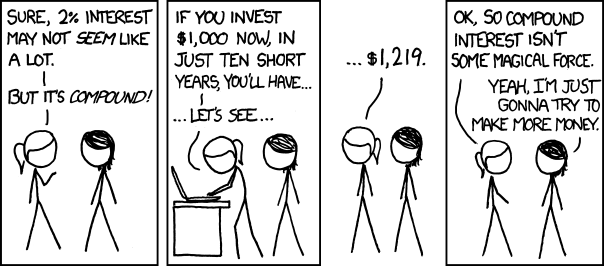
What's sad is how frequently a guy with a calculator and basic math skills can take down large chunks of conventional wisdom.
Sunday, September 4, 2011
Cassandra in reverse?
Via Paul Krugman, the Wall Street Journal has not had teh best record of predictions:
That really does point to an oddity in human culture. Being wrong does not seem to impact on the authority of the source, at least in some groups. That is an unfortunate property as incorrect predictions should make us rethink our internal models rather than reinforce them.
There are complexities here (everyone will have at least some sort of hit rate as even bad predictions are right every once in a while). But it does seem odd that we often double down on bad ideas.
Think about it (no time for full links); by reading that section you could have learned, either from the editorial page proper or from the paper’s favorite op-ed guys, that
Clinton’s tax hike would cause a recession and send stocks plunging
Dow 36,000!
American households are saving plenty thanks to capital gains on their houses
Interest rates will soar thanks to Obama’s deficits
And much, much more.
What’s remarkable is that the Journal does not seem to pay a price for this record of awesome wrongness. Maybe subscribers buy the paper for the reporting (although if you ask me, that’s been going downhill since the Murdoch takeover). But as far as I can tell, lots of people still take the editorial page’s pronouncements seriously, even though it seems likely that you could have made a lot of money by betting against whatever that page predicts.
That really does point to an oddity in human culture. Being wrong does not seem to impact on the authority of the source, at least in some groups. That is an unfortunate property as incorrect predictions should make us rethink our internal models rather than reinforce them.
There are complexities here (everyone will have at least some sort of hit rate as even bad predictions are right every once in a while). But it does seem odd that we often double down on bad ideas.
Friday, September 2, 2011
Because it isn't there

I seem to vaguely recall a time when Americans dreamed up big, ambitious projects.
From NPR's The World:
Dubbeling also insists that the Dutch need a new big engineering project.
“Since we stopped reclaiming land from the sea, we Dutch are in some kind of identity crisis. And in the last decades we could export our ideas. But now, with this economic crisis, we really have to think of something different. ”
A mountain, Dubbeling says, definitely qualifies on that score.
Subscribe to:
Posts (Atom)