Sunday, April 10, 2011

Hamsters, fitness landscapes and an excuse for a repost

All Things Considered had an interesting little story today about the origin of the hamster. I was particularly intrigued by this part:

More troubles followed in the lab. There was more hamster cannibalism, and five others escaped from their cage — never to be found. Finally, two of the remaining three hamsters started to breed, an event hailed as a miracle by their frustrated caretakers.

Those Adam-and-Eve hamsters produced 150 offspring, Dunn says, and they started to travel abroad, sent between labs or via the occasional coat pocket. Today, the hamsters you see in pet stores are most likely descendants of Aharoni's litter.

Because these hamsters are so inbred, they typically have heart disease similar to what humans suffer. Dunn says that makes them ideal research models.

This reminded me of a post from almost a year ago on the subject of lab animals. It also reminded me that I still haven't gotten around to the follow-up I had in mind. Maybe all this reminding will translate into some motivating and I'll actually get the next post on the subject written.
In this post I discussed gradient searches and the two great curses of the gradient searcher, small local optima and long, circuitous paths. I also mentioned that by making small changes to the landscape being searched (in other words, perturbing it) we could sometimes (with luck) improve our search metrics without significantly changing the size and location of our optima.

The idea that you can use a search on one landscape to find the optima of a similar landscape is the assumption behind more than just perturbing. It is also the basis of all animal testing of treatments for humans. This brings genotype into the landscape discussion, but not in the way it's normally used.

In evolutionary terms, we look at an animal's genotype as a set of coordinates for a vast genetic landscape where 'height' (the fitness function) represents that animal's fitness. Every species is found on that landscape, each clustering around its own local maximum.

Genotype figures in our research landscape, but instead of being the landscape itself, it becomes part of the fitness function. Here's an overly simplified example that might clear things up:

Consider a combination of two drugs. If we use the dosage of each drug as an axis, this gives us something that looks a lot like our first example with drug A being north/south, drug B being east/west and the effect we're measuring being height. In other words, our fitness function has a domain of all points on our AB plane and a range corresponding to the effectiveness of that dosage. Since we expect genetics to affect the subjects reaction [corrected a small typo here] to the drugs, genotype has to be part of that fitness function. If we ran the test on lab rats we would expect a different result than if we tested it on humans but we would hope that the landscapes would be similar (or else there would be no point in using lab rats).

Scientists who use animal testing are acutely aware of the problems of going from one landscape to another. For each system studied, they have spent a great deal of time and effort looking for the test species that functions most like humans. The idea is that if you could find an animal with, say, a liver that functions almost exactly like a human liver, you could do most of your controlled studies of liver disease on that animal and only use humans for the final stages.

As sound and appealing as that idea is, there is another way of looking at this.

On a sufficiently high level with some important caveats, all research can be looked at as a set of gradient searches over a vast multidimensional landscape. With each study, researchers pick a point on the landscape, gather data in the region then use their findings [another small edit] and those of other researchers to pick their next point.

In this context, important similarities between landscapes fall into two distinct categories: those involving the positions and magnitudes of the optima; and those involving the search properties of the landscape. Every point on the landscape corresponds to four search values: a max; the number of steps it will take to reach that max; a min; and the number of steps it will take to reach that min. Since we usually want to go in one direction (let's say maximizing), we can generally reduce that to two values for each point, optima of interest and time to converge.

All of this leads us to an interesting and somewhat counterintuitive conclusion. When searching on one landscape to find the corresponding optimum of another, we are vitally interested in seeing a high degree of correlation between the size and location of the optima but given that similarity between optima, similarity in search statistics is at best unimportant and at worst a serious problem.

The whole point of repeated perturbing then searching of a landscape is to produce a wide range of search statistics. Since we're only keeping the best one, the more variability the better. (Best here would generally be the one where the global optimum is associated with the largest region though time to converge can also be important.)

The Anti-Hulu Hypothesis

In response to Joseph's comment about the availability of the Big Bang Theory online, I thought I'd mention that, for the moment, CBS is keeping the two most recent episodes up on its site.

CBS has long had the most complicated but (I suspect) best thought-out approach to online viewing, deciding whether or not to provide shows on a case-by-case basis. Of course, 'best thought-out' here is in respect to stockholders, not viewers. The interests of those two groups generally align when you're talking about quality of programming but have a way of diverging when you're talking about revenue streams and cannibalization.

Saturday, April 9, 2011

[OT] Bioware's new Star Wars RPG

Based on a perceptive review by Trollsymth, It seems like the new Star Wars multi-player online game captures the music and atmosphere of Star Wars well. But it focuses on combat as the means to gaining experience. I think that this is a very unfortunate decision as Star Wars has a strong history of using guile in the place of brute force.

I think that this would make for a more interesting game and could have easily been accomplished with goal based experience points. Focusing on killing makes sense for the Sith but Jedi and Rebels would benefit from minimizing casualties.

Health Care and Confusion

One of the most important underlying issues preventing efficient markets for health care is explained in a Dilbert cartoon.

Friday, April 8, 2011

Some perspective

A nice quote from the comments on Worthwhile Canadian Initiative:

I'm sure we can all agree that in any organization the size of the Canadian federal gov't ($175 billion per annum in revenue!), there must be inefficiency somewhere. But the issue at hand is not "is there inefficiency?" but rather "is there $10-12 billion of annual waste?".


I think that it really puts questions into perspective.

And if you don't follow WCI, it really does have some of the best commentary around (right up there with Marginal Revolution at its best)

It's not often epidemiologists get pandered to

A clip for everyone in our target audience except Andrew Gelman.

"Cathie Black's Departure: Totally Predictable. Plus: Meet Dennis Walcott"

Dana Goldstein has a good, pithy post on the shake-up in NYC.

Thursday, April 7, 2011

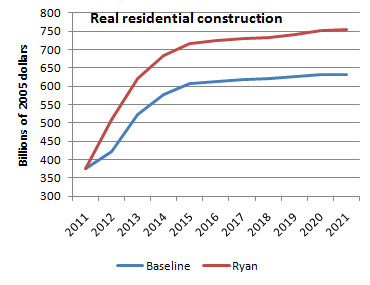
Another interesting Ryan graph from Krugman

I was listening to Talk of the Nation this evening (admittedly not NPR at its best or even second best) and I was struck by how different (and inferior) what I was hearing was to the wonk debate (Krugman, Thoma, Gelman, et al.). Journalists and pundits are arguing over whether Ryan is bold or extra bold while we should be arguing over the practicality and advisability of a recovery based on another housing boom.

Wednesday, April 6, 2011

Andrew Gelman buries the lede

As Joseph mentioned earlier, Andrew Gelman has a must-read post up at the Monkey Cage. The whole thing is worth checking out but for me the essential point came at the end:

Internal (probabilistic) vs. external (statistical) forecasts

In statistics we talk about two methods of forecasting. An internal forecast is based on a logical model that starts with assumptions and progresses forward to conclusions. To put it in the language of applied statistics: you take x, and you take assumptions about theta, and you take a model g(x,theta) and use it to forecast y. You don't need any data y at all to make this forecast! You might use past y's to fit the model and estimate the thetas and test g, but you don't have to.

In contrast, an external forecast uses past values of x and y to forecast future y. Pure statistics, no substantive knowledge. That's too bad, put the plus side is that it's grounded in data.

A famous example is the space shuttle crash in 1986. Internal models predicted a very low probability of failure (of course! otherwise they wouldn't have sent that teacher along on the mission). Simple external models said that in about 100 previous launches, 2 had failed, yielding a simple estimate of 2%.

We have argued, in the context of election forecasting, that the best approach is to combine internal and external approaches.

Based on the plausibility analysis above, the Beach et al. forecast seems to me to be purely internal. It's great that they're using real economic knowledge, but as a statistician I can see what happens whey your forecast is not grounded in the data. Short-term, I suggest they calibrate their forecasts by applying them to old data to forecast the past (this is the usual approach). Long-term, I suggest they study the problems with their forecasts and use these flaws to improve their model.

When a model makes bad predictions, that's an opportunity to do better.


All too often, we treat models like the ancient Greeks might have treated the Oracle of Delphi, an ultimate and unknowable authority. If we're going to use models in our debates, we also need to talk about where they come from, what assumptions go into them, how range-of-data concerns might affect them.

Unemployment Forecasting

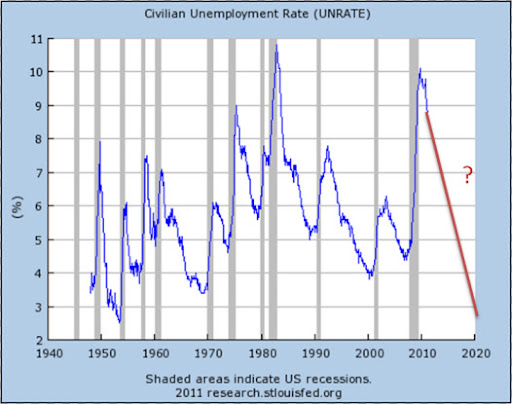
There was a nice discussion of the plausibility of the employment figures in the new Paul Ryan 2012 budget proposal for the United States by both Andrew Gelman and Paul Krugman. While this blog isn't really a political one, I do think that this current discussion is a good example of how to critically evaluate models in epidemiology. It is pretty rare that a model will be simply and obviously wrong. Instead, you have to look at the all of the different elements of the model and see what looks dodgy. After all, the actual headline result is almost always something for which we are uncertain about the actual answer. So we have to look for clues as what might be going wrong by looking at the other outputs of the model (and perhaps some of the modeling assumptions).

If a study shows that the use of statin class drugs prevents cancer that is a pretty interesting finding. But the finding gets less interesting if further exploration reveals that statins prevent all forms of disease except for cardiovascular disease. The latter would be a clue that something, somewhere, is going wrong.

In the case of the Paul Ryan budget, it seems like this estimate of unemployment is lower than it should plausibly be which might obfuscate the idea trade-off between taxes and economic growth. I am not an economist (in any way, shape or form) but am willing to conjecture that his dynamic scoring algorithm for the influence of tax cuts on unemployment might be an issue. Perhaps the algorithm should account for diminishing returns as unemployment falls (but fails to do so properly). Or maybe the model overstates the magnitude of the underlying relation (or, possibly, it might reverse it). Complex models have a lot moving parts and there are a lot of places that bias can be introduced into them. So it’s important to be critical (of both our own work and the work of others) when we try and do this type of difficult forecasting.

The way some people talked in 1930

"The boy spoke two words, the first a short guttural verb, the second 'you.'"

A few more quick thoughts before the Maltese Falcon goes back to the library. I've always been impressed by how much John Huston was able to get past the Hays office but the novel is far more frank. I'm no authority on the literature of the era but it seems ways ahead of its time.

Tuesday, April 5, 2011

Why I still drop by Krugman's blog once or twice a week

Here, in handy graph form, is what the good people at Heritage claim will happen if we adopt Ryan's budget.


These are, of course, the same people who predicted the Clinton tax hikes would trigger a devastating recession.

It's that sub-advisement you really have to worry about

Matt Yglesias is having trouble understanding John Hancock's explanation of its fee structure. I can't imagine why (via Felix Salmon):
“For internally-managed Funds advised and sub-advised exclusively by John Hancock’s affiliates, the total fees John Hancock and its affiliates receive from these Funds may be higher than those advised or sub-advised exclusively by unaffiliated mutual fund companies. These fees can come from the Fund or trust’s Rule 12b-1, sub-transfer agency, management, AMC or other fees, and may vary from Fund to Fund.”

Brad DeLong digs through the NYT archives for this memorable rebuttal of Charles Murray

From Bob Herbert:

The book shows that, on average, blacks score about 15 points lower than whites on intelligence tests, a point that was widely known and has not been in dispute. Mr. Murray and I (and many, many others) differ on the reasons for the disparity. I would argue that a group that was enslaved until little more than a century ago; that has long been subjected to the most brutal, often murderous, oppression; that has been deprived of competent, sympathetic political representation; that has most often had to live in the hideous physical conditions that are the hallmark of abject poverty; that has tried its best to survive with little or no prenatal care, and with inadequate health care and nutrition; that has been segregated and ghettoized in communities that were then redlined by banks and insurance companies and otherwise shunned by business and industry; that has been systematically frozen out of the job market; that has in large measure been deliberately deprived of a reasonably decent education; that has been forced to cope with the humiliation of being treated always as inferior, even by imbeciles -- I would argue that these are factors that just might contribute to a certain amount of social pathology and to a slippage in intelligence test scores.

Mr. Murray says no. His book strongly suggests that the disparity is inherent, genetic, and there is little to be done about it....

The last time I checked, both the Protestants and the Catholics in Northern Ireland were white. And yet the Catholics, with their legacy of discrimination, grade out about 15 points lower on I.Q. tests...

Fixing performance pay

Derek Neal, Professor of Economics at the University of Chicago makes an interesting argument about the poor performance of performance pay for teachers:
"Many accountability and performance pay systems employ test scores from assessment systems that produce information used not only to determine rewards and punishments for educators, but also to inform the public about progress in student learning," Neal writes in the paper, "The Design of Performance Pay in Education."

These testing systems make it easy, in theory, for policymakers to obtain consistent measures of student and teacher performance over time. But Neal argues that the same testing regimes also make it easy, in practice, for educators to game incentive systems by coaching students for exams rather than teaching them to master subject matter.

"As long as education authorities keep trying to accomplish both of these tasks (measurement and incentive provisions) with one set of assessments, they will continue to fail at both tasks," he adds in the paper, which was published by the National Bureau of Economic Research and is a chapter in the upcoming Handbook of Economics of Education.

...

Separate assessment systems that involve no stakes for teachers, and thus no incentives for manipulation, should be used to produce measures of student performance over time, Neal contends. This two-system approach would discourage excessive "teaching to the test."

"The designers of assessment-based incentive schemes must take seriously the challenge of designing a series of assessments such that the best response of educators is not to coach, but to teach in ways that build true mastering," Neal said.
I'm not sure I'm in full agreement here. For one thing, the problems with our current methods for evaluating student progress are deeply flawed even when not asked to do double duty. Second, in my experience, most of the pressure to inflate scores comes from above. As long as test scores affect the fortunes of administrators, the less ethical superintendents and principals will find a way to influence teachers (even without the option of dismissal, a principal can make a teacher's life very tough).

Just to be clear, almost all of the administrators I've worked have been dedicated and ethical but I can think of at least one guy, two time zones and two decades from here and now, who managed to pressure a number of tenured but spineless teachers into spending weeks doing nothing but prepping for standardized tests.

What we need is a more comprehensive and better thought out system for measuring student progress.

Monday, April 4, 2011

It's possible that statisticians have an odd definition of 'interesting'

That being said, I'm always interested in stories about where the numbers come from, like this article from CNNMoney:
Two recent price comparisons of grocery and household goods revealed that Target's prices are lower than at No. 1 retailer Wal-Mart.

Craig Johnson, president of retail consulting firm Customer Growth Partners, compared 35 brand-name items sold at Wal-Mart and Target stores in New York, Indiana and North Carolina. They consisted of 22 common grocery goods such as milk, cereal and rice; 10 general merchandise products such as clothing and home furnishings; and three health and beauty items.

Target's shopping cart rang in at $269.13 (pre-tax), a hair lower than the $271.07 charged at Wal-Mart.

"For the first time in four years, our price comparisons between the two has shown that Target has a slight edge over Wal-Mart," said Johnson. A smaller study by Kantar Retail found similar results.
Though I don't have enough information to say for sure, the CGP study looks pretty solid (particularly compared to some of the research I've seen from other consultants) and it's backed by additional analysis and a separate study.

What really stands out for me, however, is the slipperiness of assigning even a well-designed metric to something like the cost of shopping at a certain store. In order to get these results you have to buy the same brands of the same items in the same quantities as those in the studies. Your own shopping list would certainly produce different results (though the difference probably wouldn't be all that large).

It's always useful to remember that metrics are, with few exceptions, arbitrary. They may be useful and well thought-out but they should be approached with that caveat in mind.

Denominators

It is always useful to remind ourselves of the correct use of denominators, like in today's offering from Statistical Modeling, Causal Inference, and Social Science:

The article also explicitly discusses the fact, previously discussed on this blog, that it's misleading, to the point of being wrong in most contexts, to compare the safety of walking vs cycling vs driving by looking at the casualty or fatality rate per kilometer. Often, as in this article, the question of interest is something like, if more people switched from driving to cycling, how many more or fewer people would die? Obviously, if people give up their cars, they will travel a lot fewer kilometers! According to the article, in Denmark in 1992 (!), cycling was about 3x as dangerous per kilometer as driving, but was essentially equally safe per hour and somewhat safer per trip.


Transportation safety is a tricky thing and it only gets trickier as you try to define the best possible measure of risk. However, it is worth noting that when results vary as widely as cycling does based on the selection of the denominator then it is worth reporting all of the possible metrics. Otherwise, the person presenting the data is makign a decision as to what is the most relevant comparison.

For example, opponents of urban density may see commuting distances as inflexible and be interested in the risk per mile. On the other hand, advocates for cycling may well point out that the decision to cycle may feed into the decision of where to live.

But it is a good point to remember just how easily convincing measures of association can be misleading.

Sunday, April 3, 2011

Google's autocomplete can lead you to some strange and dark places

Case in point.

I'm not reading the funny pages -- I'm studying the implications of comparative advantage

Click the strip for the punchline.

Weekend Thriller Blogging -- the Maltese Falcon

I've been chipping away at the Joe Gores catalog and I decided to check out Spade and Archer, Gores' authorized prequel to the Maltese Falcon. The idea of trying to follow up Hammett was probably not wise but if it had to be done, Gores was the only choice. Not only did he have the literary talent and standing, he also shared Hammett's background as a San Francisco P.I.

Before starting Gores' novel I decided to go back and reread the original. It's not Hammett's best book. That would either be Red Harvest* or the collected Continental Op stories, but Falcon is still very good and it offers an almost unique experience for the reader.

The Maltese Falcon and Shane are the only two cases I can think of where strong, well-written, enjoyable novels were made, with almost complete fidelity, into great, iconic films. To read these books is to be pleasantly overwhelmed by memories of the movies they inspired.**

There is almost a one-to-one mapping of page to screen. This is only possible because both are short novels. Each comes in under two hundred pages. Most otherwise faithful adaptations either have to add material (The Man Who Would Be King) or leave large parts out (The Silence of the Lambs). Almost everything you read in the Maltese Falcon is associated with some unforgettable image.

There is one deviation worth noting. As Pauline Kael pointed out, Effie's reaction to Spade at the end of the book is significant, highlighting aspects of the characters we might have tried to overlook. It is an important difference from the movie but by the time you get to it you're so immersed in the experience, it's almost like seeing a deleted scene.

*I was tempted to mention Yojimbo here but that's a fight for another post.***

** I realize some of you have another set of films to add to this list, but I never made it past Fellowship, so I'll just have to take your word for it.

*** If I do post on Red Harvest and Yojimbo, remind me to toss Savage Range into the discussion

At least we can still drink and drive

Brad DeLong has a list of around two dozen changes and corrections he'd like to see in the paperback edition of Superfreakonomics and he doesn't even get around to this.

Saturday, April 2, 2011

Press-release journalism and the NYT's lost default setting

As I've mentioned before, much of what we've heard about the NYT paywall makes me wonder if they've really thought things through. The following link from Mark Thoma raised yet another question:

Microsoft Accusing Google of Antitrust Violations - NYTimes.com

Most shorter news stories, particularly those based on press conferences, released statements or other publicly available information, are pretty much interchangeable with respect to provider. The version you get from the New York Times will be essentially identical to the ones from the Washington Post or the LA Times or NPR or any other major outlet.

The New York Times traditionally got a disproportionate share of the traffic for these stories because it had become something of a default setting. This traffic meant increased ad revenue. Perhaps more importantly, it brought people into the site where they could be introduced to other, less interchangeable features (for example, the film reviews of A.O. Scott or the columns of Frank Rich). These features are the basis of a loyal readership.

I'm sure that the models Sulzberger and company are using take into account the fact that traffic will drop when you put the paywall into effect. Having worked on some major corporate initiatives, I can tell you that is not the sort of thing that is likely to be omitted. What is, however, often left out is the necessary disaggregation. For example, even in well-run Fortune-500 businesses, you will often run across analyses that correctly predict that a change will cause a net gain of ten percent of market share but fail to note that most of the established customers you will lose are highly profitable while most of those you're going to gain aren't worth having.

Friday, April 1, 2011

Interactively nerdy

Pass the cursor over the image.

AP classes and college development

I'm a big believer in acceleration and giving students the opportunity to test out of courses (I always advised students to explore CLEP). I have never been that impressed, however, with the AP approach. It always struck me as badly thought out and prone to play to the weakest parts of our education system.

I'll make a partial exception for calculus. Because of the extensive prerequisites in majors such as engineering, having cal I or, better yet, cal II out of the way can be a tremendous advantage to an incoming freshman. Add to that the fact that the nature of the subject makes teaching to the test much less of a concern.

With that exception noted, I never saw that strong a case for AP. On the whole, I suspect that college level material is better taught by college faculty, particularly given the test-prep approach of many of the AP classes. If anything, I'd like to see more anti-AP programs. Instead of giving college credit for high school courses, give high school students more opportunities to take college courses (either on site or through distance learning or some kind of independent study). There are certainly precedents: even back in the dark ages, I was in a program where as a high school senior I could attend the local college half-time. With the advent of distance learning, email and digital media, the argument for AP has only gotten weaker.

At this point, I should segue gracefully into a discussion of this paper (via TNR) on the impact of AP courses but to be perfectly honest, I'm in a hurry so I'm just going to give you the abstract and let you all talk it over amongst yourselves:

The Advanced Placement (AP) Program was originally designed to provide students a means to earn college credit and/or advanced placement for learning college-level material in high school. Today the program serves an equally important role as a signal in college admissions. This paper examines the extent to which AP course-taking predicts early college grades and retention. Controlling for a broad range of student, school, and curricular characteristics, we find that AP experience does not reliably predict first semester college grades or retention to the second year. We show that failing to control for the student’s non-AP curricular experience, particularly in math and science, leads to positively biased AP coefficients. Our findings raise questions about recent state policies mandating AP inclusion in all school districts or high schools and the practice of giving preference to students with AP course experience in the university admissions process.

Finally, a bill that will "empower and protect teachers"

I wonder if there's a catch?

Thursday, March 31, 2011

Test Scores

Diane Ravitch has some comments on the evidence that there may have been some alterations of D.C. test score results:

What will this revelation mean for Rhee's campaign to promote her test-driven reforms? Her theory seemed to be that if she pushed incentives and sanctions hard enough, the scores would rise. Her theory was right, the scores did rise, but they didn't represent genuine learning. She incentivized desperate behavior by principals and teachers trying to save their jobs and meet their targets and comply with their boss' demands.

Rhee's advocates point out that D.C. scores went up on the National Assessment of Educational Progress, the federal test. This is true, but the gains under Rhee were no greater than the gains registered under her predecessor Clifford Janey, who did not use Rhee's high-powered tactics, such as firing massive numbers of teachers.


I think that this type of issue is another reason that making testing into such a high stakes gamble may be problematic -- it could massively incent poor behavior (at all levels). Furthermore, that a more humane approach had the same absolute level of improvement as the draconian approach is worth noting. I am sympathetic to arguments that education is important but it seems that dramatic reforms aren't really beating incremental reforms. I suspect that this behavior may be true of many complex systems (and learning is nothing if not complex) that are challenging optimization problems.

Wednesday, March 30, 2011

If you haven't used your 20 yet...

This one's definitely worth a click.
In Prison for Taking a Liar Loan
By JOE NOCERA

A few weeks ago, when the Justice Department decided not to prosecute Angelo Mozilo, the former chief executive of Countrywide, I wrote a column lamenting the fact that none of the big fish were likely to go to prison for their roles in the financial crisis.

Soon after that column ran, I received an e-mail from a man named Richard Engle, who informed me that I was wrong. There was, in fact, someone behind bars for what he’d supposedly done during the subprime bubble. It was his 48-year-old son, Charlie.

On Valentine’s Day, the elder Mr. Engle said, his son had entered a minimum-security prison in Beaver, W.Va., to begin serving a 21-month sentence for mortgage fraud. He then proceeded to tell me the tale of how federal agents nabbed his son — a tale he backed up with reams of documents and records that suggest, if nothing else, that when the federal government is truly motivated, there is no mountain it won’t move to prosecute someone it wants to nail. And it was definitely motivated to nail Charlie Engle.

Mr. Engle’s is a tale worth telling for a number of reasons, not the least of which is its punch line. Was Mr. Engle convicted of running a crooked subprime company? Was he a mortgage broker who trafficked in predatory loans? A Wall Street huckster who sold toxic assets?

No. Charlie Engle wasn’t a seller of bad mortgages. He was a borrower. And the “mortgage fraud” for which he was prosecuted was something that literally millions of Americans did during the subprime bubble. Supposedly, he lied on two liar loans.

...

Apparently, though, it’s only a high priority if the target is a borrower. Mr. Mozilo’s company made billions in profit, some of it on liar loans that he acknowledged at the time were likely to be fraudulent and which did untold damage to the economy. And he personally was paid hundreds of millions of dollars. Though he agreed last year to a $67.5 million fine to settle fraud charges brought by the Securities and Exchange Commission, it was a small fraction of what he earned. Otherwise, he walked. Thus does the Justice Department display its priorities in the aftermath of the crisis.


It’s not just that Mr. Engle is the smallest of small fry that is bothersome about his prosecution. It is also the way the government went about building its case. Although Mr. Engle took out the two stated-income loans, as liar loans are more formally called, in late 2005 and early 2006, it wasn’t until three years later that his troubles began.

...

The film, “Running the Sahara,” was released in the fall of 2008. Eventually, it caught the attention of Robert W. Nordlander, a special agent for the Internal Revenue Service. As Mr. Nordlander later told the grand jury, “Being the special agent that I am, I was wondering, how does a guy train for this because most people have to work from nine to five and it’s very difficult to train for this part-time.” (He also told the grand jurors that sometimes, when he sees somebody driving a Ferrari, he’ll check to see if they make enough money to afford it. When I called Mr. Nordlander and others at the I.R.S. to ask whether this was an appropriate way to choose subjects for criminal tax investigations, my questions were met with a stone wall of silence.)

Mr. Engle’s tax records showed that while his actual income was substantial, his taxable income was quite small, in part because he had a large tax-loss carry forward, due to a business deal he’d been involved in several years earlier. (Mr. Nordlander would later inform the grand jury only of his much lower taxable income, which made it seem more suspicious.) Still convinced that Mr. Engle must be hiding income, Mr. Nordlander did undercover surveillance and took “Dumpster dives” into Mr. Engle’s garbage. He mainly discovered that Mr. Engle lived modestly.

In March 2009, still unsatisfied, Mr. Nordlander persuaded his superiors to send an attractive female undercover agent, Ellen Burrows, to meet Mr. Engle and see if she could get him to say something incriminating. In the course of several flirtatious encounters, she asked him about his investments.

After acknowledging that he had been speculating in real estate during the bubble to help support his running, he said, according to Mr. Nordlander’s grand jury testimony, “I had a couple of good liar loans out there, you know, which my mortgage broker didn’t mind writing down, you know, that I was making four hundred thousand grand a year when he knew I wasn’t.”

Mr. Engle added, “Everybody was doing it because it was simply the way it was done. That doesn’t make me proud of the fact that I am at least a small part of the problem.”

Unbeknownst to Mr. Engle, Ms. Burrows was wearing a wire.
...

It gets worse from there

One more radio story then I'll call it a night

More extraordinary journalism from This American Life about how a small drug-related offense at the wrong place and the wrong time can have truly horrifying consequences.

Ira reports from Glynn County Georgia on Superior Court Judge Amanda Williams and how she runs the drug courts in Glynn, Camden and Wayne counties. We hear the story of Lindsey Dills, who forges two checks on her parents' checking account when she's 17, one for $40 and one for $60, and ends up in drug court for five and a half years, including 14 months behind bars, and then she serves another five years after that—six months of it in Arrendale State Prison, the other four and a half on probation. The average drug court program in the U.S. lasts 15 months. But one main way that Judge Williams' drug court is different from most is how punitive it is. Such long jail sentences are contrary to the philosophy of drug court, as well as the guidelines of the National Association of Drug Court Professionals. For violating drug court rules, Lindsey not only does jail terms of 51 days, 90 days and 104 days, Judge Williams sends her on what she calls an "indefinite sentence," where she did not specify when Lindsey would get out.
As the story notes, Williams' court is also unusually ineffective.

Harsh, cold moments of self-realization

I write for a blog called Observational Epidemiology.

I actually look forward to listening to podcasts on math history.

It's a wonder I date at all.

Why we need NPR

Here's All Things Considered covering the Japanese nuclear crisis with a calm tone and meaningful context.

And then there's this...

Just pay the 99 cents, you cheapskate!

A while back, This American Life did a piece on college partying. It's a fantastic piece of journalism and it's highly relevant to the debate over the impact, positive and negative, of colleges on the areas that host them.

And while we're on the subject, our friend at Metaphor Hacker sends us another relevant radio piece (this time on the BBC).

Tuesday, March 29, 2011

"The best report ever on media piracy"

You probably don't have time to read the entire 440 page report (I didn't), but you should at least clear out a few minutes for Salmon's sharp and insightful summary.

Student Assessment

From Dana Goldstein:

The good news is that Campbell’s Law does not mean we should give up on assessing students and holding school systems accountable for their academic success. Research shows that certain kinds of exams—those that require essay writing on broad themes, for example—enhance student learning of key concepts. We can also assess students by requiring them to give oral presentations, or by looking for growth in portfolios of their work over the course of a year. Effective teachers produce students who excel when held to these more sophisticated standards, which are difficult to fudge or cheat.


This actually matches my experience with teaching quote well. Standardized tests are the only feasible way to handle large classes (how else do you assess 400 students?). But my best results come from asking essay questions (in free hand) and requiring many, many class presentations. Not only is the assessment a lot more complete but I gain a very good idea of what concepts and ideas that I failed to communicate well.

This type of assessment is a valuable tool in making next years class better than the one before it (a process I hope never stops). Sadly, it is not well suited for mass comparisons between schools. But then complex phenomena rarely summarize well (just consider confounding by indication for how hard it is to use summarized data to capture complex processes).

Monday, March 28, 2011

"We had a reason..."

A few years ago, I was working on the roll out of a big project (think lots of zeros) for a company which will remain nameless for obvious reasons. Though impressive in many ways, the initial launch was set up in a way that seemed to preclude us from using most of the data that we had spent a tremendous amount of time and money acquiring.

One day, toward the end of the project, I was having a few beers with one of the chief architects and I asked him point blank why they chose to set things up this way. His answer was (and I'm giving you this verbatim) "I remember we had a reason but I don't remember what it was."

I've been flashing back on that conversation quite a bit recently as the details of the NYT paywall emerge. Of course, the resemblance could be the result of incomplete information. If I had access to all of the data and analyses, I might be loading up on their stock instead of mocking their corporate strategy (I would continue to mock Maureen Dowd regardless), but being limited to an outsider's view, I have to wonder what would happen if you downed a couple of beers with Sulzberger then asked him about this post from Philip Greenspun:

...how the NY Times spent a reported $40-50 million writing the code (Bloomberg; other sources are consistent). Google was financed with $25 million. The New York Times already had a credit card processing system for selling home delivery. It already had a database management system for keeping track of Web site registrants. What did they spend the $40-50 million on? A monster database server to keep track of which readers downloaded how many articles? They should already have been tracking some of that for ad targeting. In any case, a rack of database servers shouldn’t cost $40 million.

What am I missing?

[I built a pay wall back in 1995 for the MIT Press, restricting access to some of their journals, e.g., Cell, to individual subscribers and people whose IP addresses indicated that they were at institutions with site-wide subscriptions. I can't remember exactly what I charged the Press, but it was only a few days of work and I think the invoice worked out to approximately $40 million less than $40 million.]

What exactly are the localized benefits of a university?

I grew up in a small university town and I can say definitively it was a great environment. There were plays and concerts and speakers. When I started writing fiction as a high school sophomore, I got to sit in on a class taught by a well-established novelist. When I was a senior there was a program where I could take my remaining high school requirements in the morning and take college classes in the afternoon.

I am, as you might imagine, a great supporter of colleges and college towns as is Joseph, my co-blogger. This puts us in an odd position. We are always looking for an excuse to promote higher education but the current line of argument about the economic benefits of universities at the local level is so weak and ignores so many counter-examples that it may do more harm than good.

The focus on local benefits is almost fatally flawed from the beginning by the fact that most of the benefits accrue at the state or more often national level. Both innovations and people tend to flow with the market. When we fund research and produce skilled workers, the chances of a big long-term pay-off are very good but predicting the exact form and location of that pay-off is all but impossible.

Keeping in mind that we are leaving out the majority of the return we expect on our investment, what benefits do we expect a university to provide to its host?

First there are the soft benefits such as enriching an area's intellectual and cultural life, providing role models, enhancing reputation. Viewed from a high enough level, the soft benefits may turn out to be the far most important, but they are difficult to measure and plan around. For now let's focus on the hard benefits.

University as employer

Universities are often seen as an almost ideal industry -- pollution-free, creating a number of stable, middle-class jobs and generating charming, highly liveable neighborhoods.

The problem here is that, if the suburban model takes hold and the town doesn't have a lot to recommend it outside of the school, the results can be really ugly, leaving the area with no tax base, an economy based on delivering pizzas and thousands of poor, badly-behaved students who get loud and drunk on Thursday night then head back to their parents' houses on Friday.

How do you avoid this fate?

One way is simply to stay small enough to maintain that Mayberry quality where it is possible for a professor to afford a decent little house within three or four miles from the school. I could give you some examples but while they may be charming, they aren't relevant to this discussion.

Another solution is to have a university in a large, economically diverse town where the economy and quality of life won't be completely overwhelmed by the ebb and flow of the academic calendar. Unfortunately, even very large universities only have twenty or thirty thousand employees (academic and administrative). College Station can build an economy around a university. Seattle really can't.


University as incubator

Call this the SAS model. Entrepreneurs who began as students and faculty decide to start some innovative new business just down the street. It's great when these things happen, but they don't seem to happen frequently enough, particularly not on the scale we'll need if we want to count on them to revitalize a stagnating city.

To further complicate matters, this desire to start a business in the vicinity of a school is directly related to the appeal of the area (students who hate to leave a town are more likely to find a way to stay). The vibrant urban areas that are likely to attract these small businesses are the very areas that don't need them.


University as labor supplier

This is probably the most commonly cited effect and it's certainly true that many of the more attractive industries require highly educated workers. It is not, however, so clear that these workers have to be in the area before the jobs are there or that the advantages of being able to recruit from an area college are that great. With only one very small nationally ranked school, Houston can't hope to supply itself with the first string academic talent it needs but that hasn't stopped its phenomenal growth (plenty of Ivy League grads are willing to move south), nor have the advantages of a local school caused Microsoft to focus its attention on UW instead of Waterloo.

Universities are vitally important to our intellectual, cultural and economic future and they have paid for themselves many times over. They do not, however, have that great a record of revitalizing urban areas. It would appear that you need more than a "build it and they will come" attitude, that certain conditions have to be in place and, even with those conditions, the short-term magnitude of the effects may be less than we hope.

Things it's too late to blog about

Felix explains how the NYT paywall is like baseball.

"Like it's 1999..."

A good James Kwak column with a Joe Nocera link that might be worth using one of your twenty on.

A worthwhile Worthwhile Canadian Initiative post.

An sad story that would have been tragic if not for the amazing restraint and professionalism of the cops on the scene.

Off to bed.

Sunday, March 27, 2011

Weekend Gaming -- Escape the orthogonal

Personally and pedagogically, I'm a big believer in finding new spots to drop the marble,* finding a different way of approaching old problems. This is particularly valuable when plateaus (defined here as periods of at best negligible improvement) are a concern.

Variants are a good way to get new insights into old familiar games and keep things from getting stale. Some of the most interesting variants are based on replacing the square tiles of a standard chess board with hexagons.

Most games played on an eight by eight rectangular board have been adapted to a six by six by six hex board (such as the one used for Agon). You can find game sets with these boards at many game stores (including mine) or you can create them yourself with pretty much any computer graphics program.

The following list is by no mean exhaustive but it should be a good introduction. You can find complete rules for each game by following the links.

Hexagonal Checkers

I don't know that there's really a standard version of hexagonal checkers so I decided to play around with this one and borrowed the border restriction from Kruzno (you can find a number of others online). There's no reason you can't do some experimenting on your own. (let me know if you come up with something interesting.)


Hexagonal Chess

As previously mentioned, Władysław Gliński's chess variant is hugely popular in Europe (more than 100,000 sets have been sold). I've played this one quite a bit and had a good time with it.


You can probably figure most of the moves out for yourself. The only pieces that might give you trouble are the bishops and,to a lesser extent, the knights.


Bishops come in three colors, which points out an interesting topological feature of a hexagonal grid which I'm betting you can spot for yourself.

TacTex


I believe Piet Hein himself may have come up with this variation on his game TacTix.


Hexagonal Reversi

There's a rather complicated intellectual property background to the game Reversi/Othello, but the game itself couldn't be simpler. Here's one configuration for playing it on a hexagonal board.


I wasn't able to find a standard version of hexagonal reversi. This version seems to work well but there may be room for improvement.

* Always remember to flip your fitness landscape upside-down before dropping your marble. Energy landscapes should be good to go.

For a more on this, take a look at "Fitness Landscapes, Ozark Style."

Saturday, March 26, 2011

Another New Haven thought

Matt Yglesias wonders if looking at just New Haven alone is the wrong unit of analysis as the surrounding county is quite prosperous. I think that this quote nicely summarizes the problem with this analysis:

But even the strongest cities can't -- and shouldn't have to -- handle the costs of urban poverty by themselves/ In the 1960s and 1970s, rich and middle-class city dwellers fled to the suburbs in part to escape having to pay the costs of addressing urban inequality. Rich enclaves have often formed right outside of urban political boundaries, where the prosperous can be close to the city without having to pay its taxes or attend its schools. A level playing field mans that people should be choosing where to live based on their desires for neighborhood or opportunity, not based on where they can avoid paying for the poor.


-- Edward Glaeser, Triumph of the City, page 258.

The difference between Seattle and New Haven is that the core of Seattle had managed to capture at least part of the prosperity that comes from institutions like the University of Washington and Microsoft. This suggests to me that there is at least a two stage process to using a university to enhance urban prosperity.

It also suggests we might want to be leery about things like significant budget cuts as it would be foolish to risk disrupting these types of success stories.

"Academic Intimidation"

One of the reasons we have tenure is to protect the intellectual independence of academicians. If you think they no longer require that protection, you haven't been paying attention.

From Paul Krugman:

Regular readers may recall my praise for William Cronon’s Nature’s Metropolis: Chicago and the Great West, a great book that had a big influence on my work in economic geography. Cronon has inspired many other people; Josh Marshall was deeply influenced by his environmental history of New England. Cronon, who teaches at the University of Wisconsin, is, quite simply, a great historian.

He also feels some duty as a citizen, in particular a citizen of his state. So earlier this week he published an op-ed in the Times condemning the power grab by the state’s governor.

And what happened next? Wisconsin Republicans have demanded access to his personal email records.

Yes, personal. Cronon has a wisconsin.edu email address — but nobody, and I mean nobody, considers such academic email addresses something specially reserved for university business. Actually, according to Cronon he has been especially careful, maintaining a separate personal account — but nobody would have considered it out of the ordinary if he mingled personal correspondence with official business on the dot edu address. And no, the fact that he’s at a public university doesn’t change that: when my students take jobs at Berkeley or SUNY, they don’t imagine that they’re entering into a special fishbowl environment that they wouldn’t encounter at Georgetown or Haverford.

But then, we know perfectly well what’s going on here. Republicans aren’t looking for some abuse of Cronon’s position; they’re hoping to find some statement that can be quoted out of context to discredit him. At the very least, they hope that other academics will henceforth feel intimidated...

Friday, March 25, 2011

Universities and prosperity -- another data point

Re our ongoing discussion of universities and economic growth, when we think of universities supplying skilled labor to specific companies, we generally expect the relationships to form primarily between businesses and nearby universities. That's often, but not always the case.

From Wikipedia:
During his visit to Waterloo in October 2005, Microsoft co-founder Bill Gates stated, "Most years, we hire more students out of Waterloo than any university in the world, typically 50 or even more."*
This raises some additional questions about the University of Washington's role in Seattle's success.

*For a somewhat different take on this relationship, take a look at this.

Cancer survival rates

An important point (and a nice piece of statistics writing for the general public) by Paul Krugman:

Beyond that, there’s a well-known problem with survival-rate comparisons, acknowledged in the Lancet Oncology study:

Cancer survival is a valuable indicator for international comparison of progress in cancer control,despite the fact that part of the variation in cancer survival identified in this study could be attributable to differences in the intensity of diagnostic activity (case-finding) in participating populations.

Here’s how I understand the over-diagnosis issue, in terms of an extreme example: suppose that there’s a form of cancer that kills people 7 years after it starts, and that there is in fact nothing you can do about it. Suppose that country A screens for cancer very aggressively, and always catches this cancer in year 1, while country B chooses to invest its medical resources differently, and never catches the cancer until year 4. In that case, country A will have a 100% 5-year survival rate, while country B will have a 0% 5-year survival rate — because survival is measured from the time the cancer is diagnosed. Yet treatment in country B is no worse than in country A.

Thursday, March 24, 2011

Credit where credit is due

I have resumed reading Edward Glaeser's book Triumph of the City. I am not always a fan of Dr. Glaeser's arguments but his discussion of urban sprawl is interesting, perceptive, and (I suspect) correct. The section is worth it for the discussion of Paris and alternative models of urban density alone.

I am not convinced that he has modeled the predictors of urban prosperity well but I find his arguments for the drivers of sprawl to be compelling. I would be skeptical of any attempt to seriously engage the problem that did not consider these points. For example he references a fixed time cost to public transportation (waiting for the bus, traveling between destinations and stops) that puts the focus on car use in a whole different light.

I was back to being impressed with his work in this section.

Teachers are nervous about Michelle Rhee's suggestions because they're afraid other people in power will act like Michelle Rhee

The debate over job security for teachers is often employs an analog of the "If you're not hiding something..." argument in national security. Just as those who are guilty of nothing are supposed to have no reason to object to searches and wiretaps, teachers who are effective and conscientious have nothing to fear from the elimination of tenure and LIFO.

The argument works on two levels: it has a convincing though overly simplistic logic and it casts aspersions on the competence and character of those who object to it.

Of course, it collapses completely if those with the power to hire and fire ignore educators' accomplishments, make arbitrary and opaque decisions, play politics, let small factions gain undue influence over the process.

In other words...

Rhee Dismisses Principal of School That Her Children Attend


By Bill Turque
Washington Post Staff Writer
Friday, May 9, 2008

Oyster-Adams Principal Marta Guzman can recall the ripple of anxiety that ran through some faculty members last summer when they learned that the new D.C. schools chancellor, Michelle A. Rhee, had chosen the bilingual school for her two daughters, a kindergartner and a third-grader.

But Guzman, an educator with more than 30 years' experience, said she wasn't concerned. The dual-immersion program, where native English and Spanish-speaking children learn side by side, has long made the Cleveland Park school among the city's most coveted, with high test scores and a national Blue Ribbon for academic achievement. Every year, parents from outside its attendance boundaries vie through a lottery for a handful of spaces to enroll their children.

"I thought it was a good thing," she said of the Rhee children's enrollment.

This week, Rhee fired her.

Guzman received a form letter from Rhee informing her that she was out of a job effective June 30, one of at least two dozen principals whose contracts for the 2008-09 school year were not renewed. Guzman said she was given no reason for her dismissal, either in the letter from Rhee or at a Monday meeting with Assistant Superintendent Francisco Millet.

...

Guzman's departure has stunned many Oyster-Adams parents who wonder why, in a city filled with under-performing public schools, Rhee would sack a principal who has presided for the past five years over one of its few success stories. The move has also heightened ethnic and class tensions within the school's diverse community. Eduardo Barada, co-chairman of the Oyster-Adams Community Council, the school's PTA, said Guzman was toppled by a cadre of dissatisfied and largely affluent Anglo parents with the ear of a woman who was both a fellow parent and the chancellor.

"I believe there are some parents who want to control and dominate," he said. "They want to silence the Latinos there."

Claire Taylor, council co-chairwoman, said she "absolutely respects Eduardo's position" but doesn't agree with it. "From what I've seen of Michelle Rhee, she is an exceedingly fair person who wants what's in the best interests of the students," she said.

Taylor added that ethnic and class divisions are the norm at Oyster-Adams. "A leaf falls and there are issues," she said.

Taylor was one of a group of Oyster-Adams parents, both white and Latino, who dined with Rhee in November and aired complaints about Guzman. Among the issues raised with Rhee, who took notes, according to another attendee, were Guzman's alleged lack of organization, reluctance to delegate and sometimes-brusque style.

Asked to discuss the dinner, which was at the home of another parent, Taylor said she was "not going to get into intra-school politics."

...

The first sign that her job was in jeopardy, Guzman said, came last month, when Millet convened a meeting of Oyster-Adams teachers to discuss her leadership. Guzman, who was not invited to the meeting, said she learned from a teacher that Millet began the meeting by announcing that a national search was underway for her replacement.

She quickly asked for a meeting with Rhee, who told her about the dinner meeting. Rhee said parents were frustrated by Guzman's lack of organization and "not comfortable with her" on a personal level.
...

Maureen Diner, who has a fourth-grader at the school, said Rhee's silence is not seemly for a chancellor who came into office a year ago promising reform.

"Anybody asked not to return deserves a process, at the very least a community meeting," Diner said. As for Rhee, "she talked about creating a culture of accountability. At the same time, she needs to be accountable for her own actions."
I wish I could say I was shocked to read this, but I can't. I can't tell you that this sort of politics is unusual. I can't even claim that this is my first encounter with a dinner party putsch.

At the risk of putting too fine a point on what is already a damned sharp spike, a group of parents who invite the chancellor of a major metropolitan school district over for dinner will not, as a rule, be poor, simple, honest workin' folk. They will tend to be wealthy, influential and grossly unrepresentative. To accept their invitation at all showed exceptionally poor judgement. To fire one of the district's most effective administrators based on their influence showed none whatsoever.

Of course, under the current system, teachers have protections that principals don't. They can give poor grades for poor work, keep the wooden and the clumsy in the chorus and the second string respectively, write honest evaluations. They can, and often will, be harassed for doing their jobs but they aren't in danger of losing them.

At least for now.

NYT Paywall -- still getting the feeling they haven't thought this through

As Felix Salmon observes "Here’s the difference, Arthur: stealing a paper on 6th Ave is illegal."

Wednesday, March 23, 2011

In coal's defense, it is a wonderful source of mercury

From Michael Froomkin (via DeLong):

The little tiny box is “nuclear.”

I knew this, and the chart still is effective. And my kids were at first very skeptical last week when I tried to tell them that so far coal had killed far more people than nuclear power. (Of course the very worst case scenario for a nuclear plant is much worse than the very worst case scenario for any coal-fired plant; but the very worst case scenario for coal plants aggregated is…global warming.)

Introducing the headless clowns analogy

(Believe it or not, I really am going somewhere with this.)

From Friends, season 2:
Chandler: Please tell me you know which one is our baby.
Joey: Well, well that one has ducks on his t-shirt, and this one has clowns. And Ben was definitely wearing ducks.
Chandler: Ok.
Joey: Or clowns. Oh, oh wait. That one's definitely Ben. Remember, he had that cute little mole by his mouth.
Chandler: Yeah?
Joey: Yeah.
Chandler: Hey, Ben, remember us? Ok, the mole came off.
Joey: Ahh!
Chandler: What're we gonna do? What're we gonna do?
Joey: Uh, uh, we'll flip for it. Ducks or clowns.
Chandler: Oh, we're gonna flip for the baby?
Joey: You got a better idea?
Chandler: All right, call it in the air.
Joey: Heads.
Chandler: Heads it is.
Joey: Yes! Whew!
Chandler: We have to assign heads to something.
Joey: Right. Ok, ok, uh, ducks is heads, because ducks have heads.
Chandler: What kind of scary-ass clowns came to your birthday?

Tuesday, March 22, 2011

"Is economics a science?" and other silly question

There are few debates more annoying than the perennial economics-as-a-science discussion. For one thing, it almost invariably prompts someone to bring out the old "look at our math" argument, apparently unaware that unnecessarily complicated mathematics is a standard trait of pseudo-science (just try talking to an astrologer or a relativity denier).

Worse yet is the idea that being a scientist buys you a certain credibility, that your pronouncements should automatically be given weight because of the lab coat. (There's a reason the FDA doesn't let actors in drug ads dress as doctors any more.) A well-reasoned, well-supported argument from a historian still trumps a stupid one from a scientist.

But if you have to make the classification, it seems obvious to me that economics is a social science, albeit one facing some special challenges (as discussed in this previous post):
Compared to their nearest neighbors, film criticism and economics (particularly macroeconomics) are both difficult, messy fields. Films are collaborative efforts where individual contributions defy attribution and creative decisions often can't be distinguished from accidents of filming. Worse yet, most films are the product of large corporations which means that dozens of VPs and executives might have played a role (sometimes an appallingly large one) in determining what got to the screen.

Economists face a comparably daunting task. Unlike researchers in the hard sciences, they have to deal with messiness of human behavior. Unlike psychologists, microeconomists have few opportunities to perform randomized trials and macroeconomists have none whatsoever. Finally, unlike any other researchers in any other field, economists face a massive problem with deliberate feedback. It is true that subjects in psychological and sociological studies might be aware of and influenced by the results of previous studies but in economics, most of the major players are consciously modifying their behavior based on economic research. It is as if the white mice got together before every experiment and did a literature search. ("Well, there's our problem. We should have been pulling the black lever.")

Faced with all this confusion, film scholars and economists (at least, macroeconomists) both reached the same inevitable conclusion: they would have to rely on broader, stronger assumptions than those colleagues in adjacent fields were using. This does not apply simply to auteurists and freshwater economists. Anyone who does any work in these fields will have to start with some sweeping and unprovable statements about how the world works. Auteurists and freshwater economists just took this idea to its logical conclusion and built their work on the simplest and most elegant assumptions possible, like Euclid demonstrating every aspect of shape and measure using only five little postulates.

(Except, of course, Euclid didn't. His set of postulates didn't actually support his conclusions. The world would have to wait for Hilbert to come up with a set that did. The question of whether economists need a Hilbert will have to wait for another day.)
Having said that, the current debate is several notches above what I expected. Brad DeLong is asking some tough questions about economics not just as a science but as a discipline and we're getting some interesting and insightful comments from scientists in other fields.

This time, it's a discussion worth following.

If you can't say something nice, quote Kaufman

I had started writing this post to complain about a waste-of-space article I had read about on a well-known blog, a complaint I would wrap up with a memorable George S. Kaufman anecdote. As I was looking up the quote, though, it hit me that there is nothing less necessary than journalism complaining about unnecessary journalism.

So here's the good part. You can fill in the rest.

Kaufman was one of three panelists on a live, black-and-white TV show called “This is Show Business.” A performer would come on, tell the panel a problem of his, perform and then return to sit before the panel. Each panelist would then comment on the person’s “problem.” (There is a tantalizing glimpse of the great man on this show, on YouTube.)

On the memorable night, Pfc. Eddie Fisher — in uniform, looking about 16 — laid out his problem. It was a complaint. He said he was appearing at the Copacabana night club and because of his extreme youth and boyish looks, none of the gorgeous showgirls would consent to go out with him. Then he sang, probably, “O Mein Papa” and sat down to receive the panel’s remarks and advice.

It began with “The Gloomy Dean of American Comedy,” as Kaufman had been labeled by someone. (My guess would be the wit Oscar Levant.) Kaufman’s dark countenance as he balefully gazed upon the juvenile Mr. Fisher promised something good — but what? Though I’m working from memory, the thing is so indelible in my mind that I can just about guarantee you that what follows is no more than — here and there — a few words off. At a measured pace, Kaufman began:

Mr. Fisher, on Mt. Wilson there is a telescope. A powerful telescope that has made it possible to magnify the distant stars to approximately 12 times the magnification of any previous telescope. [pause]

And, Mr. Fisher, atop Mt. Palomar, sits a more recently perfected telescope. This magnificent instrument can magnify the stars up to six times the magnification of the Mt. Wilson telescope.

(Where is he going?, I wondered, glued to the screen, back in Nebraska.)

Then:

As improbable as it would doubtless be, if you could somehow contrive to place the Mt. Wilson telescope inside the Mt. Palomar telescope, Mr. Fisher . . . you still wouldn’t be able to see my interest in your problem.

Make that 300... No, make that 400 years

From Edward Glaeser:
The late Senator Daniel Patrick Moynihan of New York is often credited with saying that the way to create a great city is to “create a great university and wait 200 years,” and the body of evidence on the role that universities play in generating urban growth continues to grow. (Disclosure: I work for a university.)
I'm a big believer in more funding for education and research, but as for generating urban growth, the evidence is decidedly Glaeserian.

I'll let Joseph take it from here:

Mark has been discussing Edward Glaeser and his comments on how universities Now, I am a big fan of universities and think that they serve an important role in global economic development. However, I am dubious that they make any particular community prosperous. Consider New Haven, CT -- the home of Yale University (recently ranked the #11 university in the world).

According to wikipedia, the poverty rate in New Haven is 24%, which compares unfavorably with the rest of the United States where it is 14%. The poverty rate in New Haven, despite the presence of Yale, is nearly twice that of the United States as a whole.

Now, one might note that many of the poor residents of New Haven are likely to be students. This is true. But these students still use municipal services and thus require the local tax base to support them (in addition to the long term residents). They do not (after they graduate and make additional income) send money back to New Haven so, in a sense, New Haven is actually subsiding the urban communities that Yale graduates move to.

So, it is actually possible that a large university in a small community could be a drag on the economy due to the lower per capita tax base. Plus, you have a large segment of the population with only a short term interest in the community which may make long term planning more difficult. And New Haven, CT is not the only university town that I can think of with high levels of poverty.

Furthermore, if a strong local university (like the University of Washington) is a solution to urban poverty (as it was presented in the Detroit versus Seattle comparison of Edward Glaeser) then it is unclear why a stronger economy has not grown up around Yale which is a strong school by any measure.

Doesn't Alton Brown have a hand puppet for this?

Andrew Gelman feels he may have the solution to the mystery of why Nathan Myhrvold (billionaire, physicist and former Microsoft CTO) became so fixated on solar cells acerbating global warming that he convinced the authors of Superfreakonomics to include an almost immediately discredited section on the subject.
Aha! Now, I'm just guessing here, but my conjecture is that after studying this albedo effect in the kitchen, Myhrvold was primed to see it everywhere. Of course, maybe it went the other way: he was thinking about solar panels first and then applied his ideas to the kitchen. But, given that the experts seem to think the albedo effect is a red herring (so to speak) regarding solar panels, I wouldn't be surprised if Myhrvold just started talking about reflectivity because it was on his mind from the cooking project. My own research ideas often leak from one project to another, so I wouldn't be surprised if this happens to others too.
Gelman was referring to Myhrvold's writings on modernist cuisine (or what the slightly less trendy call molecular gastronomy) and specifically to this passage, "As browning reactions begin, the darkening surface rapidly soaks up more and more of the heat rays. The increase in temperature accelerates dramatically."

This may explain why Myhrvold had albedo on his mind, but the comments to Gelman's post suggest another mystery: does the change in color actually have a dramatic effect the rate of browning or is the rate primarily driven by other changes such as water boiling away from the surface of the food*?

Is it possible that Myhrvold is, at heart, basically a freakonomist? Someone who, though brilliant and accomplished, is so eager to find examples of important principles that he sees them where they don't apply?

The following clip has nothing to do with anything in this post, but it does feature an exploding turkey which is really cool.


* From Wikipedia:
High temperature, intermediate moisture levels, and alkaline conditions all promote the Maillard reaction. In cooking, low moisture levels are necessary mainly because water boils into steam at 212 °F (100 °C), whereas the Maillard reaction happens noticeably around 310 °F (154 °C): significant browning of food does not occur until all surface water is vaporized.