Monday, July 22, 2013

Urban Sprawl

Mark Thoma's site has a link to Paul Krugman's discussion of the association between sprawl and low social mobility.  It appears that if you do a plot of urban density versus social mobility of the lowest quintile to the highest quintile you get a very surprising linear relation: as density drops it looks like persistent inequality rises.  Paul Krugman is appropriately skeptical that this is the whole story:
Is the relationship causal? You can easily think of reasons for spurious correlation: sprawl is associated with being in the sunbelt, with voting Republican, with having weak social safety net programs, etc.. Still, it’s striking.

Matt Yglesias adds additional data about what happens with kids who move into high density urban areas as well as a few other possible explanations:
So what drives this? The study does not really make a high-powered effort to draw strong causal inferences. But the study does show that kids who moved into a high-mobility area at a young age do about as well as the kids born in high-mobility areas, but kids who move as teenagers don't. So there seems to be a factor that isn't parent-driven. The authors report that tax policy, the existence and affordability of local colleges, and the level of extreme local wealth do not appear to be strong correlates of intergenerational mobility. Metro areas where the poor are geographically isolated from the middle class have less intergenerational mobility, while metro areas with more two-parents households, better elementary and high schools, and more "civic engagement" (measured through membership in religious and community groups) have more.
 So clearly it would be a mistake to over-interpret these data. But they do have one major policy piece embedded into them -- it makes absolutely no sense to subsidize sprawl as a positive good.  It may not be worth it to try and discourage it, but generally there are a lot of laws (think zoning laws and car centered transportation grids) that implicitly subsidize sub-urban communities.

There are still pieces to be considered -- like does the poorest quintile do objectively better or worse in the low social mobility environments (you can justify low mobility if everyone is better off as a result).  However, the two extremes in Paul Krugman's graph are Atlanta (low density and mobility) and Los Angeles (high density and mobility).  It's not 100% clear that it is better to be poor in California than Georgia, but it isn't like it is far worse in California so far as I can tell.  Maybe Mark can weigh in here? 

But this all points to a big picture that urban planning is actually a much bigger deal than I had previously realized. 


Not really movie people...

Signed up for Netflix recently and one of the things I've noticed is that their blurbs often do an extraordinarily bad job at pitching. Compared to the capsules you'll find from Maltin or TV Guide, they have a tendency to leave out the details that would make a person who would enjoy a movie actually go ahead and watch it.

This is a bigger deal than you might think. Consider the Netflix viewing model:

1. I watch a show;

2. Netflix recommends other shows;

3. Based on the information provided and what I know about the show, I decide whether or not to pay the the cost in time required to watch it.

It isimportant to note that this process adds the most value when it gets me to watch and enjoy a show that I was previously unaware of. Here's where a good blurb is vital. Even if the recommendation model works perfectly, the process is a failure when I don't watch the film it recommends.

With that in mind, check out this Netflix description:
Royal Deceit(Prince of Jutland)
1994R1hr 25m
Young Jute Amled avenges his father's murder at the hands of his dissembling uncle, only to be banished to Scotland for the deed. But Amled has other plans, and soon practices a little deception of his own.
Cast: Gabriel Byrne, Helen Mirren, Christian Bale
Genre: Action & Adventure, Dramas, Adventures, Crime Action & Adventure
This movie is: Dark
With the exception of some interesting names in the cast, there's nothing (at least nothing explicit) that would make me want to watch this. That would represent a significant failure for Netflix because the right blurb (from TV Guide) could and did make me watch Royal Deceit on ThisTV a few months ago.

That summary mentioned that the film was directed by Gabriel Axel (1987's BABETTE'S FEAST).

It included Brian Cox, Kate Beckinsale and Tom Wilkinson in the cast list.

And most importantly, it pointed to the aspect of the film most likely to interest the target audience. You may have guessed this part, but if not, here's a hint: in various retellings of the legendary story of this Danish prince,  Amled is often spelled Amleth.

I don't have the TV Guide blurb in front of me but I believe it read a great deal like the first paragraph of their review.
A reworking of Shakespeare's Hamlet, ROYAL DECEIT may lack the Bard's lyrical dialogue but it does boast some sensational action sequences and a truly top-notch cast.
I really do want to see Netflix succeed -- it's a good service for the price and significantly diversifies the media landscape -- but I can't get past the suspicion that the people behind Netflix are bored with the actual business of running the company. They like the part where people call them visionaries and give them a gazillion dollars for their stock, but the low glamour stuff makes their eyes glaze over.

This is one of the reasons I keep going back to Weigel as an example. They obviously love the details (Joe Dale has apparently memorized thousands of TV episodes). When Steve Jobs famously got upset because a headphone jack on an IPod didn't have a satisfying click, he was illustrating this same mentality. You saw similar attitudes in Sam Walton and Don Tyson.

I'm not suggesting that we should judge management based on one anecdote, but the more I look at the company the more it looks like they don't care about details like blurbs and audience demographics. and as someone who wants to see Netflix make it, that wories me.

Sunday, July 21, 2013

Safe failures from "Why Are Movies So Bad? Or, The Numbers"

I'd been meaning to spread out the Pauline Kael posts, but I realized that this 1980 essay about the relationship between corporate culture, misaligned incentives and cinema has an extraordinary number of salient points for some of our ongoing threads.

For example, Kael explains how, under a fairly common set of circumstances, it can be in an executive's best interests to opt for a project with higher costs and lower potential returns.

Why Are Movies So Bad? Or, The Numbers
There is an even grimmer side to all this: because the studios have discovered how to take the risk out of moviemaking, they don’t want to make any movies that they can’t protect themselves on. Production and advertising costs have gone so high that there is genuine nervous panic about risky projects. If an executive finances what looks like a perfectly safe, stale piece of material and packs it with stars, and the production costs skyrocket way beyond the guarantees, and the pictures loses many millions, he won’t be blamed for it—he was playing the game by the same rules as everybody else. If, however, he takes a gamble on a small project that can’t be sold in advance—something that a gifted director really wants to do, with a subtle, not easily summarized theme and no big names in the cast—and it loses just a little money, his neck is on the block. So to the executives a good script is a script that attracts a star, and they will make their deals and set the full machinery of a big production in motion and schedule the picture’s release dates, even though the script problems have never been worked out and everyone (even the director) secretly knows that the film will be a confused mess, an embarrassment.
It's worth noting that since Kael wrote this in 1980 (when she was describing a fairly new situation), budgets for major releases have far outpaced inflation. As far as I can tell, none of the top ten films of that year cost more than $90 million in 2013 dollars and only two broke $50 million (the major spectacle and proven property Empire Strikes Back and the notoriously bloated Blues Brothers). I suspect the dynamic Kael describes has a lot to do with that change.


Saturday, July 20, 2013

Weekend blogging -- Kael on Directors

From Trash, Art, and the Movies by Pauline Kael
The craftsmanship that Hollywood has always used as a selling point not only doesn’t have much to do with art—the expressive use of techniques—it probably doesn’t have very much to do with actual box-office appeal, either. A dull movie like Sidney Furie’s “The Naked Runner” is technically competent. The appalling “Half a Sixpence” is technically astonishing. Though the large popular audience has generally been respectful of expenditure (so much so that a critic who wasn’t impressed by the money and effort that went into a “Dr. Zhivago” might be sharply reprimanded by readers), people who like “The President’s Analyst” or “The Producers” or “The Odd Couple” don’t seem to be bothered by their technical ineptitude and visual ugliness. And on the other hand, the expensive slick techniques of ornately empty movies like “A Dandy in Aspic” can actually work against one’s enjoyment, because such extravagance and waste are morally ugly. If one compares movies one likes to movies one doesn’t like, craftsmanship of the big-studio variety is hardly a decisive factor. And if one compares a movie one likes by a competent director such as John Sturges or Franklin Schaffner or John Frankenheimer to a movie one doesn’t much like by the same director, his technique is probably not the decisive factor. After directing “The Manchurian Candidate” Frankenheimer directed another political thriller, “Seven Days in May,” which, considered just as a piece of direction, was considerably more confident. While seeing it, one could take pleasure in Frankenheimer’s smooth showmanship. But the material (Rod Serling out of Fletcher Knebel and Charles W. Bailey II) was like a straight (i.e., square) version of “The Manchurian Candidate.” I have to chase around the corridors of memory to summon up images from “Seven Days in May”; despite the brilliant technique, all that is clear to mind is the touchingly, desperately anxious face of Ava Gardner—how when she smiled you couldn’t be sure if you were seeing dimples or tics. But “The Manchurian Candidate,” despite Frankenheimer’s uneven, often barely adequate, staging, is still vivid because of the script. It took off from a political double entendre that everybody had been thinking of (“Why, if Joe McCarthy were working for the Communists, he couldn’t be doing them more good!”) and carried it to startling absurdity, and the extravagances and conceits and conversational non sequiturs (by George Axelrod out of Richard Condon) were ambivalent and funny in a way that was trashy yet liberating.
On a related note, I read The Manchurian Candidate not that long ago and I was struck how faithful the movie was (the original, not the incredibly pointless remake), but also how much more restrained it was. The book was a full bore, pitch black, satiric farce. There is simply no way you could have gotten the sexual content (including an explicit incest subplot and a wartime incident that plays like something conceived by the Farrelly brothers) under even a fading Hays Code. More importantly, in 1962 the red scare was still fresh enough that no major studio film would have had the nerve to take the central joke as far as the book did and leave no doubt about who these murderous, sexually deviant communists agents were supposed to be.


Friday, July 19, 2013

Wages

One issue that is brought up by Mark's recent post but not explicitly discussed is the issue of "living wages".  It is popular to argue that wages are set but fundamental market forces and thus are deserved.  But that view isn't universal and Justin Fox claims it may be seeing some pushback:
That's because it's becoming clear that pay levels aren't entirely set by the market. They are also affected by custom, by the balance of power between workers and employers, and by government regulation. Early economists understood that wage setting was "fundamentally a social decision," Jonathan Schlefer wrote on HBR.org last year, but their 20th century successors became fixated on the idea of a "natural law" that kept pay in line with productivity. And this idea that wages are set by inexorable economic forces came to dominate popular discourse as well.
One of the better pieces of evidence he brings up is the difference between the experiences of the American and German auto-workers:
In 2010, Germany produced more than 5.5 million automobiles; the U.S produced 2.7 million. At the same time, the average auto worker in Germany made $67.14 per hour in salary in benefits; the average one in the U.S. made $33.77 per hour. Yet Germany’s big three car companies—BMW, Daimler (Mercedes-Benz), and Volkswagen—are very profitable.

Now it is hard to build a theory around an anecdote.  But science demands that we look for places that the theory does not fit with the facts, and facts like this are inconvenient.  Not because I can't try and explain why there may be confounding factors, but because maintaining high wages and high market share seems paradoxical in the current world. 

But really it should be making us question the market as a law of nature as opposed to a social construct.  Because once you accept that wage decisions are socially negotiated, it makes issues like inequality of wages much more salient. 


First assume a fairy godmother...

This is one of those stories illustrates just how bad journalists have gotten at covering life in the bottom quartile. Here, from Marketplace, is the set-up:
The fast food chain teamed up with Visa to create an online budget guide for its employees. And most of the criticism is directed at the fact that the company's budget doesn't list 'food' or 'heat' as monthly budget items. 
...
"Helping you succeed financially is one of the many ways McDonald's is creating a satisfying and rewarding work environment," the McDonald's site's about page states. "So you can take the next step towards financial freedom." 
To do that, the guide suggests journaling daily expenses, setting up a budget and outling a savings goal. Sound reasonable? 
One problem: the sample budget offered by McDonald's (below) doesn't mention money for basic necessities like food, heat, gas and clothing. 
The budget also assumes a worker will need to maintain two jobs in order to make roughly $24,500 a year.

Here's the actual document:


A heated debate has broken out over whether it's possible to live on $24,500 a year. This is not a question that would perplex a group pulled at random from the general populace. People do it all the time. I've done it myself (and yes, I'm adjusting for inflation). I even have a musician friend in New York City who's doing it now.

You eat lots of beans and potatoes. You get a prepaid phone. You buy a set of rabbit ears (which, as mentioned before, would actually give you more channels and better picture than the basic cable the WP article suggests). You live day-to-day. You constantly worry about money. You're one one bad break away from disaster but with exception of the health insurance and heating items, nothing in expenses, including rent, is that unreasonable.

There is, in fact, only one completely unrealistic item here:

Second job: $955

Angry Bear, which does get it, explains just how much work we're talking about.
Besides skipping certain expenses and skimping on others; to meet the income levels portrayed in the budget, McDonalds suggests associates to work not one but two jobs. A full time job at McDonalds and a part time job elsewhere totally 62 hours per week (if the worker resides in Illinois where the minimum wage is $8.25/hour). If perchance, the worker resides in one of the other 48 states; the total hours needed to hit the suggested income level jumps to 74 hours/week due to a lower minimum wage (the equivalent of a second full time job). 
And Marketplace explains how unlikely that 74 is:
At the same time, there’s been a sharp drop in the number of people who are holding down multiple jobs, and most of those are likely to be part-time, since there are only so many hours in a day. The number of multiple job-holders is down by more than 500,000 since 2007.  So, there are more people in part-time jobs, but fewer people able to cobble together two or more of those jobs to make ends meet.
...
This trend to more part-time work could be permanent. Employers like the flexibility, and the low cost. Benefits in many part-time jobs -- health care, retirement -- are slim to none.

But there’s a complication. For job-seekers, it’s now harder to find and keep multiple part-time jobs. “Among low-wage employers -- retail, hospitality, food service -- employers are requiring their employees to say they’re available for a full-time schedule, even when they know they’re never going to schedule them for full-time,” says Stephanie Luce at the City University of New York’s Murphy Institute.

Luce is a labor sociologist who studies union movements around the world. She co-authored, with the Retail Action Network, a study based on surveys of retail workers in New York, Discounted Jobs: How Retailers Sell Workers Short. “Managers are asked to schedule based on customer-flow, on weather, on trends in the economy, and to change the schedule day-to-day,” says Luce. “They don’t want employees that are going to say ‘I can’t come in, I have another job.’ They want employees that’ll say, ‘OK, I’ll come in if you need me. I won’t come in if you don’t need me.’”  


Thursday, July 18, 2013

If we just look at climate change, we should do these things. If we take climate change out of the picture we should still do these things

Massoud Amin, chair of the Institute of Electrical and Electronics Engineers Control Systems Society’s Technical Committee on Smart Grids, has a must-read opinion piece up at Nature (unfortunately behind a pay wall though you can get most of the same information from this interview). He lays out a highly persuasive case based on both economic benefits like greatly reducing the number and duration of power outages (which are currently estimated to cost the US economy between US$80 billion and $188 billion each year) and environmental benefits like reducing carbon dioxide emissions by 12–18% by 2030.

Two things in particular struck me as I read this. The first was that Amin could make his argument strictly on economic terms and strictly on environmental ones. There's an obvious parallel here with fixing choke points in our freight rail system, an infrastructure improvement that would pay for itself two or three-fold in areas like transportation costs, highway congestion and wear-and-tear on roads and bridges. Our inability to take action is so entrenched that we can't take significant steps to address climate change even when there's a overwhelming non-environmental case for moving forward.

The second thing that hit me was the cost Amin gives: around $400 billion, or $21 billion to $24 billion a year for 20 years. That is a great deal of money in absolute terms but when you start looking at the various costs associated with climate change-- sea level, ocean acidification, droughts, extreme weather -- you get into the trillions fairly quickly (you might well hit a trillion in Florida alone).

What follows is very back-of-the-envelope, but based on the US share of carbon emissions, it looks like, if you make all sorts of simplifying assumptions, the smart grid impact would be around 2.5% of global totals. In gross terms, ignoring all other economic benefits, smart grids are not a particularly cheap way of reducing carbon emissions (in net terms they actually pay for themselves, but put that aside) but $400 billion for a two and a half percent reduction doesn't seem that high.

The climate change debate is often framed as a choice between saving the planet and saving the economy, but when you look at the proposed solutions, they either don't seem to put that much of a drag on the economy (carbon taxes, moving away from coal) or they actually pay for themselves (infrastructure improvements) while the potential economic damage of climate change dwarfs the combined costs of all of the proposed solutions.


Wednesday, July 17, 2013

Intellectual property and Marvel

(I told you I'd connect Stan Lee to this)

For about the past fifty years the company which is now Marvel entertainment, has made a spectacular amount of money and has done it in virtually every medium from comics to television to film to video games to  novels to even, Heaven help us, the stage.

This is all the more remarkable when you consider that shortly before its period of dominance the company was a third rate imprint that was, by some accounts, on its last legs.

The rise was a remarkable achievement both in American publishing and pop culture. In economic terms alone, it shows how a small company with almost no resources or structural advantages can come to dominate an industry and generate billions of dollars.

One aspect of that story which is particularly relevant given our recent posts on the subject is the way Stan Lee used public domain (and in some cases, not-quite-public domain) intellectual properties as an important part of his business model.

First a quick and hopefully painless bit of comic book history.

Superheroes were the first big original content hit of the medium. Starting with Superman in 1938, they dominated that side of the industry for almost a decade. Licensed titles (like Dell's Disney line) were, by some sources, bigger sellers but if you were creating characters specifically for comics in the early Forties, superheroes were where the money was. By the end of the decade, though, the boom was largely over and other fads such as crime, horror, Western, funny animals, funny teenagers and (with a very unlikely origin) romance took turns as the next big thing.

Of course, comic book publishers kept trying to bring back the genre that had started it all. Lots of companies tried to introduce new superheroes or dust off old ones but without real success. Among others, the company that would become Marvel was particularly badly burned by a superhero push in the mid-Fifties). The big exception here is Magazine Enterprise's Ghost Rider in 1949 but as Don Markstein pointed out, that character blended the faded superhero genre with the up-and-coming genres western and horror.

It was not until 1956 that a team working under DC editor Julius Schwartz came up with a workable formula: take a dormant mid-tier character from the Forties; completely rework the character (sometimes keeping only the name) with a science fiction origin, streamlined jump-suit inspired costumes and a heavy emphasis on space age themes.

In rapid succession and generally with great success,  Schwartz applied this rebooting approach to a number of properties and soon other companies were trying their hand. As early as 1959, Archie Comics (which had been known for a relatively successful and very violent collection of superhero titles in the Forties) had hired Joe Simon and Jack Kirby to rework their character the Shield. As the Sixties got going almost everyone was in on the act.

In 1961, Marvel Comics joined in. Marvel was a small part of Martin Goodman's middling publishing company but it did have a couple of significant assets: a few well-remembered Golden Age characters (the Human Torch, Namor and Captain America) and comics auteur Jack Kirby. Given the market conditions of the time, Kirby's brand was extremely valuable. There was a tremendous demand for all things associated with the previous era of superheroes and Kirby had been a major player with an exceptional level of prominence. In an era when most stories went unsigned, his name was a big enough selling point to be featured prominently on the covers.

Much myth has accumulated around the creation of the Fantastic Four, partially because of the impact the title would go on to have and partially because none of the people involved (Goodman, Lee, Kirby) can be considered reliable narrators, but if you simply look at the book itself and what had been going on in the industry at the time, FF #1 is about what you would expect, combining Schwartz's formula with the group dynamics of Kirby's team comics and elements of the monster comics Marvel had been producing (the two most unusual aspects, the lack of costumes and secret identity were completely dropped when Marvel introduced Spider-man less than a year later).

I don't mean any disrespect for Marvel here. This is usually how companies really work. You find an existing business model, modify it slightly, then use it to establish a revenue stream and a loyal customer base. That's what Lee did. That's what Sam Walton did with Ben Franklin stores. The big ideas and innovation tend to come only after you have a successful stable operation (which was certainly the case with Marvel). That leads to a much bigger point.

We have seen over the past few years a tendency to grant intellectual property protection to ideas that would previously have been considered general parts of a business plan (for example, offering free wi-fi to customers). What if the ability to borrow and recombine elements of business plans in kind of a de facto genetic algorithm is an important part of a creative economy? What if being derivative is the first step for coming up with something original?

There are also some interesting IP questions involving the creation of Spider-man (Wikipedia has a good summary), but that's a discussion for another time. The part of the story that's most relevant comes a couple of years later.

As mentioned previously, from approximately 1956 to 1966, the big thing in comics was to modernize and reboot Golden age characters. This left Marvel with a problem: With the exception of Captain America, the Human Torch and Namor, the company had a very thin bench. You very soon got down to really obscure characters. The whole purpose of the reboot model is to cash in on name recognition so rebooting the virtually forgotten is of limited value. (You have to wonder how many readers in the Sixties had ever heard of the Thirties Tarzan knock-off Ka-Zar.)

Lee's solution was to launch characters using at least the names of three of the biggest sellers of the Golden Age: Daredevil; Ghost Rider; and Captain Marvel, none of which actually belonged to Marvel, but were instead arguably in the public domain. It is the third one that required considerable nerve.

Captain Marvel had been, by some standards, the most successful character to come out of the Golden Age, outselling even Superman (nuisance suits from DC were a big factor in the decision to eventually cancel the series in 1953). What's more, the publisher, Fawcett was big and, though out of the comics business, still very active, publishing title including Family Circle, Woman's Day, Mechanix Illustrated and Gold Medal paperbacks.

Lee was betting (correctly as it turns out) that Fawcett either wouldn't notice or wouldn't bother to sue an obvious copyright infringement. It was a bold but not a reckless move. Attitudes toward copyrights have changed greatly and many of those changes involve the earlier emphasis on active properties and going concerns. Up until recently, the primary reason you acquired and held copyrights was because you wanted to do something with those properties. As a result, if someone went out of the comics business and no one had an immediate interest in their properties, the copyrights were often allowed to lapse or (in the case of Fawcett) go unenforced.

There's a lesson here about creative destruction. Companies, particularly those in the creation business, often start out by borrowing business plans and skirting copyright and patent laws. You can certainly argue that this lowers the value of the intellectual property they are making use of, but I think you can also argue, as or more persuasively, that the returns on tolerating this behavior from small, young companies far outweigh the cost.

For more on the IP beat, click here, here, and here.

Tuesday, July 16, 2013

Krugman is on a roll

Krugman begins to build the case against a direct application of the theories proposed in Ayn Rand's magnum Opus Atlas Shrugged here:
Of course, that’s not how we do things. We may live in a market sea, but that sea is dotted with many islands that we call firms, some of them quite large, within which decisions are made not via markets but via hierarchy — even, you might say, via central planning. Clearly, there are some things you don’t want to leave up to the market — the market itself is telling us that, by creating those islands of planning and hierarchy.


and here:
The thing is, however, that for a free-market true believer the recognition that some things are best not left up to markets should be a disturbing notion. If the limitations of markets in providing certain kinds of shared services are important enough to justify the creation of command-and-control entities with hundreds of thousands or even millions of workers, might there not even be some goods and services (*cough* health care *cough*) best provided by non-market means even at the level of the economy as a whole?
 In a lot of ways, the corporation is a huge challenge for theories of free markets.  They are large organizations that have a great deal of political power and are famous for being able to survive sub-optimal decisions (see Dilbert, especially the Wally character).  This use of political power can result in firms being successful due to favorable regulation (consider agricultural subsidies). 

This is quite different than the nation of shopkeepers envisioned by Adam Smith.  Without all business being set up in small units, the net result is that new entrants to the market can be strangled by existing firms (if nothing else, it is expensive to fend off spurious lawsuits).  The Sears experiment that Krugman references is another good piece of evidence that there can be returns to cooperation as well as competition.  Heck, a student of history who has read Caesar's account of his war against the Gauls should be highly suspicious that cooperation can be extremely important in the success or failure of groups.   

Relative versus absolute changes

Paul Krugman:
One implication of all this is what Gauti Eggerstsson and I (pdf) call the paradox of flexibility: making it easier for wages to fall, as Hazlitt demanded then and his modern acolytes demand now, doesn’t just redistribute income away from workers to the wealthy (funny how that happens); it actually worsens the economy as a whole.
I think this is a very good example of cases where relative advantage and absolute advantage are confused.  Any one firm can become more competitive by reducing costs.  But if everyone reduces costs then there is no advantage.  Things only get interesting if railroad workers and teachers are out of alignment on wages and you can change the wages of one relative to the others. 

But there isn't a clear reason that this has to be due to dropping wages.  The difference in wage increases over time can address this misalignment without causing massive hardship in a world where obligations are in nominal dollars. 

So I think Paul Krugman is right to be skeptical about deflation as a solution.  


Monday, July 15, 2013

Believe or not, I'm going to tie this in with the Fantastic Four


Joseph Stiglitz has a NYT opinion piece entitled "How Intellectual Property Reinforces Inequality" which lays out in one of the most serious areas imaginable just how costly out of control IP laws can be (a point we've been making in much more frivolous terms).
The drug industry, as always, claimed that without patent protection, there would be no incentives for research and all would suffer. I filed an amicus brief with the court, explaining why the industry’s arguments were wrong, and why this and similar patents actually impeded, rather than fostered, innovation. Through my participation in the case, I heard heart-rending stories of women who didn’t take the actions they should have, because they believed the false-negative results of Myriad’s inferior tests. The better tests would have told them they did in fact have a gene associated with cancer.The good news coming from the Supreme Court was that in the United States, genes could not be patented. In a sense, the court gave back to women something they thought they already owned. This had two enormous practical implications: one is it meant that there could now be competition to develop better, more accurate, less expensive tests for the gene. We could once again have competitive markets driving innovation. And the second is that poor women would have a more equal chance to live — in this case, to conquer breast cancer.

But as important a victory as this is, it is ultimately only one corner of a global intellectual property landscape that is heavily shaped by corporate interests — usually American. And America has attempted to foist its intellectual property regime on others, through the World Trade Organization and bilateral and other multilateral trade regimes. It is doing so now in negotiations as part of the so-called trans-Pacific Partnership. Trade agreements are supposed to be an important instrument of diplomacy: closer trade integration brings closer ties in other dimensions. But attempts by the office of the United States Trade Representative to persuade others that, in effect, corporate profits are more important than human lives undermines America’s international standing: if anything, it reinforces the stereotype of the crass American.

Economic power often speaks louder, though, than moral values; and in the many instances in which American corporate interests prevail in intellectual property rights, our policies help increase inequality abroad. In most countries, it’s much the same as in the United States: the lives of the poor are sacrificed at the altar of corporate profits. But even in those where, say, the government would provide a test like Myriad’s at affordable prices for all, there is a cost: when a government pays monopoly prices for a medical test, it takes money away that could be spent for other lifesaving health expenditures.

Call me suspicious...

But I've gotten to the point where I look for signs of manipulation in all business news and brokers' recommendations. Case in point, Disney had a bad week recently. As you've probably heard, the Lone Ranger reboot is on track to lose a lot of money (the figure $100 million keeps being tossed around), but that doesn't cover the full drop in expected value. Disney was shooting for another Pirates franchise (complete with the same writers, director, producer and star). The first four installments of that series have done almost four billion in box office and the fifth and sixth chapters are in the works. And that box office total doesn't include toys and tee shirts and all of the other ways Disney could make money off something like this. Investors who had priced in the possibility of this being another Pirates will need to recalibrate.

Disney is a huge company, but even there the old saying applies -- "a billion here... a billion there... pretty soon you're talking about real money." Not enough to threaten the company but worth taking into account when thinking about stock price. Fortunately for Disney, this terrible news was balanced out by quite a bit of good (enough to bump the price up a bit). Credit Suisse analyst Michael Senno estimated a global take of $1.2 billion for Star Wars Episode VII and Motley Fool* ran a string of positive stories arguing that Disney was adding value to Marvel and that "Buena Vista Pictures is earning as much as ever." That second claim was supported with a year over year comparison:
Disney won't be as fortunate with The Lone Ranger, which is why so many are comparing this flop-in-the-making to John Carter, last year's $250 million box office bomb that effectively ended the Disney career of former studio chief Rich Ross. 
If only he knew then what we know now. John Carter, for as big a disaster as it was, did nothing to diminish the House of Mouse's theatrical prowess. Here's a closer look at the year-over-year numbers from Jan. 1 through June 30: 
Buena Vista Year-Over-Year Comparison
                                    YTD 2013          YTD 2012          Change  
Number of films            10                       12**                   (2)
Total U.S. box office    $886.8 million      $949.8 million     (6.6%)
Per-film average           $88.7 million        $79.2 million       11.9%
Source: Box Office Mojo.
** Includes a 3D rerelease of The Lion King. 
After achieving $800 million in domestic box office receipts only once since 2000 (in 2010), Disney has done at least that in both 2012 and this year. Impressive may be too timid a word for how well Buena Vista is doing right now.
Notice anything missing? How about budgets, marketing costs, performance of comparable films from other studios? Keep in mind that in absolute numbers, John Carter did pretty well:
John Carter earned $73,078,100 in North America and $209,700,000 in other countries, for a worldwide total as of June 28, 2012 of $282,778,100.
In relative terms, not so much:
Paul Dergarabedian, president of Hollywood.com noted, "John Carter’s bloated budget would have required it to generate worldwide tickets sales of more than $600 million to break even...a height reached by only 63 films in the history of moviemaking"
(According to the New York Times, the Lone Ranger would have to hit $800 million to break even.)

How about Disney adding value to Marvel? The only real example I saw in the article was the willingness to cough up extra money to hold on to talent like Whedon and Downey. Probably a good investment but old news and a case of maintaining, not adding, value.

And that incredible prediction for the Star Wars reboot? Not credible about covers it.

Perhaps I'm too cynical, but given the low quality but excellent timing of these analyses, I have to believe that some folks at Disney have really been working the phones.

* I'm going by the Motley Fool posts and not the videos that accompany them. If anyone out there wants to take one for the team and watch them, let me know if anything of value is said.

Thanks


Saturday, July 13, 2013

Weekend blogging -- Listen slowly

A music historian I know speaks eloquently about this very long piece (the first ten minutes of which can be heard here). He has listened to most if not all of the piece (I did mention it was long, right?) and he says the key is letting yourself give in to the pace of the music, though I suspect that his complete familiarity with the composition being adapted helps a bit.

If you're interested in classical or experimental music, take a listen at the link above then click here to see what you've just heard.

Friday, July 12, 2013

Apologist Watch

There is a danger in using small incidents to make big arguments. List enough anecdotes and you can often overwhelm by sheer weight even though, with time, someone could probably amass a comparable pile on the other side of the debate. But that doesn't mean we should ignore all information that doesn't come in big, clean, conclusive data sets. Even an old-school frequentist will acknowledge the value of a reality check, seeing how well and how often the world matches your theories.

Take, for instance, the argument that the quality of today's journalism has been damaged by the group dynamics of the profession and particularly by the tendency of media critics to adopt the role of group apologists. With that hypothesis in mind, look at these two paragraphs from Politico's Dylan Byers (expertly satirized by Esquire's Charles Pierce).
This is not the first time folks have been fooled by The Daily Currant. In February, The Washington Post picked up one of the site's stories and erroneously reported that Sarah Palin was joining Al Jazeera. In March, both the Boston Globe and Breitbart.com ran reports that Paul Krugman had filed for personal bankruptcy, again based on a Daily Currant report. Needless to say, the real journalists bear the responsibility here: They should verify the news they report or, at the very least, know the sources from which they aggregate.
As Pierce notes, Byers would be fine if he stopped here. Unfortunately he follows with this:
But these mistakes don't reflect well on The Daily Currant, either. If their stories are plausible, it's because they aren't funny enough. No one -- almost no one -- mistakes The Onion for a real news organization. That's not just because it has greater brand recognition. It's because their stories make readers laugh. Here are some recent headlines from The Onion: "Dick Cheney Vice Presidential Library Opens In Pitch-Dark, Sulfurous Underground Cave" ... "John Kerry Lost Somewhere In Gobi Desert" ... "'F--- You,' Obama Says In Hilarious Correspondents' Dinner Speech." Here are some recent headlines from The Daily Currant: "Obama Instantly Backs Off Plan to Close Guantanamo" ... "CNN Head Suggests Covering More News for Ratings" ... "Santorum Pulls Son Out of Basketball League."
There are at least a couple of critical fallacies here. The first is, as Pierce observes, confusing title and story. The other is the assumption that the humor and effectiveness of satire depends on its obviousness (has anyone at Politico read "a Modest Proposal"?).

Those would be interesting topics for another discussion, but what's relevant here is the social dynamic. Outsiders play a joke on some insiders and trick them into doing something stupid. Byers concedes that the insiders shouldn't have been stupid but complains that the joke wasn't funny. That's pretty much the expected response of a group apologist under the circumstances, made doubly problematic by the fact that a lot of people are laughing.

p.s. Sorry about being so late to get this one out.

Thursday, July 11, 2013

Data points

You could use this anecdote as a launching point for any number of interesting discussions, but I think it might be more valuable if it simply stands on its own as an example off how school policies are made and implemented.


16-year-old Kiera Wilmot is accused of mixing housing chemicals in a small water bottle at Bartow High School, causing the cap to fly off and produce a bit of smoke. The experiment was conducted outdoors, no property was damaged, and no one was injured.

Not long after Wilmot’s experiment, authorities arrested her and charged her with “possession/discharge of a weapon on school property and discharging a destructive device,” according to WTSP-TV. The school district proceeded to expel Wilmot for handling the “dangerous weapon,” also known as a water bottle. She will have to complete her high school education through an expulsion program.

Friends and staffers, including the school principal, came to Wilmot’s defense, telling media that authorities arrested an upstanding student who meant no harm.

"She is a good kid," principal Ron Richard told WTSP-TV. "She has never been in trouble before. Ever."

"She just wanted to see what happened to those chemicals in the bottle," a classmate added. "Now, look what happened."

Wednesday, July 10, 2013

I have no doubt these numbers were pulled from someplace other than "thin air"

I have no opinion on the price of a share of Disney, but as of now I'm a bit more inclined to short Credit Suisse:
Here's something you don't see very often. The Walt Disney Company suffered a major bomb over the weekend, opening The Lone Ranger to a pitiful $48 million 5-day box office, forcing the studio to lose an anticipated $150 million on the big-budget Western. But if you're a Disney stockholder, things are still looking up. According to Variety the studio's stock is up 1.3%. Why? You probably already know the answer: Star Wars. 
OK, partial credit goes to Monsters University and Iron Man 3, two huge hits that help soften the blow of The Lone Ranger's failure. But Credit Suisse analyst Michael Senno estimates that Disney will make $733 million in profit-- that's $1.2 billion in global ticket sales-- from Star Wars Episode VII, which means that the company still ought to remain a solid investment. He didn't pull that number out from thin air, of course-- the final Star Wars prequel, Revenge of the Sith, made $850 million worldwide, and of course Disney's last giant hit The Avengers was a huge global success, making $1.5 billion. If anything, $1.2 billion for Star Wars Episode VII might be lowballing it. 
First, a quick belaboring of the obvious...

1. Movies are an unpredictable business, particularly movies scheduled for release two years from now.

2. Senno is predicting a extraordinarily rare event. According to Wikipedia, only five films have broken $1.2 billion in global ticket sales 

1 Avatar $2,782,275,172 2009
2 Titanic $2,185,372,302 1997
3 The Avengers $1,511,757,910 2012
4 Harry Potter and the Deathly Hallows – Part 2 $1,341,511,219 2011
5 Iron Man 3  (currently playing) $1,211,010,987 2013

3. Though the data jumps around quite a bit, when we correct for inflation, there's reason to believe that the box office of the Star Wars franchise is trending down. With inflation, the first film made far more than the Phantom Menace (check my numbers but I believe almost twice) which made more than considerably more than the latest.

Of course, it's entirely possible that this reboot will hit Avengers territory -- all of the films in the franchise have been enormously profitable -- but the idea that someone can forecast this with any level of confidence is simply silly.

None of this is meant to be taken as a comment on the value of Disney stock which could be badly undervalued as far as I know. What this is a reminder of is how often we are fed unbelievable numbers and, more troublingly, how often established institutions are willing to put their reputations behind them.

Tuesday, July 9, 2013

[Insert joke headline here]

Just when I was starting to feel bad about that Marx Brothers crack this comes along (from Yahoo):
In an attempt to ban Internet cafes in the Sunshine State, legislators may have been a bit too broad in their language, resulting in what some legal experts say is a law that inadvertently makes it illegal to own a computer or a smartphone. 
The bill, which was signed into law by Florida governor Rick Scott in April, was meant to shut down cafes, some of which have been tied to illegal gambling in the state. And shut them down it did: over 1,000 cafes were immediately closed. 
But it's the wording that's problematic, as it defines a slot machine as "any machine or device or system or network of devices" that can be used in games of chance. Turns out the Internet is full of gambling sites, which is where the definition runs into some problems.

The show business equivalent of a patent troll -- more from the post pretense stage of intellectual property

Back on the IP beat, take a look at this item from Entertainment Weekly:
The Weinstein Company’s upcoming movie The Butler, which stars Forest Whitaker as the African-American servant who worked in the White House for more than 40 years, has tripped over an industry obstacle on the way to its Aug. 16 release in theaters. As Deadline reported Monday, Warner Bros. is claiming protective rights to the film’s title due to a 1916 silent short film with the same name that resides in its archives, and both sides are heading to arbitration to reach a resolution. 
Technically, this isn’t a legal issue, since you can’t typically copyright or trademark a movie title. But the MPAA has a voluntary Title Registration Bureau that the industry uses to self-regulate and avoid title conflicts that might confuse audiences. In this case, it’s unlikely that moviegoers are even aware of the 1916 silent film that Warner Bros. is citing, but TWC apparently never cleared the title.
Just so we're clear, my obscurity bar is alarmingly high, but the Butler (1916) clears it in street shoes. This short subject seems to have been forgotten almost on its release. No one of any note was involved either in front of or behind the camera. It doesn't seem to have had any airings in any media after the late Teens. There's no plot synopsis on IMDB or, as far as I can tell, anywhere else on line and though we can only guess at what the film is about, one thing we can say with near certainty is that it has nothing whatsoever to do with the Forest Whitaker movie.

None of the standard defenses of copyright apply here. This is a work completely forgotten by the general public, unseen for almost a century, created by people long dead, of no conventional value as a piece of intellectual property. There's no way Warner Bros. (which didn't even produce the 1916 film) can argue this is anything more than rent seeking and the harassment of smaller competitors.

That's what I meant when I called this the post-pretense stage of intellectual property rights. Up until a few decades ago, I believe we were in the sincere stage: patent and copyright laws were, for the most part, honest attempts at protecting creators' rights and encouraging the creation of socially and economically beneficial art and technology. Then came the pretense stage, where the arguments about protecting creators and encouraging invention were used as cover for powerful interests to hang on to valuable government-granted monopolies (or in this case industry-granted -- not that surprising since the same major players that dominate industry organizations are the ones that benefit most from and lobby hardest for these laws). Now we're entering the stage where even the pretense of fairness and social good can no longer be maintained with a straight face.

Monday, July 8, 2013

S&P defense

In a startling approach, S&P seems to be making a claim that their ratings are marketing activities and not a credible estimate of credit-worthiness.  I am going to outsource the obvious conclusion from Matthew Yglesias:

If talk of objectivity is just marketing hype, then the ratings are worthless. It's just a form of paid public relations for security issuers and nobody should take the ratings seriously for a minute.

In case you have trouble imaging this defense, Kevin Drum posted a picture showing the actual text.  What passes imagination is that the US government has written these ratings into law in terms of what pension funds can invest in.  If this is just paid marketing, should we not repeal these laws?  And would that not remove what little is left of the business model?

What am I missing here?

"Don't you cry for me..."

In the recent IP thread (see here, here, here and here to get caught up), Joseph and I have generally been bemoaning regulatory capture and trying to make the case that ludicrously broad patents and endlessly extended copyrights are socially costly. We were not, however, arguing for the other extreme, a world of no intellectual property protection where "information wants to be free." We've seen how how things work in a world where copyrights go unenforced:
Stephen Collins Foster (July 4, 1826 – January 13, 1864), known as the "father of American music", was an American songwriter primarily known for his parlour and minstrel music. Foster wrote over 200 songs; among his best known are "Oh! Susanna", "Camptown Races", "Old Folks at Home", "My Old Kentucky Home", "Jeanie with the Light Brown Hair", "Old Black Joe", and "Beautiful Dreamer". Many of his compositions remain popular more than 150 years after he wrote them.
...
Stephen Foster had become impoverished while living at the North American Hotel at 30 Bowery on the Lower East Side of Manhattan, New York. He was reportedly confined to his bed for days by a persistent fever; Foster tried to call a chambermaid, but collapsed, falling against the washbasin next to his bed and shattering it, which gouged his head. It took three hours to get him to Bellevue Hospital. In an era before transfusions and antibiotics, he succumbed three days after his admittance, aged 37. 
His worn leather wallet contained a scrap of paper that simply said, "Dear friends and gentle hearts," along with 38 cents in Civil War scrip and three pennies.
(According to a music historian I know, the example of Foster was very much on the minds of the people who created ASCAP fifty years later.)

Just so there's no room for confusion, Joseph and I are arguing for the middle ground for IP protection, such as what we saw with American copyrights from 1909 to 1976 (a period that represented a pretty good run).

Intellectual Property and Merit

Mark and I had an offline discussion about how intellectual property law (intended to reward innovators) can often be co-opted by large financial interests who have much more bargaining power.  The classic example is a band signing up for their first record deal -- there is a lot of pressure to sign with a label and the negotiations may be asymmetric unless the group has an amazing agent. 

In the same sense, Chris Dillow has a great piece on how many innovators were too far ahead of their time and never reaped the rewards of their innovation.  The classic example is Doug Engelbert:
Doug Engelbart, who invented the computer mouse, did not make much money from his invention because its patent expired in 1987, before the surge in demand for home comupters. This fact poses a problem for people daft enough to think that markets reward merit - because it's quite common for very meritorious people to fail simply by being ahead of their time.


He goes on to discuss a number of other examples in technology, music, and sports.  That this happens is, I think, quite clear unless the definition of innovation becomes aliased with the definition of marketing; if you do alias innovation with marketing (e.g. making the mouse computer tool popular and/or getting large companies interested in it) then it becomes rather unclear what the compelling government interest is.  Selling good ideas to large companies is its own reward and does not really need a government subsidy to continue to be a rewarding activity.  Creating a new drug or technology, on the other hand, is important and the compelling interest in making these things happen is much clearer. 

Now, this may be a straw man in the sense of market theory (as you can have rich and complex theories about how markets should reward merit and it is hard to easily generalize).  But I think it bears reflection in the sense of intellectual property.  In what sense are we motivating innovation with these laws and what is the right balance to strike.  That is a much more interesting line of discussion. 

Straw Stick Men

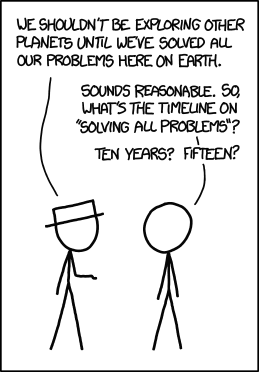
You can find about sixty years worth of arguments suggesting that planetary exploration should be deferred until we have addressed some immediate problem (cure cancer, end pollution, etc.). I don't want to defend these arguments -- at least not in their blanket form -- but I do feel obliged to point out that I've never seen anyone that we should wait until we've solved "all our problems."


Saturday, July 6, 2013

Weekend blogging -- the surprising overlap between chemistry majors and comic book nerds

OK... maybe not all that surprising.

Here's the description from Freetech4teachers:
The Periodic Table of Comic Books is a project of the chemistry department at the University of Kentucky. The idea is that for every element in the Periodic Table of Elements there is a comic book reference. Clicking on an element in the periodic table displayed on the homepage will take visitors to a list and images of comic book references to that particular element. After looking at the comic book reference if visitors want more information about a particular element they can find it by using the provided link to Web Elements. 
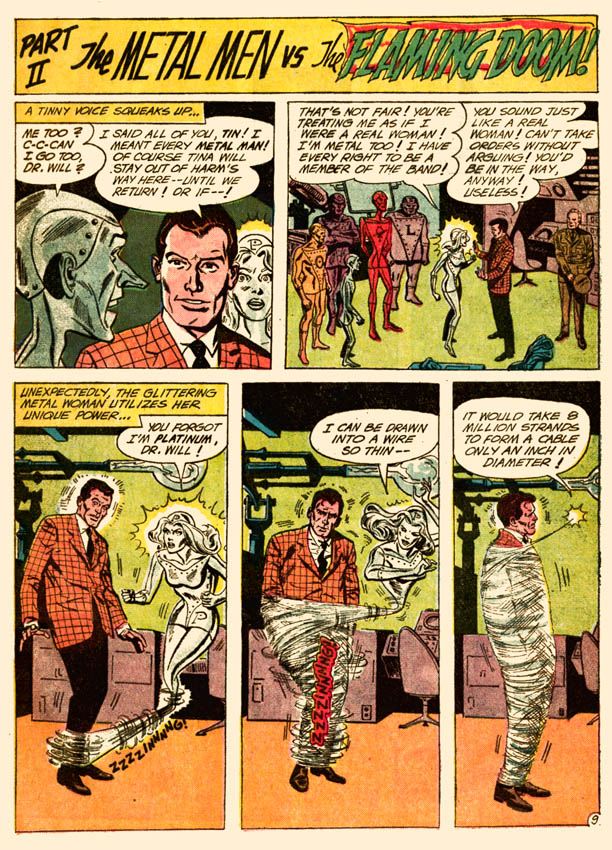
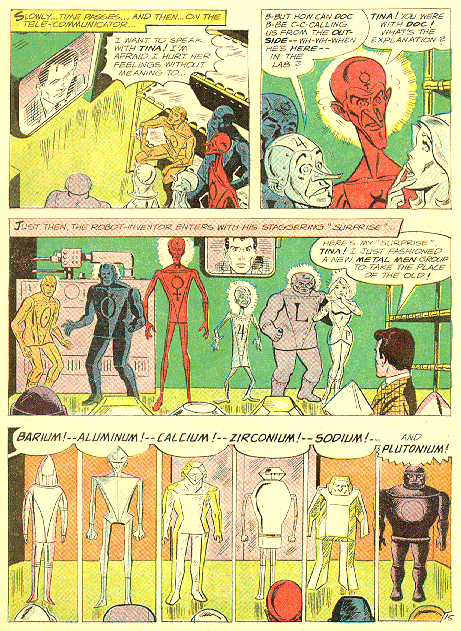
Here are a couple of the items you'll find under Platinum.


(apparently we have made some progress in gender attitudes in the past fifty years.)


Friday, July 5, 2013

The real issue

Frances Woolley gets to the heart of the problem with citibike that Mark and I have been discussing:
The biggest losers from a carbon tax are people like my cousins in the exurbs. The map above, taken from a paper by VandeWeghe and Kennedy, highlights the parts of Toronto with the highest per capita carbon consumption in red. These are place where people live in reasonably large houses, and commute long distances to work, generating whopping carbon footprints. The whole purpose of a carbon tax is to discourage this type of lifestyle. But I can see why people are reluctant to give it up. Except for the commute, it's great. The streets are quiet, clean and friendly, and there's lots of green space near by. For a person who wants a garden and ample living space, the alternative housing options in the same price range are clearly less desirable: a small, unrenovated bungalow in Scarborough, say, or a downtown condo.
This is really what is going to be the core issue of carbon reform.  Right now we subsidize the exurbs and the large living space ideal.  If you don't believe me, just think of what the response would be to a plan to stop keeping commuter roads in place in order to save money.   Or to just banning cars in NYC, as they are clearly inefficient relative to alternatives.  It'd be brutal.  Yet nobody has an equivalent problem with massive cuts to public transit

So the biggest problem is that there just isn't a consensus on dealing with this problem.  At the margins, a carbon tax would be purely good news.  It would raise revenue and that would be a good thing in a low tax country (kind of like cigarette and alcohol taxes being very positive revenue generators).  But even a "revenue neutral tax" can be opposed over fears that it might end up generating additional tax revenue.   In what other context would this be rational?  Would we be worried about accepting employment because there might be a pay raise?  Is it not good for the central government to have as many different levers as possible to collect revenue? 

In that context, citibike is an interesting flash point because it illustrates just how entrenched the opposition to meaningful change is (i.e. even when the change is trivial it brings forth strong emotions).  Yet we need to develop meaningful alternatives to the status quo at some point, even if it is just when all of the oil is consumed. 


A very different perspective on the NYC bike share program

Check here to get up to speed on the discussion.

At least for me, big posts tend to bring a lot of little posts in their wake. In the course of fact checking and looking up background, interesting facts pop up that make for brief, freestanding posts. Since these are quick to write, they usually get posted before the piece that inspired them (thus somewhat mixing the wake metaphor). Sometimes the big posts never get finished, leaving the smaller ones with something of a non sequitur quality.

In the case of the recent bike share thread, the main topic I wanted to address was the way New York City's bike share program has been covered (particularly the environmental aspect) and how that coverage compares to other recent environmental stories.

Citi Bike has turned into a major national story. Here are some of the reasons I think it does not merit that level of attention:

More bicycles are not going to be a big part of the solution to our environmental and transportation problems. This is a cheap, reliable, and well-established technology that everybody knows about. As a result, most of the benefits of the technology have been realized. We can, of course, get still more by making cities more bike-friendly and bikes cheaper and more convenient, but there's not a lot of low hanging fruit here, particularly when compared to steps like fixing rail choke points and shifting over to more plug in hybrids and electric vehicles;

Bike share programs can only play a limited role in promoting cycling. Bikes are already cheap and easily stored and transported, thus limiting the incremental value. Furthermore, sharing programs work best in the same high density areas where public transportation is generally most plentiful;

The New York City example is likely to have little impact on the future of bike share programs. We're talking about an extraordinarily unrepresentative place, expensive, densely populated, compact with so little available space that even bike parking is an issue, and served by an exceptional public transportation system. It's going to be difficult to widely generalize from that experience.  

This is not to say that the NYC program and ride sharing in general aren't admirable and worthwhile programs -- give me an initiative, I'll vote for it -- but they remain a small part of a small part of the solution.

By comparison, a major international reduction in the use of coal might well be the most important thing we can do to address global warming and ocean acidification. It is also a story with huge economic implications and a long list of winners and losers.

By any reasonable standard, the Obama administration's recent proposed policy changes surrounding coal are a couple of orders of journalistic magnitude bigger than a bike share program in a single city, but that certainly doesn't seem to be reflected in the levels of coverage we've seen.

As an admittedly crude way of attaching some numbers to this I did the following Google news searches and noted the number of hits I got for certain phrases (no quotes). The actual numbers jumped around but the first position seems to remain the same

new york city bike share

About 65,000 results


obama climate change speech

About 57,500 results


obama climate change coal

41,700 results


I take a couple of things away from this. the first is the way that the culture of journalism affects what we see and read. The second is our ability to have the kind of discussion needed to solve big problems.

I've been making the point for a while now that the press corps has a problem with homogeneity and insularity. If you look at truly influential journalists and opinion makers, you will see certain groups highly over-represented (such as New Yorkers). It's only natural that stories which affect those groups tend to get noticed. What's less excusable is the apparent lack of awareness on the subject. There's nothing wrong with being an upper-middle to upper class, ivy-league educated professional who lives and/or works in NYC or DC. The is something wrong with assuming that most people share those circumstances, particularly if part of your job is providing a balanced account of things. The NYC bike share program has a disproportionate effect on important members of the press corps so it's not surprising that it receives disproportionate coverage. A similar dynamic tends to amplify the coverage of high end electronics and dampen coverage of items predominantly used by the lower-middle and lower classes like over the air TV (though that demographic is changing).

But the far bigger issue is our apparent inability to maintain the sense of prospective necessary for the kind of prioritized discussions that lead to solutions of big problems. I'm not saying there's no room for smaller matters but there needs to be some sense of proportionality. Important issues like coal policy, ocean acidification, CAFE standards and the future of nuclear power are often pushed to the back pages. Others, like rail choke points, receive almost no attention at all.

Obviously public discourse is not a zero sum game. The time we spend talking about bike sharing doesn't have to come out of the time we would have spent talking about fuel efficiency, but there are limits to our bandwidth and until we start giving appropriate attention to environmental issues, we simply won't have time for the small stuff.


Thursday, July 4, 2013

A perspective on bike culture

One point that I wanted to add to the discussion with Mark about bicycles is the importance of having a plan.  In a lot of ways, I prefer a bad plan to no plan at all.  Mostly because hard decisions made in the face of crisis tend to be sub-optimal.  One question that really needs to be addressed in any discussion of trying to avoid climate change or creating a greener world is what will replace the current sources of greenhouse gas and/or pollution.

It may be the case that some things can be discontinued.  But we need electricity for computers and we will always need to be able to travel from place to place.  Walking has significant limitations. 

What the bicycle crowd has is an option that might well work to replace short and medium length commutes.  It has a lot of downsides and disadvantages.  In a lot of ways I almost prefer golf carts, although given that golf carts mix well with bicycles this isn't a major problem. 

This might be the wrong way forward -- I don't know.  But I think that proposing a plan is a good forward step.  Sure, it might be the case that the plan isn't going to survive scrutiny.  But I would like to see alternative proposed that are not "we can keep the status quo forever" unless these plans address issues like peak oil and pollution thoughtfully.

So I like the conversation starting as that is so much better than pretending that there isn't going to be a problem.

Five... Four... Three... Two...


A side note on Joseph's climate change post...

Particularly the part where he discusses Miami and its grim-looking future. Of the coastal cities in North America, Miami is certainly among the most vulnerable to rising sea levels. Here, via Wikipedia, are some elevations:

Miami    Elevation 6 ft (2 m)

New York City Elevation 33 ft (10 m)

Los Angeles   Elevation 233 (city hall) ft (71 m)
(Ours is a rugged shore)

Even before rising sea level was a concern, building a major city in an area routinely hit by hurricanes (often accompanied by large storm surges) on a patch of land with an elevation of six feet was a questionable idea.

Consider the Miami Hurricane of 1926:
Most of the coastal inhabitants had not evacuated, partly because of short warning (a hurricane warning was issued just a few hours before landfall) and partly because the "young" city's population knew little about the danger a major hurricane posed. A 15-foot (4.6 m) storm surge inundated the area, causing massive property damage and some fatalities. As the eye of the hurricane crossed over Miami Beach and downtown Miami, many people believed the storm had passed. Some tried to leave the barrier islands, only to be swept off the bridges by the rear eyewall. "The lull lasted 35 minutes, and during that time the streets of the city became crowded with people," wrote Richard Gray, the local weather chief. "As a result, many lives were lost during the second phase of the storm."
Inland, Lake Okeechobee experienced a high storm surge that broke a portion of the dikes, flooding the town of Moore Haven and killing many. This was just a prelude to the deadly 1928 Okeechobee Hurricane, which would cause a massive number of fatalities estimated at 2,500 around the lake. 
Coastal regions between Mobile and Pensacola, Florida also suffered heavy damage from wind, rain, and storm surge, but this paled beside the news of the destruction in Miami. According to the Red Cross there were 373 fatalities. Other estimates vary, since there were a large number of people listed as "missing". Between 25,000 and 50,000 people were left homeless, mostly in the Miami area. 
The damage from the storm was immense; few buildings in Miami or Miami Beach were left intact. The toll for the storm was $100 million ($1.3 billion 2013 USD). It is estimated that if an identical storm hit in the year 2005, with modern development and prices, the storm would have caused $140–157 billion in damage.

$157 billion (adjusted for inflation) also happened to be the total cost of the hurricane. (from the same source):

Costliest U.S. Atlantic hurricanes 1900–2005
Total estimated property damage, adjusted for wealth normalization[4]
Rank Hurricane Season Cost (2005 USD)
1 "Miami" 1926 $157 billion
2 "Galveston" 1900 $99.4 billion
3 Katrina 2005 $81.0 billion
4 "Galveston" 1915 $68.0 billion
5 Andrew 1992 $55.8 billion
6 "New England" 1938 $39.2 billion
7 "Cuba–Florida" 1944 $38.7 billion
8 "Okeechobee" 1928 $33.6 billion
9 Donna 1960 $26.8 billion
10 Camille 1969 $21.2 billion

All of which got me wondering if this seemingly inexplicable piece of bad urban planning could be traced back to Florida's long and colorful history of real estate bubbles. People, pretty much by definition, act irrationally during bubbles and you'd be hard pressed to find a state more associated with them than Florida.

This association is so long standing that buying Florida swamp land was a reliable punchline all the way back in the Twenties.
The Cocoanuts was written for the Marx Brothers after the success of their Broadway hit I'll Say She Is (1924). The Cocoanuts is set against the backdrop of the 1920s Florida Land Boom, which was followed by the inevitable bust. Groucho is a hotel proprietor, land impresario, and con man, assisted and hampered by two inept grifters, Chico and Harpo, and the ultra-rational hotel assistant, Zeppo. Groucho pursues a wealthy dowager ripe for a swindle, played by the dignified Margaret Dumont.


If Florida didn't have such a history of scams and bubbles, would it still look so much like a Marx Brothers movie today?

Wednesday, July 3, 2013

Corporate term of the day -- FUBAR Promotions

Sometimes a major initiative will blow up so badly that the careers of everyone associated will take a major, possibly fatal hit. As far as I can tell, though, that seems to be the exception, driven as much by company politics and poor spin control as by the actual magnitude of the screw-up.

I can't recall personally seeing a heads-will-roll disaster but I've seen quite a few either scapegoated or rebranded ones. Scapegoating goes about like you would expect. A mid-level person (preferably one who actually did screw something up) is fired and the remaining people line up behind the story that the project would have been a huge success if not for that one idiot. This often results in a de facto posthumous promotion: the departed financial analyst not only underestimated the cost; he was also responsible for the disastrous marketing campaign.

There are a couple of problems with the scapegoating approach to spin control. First, unless there's been a recent change in upper management, it raises the problematic why'd-you-hire-the-guy question. Second, disseminating that particular narrative on a company wide scale can be tricky. Corporate communications are much better suited at putting a positive spin on things. That's where rebranding comes in.

The somewhat Orwellian process goes like this: first, the goalposts are moved (project objectives are rewritten so that relatively minor improvements and largely cosmetic changes qualify as objectives); second, the accomplishments of the project are depicted as positively as possible internally and externally with emails, announcements, recognition at meetings and press releases; third, everyone prominently associated with the project receives a career bump through excellent evaluations, bonuses and promotions.

The other nice thing about the rebranding approach is that it can be done on a massive scale. The worst corporate disaster I've ever seen first hand resulted in dozens of promotions, even though the people in the know were privately describing the project as an almost complete failure.

I wonder how many dysfunctional corporate cultures can be partially attributed to FUBAR promotions. Who knows... that might even explain the post-Zucker NBC.

Tuesday, July 2, 2013

More on climate change

You might wonder why I was strident about Mark's piece on citi-bike and why I am getting worried about climate change.  This piece in Rolling Stone about the future of Miami is a good example of the sort of issue that is worrying me.  Part of where I am coming from is I am a huge technological optimist, which is really not a position that makes sense given my other preferences.  But I have a firm belief that a) people prefer not to work hard and b) when there are incentives then a group of dreamers are likely to find ways to make things work better. 

The current car culture is already in decline.  There are a couple of ways we can respond to this shift in cultural values.  We can be paralyzed by fear and do everything that we can to prevent this shift away from cars.  Exhibit A comes from the Wall Street journal editorial board.  Or we can try and adapt to a new and different world. 

What I want to avoid is the Megan McArdle position where we look at all of the costs and none of the benefits.  Or where we don't see the costs as challenges to be met.  I am very interested in the potential of alternative energy -- including wind and especially solar power.  True, we may end up having to run our dishwashers during daylight hours.  Now if only somebody could invent a timer that could be put on a dishwasher to have it run during non-peak times.  Curiously, I remember such timers as a child and see absolutely no reason why they could not come back. 

So I think we should look with interest on the small cases because they define the legal, intellectual and cultural context for the big battles.  I would like to bet on the sort of American innovation that changes the world last century.  Because I think it remains the best way forward. 

Monday, July 1, 2013

Note to Blogger -- today is not the sixth of July -- updated

Blogger,

When I schedule a post for July 6th, I want you not just to label it "SATURDAY, JULY 6, 2013" but to actually post it on that day. I apologize if that wasn't clear. My lighthearted weekend blogging features simply work better if they appear, you know, on the weekend.

While we're on the subject, it would be great if readers, particularly those who follow the blog, could see their comments appear in the comment section or at least go to the spam filter where I can recover them. Having them disappear for no reason creates bad feelings.

We'll talk more later.

Mark

UPDATE -- I thought about leaving the post from the future up just for the weirdness factor, but Blogger was putting all of the new posts (like this) under it and I didn't want to leave people with the impression that we weren't updating. 

Drilling down in the Citi-Bike topic

"I think comparing to the cost of a bike kinda misses the point. I often get around with my bike, but I'd love to pay for the additional option. "

comment on "A quick note on Citi-Bike" eaten by Blogger.

This is still off the main point I want to make, but based on the reaction to my last post, in which I pointed out that you could buy a new bike for less than a one year pass for the NYC bike share program, I thought I ought to spell out a couple of points.

What is Citi Bike selling and whom are they selling it to?

What they aren't selling is a general substitute for a bike, at least not for purposes of leisure, exercise or long trips. The people at Citi Bike are explicit on this point, "If you would like to use a bike for an extended period of time, we encourage you to rent a bike at a local bike shop or rental business."

Instead, the product offers a quick and convenient way of making short trips assuming clement weather and appropriate start and end points. It's important to note that the places you can go on these trips is almost entirely a small subset of the places you can go  with public transportation. The logistics of bike sharing simply do not favor the out-of-the-way destination.

If we think in terms of functionality (which, if you search on 'ddulite,' you'll see is a bit of a hobbyhorse of mine), the service looks like less an alternative to owning a bike and more like a quicker and more pleasant alternative to mass transit. This raises some interesting policy questions. If the purpose of Citi Bike is to make urban living more inviting, it makes a great deal of sense; if the purpose is to reduce congestion and carbon emissions, the case is considerably weaker.

That's what. Now how about who? Here's how I see the target market:

Urban;

Relatively fit;

Financially stable and reasonably upscale;

Willing to pay a premium for convenience;

Bike owner.

I know that last one seems a bit strange but we're looking at people who like cycling and are comfortable paying $95 up front for a service. Most of those people will own a bike. There will be exceptions, such as the extremely space constrained or those heavily into a just-in-time lifestyle (who will seek out other rental options for long rides) but for the most part I see typical customers as having a bike (and sometimes a very nice one), but often not having it with them when they need it.

For this target market, Citi Bike is an excellent service and a good value. My concern is that we've gotten confused about what the program is supposed to accomplish and that the demographics of the target audience is muddling the discussion.

But more on that later.

A defense of the media coverage of citi-bike

I think this piece by Mike the Mad Biologist helps explain what is going on with the reaction to Mark's Citi-bike piece.  The issue is not that this program has a lot of potential to change the climate -- it is a small step in the right direction that can, at most, have marginal benefits.  What is remarkable is that such a small program can not only achieve such a strong reaction but that there is actually legal moves afoot to remove these stations from high end neighborhoods

It is this piece, the degree of reaction to a small change, that really is newsworthy (even if the lede often seems to be deeply buried).  In a real sense, this story is directly linked to President Obama's climate change speech.  Because if the law can be used as a weapon to remove bike stations then why would we not expect it to be used against the EPA? 

The law and the environment is a very unfortunate combination.  On one hand, environmental review seems to be linked to delays in critically needed infrastructure.  But it has a decidedly mixed record on tackling issues like coal use that have broad external costs that are not borne by the industry. 

So, in this sense, citi-bike is a canary in the coal mine for how the larger drama may well play out. 

Sunday, June 30, 2013

A quick note on Citi-Bike

Came across this while doing background for an upcoming post.

From Wikipedia:
Yearly passes (US$95.00) are sold through the Citi Bike website. Purchasers receive an electronic key and can make trips of up to 45 minutes without added charge.
Daily (US$9.95) and weekly (US$25.00) passes are sold at Citi Bike docking stations. Trips using these passes are limited to 30 minutes before extra fees kick in.[3] 
All payments are by credit card. Citi Bike does not accept Wageworks or Transitchek prepaid commuter cards.
In case you're wondering, Walmart offers eight different adult bikes for under US$95.00, all of which allow you to make trips of over 45 minutes without added charge. You can get quite a few at Target as well.


Saturday, June 29, 2013

Sadly, the follow-up "Betty Boop explains Uncertainty" never made it past the initial sketches

OK, just kidding about Betty, but the incredibly inventive Fleischer Studios did produce this interesting attempt at introducing Einstein to the masses (if you'll pardon the expression).

From Wikipedia;
Six months later, on February 11, 1923, the Fleischers released their relativity film, produced in collaboration with popular science journalist Garrett P. Serviss to accompany his book on the same topic. Two versions of the Fleischer film are reported to exist - a shorter two-reel (20 minute) edit intended for general theater audiences, and a longer five-reel (50 minute) version intended for educational use.[1] 
The Fleischers lifted footage from the German predecessor, Die Grundlagen der Einsteinschen Relativitäts-Theorie,[2] directed by Hanns-Walter Kornblum, for inclusion into their film. Presented here are images from the Fleischer film and German film. If actual footage was not recycled into The Einstein Theory of Relativity, these images and text from the Scientific American article suggest that original visual elements from the German film were.[3] 
This film, like much of the Fleischer's work, has fallen into the public domain. Unlike Fleischer Studio's Superman or Betty Boop cartoons, The Einstein Theory of Relativity has very few existing prints and is available in 16mm from only a few specialized film preservation organizations.