Friday, July 5, 2019

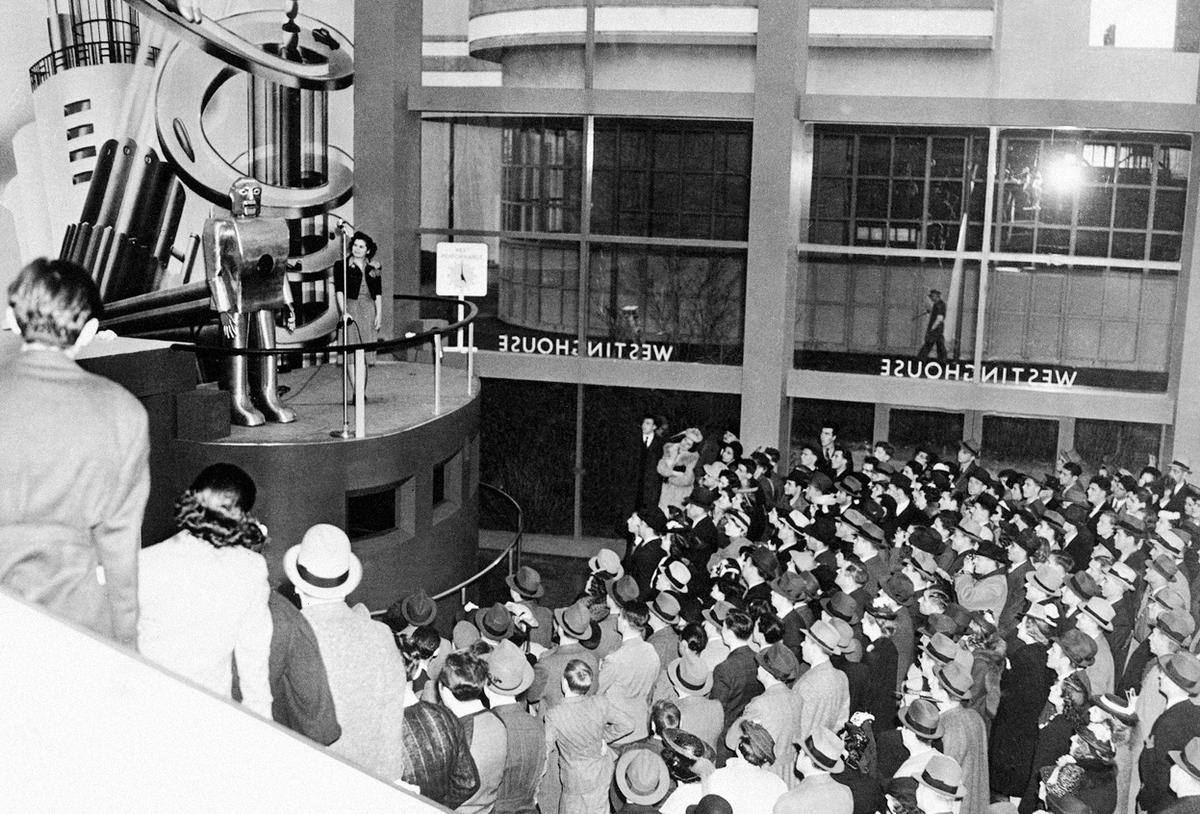
We'll come back to Elektro the Moto-Man

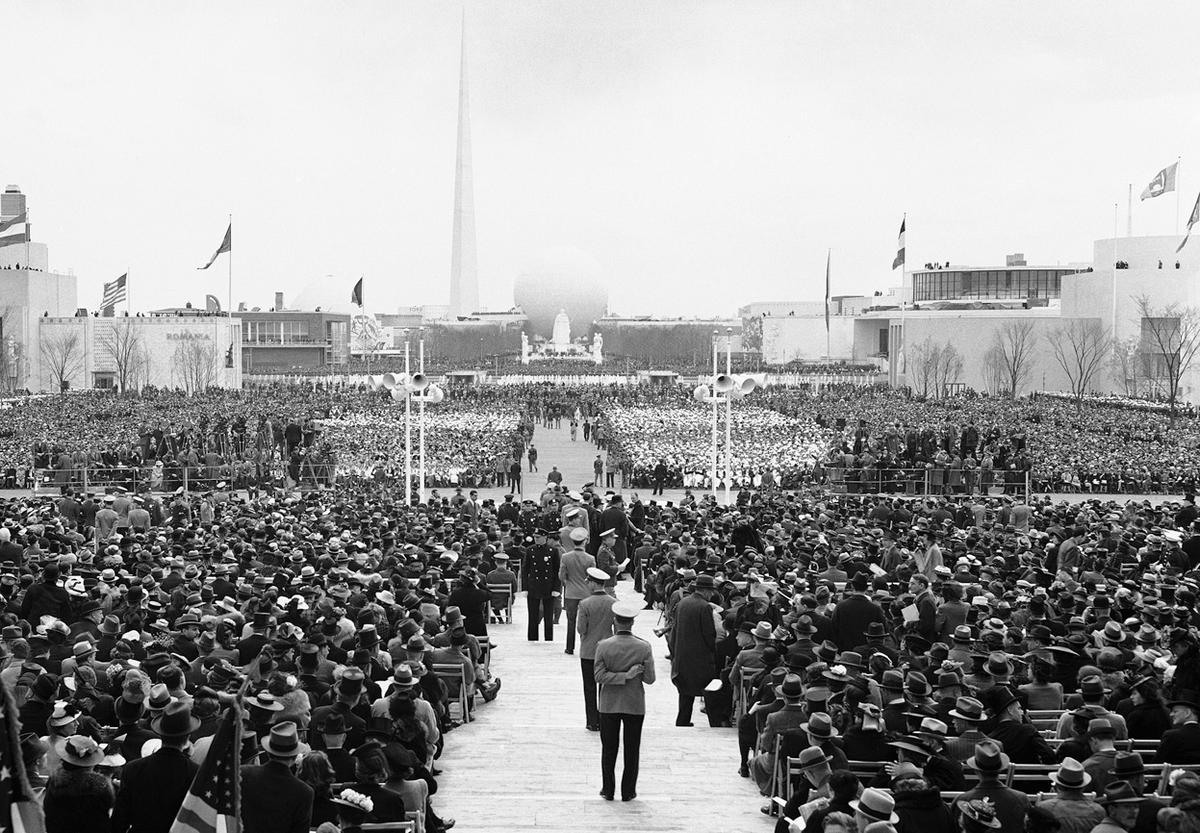
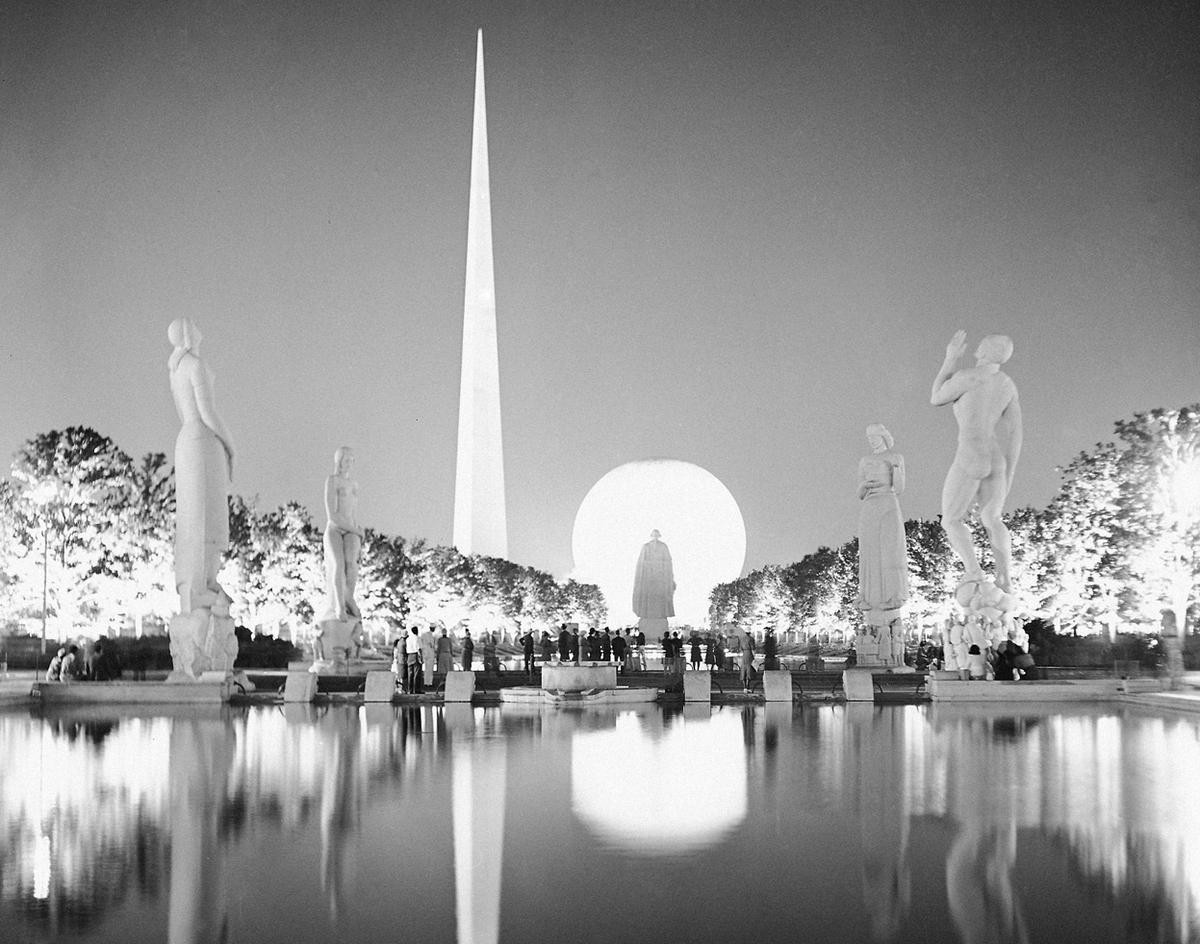
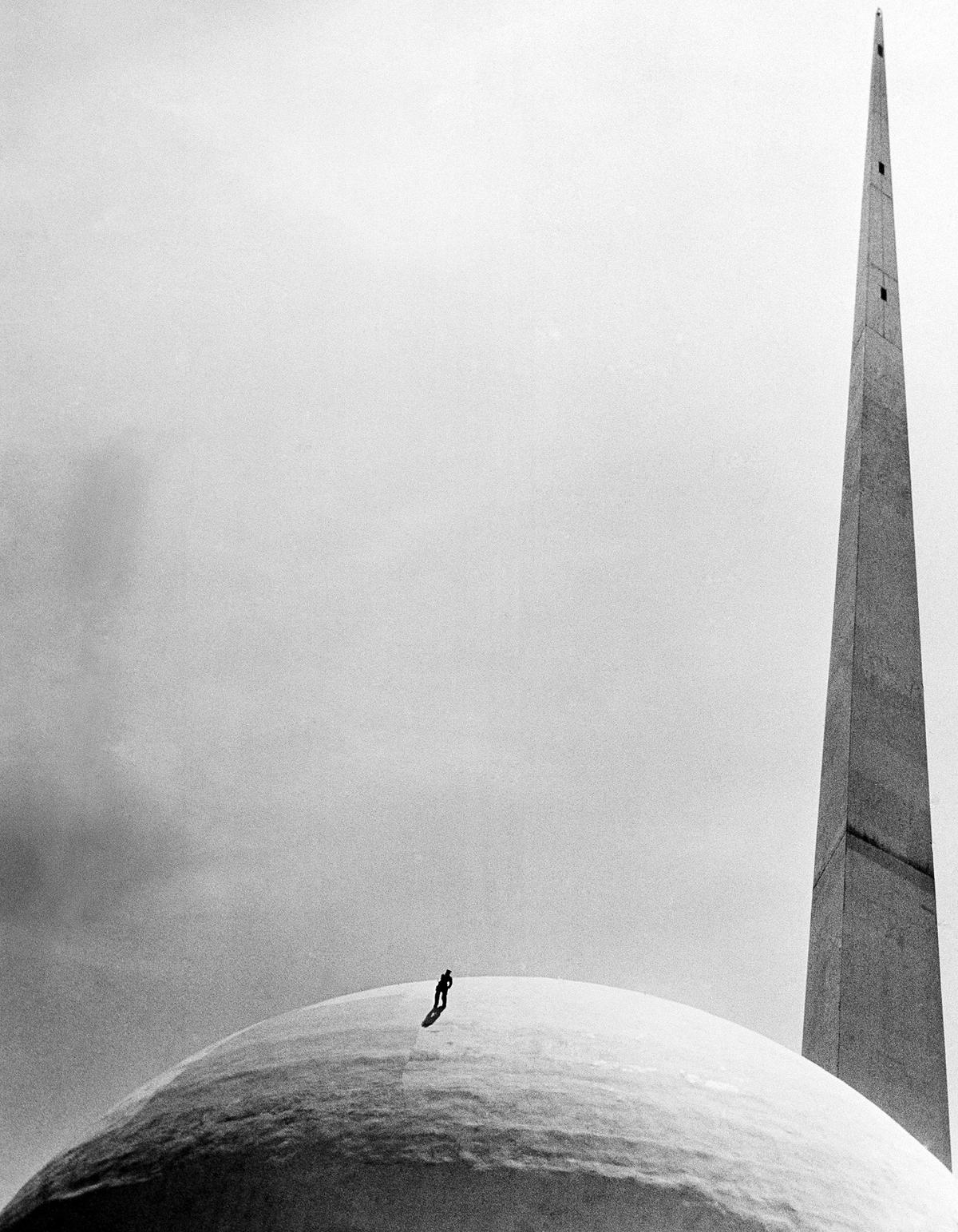
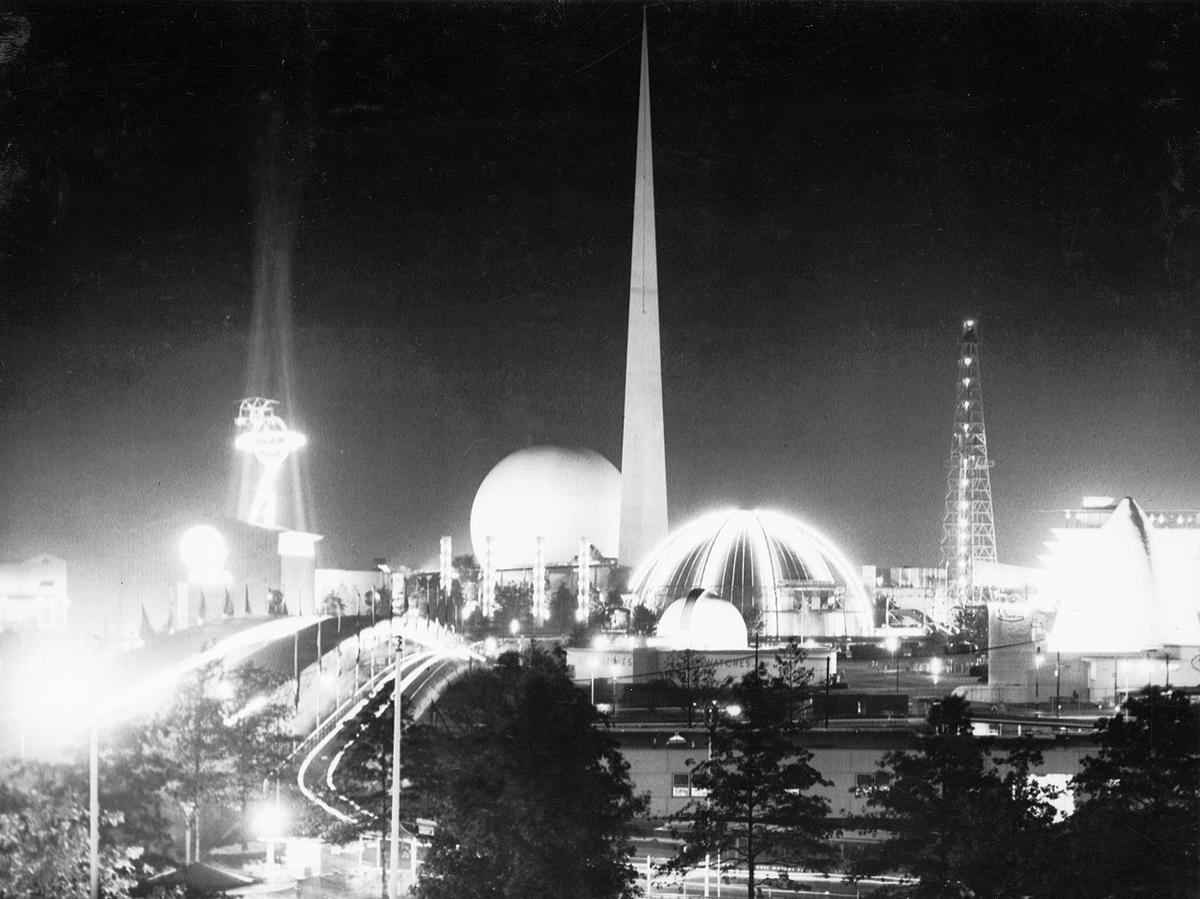
The Atlantic has a beautiful photo spread on the 1939 World's Fair. If ever there was a period when pessimism was justified, this was it, which makes the whole thing that much more extraordinary.

From Wikipedia.

The 1939–40 New York World's Fair, which covered the 1,216 acres (492 ha) of Flushing Meadows–Corona Park (also the location of the 1964–1965 New York World's Fair), was the second most expensive American world's fair of all time, exceeded only by St. Louis's Louisiana Purchase Exposition of 1904. Many countries around the world participated in it, and over 44 million people attended its exhibits in two seasons.[2] It was the first exposition to be based on the future, with an opening slogan of "Dawn of a New Day", and it allowed all visitors to take a look at "the world of tomorrow". According to the official pamphlet:

    The eyes of the Fair are on the future—not in the sense of peering toward the unknown nor attempting to foretell the events of tomorrow and the shape of things to come, but in the sense of presenting a new and clearer view of today in preparation for tomorrow; a view of the forces and ideas that prevail as well as the machines.

    To its visitors the Fair will say: "Here are the materials, ideas, and forces at work in our world. These are the tools with which the World of Tomorrow must be made. They are all interesting and much effort has been expended to lay them before you in an interesting way. Familiarity with today is the best preparation for the future.

Within six months of the Fair's opening, World War II began, a war that lasted six years and resulted in the deaths of 70–85 million people.


There's Elektro.


And finally, an imagining of the future of 1960.


Thursday, July 4, 2019

America versus the rest of the world

This is Joseph.

All of the points in this piece are good.  But I am particularly struck by:
Of course Americans love their own children as much as any parents anywhere. But raising kids is seen as a private decision, freighted with hardship and annoyances that are to be entirely borne by the parents themselves. Enter many places in America with a preschooler and the unspoken message feels more like, "Please move quietly to the suburbs to suffer in silence. Don't bother the rest of us with your uncool offspring."
But the idea of making children an entirely private concern is culturally unusual.  We have a lot of laws and regulations around children, but a fear of having to contribute to making children viable.  Just look at the daycare expenses that some area have

I don't think that this attitude is necessarily wrong -- everyone has to make some trade-offs but it is odd to see this in any culture that frames itself as pro-family. 

Happy 4th

Some [reposted] music for the holiday.


Listening to Cohan, it's easy to forget how controversial going to war in Europe was.


Wednesday, July 3, 2019

And Josh Marshall wins the award for best use of the word "Timesian"

Josh Marshall puts his finger on one of the issues I've long had with the New York Times. (emphasis added)


The New York Times has a rather lengthy and Timesian piece out this morning on the on-going mystery of Jerry Falwell Jr, his wife and family and this “pool boy” who they befriended and then put into the divey youth hostel business in South Florida. For those who’ve read the earlier reporting by Politico, Buzzfeed and Reuters, there’s no big new bombshell or piece of evidence in the new piece. (If anyone’s read it and thinks otherwise, let me know.) What there is is bits and pieces of more confirmation and nuggets of detail throughout. It’s a classic Timesian piece, the kind fellow journalists often grind their teeth over. The Times comes in late, largely with other people’s reporting and makes the whole thing official with splash of Times holy water. And yet, as usual, they’ve used their name and resources to unearth enough new details and additional confirmations to put the whole edifice on a rather firmer footing.


How much of this is insult and how much is injury? No institution in journalism is as relentlessly smug and as compulsive with its self-congratulation, but just being annoying isn't a crime, so does this go beyond the hurt feelings of a few competitors? I'd say yes for at least a couple of reasons.

I tend to be dismissive of charges of plagiarism partially because I'm far more concerned with crimes of content underneath the byline, but also because we only focus on a form that is minor and relatively rare. There are all sorts of ways of stealing other writers' work, ideas and style, and as long as you don't actually lift specific phrases, it is a crime without consequence. 

Writers for the New York Times routinely arrive late and build on the foundation of other journalists. They may mention the previous work, but it's the NYT story that gets the attention, even if it adds relatively little.

More importantly, the practice of automatically anointing any story from the paper "groundbreaking and definitive" status feds the rot that is already undermining the paper's culture.

In terms of quality, the New York Times is no longer our best paper (the Washington Post has been blowing it away ever since Marty Baron took over and certainly since they lost Margaret Sullivan). It may not break the top five. It is still, however, the paper that matters.

Self-examination has never been a strong suit of the New York Times, but since its disastrous handling of the 2016 election, it has doubled down on the denial and has become openly hostile to its critics. The reception that stories like this get help the paper maintain the fiction that nothing is wrong, and that's the worst possible outcome.


Tuesday, July 2, 2019

"He changed me"

North Carolina in 2019:

There are quite a few clergy members at the picnic. Another is the Rev. Jerry Miller, whose son came out as gay four decades ago. At first, it wasn't easy for Miller to reconcile his faith with his son's identity.

"My wife and I basically went in the closet because I was a pastor of a Baptist church at that time. And I prayed that God would change my son someday," Miller says. "God didn't change him; he changed me."


Thursday, May 7, 2015


An Arkansas Tea Party group plans an anti-equality rally. Guess what happens next...

There is a big and largely untold story here about cultural and political shifts south of the Mason Dixon Line. They don't get much coverage but I've been noticing items like this.
RUSSELLVILLE, AR -- Hundreds of people marched down Main Street in Russellville for the definition of marriage in Arkansas just three days before the U.S. Supreme Court considers the fundamental question of whether same-sex couples have a constitutional right to marry.

The rallies were on the same street at the same time, but were on opposite sides of the street because of people's opposing views on same-sex marriage.

The march started off calm. Nearly 80 people walked on Main Street to the Pope County Courthouse holding signs that read, "One man + one woman = marriage and family" and other signs that supported heterosexual marriage and disagreed with homosexual marriage. The group, which included members of the Tri County Tea Party, headed its own march with a separate march trailing behind.

...

All while hundreds of people rallying at the other march chanted "marriage equality" across the street.

...

That was the message speakers at the original rally tried to get out, but struggled because of the loud chants across the street.

Even though March for Marriage was the first march formally announced, supporters were outnumbered by the crowd across the street.
Outnumbered is a bit of an understatement.
Because I've heard conflicting numbers regarding the folks on both sides of the two rallies in Russellville this weekend, I asked Travis Simpson, a reporter at the Russellville Courier, who was there on the scene on Saturday.

He said the crowd supporting marriage equality was the larger of the two, "no contest." Simpson said he estimated there were perhaps 30 rallying against same-sex marriage, but around 200 on the pro-equality side.
Nor was that the end it.
On Saturday, a group called Pope County for Equality organized a rally in Russellville to show support for marriage equality and LGBTQ civil rights in Arkansas. More than 300 people showed up — quite a significant turnout for a community of under 30,000. Klay Rutherford, an organizer of the event and an undergrad at Arkansas Tech University, sent this report to the Arkansas Times. All pictures are courtesy of Pope County for Equality's Facebook page.

Residents of Pope County gathered in Russellville at 3 p.m. on Saturday, May 2 for a march and rally for marriage equality. Over 300 attendees marched through downtown and congregated at a stage near the historic Missouri-Pacific train depot.

The event was sponsored by Pope County for Equality, an online organization that advocates for the equal treatment of all individuals, regardless of race, religion, sexual orientation or gender identity. Speakers included Dr. MarTeze Hammonds, Associate Dean for Diversity and Inclusion at Arkansas Tech University; Jeannie Fowler Stone, a proud Christian and an accepting mother of a transgender son; and, James Bittle, a retired sergeant in the U.S. Army who is gay and recently married. Hammonds, Stone and Bittle are all residents of Russellville.

Event organizers said, “Our goal is to be an overwhelming presence of love and acceptance. We aim to lift people up, start discussions, and show our community that we are more than a stereotype. We simply want to bring our community closer together in a setting of love and peace.”

An impromptu marriage proposal took place on stage as Russellville resident Morgan Walker got down on one knee, surprising the crowd and her new fiancé, Silvia Harper (also of Russellville). The band Sad Magick provided entertainment.

The rally was held in part as a response to an event the previous weekend (Saturday, April 25) organized by an Arkansas River Valley Tea Party group in support of defining marriage as between one man and one woman. Protests that weekend were organized by pro-equality individuals not affiliated with Pope County for Equality. While many media outlets downplayed the presence and role of the protesters at the April 25 event, we estimate that there were at least 250 pro-equality protesters and no more than 50 participants among the the anti-equality crowd.

Pope County for Equality would like to thank the Russellville Police Department for their unbiased approach in handling both marches. Despite the surprising turnout at both events, they occurred without incident or injury.
In the fairly near future, I'm planning a deep dive into how the culture and politics of the South are shifting in ways that our standard metrics tend to miss. For now though, just remember that Russellville is in the most Republican part of the state.

Monday, July 1, 2019

Primary polls, noise and path dependency

As with rational actors and efficient markets, the strong form of the wisdom of crowds theory is too silly to bother with -- a collection of motivated reasoning and epicyles -- but the weak form stands up fairly well and, at the very least, serves as a very useful rule of thumb. Under the right conditions, more heads really are better than one.

When, however, we try to determine how much better, we run into a paradox, or at least a tricky caveat.      We are often most likely to rely on collective opinions when we should trust them the least. This is especially true in cases of limited information.

When reasonable people want to understand something or make a decision, they generally seek out both objective information and informed opinions. Furthermore, being reasonable, they constantly try to gauge the quality of that input and give more weight to the good and reliable. Unfortunately, our ability to judge the information other people are using is less than our ability to judge the information we’re using. This leads to a big problem when everyone is using the same basic set of facts.

If I feel ignorant on a subject, I’m more inclined to rely on your take. If you feel ignorant on a subject, you’re more inclined to rely on mine. Extend this out to a large number of people and limit their ability to share their uncertainty and you can see where this is going.

Which brings us to primary polls, noise and path dependency.

Supporting a candidate partially because other party members support her is not necessarily a bad thing. In a democracy, agreement is a positive and if you believe elections have consequences, it is only ration to consider electability (with the caveat that much of the conventional wisdom about electability is demonstrable bullshit). Six months from now, ignoring the polls when deciding who to support will border on irresponsible.

At the moment, though, the focus on polls and horse race coverage actually damage the democratic process, amplifying noise and creating the illusion of information. With all due respect to Nate Silver and his peers, if they would all just take the next few months off, the country would be better off.

Friday, June 28, 2019

Believe it or not, if I had more time, I'd tie Chucky in with the Joe Biden campaign


I've been meaning to do a thread about how we have come to put irrationally high value on name recognition and known IP. Chipman's argument here -- that this is a clever premise clumsily tied to a deserving cult classic in a way that does disservice to the old and ruins the new -- would be a great fit.

Unfortunately, I don't have time to write that now, so I'm just going to post this and go to bed. Maybe next week.


...

OK, NOW I;m going to bed, but first I stayed up a little longer and checked out this deep dive by Chipman into why there are two ongoing Chucky franchises. If you're into both pop culture and the strange world of intellectual property law (which sadly puts me in the center of the target audience), it's definitely worth your time.

Thursday, June 27, 2019

You know the writers are running out of ideas when they start doing cross-overs

From Steve Moore’s New Crypto Start-up Is Dumb Even by Crypto Start-up Standards by Josh Barro


Here’s how Moynihan and Gasparino describe the proposed venture:
“Decentral,” as it is known, will attempt to perform Fed-like duties in terms of regulating the supply of crypto in the same way as the Fed controls the supply of money for the U.S. economy, they contend. It will exchange its own new token for other cryptos; the supply of the new cryptocurrency will be tied to the value of the dollar or some other “stable” valuation method and will be strictly controlled by an algorithm, company officials tell Fox Business.

You may have some questions. Like “What?” or “Why?” or “What could that possibly even mean?” When I read that paragraph, I also had these questions. It sounds like announcing you’re going to start a private “central bank” that trades in gold in order to control the supply and price of gold. How would that possibly work? It wouldn’t, is the short answer.

So I spoke with Moore’s business partner, Sam Kazemian (a 2015 UCLA graduate whose previous venture, Everipedia, is a blockchain-based competitor to Wikipedia), to ask what it would mean for a crypto start-up to “perform Fed-like duties” and “regulate the supply of crypto.” Having spoken with him and gotten more detail on the proposed business plan, I think the “central bank” branding is distracting and it’s most accurate to say that Kazemian and Moore hope to issue a fiat stablecoin. Let me explain what that means. (Spoiler: It’s still not a good idea.)
   

Before we go on, let's pay a quick visit to Everipedia.

The closer you look at Everipedia, which didn’t respond to questions or a request for a list of its most visited pages, the less substantial it appears. Almost every page on the site is copied verbatim from Wikipedia — although not updated as frequently as Wikipedia — and the trickle of entries posted by Everipedia users relate almost exclusively to sensational topics including YouTube trolls, the “meme war of 2017” and the hip hop producer who tattooed an image of Anne Frank onto his face. Other recurring subjects are activists, white supremacists, and people who were shot and killed by police — all topics that seem engineered to capitalize on trending search terms.

Also unlike Wikipedia, a collaborative nonprofit encyclopedia launched in 2001, Everipedia has its eye on revenue. The site offers a service in which individuals and businesses can pay an annual fee in exchange for a custom-made Everipedia entry that receives “full-time monitoring for updates and preventing vandalism,” starting at $299 per year. Its home page claims that it is “free from ads,” but ads periodically appear on the site, and a link at the bottom of every page labeled “Advertise” links to information for prospective sponsors. Maghodam has trumpeted the site’s growing traffic, but its Alexa score indicates limited popularity.
Which these days is enough to net you $30 million.

Now back the main stage.


For a number of reasons, Moore and the founders of Decentral would like to avoid backing their stablecoin 1:1 with traditional currencies. The premise behind their venture: What if you could have a coin that was stable but that wasn’t backed by a whole bunch of stable assets? What if, like a central bank, you found a way to issue currency and achieve a stable price not through backing by valuable reserves but by fiat — that is, through reliance on a reputation for stability plus certain open-market operations designed to influence the value of the currency you have issued?

Of course, there are some problems with this idea.

...

Sovereign governments fail at this despite having advantages that Decentral will not. For example, they can levy taxes. They regulate banks that take deposits and issue loans in the fiat currency and adjust the supply of that currency by telling them how much they must hold in reserve. They also preside over economies in which people are likely to feel compelled to hold and use the local currency — because they have to pay taxes in it, for example. Nobody will need to pay taxes in Decentral’s coin.

Kazemian told me he understands these concerns, and that is why Decentral will begin its operations with a more traditional stablecoin model, achieving a stable price by holding other stablecoins in full and equal value to the coins Decentral itself will issue.

He said a key reason the company brought Moore onboard was to help understand how big it would need to get in order to successfully behave like a central bank and issue a stable fiat currency. “When it is big enough, when it’s the kind of self-fulfilling prophesy of the Fed,” Kazemian said, they would pivot to a model similar to the Fed’s, in which the currency isn’t fully backed by reserves.

That's right, Moore is supposed to be the economic brains of the operation

Wednesday, June 26, 2019

Paul Krugman is just scratching the surface here, but it's a valuable scratch


In fairness, this is only a prelude to a longer talk, but even if he stopped here, Krugman would deserve credit for clearly laying out points that are vitally important and should be obvious but are all too often ignored. Part of the problem, I think, is that the mainstream centrist press, especially the paper Krugman writes for, tends to be overwhelmingly deferential toward the rich and the powerful. That, however, is a topic for another post.

While popular discourse has concentrated on the “1 percent,” what’s really at issue here is the role of the 0.1 percent, or maybe the 0.01 percent — the truly wealthy, not the “$400,000 a year working Wall Street stiff” memorably ridiculed in the movie Wall Street. This is a really tiny group of people, but one that exerts huge influence over policy.

Where does this influence come from? People often talk about campaign contributions, but those are only one channel. In fact, I’d identify at least four ways in which the financial resources of the 0.1 percent distort policy priorities:

1. Raw corruption. We like to imagine that simple bribery of politicians isn’t an important factor in America, but it’s almost surely a much bigger deal than we like to think.

2. Soft corruption. What I mean by this are the various ways short of direct bribery politicians, government officials, and people with policy influence of any kind stand to gain financially by promoting policies that serve the interests or prejudices of the wealthy. This includes the revolving door between public service and private-sector employment, think-tank fellowships, fees on the lecture circuit, and so on.

3. Campaign contributions. Yes, these matter.

4. Defining the agenda: Through a variety of channels — media ownership, think tanks, and the simple tendency to assume that being rich also means being wise — the 0.1 percent has an extraordinary ability to set the agenda for policy discussion, in ways that can be sharply at odds with both a reasonable assessment of priorities and public opinion more generally.

Tuesday, June 25, 2019

Tuesday Tweets

I've probably said this before, but I wonder how much of the postwar futurism that seems wildly optimistic today would have been viable if nuclear thermal rockets and fusion reactors had progressed as expected.


Here's one for the social scientists in the audience.


Keep this in mind when we come back to the voter suppression thread.


When studies favor the predictions of social psych crowd over the economists, people are always surprised, even though that seems to be how things generally break.


Presented without comment.


The smarter commentators (Pierce, Marshall) are starting to point out that, while you can never entirely dismiss the election chances of a sitting president and a lot can happen in a year and a half, the odds against Trump pulling off a legitimate (or even semi-legitimate) win in 2020 are looking pretty high. More on this soon.


Monday, June 24, 2019

There's even a Gwyneth Paltrow connection

There's a lot to unpack in this piece by Reeves Wiedeman, but here are a few points I want to highlight.

Its core business is simple: lease offices from landlords — the company owns hardly any real estate — slice them up, and rent them out in smaller portions with an upcharge for cool design, regular happy hours, and a more flexible short-term lease. There are hundreds of co-working companies around the world, but what has long distinguished WeWork is Neumann’s insistence that his is something bigger. In 2017, Neumann declared that WeWork’s “valuation and size today are much more based on our energy and spirituality than it is on a multiple of revenue.” He has long maintained that categorizing WeWork as a real-estate concern is too limiting; it is a “community company” with huge ambitions. “We are here in order to change the world,” Neumann said that same year. “Nothing less than that interests me.”

We've seen a lot of tech messiahs promising disruptive transformation over the past few years, but I can't recall a case where this level of grandiosity rested on a business plan as mundane as subletting office space. Say what you will about Elon Musk, he could promise big.

Here, it's almost like we've moved past the need to ground the god complexes in even the suggestion of a viable argument.


And what Neumann has accomplished is staggering: WeWork now has 466,000 members working out of 485 locations in more than 100 cities in 28 countries. Its revenue has grown from $75 million in 2014 to $1.8 billion last year. Three years ago, it had 1,000 employees; today, it has 12,000 and is adding 100 every week. It has installed 22 million square feet of the glass partitions that have defined an era of workplace aesthetics, and last fall, it became Manhattan’s largest tenant. (In Central London, it is second only to the British government.) In the wake of Uber’s (disappointing) debut on the New York Stock Exchange, the We Company is now America’s most highly valued start-up, at $47 billion — at least for the moment. At the end of April, Neumann announced that the company had filed paperwork to begin the process of an IPO.

Inside the company, however, employees and executives describe an environment that can be marked by the chaos, churn, and misbehavior that have come to characterize hypergrowth start-up life, not to mention questions about its business: WeWork lost $1.9 billion last year. But WeWork has already reshaped the commercial real-estate world, and it has its eyes on the rest of our lives. As Neumann recently told a person close to the company, he believes that WeWork’s size and scale could put it in a position to help deal with some of the world’s largest problems, like the refugee crisis, saying, “I need to have the biggest valuation I can, because when countries are shooting at each other, I want them to come to me.”
I probably shouldn't have to say this, but hitting $1.8 billion in revenue when you're losing $1.9 billion isn't actually  all that staggering an accomplishment.

During the dot-com boom, a company called Regus became a stock-market darling by offering similar but much blander flexible offices. In 2000, Fast Company published a story about Regus titled “Office of the Future,” highlighting its efforts to bring “community” to the workplace. But the bubble burst and Regus went bankrupt. The company recovered and rebranded as IWG, but its existence presents another conundrum for WeWork. IWG currently has roughly 3,000 locations and 2.5 million customers worldwide, numbers that dwarf WeWork’s. IWG is profitable and now has a hipper, WeWork-ish offering. It is publicly traded and worth around $3 billion.


I'm just going to stop now.


Friday, June 21, 2019

"Start your day a little bit better"


A fun piece of marketing history from a magazine that's consistently better than it ought to be.


 In many ways, the cereal flake is the perfect consumer product. It's easy to produce, easy to sell, and surprisingly lucrative. To this day, cereal comes with an eye-popping profit margin of 50 percent. These merits became clear to Charles Post, a failed suspender salesman who moved to Battle Creek in 1895. Post began selling knock-off versions of Kellogg's products with a twist of his own—advertising. At the time, advertising was associated with snake-oil salesmen and con artists. But Post, who had a background in sales, didn't mind drizzling a little snake oil on his product. He published pamphlets with titles such as "The Road To Wellville" and claimed his cereal, Grape-Nuts, could cure appendicitis, improve one's IQ, and even "make red blood redder." By 1903, he was clearing $1 million a year.

Across town, Dr. Kellogg refused to sully The San's reputation with heathen advertising, and his profits suffered as a result. W.K., however, had no such qualms and set out to emulate Post. In his first national campaign, he told women to "Wink at your grocer, and see what you get." (Answer: a free box of Kellogg's Corn Flakes.) Within a year, he'd sold 1 million cases of cereal. With the leading cereal makers embracing such unabashed hucksterism, it was clear that cereal's connection to its fundamentalist roots had come to an end.
...

But the real winner was a cereal called Force. Its mascot, Sunny Jim, was a strutting, top-hatted gentleman who became so popular in newspapers and magazines that other cereal makers rushed to create their own mascots. For a cereal called Elijah's Manna, Charles Post even tried putting a picture of the prophet on the label. Although the product was eventually pulled, one industry ground rule had been established: Every box needs a character.

Before long, cereal makers had an insatiable appetite for finding the right mascot, regardless of the cost. During the Depression, Post Toasties decided to use cartoon animals on its boxes and paid its cartoonist $1.5 million in the first year. That artist was Walt Disney, and he used the earnings to build the Disney empire.

Cereal's total reliance on advertising meant that it was essential for companies to keep up with new forms of media. Quaker Oats, for example, hitched its sales to the rise of radio in a Dennis the Menace type who frequently interrupted his adventures to extol the virtues of Wheaties, Skippy was the first cereal character directly marketed to children. As it turned out, kids ate him up, and cereal producers learned an important lesson: Children are suckers. The flood of kid-friendly, cereal-shilling characters that followed reads like a Who's Who of American iconography, including the Lone Ranger, Dick Tracy, and Buck Rogers. By the 1960s, cereal advertisers were devoting 90 percent of their budgets to reaching children.

Thursday, June 20, 2019

Repost -- We'll be revisiting this again


Thursday, March 2, 2017

There will be safe seats. There are no safe seats.

In 2017, we have a perfect example of when not to use static thinking and naĂŻve extrapolation.

Not only are things changing rapidly, but, more importantly, there are a large number of entirely plausible scenarios that would radically reshape the political landscape and would undoubtedly interact in unpredictable ways. This is not "what if the ax falls?" speculation; if anything, have gotten to the point where the probability of at least one of these cataclysmic shifts happening is greater than the probability of none. And while we can't productively speculate on exactly how things will play out, we can say that the risks fall disproportionately on the Republicans.

Somewhat paradoxically, chaos and uncertainty can make certain strategic decisions easier. Under more normal (i.e. stable) circumstances it makes sense to expend little or no resources on unwinnable fights (or, conversely,  to spend considerable time and effort deciding what's winnable). The very concept of "unwinnable," however, is based on a whole string of assumptions, many of which we cannot make under the present conditions.

The optimal strategy under the circumstances for the Democrats is to field viable candidates for, if possible, every major 2018 race. This is based on the assumption not that every seat is winnable, but that no one can, at this point, say with a high level of confidence what the winnable seats are.

Wednesday, June 19, 2019

Running out of snarky Musk titles

I know we've covered this before, but this is such an apt example of how Elon Musk still doesn't get engineering, despite being surrounded by some of the most brilliant people in the fields of aerospace, transportation and artificial intelligence. They spend endless hours briefing him on technical subjects, and as long as he stays on script, he seems to grasp the concepts. The moment he starts to ad lib, however, his lack of comprehension becomes painful to watch.

There is a certain mindset that you find in pretty much all fields of applied mathematics (engineering, statistics, computer science, etc.), at least among the competent. It's a tendency to think in terms of complex systems, ranges,constraints,  trade-offs. Musk does exactly the opposite. He seems to believe that evaluating a design is done by taking a bunch of numbers, picking the best ones and shoving them together.

This wouldn't be so bad if Elon Musk were just another clueless CEO, but the myth of the real life Tony Stark has been so internalized by journalists, investors and politicians that it has started to warp our discourse and decision making.

Tuesday, June 18, 2019

Tuesday Tweets


I've been going back and forth on posting this for years. It makes more sense in periods of high unemployment. Maybe I'll dust it off for the next recession.


For a long time now, we've been pointing out that the culture of education reform movement left it vulnerable to abuses.


If more journalists had actually listened to Margaret Sullivan, journalism (and the country as a whole) would be in better shape.


Another one I'd like to revisit.

When you can get your summary down to four letters.

No one knows the subtleties of this stuff like Silver.


Monday, June 17, 2019

The sad part is I'm sure this isn't the first time the worlds of cryptocurrency and Perlstein's "the Long Con" have collided


From Madison Malone Kircher writing for New York Magazine.
In the name of the father, the son, and the HODL spirit … amen. Rick Santorum — former Pennsylvania senator, two-time failed Republican presidential candidate, conservative Catholic — is getting into cryptocurrency. He’s an adviser on the board of a new company called Cathio, which says it “provides Catholic organizations with a payments platform that aligns with Catholic values, provides the tools necessary to increase donations and connect with both local and global Catholic communities.” Santorum’s son-in-law is Cathio’s CEO.
From the Financial Times’ Alphaville blog:
There are some other big hitters on the board too, including former US ambassador to the Vatican Jim Nicholson, and former head of the US Mint Ed Moy, who also happens to have been an adviser for “bitcoin IRA”, an investment fund that encourages people to put their retirement savings into crypto (what could possibly go wrong, etc). Also on the board — and co-founder of Cathio — is Cameron Chell, chairman of ICOx Innovations, the company that ran Kodak’s infamous “Kodakcoin” ICO, which managed to raise less than 7 per cent of its target.
And in case you never read Rick Perlstein's essential essay...


Friday, June 14, 2019

Opossum is a real mood killer of a safe word


More solid work from the Last Week Tonight team.


Thursday, June 13, 2019

And if we committed to tithing to Uber, the company would break even within the decade


You always have to be careful reading too much into an anecdote, particularly one that came to your attention via social media, but they can be instructive. As Jason Torchinsky of Jalopnik puts it:

I know there’s sort of a stereotype about a certain sort of painfully obsessed Tesla fan/Elon Musk worshipper that is, likely, an unfair categorization of most Tesla fans. But then you see something like this recent discussion on Reddit’s r/TeslaMotors forum, and you remember that, oh yeah, sometimes stereotypes do come from somewhere.


Wednesday, June 12, 2019

Once you're on the list, you're pretty much set.

Parul Sehgal has a devastating review of the latest from Naomi Wolf, but while Sehgal is being justly praised for her sharp and relentless treatment of her subject, she stops short before she gets to the most disturbing and important implication of the story.
There's an excellent case made here that Wolf's career should have collapsed long ago under the weight of her contradictions and factual errors, but the question of responsibility, of how enablers have sustained that career, and how many other journalistic all-stars owe their successes to the turning of blind eyes.

For example, Sehgal's review ran in the New York Times. One of, if not the most prominent voice of that paper is David Brooks. If you'll recall, Brooks got his sinecure (and if NYT opinion writer doesn't qualify, I don't know what does) in part because of a widely read article based largely on fabrications. There were no consequences for Brooks when this came out, or when similar complaints were raised later.


That her advice can contradict itself from book to book doesn’t appear to distress her (she fluctuates between regarding women as all-powerful sorceresses and abjectly dependent). The method has worked too efficiently, and at every stage of her life — as a young woman protesting beauty standards (“The Beauty Myth”) through motherhood (“Misconceptions”) and, later, the aging of her parents (“The Treehouse”), as she has grappled with her ambition (“Fire With Fire”) and her sex life (“Vagina”). Always the books are lit by a strange messianic energy, shored up by dubious data and structured around a moment of crisis and revelation as some veil — some long-held notion — falls away.

Recently, we had the opportunity to witness such a revelation in real time. Wolf was a guest on a BBC radio program, publicizing her new book, “Outrages,” a study of the criminalization of same-sex relationships in the Victorian era. She spoke passionately about discovering “several dozen executions” of men, including teenagers, accused of having sex with other men.

“Several dozen executions? I don’t think you’re right about this,” the host, Matthew Sweet, said, very politely filleting one of Wolf’s central claims. What Wolf regarded as evidence of executions — the notation of “death recorded” on court records — indicated, in fact, the opposite, that the judge had recommended a pardon from the death sentence. Sweet said he could find no evidence that anyone had ever been executed for sodomy in Victorian Britain, and furthermore, that Wolf mistakenly regarded sodomy in the court records as referring exclusively to homosexuality when, in fact, it was also used for child abuse. “I can’t find any evidence that any of the relationships you describe were consensual,” he pointed out.

It was a surprisingly cordial interaction, however. Wolf took the news on the chin, and later expressed her gratitude: “It’s such an important story and I welcome the chance to correct these two out of hundreds of citations and make it perfect.” Her publishers regretted the error but stated they believed the overall thesis still held.


Her first, career-making book, “The Beauty Myth,” is well-known for exaggerating the number of women who died of anorexia (Wolf stated that anorexia kills 150,000 women annually; the actual figure at the time, in the mid-1990s, was said to be closer to 50 or 60). One academic paper found that fully 18 of the 23 statistics about anorexia in the book were inaccurate and coined a term — “WOLF” (Wolf’s Overdo and Lie Factor) — to determine the degree to which Wolf was wrong: “On average, a statistic on anorexia by Naomi Wolf should be divided by eight to get close to the real figure.”


Throughout it all, she remains impervious to criticism. “I’m lucky,” she said in a recent profile in The Guardian. “I had a good education. I know my books are true.”

Not accurate or factual, but true. This is a key to understanding why charges of sloppiness or misrepresentation don’t seem to stymie, or even embarrass, writers like Wolf (or Jared Diamond and Annie Jacobsen, who have both been involved in similar scandals in recent weeks, facing them with the same blithe indifference). The issue isn’t simply that publishers don’t spring for fact-checking and leave writers vulnerable to making such errors. These writers see themselves in service of something larger than grubby reporting. “The important thing is that these stories are told,” Wolf recently told The Times of London. They are the emissaries of great stories, suppressed stories, and if they take liberties or eschew careful research — as consistently as Wolf has done — it is because they believe they have a right to them, that the story, the cause, somehow sanctions it.


Tuesday, June 11, 2019

Tuesday Tweets


And a thoughtful thread.


Monday, June 10, 2019

Repost: Phoenix Interruptus -- just ashes

Disney can certainly take the hit, but still:

According to Box Office Mojo, Dark Phoenix tanked with $33 million in its first three days, domestically. That is by far the worst opening in the franchise, finishing well below The Wolverine's $53.1 million back in 2013. It's more than $20 million less than the original X-Men from 2000, even though there have been nearly 20 years of ticket price inflation and premium formats such as 3D. Dark Phoenix finished second for the weekend, trailing The Secret Life of Pets 2 ($47.1 million).

It goes without saying this is a disaster for Fox. While it's true Dark Phoenix was something of a lame duck from the get-go since the Disney/Fox deal made a hard reboot inevitable, everyone involved was still hoping for the film to be successful. Dark Phoenix was even one of the more expensive X-Men movies, with a budget of $200 million. Odds are, it won't turn a profit for the studio; X-Men: Apocalypse, which opened with $65.7 million in 2016, earned $543.9 million globally. That's a figure Dark Phoenix is unlikely to match or surpass, especially with how low interest was at the start. This decidedly was not a must-see cinematic event, and due to the bad reviews, it's not going to have strong legs.

Keep in mind a good rule of thumb is that a film has to more than double its box office to break even, making this a big money loser for Disney/Fox.

The thinking in the film industry for a number of years now has been that the more you spend on these big franchise films, the more you'll make. For those versed in the history of the industry, this line of reasoning strikes a familiar note.

This isn't to say that we're looking at another late-sixties type crash, but the bigger budgets=more profits assumption never ends well.

Film history for fools -- box office disasters

Consider this a footnote to the previous Motley Fool rant.
There's an old and very common saying in Hollywood that the biggest money-losing film ever was the Sound of Music. The joke here is that though the film did rather well...
Upon its initial release, The Sound of Music briefly displaced Gone with the Wind as the highest-grossing film of all-time; taking re-releases into account, it ultimately grossed $286 million internationally. Adjusted to contemporary prices it is the third highest-grossing film of all-time at the North American box office and the fifth highest-grossing film worldwide.
... The films it inspired lost a lot of money. That's a bit of an oversimplification. Music was just the last of a string of hit musicals in the early Sixties ( West Side Story, The Music Man, My Fair Lady, Mary Poppins) but it was the biggest and it suggested an upward trend and, to the extent that it was responsible for what followed, it might well justify that money-losing title. 
The commercially and/or critically unsuccessful films included Camelot, Finian's Rainbow, Hello Dolly!, Sweet Charity, Doctor Dolittle, Star!, Darling Lili, Paint Your Wagon, Song of Norway, On a Clear Day You Can See Forever, Man of La Mancha, Lost Horizon and Mame. Collectively and individually these failures crippled several of the major studios.
I don't want to push the analogy with comic-book movies but there are similarities, particularly regarding the budgets and the stories executives told themselves to justify them. 
And I'm pretty sure if Motley Fool had been around in, say, 1967, these upcoming movies would have generated lots of optimistic exclamation points.

Friday, June 7, 2019

Repost -- engineers were ambitious back in the day


With all this discussion of the hyperloop, it's useful to remember just how long people have been thinking about the basic concepts.

THE PORTELECTRIC SYSTEM

If there's an engineer in the audience, I'd very much like to know what the relationship is between this very cool 1890 system and the history of linear induction trains.


Thursday, June 6, 2019

If only it were underground...


From the good people at Closer than We Think:


Wednesday, June 5, 2019

"IEA: Nuke retirements could lead to 4 billion metric tons of extra CO2 emissions"

I know I'm wading into a fiercely heated debate here, but simply as a matter of consistency, it seems like the degree you take climate change seriously should correlate strongly with support for nuclear power, at least for the next 20 or 30 years.

From Ars Technica

A report released today by the International Energy Agency (IEA) warns world leaders that—without support for new nuclear power or lifetime extensions for existing nuclear power plants—the world's climate goals are at risk.

"The lack of further lifetime extensions of existing nuclear plants and new projects could result in an additional four billion tonnes of CO2 emissions," a press release from the IEA noted.
...

Though politicians have said that nuclear power will be replaced by renewable energy, in practice that may be less likely to come to fruition. When New York state announced the closure of the Indian Point nuclear plant in 2017, Governor Andrew Cuomo said he believed its power could be easily replaced by low-carbon sources of power by its closing date in 2021. But Platts Analytics says that most of Indian Point's 2GW will be "replaced with output from the newly constructed 1,100MW Cricket Valley and 680MW CPV Valley gas-fired power plants."


Tuesday, June 4, 2019

Tuesday Tweets

A few stories I'm keeping an eye on.

A thoughtful thread on the internet of things..


And one on the impact of technology on the economics of entertainment.


It's not just that Disney content is leaving Netflix; it's that it's going other places:

Remember back a few years ago when we kept insisting that the charter school system, as currently configured, was vulnerable to graft and corruption?


I'm not sure if it's a question  for a linguist or a political scientist, but the way that this childish borderline putdown has moved from rightwing talk radio to the mainstream GOP would be an interesting phenomena to study.

Monday, June 3, 2019

Even by Musk standards, the Boring Company has always been based on bait-and-switch.


Elon  Musk has a long history of debuts that arrive late and, more importantly, fail to include the very features that constituted the promised innovation, but at least products like autopilot were still cool and technologically sophisticated, even if they fell short of the revolutionary advances they had been billed as.With Musk's latest, though, the product isn't just a disappointment in relative terms. It's embarrassing any way you look at it.

Aaron Gordon of Jalopnik pretty much just cuts to the chase.


Elon Musk Says ‘Hyperloop’ Tunnel Is Now Just a Normal Car Tunnel Because ‘This Is Simple and Just Works’

Back in 2017, Elon Musk had grand visions for the test track built by The Boring Company, his tunneling firm, in Los Angeles. The Boring Company’s tunneling work was closely linked to Musk’s Hyperloop idea, which would require hundreds of miles of tunneling to be viable, although the actual test track in California bore none of the traits of an air vacuum-based transportation system. It would have proprietary vehicles with varying capacities for private travel, public transport, or freight. They would travel along electrified skates for frictionless movement. It would be fast and efficient, but more importantly, it would be different, because he’s a genius.

Six months ago, the first demonstration of that track didn’t quite match that vision: it was a Tesla Model X on a sled going down a very bumpy tunnel at roughly 50 mph.

At the time, Musk said the bumpiness was only temporary: “That bumpiness will definitely not be there down the road—it will be smooth as glass.”

Credit where credit’s due: it does appear to be smooth as glass now, according to a video The Boring Company released of a car going 127 mph down the tunnel. How did it achieve such miraculous speed and comfort improvements in a mere six months?

They paved it.

Yes, for those keeping score, in a mere two years we’ve gone from a futuristic vision of electric skates zooming around a variety of vehicles in a network of underground tunnels to—and I cannot stress this enough—a very small, paved tunnel that can fit one (1) car.

The video’s marketing conceit is that the car in the tunnel beats a car trying to go the same distance on roads. You’ll never believe this, but the car that has a dedicated right of way wins. Congratulations to The Boring Company for proving dedicated rights of way are important for speedy transportation, something transportation planners figured out roughly two centuries ago. I’m afraid for how many tunnels they’ll have to dig before they likewise acknowledge the validity of induced demand.

Friday, May 31, 2019

Days of Futures Past -- Apple edition

From Matt Novak's essential Paleo-Future
Apple Computer was an innovative and nimble company in 1987, so it makes sense that people at the tech giant would imagine a world dominated by Apple ten years into the future. And that’s precisely what it did when it released this goofy video from the perspective of the year 1997.

The 1987 video, which can be viewed on YouTube, is clearly meant to be tongue-in-cheek, but it shows viewers an amazing world of technological innovation with a handful of things that we actually got.

The video shows Apple payphone stations that communicate with satellites in space (at least they got the satellite part right), and something called the Vista Mac II, eyewear that doubles as a computer (something that we’re still waiting on, sadly). And there’s so much more.

The article has some interesting context on what the 90s were really like for Apple, but there aren't a lot of details about the production. It has the feel of something internal for a company event. These always manage to be a little bit better produced than you expect and yet a little more corny than you're ready for.


Thursday, May 30, 2019

That 72% sounds bad until you look into it, then it looks worse

As we've been  over before, the only halfway credible narrative that anyone has come up with to justify the stock price of Netflix is that it will produce so much valuable content of such long-term value that the company will not only be able to survive without the support of the studios, but will completely dominate them. Even if the studios had been able to stop Netflix at one time, the company has too much momentum now. At least that's the story.

If you go by the hype (paid for by unprecedented marketing and PR budgets), it's easy to believe that Netflix originals dominate the platform. That's not the case.

From Gizmodo [emphasis added]:
At a tech and media conference on Tuesday AT&T CEO Randall Stephenson said that the company will yank WarnerMedia content from other streaming services so that the assets will be exclusive to the streaming service his company is launching soon. That would mean that Netflix would lose popular shows like Friends and Hulu is going to lose audience favorites like ER.

... 

“Pulling it away (from Netflix)? It’s certainly something we’re willing to do,” Reilly said, according to Deadline—adding that he doesn’t think sharing assets is a good model and his “belief is that they should be exclusive.”

The move would be a major blow to Netflix. The company paid $100 million for exclusive streaming rights for Friends through 2019. Analytics firm Jumpshot showed late last year that Friends was the second- or third-most watched show on Netflix. And, as Wall Street Journal highlighted, 72 percent of Netflix viewers’ watch time is spent on non-original content, much of which is owned by WarnerMedia. The move would only add to Netflix’s incoming difficulties with the launch of Disney’s new streaming service. A recent survey conducted by Hollywood Reporter and Morning Consult showed that 28 percent of Netflix users said they would cancel their account if Disney pulled all their titles—including Marvel and Star Wars properties—from Netflix.
And that 72% understates the problem. Apologies to the regulars who have heard this before, but from an intellectual property standpoint, Netflix Originals range from complete ownership to licensing agreements where the company get no longterm rights whatsoever.

While we can't know the exact details of the contracts, it's unlikely that IP based companies like Disney or Mattel would let go of properties like Luke Cage or She-Ra. Furthermore, in addition to She-Ra, most of Netflix's other prominent kids' shows appear to be owned by studios like Universal. Historically, children are disproportionately heavy viewers, and they seem to be watching lots of original content that Netflix doesn't own.

If we put these shows with that 72%, little of the viewership seems to be going to shows that Netflix actually controls, which leaves it very much at the mercy of the industry it was supposed to disrupt.

Wednesday, May 29, 2019

Many Tesla bulls remain studies in faith

We could go back and forth on what an appropriate valuation for Tesla, but it's difficult to argue that a reasonable estimate (even a bullish one) hasn't moved at least a little south over the past year or so. The finance and cash flow picture has gotten truly ugly. Most indicators suggest sharply slackening demand. The competitive landscape is increasingly daunting, both on the EV and AV front.

Most Tesla bulls have adjusted their estimates as the picture has gotten more grim, but many remain steadfast, perhaps even willing to double down. The following is an informative if extreme example. Not surprisingly, the analyst's faith in the company is explicitly tied to her faith in Elon Musk and his ability to "achieve the impossible."

Ark Invest, whose founder predicted on CNBC last year that Tesla could hit $4,000 per share, stands by that call, even as the stock has lost about 40% of its value in 2019.

Tasha Keeney, an Ark analyst, said in an interview on CNBC’s “Squawk Box” that Wall Street is “misunderstanding the Tesla story” and the potential upside of Elon Musk’s vision. Musk’s accomplishments are widely acknowledged, but he’s gotten himself and Tesla into trouble with the government over his comments, stemming from an August tweet about possibly taking the company private with “funding secured.”

Keeney said Ark believes so strongly in Tesla that its five-year, bear-case scenario is $560 per share, which would be nearly triple the value of where the stock closed Thursday at $195.

This week, Morgan Stanley put a worst-case of $10 per share on Tesla. A day later, Citigroup said the stock could fall to $36 per share.

...
Keeney, however, said Ark is not troubled by additional fundraising. “If we talk about cash, and those worries, in our valuation model we actually expect, we have Tesla raising an additional $10 billion to $20 billion in the next five years. And we’re actually OK with that.”

“We want them to get as many cars on the road as possible” with the next step of running a “fully autonomous taxi network.” Last month, Musk promised 1 million vehicles on the road next year that are able to function as “robo-taxis,” a claim that was generally thought to be optimistic, at best.

On an investor call earlier this month, two of the invitees told CNBC that Musk predicted autonomous driving will transform Tesla into a company with a $500 billion stock market value. As of Thursday’s close, Tesla’s market cap was just over $34 billion.

Keeney admits that Musk sets “extremely aggressive goals” and often falls short. “But in doing that, in sort of pushing to that target, they’ve been able to achieve the impossible so far.”

Tuesday, May 28, 2019

Would Tesla be a healthy company today if it had never crossed the Ponzi threshold?

I'm perfectly serioius about this thought experiment.

This is an enormously complicated question, far beyond my ability to address seriously, but it's not a bad thought experiment. Imagine back ten years ago, shortly after the company received its half billion dollar loan from the DoE, Tesla had decided to limit their growth and keep the focus on high-end (and high-margin) sedans and SUVs with an eye on the truck market when the technology was ready.

The stock would probably never have hit $383 back in 2017, but I wonder if it would be above $200 today.


Tuesday, June 13, 2017


Ponzi Thresholds

Another post based on Reeves Wiedeman's Uber article in New York magazine. This one sets up a concept I've been meaning to discuss with the tentative name of a Ponzi threshold. The basic idea is that sometimes overhyped companies that start out with viable business plans see their valuation become so inflated that, in order to meet and sustain investor expectations, they have to come up with new and increasingly fantastic longshot schemes, anything that sounds like it might possibly pay off with lottery ticket odds.

Like I said, this is been bouncing around for quite a while. I may have even slipped in a previous reference that I've forgotten about. There are plenty of potential examples, but the following is the first time I've seen the phenomenon spelled out in such naked terms [emphasis added]:
Meanwhile, in an effort to show potential investors in an IPO that it has multiple revenue streams, Uber has expanded into a variety of industries tangentially related to its core business. In 2015, the company launched Uber Everything, an initiative to figure out how it could move things in addition to people, and when I visited Uber headquarters, the guest Wi-Fi password was a reference to Uber Freight, the company’s attempt to get into trucking. (A former employee said the password often seemed to be a subliminal message encouraging employees to focus on the company’s newest initiatives.) But moving things had its own complications. One former Uber Everything manager said the company had looked at transporting flowers or prescription drugs or laundry but found that the demographic of people who, for example, couldn’t afford a washer and dryer but would pay to have their laundry delivered was a small one. Uber Rush, a delivery service in New York, had become “a nice little business,” the manager said, “but at Uber, you’re looking for a billion-dollar business, not a nice little business.”

It turned out that food delivery was the only area that made much sense, though even that was difficult. In the past year, food-delivery companies SpoonRocket, TinyOwl, Take Eat Easy, and Maple have all ceased operations. Postmates said in 2015 that it could be profitable in 2016, at which point it pushed the date to 2017. Its target is now 2018. “It absolutely does not work as a one-to-one business — picking up a burrito from Chipotle and delivering it,” a former Uber Eats manager said. “It has to be ‘I’m picking up ten orders from Chipotle, and I’m picking up this person next to Chipotle, and I’m gonna drop the burritos off along the way.’ ” Uber Eats has grown significantly, but getting the business up and running had required considerable subsidies, and the manager said it was rumored that a significant portion of the company’s domestic losses were coming from Uber Everything.

Uber’s expansion into an ever-widening gyre of business interests makes sense for a company looking to justify a huge valuation, but it has drawn criticism from some who wonder why the company is moving into so many different markets without becoming profitable in its first one. “It’s a Ponzi scheme of ambition,” Anand Sanwal, a venture-capital analyst, told me. “ ‘We’re gonna raise money on the promise of dominating an industry to come in order to pay for this thing that doesn’t make us money right now.’ ” He had recently conducted an unscientific poll of subscribers to his newsletter asking how many would invest in Uber today, even at a discounted valuation, and 77 percent said they wouldn’t. But the new initiatives have the benefit of keeping everyone excited about the future: In April, Uber held a conference in Dallas to explain why it planned to one day get into flying cars.


That phrase "looking to justify a huge valuation" is one that you need to contemplate for a few moments, let the logical implications wash over you. As I suggested before, like most New York magazine tech writers, Wiedeman does a good job capturing the telling detail, but is reluctant to draw that final Dr.-Tarr-and-Prof.-Feather conclusion, particularly when it threatens a cherished narrative.

There are at least two layers of crazy here. First, hype and next-big-thingism push Uber's value far beyond any defensible level, then, as reality sets in and investors realize that the original business model, though sound, can never possibly justify the money that's been put into the company, Uber's management responds with a series of more and more improbable proposals in order to keep the buzz going.

The phenomenon is not unique to this company but I can't think of another case this big or this blatant. (And they actually used the term "Ponzi scheme.")

Monday, May 27, 2019

Memorial Day Repost


A good day for a recommendation

There is, of course, no such thing as the military perspective -- no single person can speak for all the men and women who have served in the military -- but if you are looking for a military perspective, my first choice would be Lt. Col. Robert Bateman who writes eloquently and intelligently on the subject for Esquire. Here are Bateman's recent thoughts on Memorial Day.
When the guns fell silent in the Spring of 1865, they all went home. They scattered across the country, back across the devastated south and the invigorated north. Then they made love to their wives, played with their children, found new jobs or stepped back into their old ones, and in general they tried to get on with their lives. These men were no longer soldiers; they were now veterans of the Civil War, never to wear the uniform again. But before long they started noticing that things were not as they had been before.

Now, they had memories of things that they could not erase. There were the friends who were no longer there, or who were hobbling through town on one or two pegs, or who had a sleeve pinned up on their chest. There were the nights that they could not shake the feeling that something really bad was about to happen. And, aside from those who had seen what they had seen and lived that life, they came to realize that they did not have a lot of people to talk to about these things. Those who had been at home, men and women, just did not "get it." A basic tale about life in camp would need a lot of explanation, so it was frustrating even to talk. Terminology like "what is a picket line" and "what do you mean oblique order?" and a million other elements, got in the way. These were the details of a life they had lived for years but which was now suddenly so complex that they never could get the story across to those who had not been there. Many felt they just could not explain about what had happened, to them, to their friends, to the nation.

So they started to congregate. First in little groups, then in statewide assemblies, and finally in national organizations that themselves took on a life of their own.

The Mid-1860s are a key period in American history not just because of the War of Rebellion, but also because this period saw the rise of "social organizations." Fraternities, for example, exploded in the post-war period. My own, Pi Kappa Alpha, was formed partially by veterans of the Confederacy, Lee's men (yes, I know, irony alert). Many other non-academic "fraternal" organizations got their start around the same time. By the late 1860s in the north and south there was a desire to commemorate. Not to celebrate, gloat or pine, but to remember.

Individually, at different times and in different ways, these nascent veterans groups started to create days to stop and reflect. These days were not set aside to mull on a cause -- though that did happen -- but their primary purpose was to think on the sacrifices and remember those lost. Over time, as different states incorporated these ideas into statewide holidays, a sort of critical legislative mass was achieved. "Decoration Day" was born, and for a long time that was enough. The date selected was, quite deliberately, a day upon which absolutely nothing of major significance had occurred during the entire war. Nobody in the north or south could try to change it to make it a victory day. It was a day for remembering the dead through decorating their graves, and the memorials started sprouting up in every small town in the nation. You still see them today, north and south, in small towns and villages like my own home of Chagrin Falls -- granite placed there so that the nation, and their homes, should not forget the sacrifices of the men who went away on behalf of the country and never came back.

Friday, May 24, 2019

The lure of literalism

Mainly in social sciences, there's a popular genre of papers built around supposedly showing that commonly recognized nonliteral associations are in fact literal. Pulling the the corners of your mouth back actually makes you happy. Striking a self-assured pose actually changes your body chemistry to make you more confident. Linguistic forms that encourage people to use first person pronouns make societies less likely to promote education and other institutions that make individuals more independent. 

The studies are overwhelmingly based on questionable observational data or experimental approaches so contrived or round-about that they would make Rube Goldberg dizzy. This would be a good time to start an in-depth discussion of why these obviously flawed studies are so consistently appealingly, but that would take too much effort so I'm just going to play off the Goldberg reference and post a couple of very cool OK GO videos.


Thursday, May 23, 2019

What if venture capital is keeping a viable ridesharing industry from emerging

This is not a hot take. I'm absolutely serious about this one.

Admittedly, all that venture capital flowing into Uber and Lyft put ridesharing services on the road a little sooner, but probably not as much as most people would assume. Once the two big enabling technologies (smart phones and GPS) were in place, the rest was fairly straightforward. There is little question that other companies would have stepped in to respond to the demand if there had never been a Lyft or an Uber.

We caught a glimpse of a world without the big two a few years ago when this happened:
Ride Austin was created by local tech leaders in 2016, after Uber and Lyft stopped operating in the city due to a failed referendum to overturn Austin City Council regulations. According to its website, it’s the only nonprofit ride-hailing company in the world, pays drivers more than other companies, and donates to local charities (as well as have a system for allowing drivers to do so with a portion of fares).
 As best I can tell from these accounts, Ride Austin is a better company than either Lyft or Uber in terms of management, corporate citizenship and having a business plan that consists of more than "burn large piles of money until a miracle happens." In a functioning market, it and companies modeled after it should taking over, Instead it's struggling to survive because Lyft and Uber are doing everything they can to kill it.

We've be seeing for a while an unmooring of business narratives from established business principles. We've discussed it in terms of hype and magical heuristics, but perhaps the most important element is the stunning volume of venture capital controlled by appallingly arrogant people who frequently aren't all that smart. Now we're seeing the flow of dumb money choking out actual innovation.