Thursday, November 9, 2017

Hyperloops, red flags, deep dark tunnels, and the state of American journalism [UPDATED]


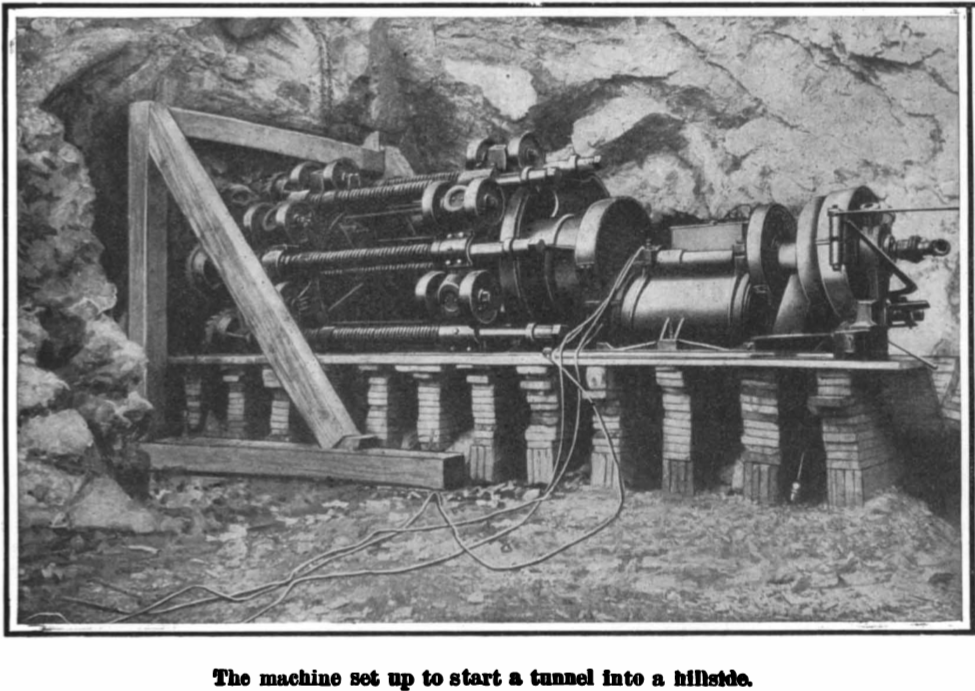
The Sigafoos Tunneling Machine, 1909


At this point, I'd imagine most of our regular readers are getting fairly burned out on the Hyperloop. I more than sympathize. In terms of technology, infrastructure, transportation, and public policy, we've pretty much exhausted the topic.

The one area, however, where the Hyperloop remain somewhat relevant, is as an example of certain dangerous journalistic trends, such as the tendency to ignore red flags, warnings that there's something wrong with the story as being presented be it lies or faulty data were simply a fundamental misunderstanding.

This recent article from the Baltimore Sun provides a perfect case study [emphasis added]:
Maryland has given transportation pioneer Elon Musk permission to dig tunnels for the high-speed, underground transit system known as a hyperloop that Musk wants to build between New York and Washington.

Hogan administration officials said Thursday the state has issued a conditional utility permit to let Musk’s tunneling firm, The Boring Co., dig a 10.3-mile tunnel beneath the state-owned portion of the Baltimore-Washington Parkway, between the Baltimore city line and Maryland 175 in Hanover.
...

The Boring Co. aims to reduce traffic congestion by creating a low-cost, efficient system of tunnels. The company has developed tunneling machines it says will drill quickly through soft soils at a fraction of the cost of traditional tunneling.

 
Before we get to our main point, there are a few important but secondary issues we need to get out of the way.

When virtually every independent authority who weighed in lambasted Elon Musk for unrealistic cost estimates, those experts were talking about a much cheaper version of the Hyperloop. It is far more expensive to elevate a train than it is to build it on the ground, and it is far more expensive to build a train underground than it is to elevate it. Though there are other expenses associated with underground construction, an 80% or 90% reduction in tunneling costs might put the underground Hyperloop on a comparable budget with the elevated version, but that just gets you back to prohibitively expensive.

These points are important for context but this is not another what's-wrong-with-the-Hyperloop post. We've been over that a number of times and I don't have much to add. Besides, that was never really the important part of the story. The important part was the dysfunctional way we discuss this and other dubious technological and business proposals.

One of the major causes of this dysfunction is the willingness to downplay or even completely ignore massive warning signs. Take the claim (if in fact it was a claim, but more on that later) that Elon Musk has reduced tunneling costs by a factor of 5 to 10.

A bit more context. The dream of a cheap, fast tunneling machine has been something that the world's best engineering minds have actively pursued since the 19th century. The revolutionary potential of such a machine was obvious to everyone from the beginning. It could completely rewrite the rules of construction and infrastructure, and, in the process, make its developers fantastically wealthy.

Based on previous statements, I suspect that Elon Musk and his spokespersons didn't actually claim (as the article suggests) that they had a tunneling machine capable of this; they probably said something vague about being in the process of getting such a machine and left it to the journalists to fill in the details. Either way, we have two reasons to believe that the Boring company does not currently have this technology.

First, this is a mechanical engineering and materials science problem that has been intensely examined by the smartest people in the field for well over 100 years. It is not an easy nut to crack, and by his own account, Elon Musk and his team only came up on the problem recently and did so with no ideas on how to proceed. It beggars the imagination to think that a small and inexperienced group of researchers took a look at this extraordinarily difficult problem and immediately made a breakthrough.

It is even more difficult to imagine that Musk would let a piece of revolutionary technology easily worth tens of billions of dollars sit essentially unused in some Hawthorne storage building. It's as if he had announced that he had developed cold fusion, but wasn't going to do anything with it until the next Tesla model came out.

Put bluntly, the only reasonable conclusions are that the article misstated a claim, or the claim was faults. It is the job of journalists to spot these red flags and follow up. The failure to do so is proving increasingly costly, not just in technology reporting, but in business, public policy, and politics


UPDATE:  I wish I would have seen this analysis by Alon Levy before I wrote this post. Levy goes through Musk's proposal and finds it even more flawed than I realized.

In short, Musk,

a) has little understanding of the drivers of tunneling costs,
b) promises reducing tunneling costs by a factor of 10, a feat that he himself has no chance to achieve, and
c) is unaware that the cost reduction he promises, relative to American construction costs, has already been achieved in a number of countries.

Wednesday, November 8, 2017

The Sigafoos Tunneling Machine


With all this discussion of hyperloops and tunneling technology, I thought this would provide some interesting context (and an excuse to post a couple of cool pictures). I found the last paragraph particularly interesting. Notice how even more than a hundred years ago, people recognized the tremendous potential of fast, cheap tunneling.


Like the poor, new ideas for tunneling through rock and doing away with drilling and powder and dangerous blasting, are forever with us. Since 1853 there have been no less than sixty-nine patents granted on tunneling machines, and of this number but three have progressed beyond the blue-print stage. One was constructed and used with some slight success in the East, but owing to lack of funds or disputes among its builders, all progress was stopped. The second was built in Colorado, and at the present time is installed in a tunnel near Boulder. This machine does the work claimed for it, but the cutting is very irregular, numerous breakdowns are constantly happening, and in the course of over six months the machine has penetrated but a few hundred feet.

The third machine, here illus­trated, was invented by Mr. Sigafoos, of Denver, long associated with many eastern manufacturers until of late, when he turned his mind and labor toward western mining fields. Mr. Sigafoos built his first model three years ago, and until the present day it is on exhibition in his offices. Even this little working model, barely two feet long, has eaten through solid granite quite as easily and determinedly as a hungry earthworm.

Early in January of this year the first regular-sized machine was constructed in the East and shipped complete to Georgetown, Col., where the first contract was let and its behavior eagerly watched. The utmost secrecy was observed, for the first trial, and the author was extremely fortunate in being allowed to witness the test. In every instance the rotary proved its value, and came up to the highest expectations. Mr. Sigafoos stands ready to take contracts with his machine, in any and all rock, and will guarantee to cut five feet an hour, twenty-four hours a day.
...

It may not be amiss to state that the famous Moffat road will probably use these large rotaries in cutting its great tunnel through the mountains. In places today where the road ascends and descends mountains, it is expected within a short time to eventually bore through them, cutting down the time from coast to coast fully twenty-four hours. The contractors, before learning of the new machine, allowed ten years for the completion of this gigantic undertaking; but today, with a sufficient number of tunnel rotaries at work, two years will not be an impractical limit. The immediate uses to which this machine can be put to work are innumerable. Subways that formerly took five years to construct can now be run for half the expense in one-tenth the time. Water in unlimited quantities can be brought through the mountain walls, and the vast arid areas of the deserts will be made to blossom as a wonderful garden. If the claims made for it continue to be substantiated in practice, Mr. Sigafoos may well be considered a world's benefactor in giving us this marvelous rotary tunnel machine. 


Repost -- we're letting this one stand


Thursday, March 2, 2017

There will be safe seats. There are no safe seats.

In 2017, we have a perfect example of when not to use static thinking and naïve extrapolation.

Not only are things changing rapidly, but, more importantly, there are a large number of entirely plausible scenarios that would radically reshape the political landscape and would undoubtedly interact in unpredictable ways. This is not "what if the ax falls?" speculation; if anything, have gotten to the point where the probability of at least one of these cataclysmic shifts happening is greater than the probability of none. And while we can't productively speculate on exactly how things will play out, we can say that the risks fall disproportionately on the Republicans.

Somewhat paradoxically, chaos and uncertainty can make certain strategic decisions easier. Under more normal (i.e. stable) circumstances it makes sense to expend little or no resources on unwinnable fights (or, conversely,  to spend considerable time and effort deciding what's winnable). The very concept of "unwinnable," however, is based on a whole string of assumptions, many of which we cannot make under the present conditions.

The optimal strategy under the circumstances for the Democrats is to field viable candidates for, if possible, every major 2018 race. This is based on the assumption not that every seat is winnable, but that no one can, at this point, say with a high level of confidence what the winnable seats are.

Tuesday, November 7, 2017

Jet packs and Martian reality shows – – there's no penalty for tech writers getting the future wrong

About five or six years ago, there was an article by a tech journalist listing 10 technologies that would disappear completely before his newborn son turned five, things like phone numbers. I'll need to go back and check, but I believe he is 0 for 5. The article was obviously silly even at the time, but it got a fair amount of play and, I'm certain, was a nice career boost for the author.

Even in an age of accountability-free journalism, "here's what the future's going to be like" may well be the genre most re-of potential penalties. Going back and calling out those who got things badly wrong is a small step, but it is at least a start.


Monday, October 4, 2010

The cusp of coolness

One of the most popular genres of science writing since at least the age of Edison has been the "cusp of coolness" story, where the writer breathlessly tells us how some futuristic development is about to revolutionize our lives.

Here's the latest entry:
Although it may sound more sci-fi than sci-fact, a commercially developed jetpack is actually being eyed for mass production, with plans to eventually release it to the public. Let that sink in for a second. Jetpacks are real, and you might be able to buy one someday soon. Or at least see them among the skies.
I don't think we'll need the full second since jet packs have been around for between fifty and seventy years and you've been able to buy them for much of that time. The Germans had a prototype in WWII (Not surprisingly, Wikipedia has an excellent write-up on the subject). By the mid-Sixties they were flying over the World's Fair and showing up in Bond movies (yes, that was an actual Bell Rocket Belt).

But despite consuming countless man-hours and numerous fortunes (and prompting at least one kidnapping*) over what is now more than half a century, progress has been glacial. Jet packs are and will probably remain one of the worst under-performing technologies of the post-war era.

"Cusp of coolness" stories are annoying but they can also be dangerous. They give a distorted impression of how technological development works. Columnists and op-ed writers like John Tierney (whose grasp of science is not strong) come away with the idea that R&D is like a big vending machine -- deposit your money and promptly get what you asked for.

It's OK when this naive attitude convinces them to clear out space in their garages for jet packs. It's dangerous when it leads them to write editorials claiming that the easiest way to handle global warming is by building giant artificial volcanoes.


*from Wikipedia:
In 1992, one-time insurance salesman and entrepreneur Brad Barker formed a company to build a rockeltbelt with two partners: Joe Wright, a businessman based in Houston, and Larry Stanley, an engineer who owned an oil well in Texas. By 1994, they had a working prototype they called the Rocketbelt-2000, or RB-2000. They even asked [Bill] Suitor to fly it for them. But the partnership soon broke down. First Stanley accused Barker of defrauding the company. Then Barker attacked Stanley and went into hiding, taking the RB-2000 with him. Police investigators questioned Barker but released him after three days. The following year Stanley took Barker to court to recover lost earnings. The judge awarded Stanley sole ownership of the RB-2000 and over $10m in costs and damages. When Barker refused to pay up, Stanley kidnapped him, tied him up and held him captive in a box disguised as a SCUBA-tank container. After eight days Barker managed to escape. Police arrested Stanley and in 2002 he was sentenced to life in prison, since reduced to eight years. The rocketbelt has never been found.

Monday, November 6, 2017

Partisan vs. Ideological

This post (America is facing an epistemic crisis) by David Roberts has been getting a fair amount of attention. Most of the main points are already familiar to readers of Josh Marshall and Jonathan Chait, but they're important and bear repeating. Unfortunately Roberts treats “partisan” and “conservative” more or less interchangeably. As we covered in this piece from 2015, that's a really bad idea when discussing Fox News.


Let's see how many people I can piss off with this one: Fox News is not all that conservative

Feel free to post angry comments but please make sure to read a few paragraphs first. What follows is by no stretch of the imagination a defense of Fox News; rather it is an appeal for more precise language when we discuss it.

In his recent paper on Fox news, Bruce Bartlett made an important distinction between ideological and partisan. These two concepts, while closely related, are quite different and yet people conflate them all the time and, as a result, most discussions of press bias don't make a lot of sense.
Political scientist Jonathan Bernstein: “It’s a real mistake to call Fox a conservative channel. It’s not. It’s a partisan channel…. To begin with, bluntly, Fox is part of the Republican Party. American political parties are made up of both formal organizations (such as the RNC) and informal networks. Fox News Channel, then, is properly understood as part of the expanded Republican Party.”
Ideologues support positions that align most closely with their belief system. Partisans support positions that they see as furthering the interest of their party. I'd argue that when we talk about "liberals" in the media we are almost always referring to ideological positions while when we refer to "conservatives" in the media we are generally referring to partisan positions. The Tea Party muddies the question somewhat but we're going to put that aside for the moment.

I realize there is a lot of gray area here, but, just as a thought experiment, try thinking about Fox News stories in relation to three continuous variables:

Emphasis ;

Ideology;

Partisanship.

If you tune in regularly to Fox News, you will see a lots of stories with significant partisan and ideological components like marriage equality (which though a losing issue nationwide is still useful for energizing the base). You will also see a lot of stories like Benghazi with little apparent ideological components but with huge partisan ones. What you will very seldom see is a story in heavy rotation without a partisan component.

This Ideology vs, Partisanship distinction is particularly notable when a relatively conservative idea is adopted by a Democratic president and suddenly becomes unacceptable. In 2008, you could see cinservative pundits talking up Mitt Romney and listing his healthcare plan as a major selling point.

Coming from the Bible Belt (where Fox is enormously influential), there are a few other examples that strike me as particularly dramatic. Historically, there are few things that evangelicals hate more than Mormonism, Catholicism and the standard celebration of Christmas.

[Courtesy of Joe Bob Briggs]


From a partisan standpoint, there are huge advantages to building denominational unity and to using Santa and Rudolph to attack "political correctness," and that is consistently the approach Fox and conservative media in general have taken despite the ideological concerns of the audience. [There's another big story here about the way the center of power shifted in the conservative movement, but that's a tale for another campfire.]

It is easy to conflate ideology and partisanship -- they often overlap and there is a great deal of collinearity -- but confusing them can lead to bad analysis, particularly when discussing journalistic bias and balance.

Friday, November 3, 2017

Remembering the future

Arthur C Clarke was one of the most interesting, and yet also representative, of the mid to late 20th century futurists. In the 50s and 60s, he was remarkably prescient both about the direction of technology and its impact on society over the range of 25 or 30 years into the future. Beyond that, however, his track record is simply bad.

If this was just a question Clarke's limitations, it would not be a topic worth discussing, but I think his failed prophecies are indicative of something larger. As mentioned before, I've been working on a couple of essays on the way we think about technology and future. The central thesis of the first is that the extraordinary spikes of innovation and resulting social change that occurred in the late 19th and early 20th centuries and, to a lesser extent, in the postwar era shaped and, in a sense, distorted our perception of the future.

The following passage from Clarke perfectly captures this mindset. His statements about the impossibility of predicting the future while sounding at all reasonable were accurate when he said them and had been even more so 70 or 80 years earlier. From the perspective of the mid-1880s, the world of 20 or 30 years into the future was genuinely difficult to imagine. It was difficult not to be overly conservative. Clarke assumed that the rate of acceleration of technological and resulting social change would not only hold but would actually increase. "Inevitably" he said, which in retrospect seems a little foolish and more than a little sad.


Trying to predict the future is a discouraging and hazardous occupation because the prophet invariably falls between two stools. If his predictions sound at all reasonable, you can be quite sure that within 20 or, at most, 50 years, the progress of science and technology has made him seem ridiculously conservative. On the other hand, if by some miracle a prophet could describe the future exactly as it was going to take place, his predictions would sound so absurd, so far-fetched, that everybody would laugh him to scorn. This has proved to be true in the past, and it will inevitably be true, even more so, of the century to come.

The only thing we can be sure of about the future is that it will be absolutely fantastic.

So, if what I say to you now seems to be very reasonable, then I'll have failed completely. Only if what I tell you appears absolutely unbelievable, have we any chance of visualizing the future as it really will happen.


Thursday, November 2, 2017

Russians, Straussians, soft landings, and hamburger emojis

Since February, we've been discussing the curiously stable dynamic that keeps the GOP aligned with Trump even as his poll numbers slip. We've also argued that, at this point in time, this alliance holds the danger of an extraordinarily hard landing for the party. At the risk of overextending the metaphor, the Republicans are desperately hoping for a soft landing but are, at the same time, doing everything they can to maintain altitude.
As many have observed, the GOP of the 70s was able to minimize the long-term damage of Watergate by distancing themselves from Nixon and very publicly refusing to impede the investigation. The response of the party now has been just the opposite. It is as if the Republicans had responded to Watergate by doubling down their defense of Nixon, insisting there was nothing to the accusations, and calling for hearings into the crimes of McGovern, Humphrey, and LBJ.

Obviously, the decision to go all in on Trump is partially motivated by a desire to achieve as many policy goals as possible while still firmly in control of all three branches of government, but there's another factor which might be as large and which is possibly doing even more to eliminate the possibility of a soft landing.


.

If some poli-sci PhD candidate out there is looking for a thesis topic, you could do worse than the breakdown of Straussian communication matrices, or as I've put it, "drinking from the wrong pipe." The conservative movement was essentially a three-legged stool built on money, prioritizing strategic offices and elections, and misinformation. This last one was arguably the most important; it is also the one that has proven the least stable.

The initial purpose of this "noble lie" approach was to use the propaganda to keep the base sending money and showing up for the polls through of a combination of rage and fear. As with all Straussian systems, it was assumed that those in power would be in on the joke while the people who believed the lies would simply serve as electoral cannon fodder.

At some point though (I suspect inevitably), a couple of things happen. First, the believers become leaders. This is become blindingly obvious with Trump, but the children of Fox News have been in control of the party since at least 2010 and the roots go back further. Remember how Dick Cheney insisted while traveling that all hotel televisions be tuned to Fox News?

The second, and possibly more dangerous problem is that a propaganda-fed base has no capacity to self correct, rather it continues follow unsustainable paths that only gain momentum, often exacerbated by ratcheting mechanisms. Soon you reach a point where, even if the leaders accurately perceive the situation and realized the best solution, they can no longer reconcile that reasonable course of action with what the vast majority of their supporters have been told to believe for decades.

One of the essential steps for achieving a soft landing is getting your core supporters to face just how dire the situation is. Fox News et al., however, has simply lost the capacity to do this.

Wednesday, November 1, 2017

We won't even get into ghosts of Mars

I've been going through old Scientific Americans gathering material for that essay on attitudes toward technology. This letter from 1908 discussing plan to signal martian civilizations caught my eye. I did a bit more digging and found the original article.

As we've mentioned before, the end of the 19th Century and the beginning of the 20th was a period when people displayed a stunning flexibility, open-mindedness and in some cases, gullibility. We tend to focus on the naysayers who got it wrong ("Man will never fly." and company), but I'm coming to the conclusion that it was far more an age of belief than skepticism, whether it was a question of technological marvels or ghosts or men from Mars.


Tuesday, October 31, 2017

Rasputian Causality


There's an exaggerated (but not all that exaggerated) account of the death of Rasputin that goes something like this: the controversial monk was, within the space of a few hours, poisoned, shot, bludgeoned, shot again, and then dumped into an icy Russian River where he drowned.

If we were to accept this account, we would have to say that the cause of death was drowning, but even if he had never been thrown in the water, he almost certainly would have died at roughly the same time from the poison or the gunshot wounds or the blows to his head.

More generally, this is an example of a causal relationship where removing the cause does not change the outcome. There are real-world implications to this idea. When we try to apply causal reasoning to practical problems like determining public policy, we almost always do so under the assumption that manipulating causes will change outcomes. That's not always true.

At the other end of the spectrum we have the case of multiple necessary conditions. This was very much the case in the 2016 election and something that most of the attempts at analysis wrong. Almost every piece you read with the headline "________ caused Trump to win" is fundamentally flawed. We almost certainly have here the opposite of the murder of Rasputin. We have a list of factors the removal of any one of which would have changed the outcome. We can debate exactly what goes on the list, but there's not much question that it includes Russian election hacking, conservative media misinformation, mainstream media false balance (particularly and perhaps primarily from the New York Times), irresponsible behavior from the FBI, and voter suppression. In terms of culpability, everyone responsible for any item on that list is responsible for what's happening to the country now and will continue to happen for the next few years.

Or, in other words, there's plenty of blame to go around.

While we're on the subject, there's this really weird movie from 1980.

Monday, October 30, 2017

Richard Thaler and 401(k) contribution limits

This is Joseph

Richard Thaler is narrowly correct in that reducing contribution limits to 401(k) accounts would be progressive.  Duncan Black points out that the implicit trade-off here is is with the estate tax, and not with something like Children's Health (look at the delays in funding CHIP).  Clearly the estate tax is much more progressive than the 401(k) contribution limit and has the desirable property of preventing wealth concentration.

So it is all about the net changes in policy.  If the 401(k) contribution limit was reduced to fund an increase in social security payments (focused on those with lowest benefits) then it would be a very progressive change in policy.  If it funded another worthy program that could also be a decent trade.

But any plan that has room to potentially eliminate the estate tax is hardly progressive, on net, and should be viewed with appropriate skepticism.

Friday, October 27, 2017

The TV movie Hyperloop may have looked cheesy, but at least you could stand up and walk around.

In 1973, Gene Roddenberry attempted to launch a post-apocalyptic science fiction series in the Buck Rogers vein largely built around a subterranean Hyperloop (actually more of a "Hyperloop," but let's not get picky). In the show, the system had been up and running by 1979, meaning we are running way behind.

From Wikipedia:

An elaborate "Subshuttle" subterranean rapid transit system was constructed during the 1970s, due to the vulnerability of air transportation to attack. The Subshuttles utilized a magnetic levitation rail system. They operated inside vactrain tunnels and ran at hundreds of miles per hour. The tunnel network was comprehensive enough to cover the entire globe. The PAX organization inherited the still-working system and used it to dispatch their teams of troubleshooters.


Thursday, October 26, 2017

Tax Policy

This is Joseph

I am mostly out for a few weeks, but this is a very interesting piece:
Three or four decades later, scholars are able to look at the fruits of those policies and draw some conclusions. The same main technologies that exist in the United States and United Kingdom are also in use in Germany and Sweden. Those countries are also exposed to the forces of global trade and immigration. But inequality has grown much more sharply in the US and UK than it has in Germany and Sweden. And the main reason seems to be taxes.
and
Lower taxes on the rich straightforwardly engender inequality by giving rich people more money. But they also shift incentives. In the old days of 70 or even 90 percent marginal tax rates, it wouldn’t make much sense for executives to expend enormous amounts of time and energy trying to maximize the amount of money they can personally extract from a company in the form of salary. Instead, you might chase social prestige or other goals. And last but by no means least, tax cuts on investment income increase the extent to which wealth can mechanically beget more wealth as financial assets inherited from or gifted by parents simply earn their natural rate of return over time. 
I think that this gets at one of the key things we forget about economies, that there is not a natural or true economy that would function without interference (or at least nothing that would look like a modern economy).  Instead there are a series of choices that we make about how to distribute resources and create incentives. 

Now there is a moral argument about taxes being a taking.  But it is utterly unclear that you can have ultra-rich people without a strong state to defend them (the classical era and modern approach) or these individuals setting themselves up as warlords (the medieval approach).  That seems to also create a moral obligation for the the rich to contribute to supporting the society that makes their wealth possible.

It would be good to consider these issues more globally when discussing tax reform -- cuts to medicare to create tax cuts for top income earners really needs to be called out as a form of increasing inequality and not as a strategy for growth. 

Wednesday, October 25, 2017

I just realized we've been at this for at least six years.

Every year or two, some attention-hungry politician realizes they can get puff-peace coverage by pulling themselves up as the taxpayers friend, and derisively pointing out some government research project with an odd sounding name. The ultimate interview whore, William Proxmire, set the mold but he's had a steady stream of imitators ever since.

Of course, Proxmire left office, just as the conservative movement was beginning to aggressively undermine faith in government and libertarian billionaires were starting to set up pseudo-think tanks to provide, if not an intellectual framework, then at least a veneer of respectability. When the Golden Fleece awards started in 1975, it is difficult to imagine a witness denying the very idea that public research can have economic value. In 2017, it's almost expected.


Paul made his case for the bill yesterday as chairperson of a Senate panel with oversight over federal spending. The hearing, titled “Broken Beakers: Federal Support for Research,” was a platform for Paul’s claim that there’s a lot of “silly research” the government has no business funding. Paul poked fun at several grants funded by NSF—a time-honored practice going back at least 40 years, to Senator William Proxmire (D–WI) and his “Golden Fleece” awards—and complained that the problem is not “how does this happen, but why does it continue to happen?”

Paul’s proposed solution starts with adding two members who have no vested interest in the proposed research to every federal panel that reviews grant applications. One would be an “expert … in a field unrelated to the research” being proposed, according to the bill. Their presence, Paul explained, would add an independent voice capable of judging which fields are most worthy of funding. The second addition would be a “taxpayer advocate,” someone who Paul says can weigh the value of the research to society.

...

Two of the witnesses—Brian Nosek of the University of Virginia in Charlottesville and Rebecca Cunningham of the University of Michigan in Ann Arbor—were generally supportive of the status quo, although Nosek emphasized the importance of replicating findings to maximize federal investments. The third witness, Terence Kealey of the Cato Institute in Washington, D.C., asserted that there’s no evidence that publicly funded research makes any contribution to economic development.


If you're up for more of the same, here's the related post we ran back in 2011.


Thursday, September 8, 2011

Earmarks and Agricultural Research

Sometimes the press isn't good at connecting stories, particularly when those stories don't match up with the journalists' rather constrained world-view. One of the most reliable examples is the coverage of earmarks. The very fact that earmarks are reported as budget stories is troubling, showing how easily reporters can be manipulated into wasting time on trivia, but as bad as these stories are on a general level, the specifics may be even worse.

Like so many bad trends in journalism, the archetypal example comes from Maureen Dowd, this time in a McCain puff piece from 2009. Here's the complete list of offending earmarks singled out by the senator and dutifully repeated by Dowd:

Before the Senate resoundingly defeated a McCain amendment on Tuesday that would have shorn 9,000 earmarks worth $7.7 billion from the $410 billion spending bill, the Arizona senator twittered lists of offensive bipartisan pork, including:

• $2.1 million for the Center for Grape Genetics in New York. “quick peel me a grape,” McCain twittered.

• $1.7 million for a honey bee factory in Weslaco, Tex.

• $1.7 million for pig odor research in Iowa.

• $1 million for Mormon cricket control in Utah. “Is that the species of cricket or a game played by the brits?” McCain tweeted.

• $819,000 for catfish genetics research in Alabama.

• $650,000 for beaver management in North Carolina and Mississippi.

• $951,500 for Sustainable Las Vegas. (McCain, a devotee of Vegas and gambling, must really be against earmarks if he doesn’t want to “sustain” Vegas.)

• $2 million “for the promotion of astronomy” in Hawaii, as McCain twittered, “because nothing says new jobs for average Americans like investing in astronomy.”

• $167,000 for the Autry National Center for the American West in Los Angeles. “Hopefully for a Back in the Saddle Again exhibit,” McCain tweeted sarcastically.

• $238,000 for the Polynesian Voyaging Society in Hawaii. “During these tough economic times with Americans out of work,” McCain twittered.

• $200,000 for a tattoo removal violence outreach program to help gang members or others shed visible signs of their past. “REALLY?” McCain twittered.

• $209,000 to improve blueberry production and efficiency in Georgia.
Putting aside the relatively minuscule amounts of money involved here, the thing that jumps out about this list is that out of 9,000 earmarks, how few real losers McCain's staff was able to come up with. I wouldn't give the Autry top priority for federal money, but they've done some good work and I assume the same holds for the Polynesian Voyaging Society. Along the same lines, I have trouble getting that upset public monies spent on astronomical research. After that, McCain's selections become truly bizarre. Urban water usage is a huge issue, nowhere more important than in Western cities like Los Vegas and it's difficult to imagine anyone objecting to a program that actually gets kids out of gangs.

Of course, we have no way of knowing how effective these programs are, but questions of effectiveness are notably absent from McCain/Dowd's piece. Instead it functions solely on the level of mocking the stated purposes of the projects, which brings us to one of the most interesting and for me, damning, aspects of the list: the preponderance of agricultural research.

You could make a damned good case for agricultural research having had a bigger impact on the world and its economy over the past fifty years than research in any other field. That research continues to pay extraordinary dividends both in new production and in the control of pest and diseases. It also helps us address the substantial environmental issues that have come with industrial agriculture.

As I said before, this earmark coverage with an emphasis on agriculture is a recurring event. I remember Howard Kurtz getting all giggly over earmarks for research on dealing with waste from pig farms about ten years ago and I've lost count of the examples since then.

And interspaced between those stories at odd intervals were other reports, less flashy but far more substantial, describing some economic, environmental or public health crisis that reminded us of the need for just this kind of research. Sometimes the crisis is in one of the areas explicitly mocked (look up the impact of industrial pig farming on rural America* and see if you share Mr. Kurtz's sense of humor). Other times the specifics change, a different crop, a new pestilence, but still well within the type that writers like Dowd find so amusing.

Here's the most recent example:
Across North America, a tiny, invasive insect is threatening some eight billion trees. The emerald ash borer is deadly to ash trees. It first turned up in Detroit nine years ago, probably after arriving on a cargo ship from Asia. And since then, the ash borer has devastated forests in the upper Midwest and beyond.
* Credit where credit is due. Though not as influential as Dowd, the New York Times also runs Nicholas Kristof who has done some excellent work describing the human cost of these crises.

Tuesday, October 24, 2017

When we say the Mars/Tesla connection goes way back, we mean way back


[No, not that Tesla, this Tesla.]

I was meaning to run something topical today (probably something that will run later in the week), but for now, here's another trip through the Scientific American archives.


If the following consists of an old painting from Galaxy Magazine, you'll know I didn't finish today's post


From June, 1951

Monday, October 23, 2017

Baum miscellanea

A few weeks ago, while working on a blog post (I don't remember which one) something (I don't remember what) brought to mind a detail from an Oz book. As has become more or less a compulsion with me, I looked up the specifics which inevitably led to a random Wikipedia walk, in this case through the articles on L Frank Baum. Here are a few bits of trivia that struck me as worth sharing and/or filing away for future reference.

For starters, there's this sly bit of gilded age satire from the Sea Fairies (1911):
"Let's go," said Trot.  "I don't like to 'sociate with octopuses."
"OctoPI," said the creature, again correcting her.
"You're jus' as horrid whether you're puses or pies," she declared.
"Horrid!" cried the monster in a shocked tone of voice.
"Not only horrid, but horrible!" persisted the girl.
"May I ask in what way?" he inquired, and it was easy to see he was offended.
"Why, ev'rybody knows that octopuses are jus' wicked an' deceitful," she said.  "Up on the earth, where I live, we call the Stannerd Oil Company an octopus, an' the Coal Trust an octopus, an'--"
"Stop, stop!" cried the monster in a pleading voice.  "Do you mean to tell me that the earth people whom I have always respected compare me to the Stannerd Oil Company?"
"Yes," said Trot positively.
"Oh, what a disgrace!  What a cruel, direful, dreadful disgrace!" moaned the Octopus, drooping his head in shame, and Trot could see great tears falling down his cheeks.
"This comes of having a bad name," said the Queen gently, for she was moved by the monster's grief.
"It is unjust!  It is cruel and unjust!" sobbed the creature mournfully.  "Just because we have several long arms and take whatever we can reach, they accuse us of being like--like--oh, I cannot say it! It is
too shameful, too humiliating."
"Come, let's go," said Trot again.  So they left the poor octopus weeping and wiping his watery eyes with his handkerchief and swam on their way. 


This description of what we might now call a multimedia show from 1908 demonstrates that the desire for cutting-edge sounding names goes back a long time.


The films were colored (credited as "illuminations") by Duval Frères of Paris, in a process known as "Radio-Play", and were noted for being the most lifelike hand-tinted imagery of the time. Baum once claimed in an interview that a "Michael Radio" was a Frenchman who colored the films, though no evidence of such a person, even with the more proper French spelling "Michel", as second-hand reports unsurprisingly revise it, has been documented. It did not refer to the contemporary concept of radio (or, for that matter, a radio play), but played on notions of the new and fantastic at the time, similar to the way "high-tech" or sometimes "cyber" would be used later in the century. The "Fairylogue" part of the title was to liken it to a travelogue, which at the time was a very popular type of documentary film entertainment.


We even have a genuinely disturbing example of what we would now call body horror from the 1912 sequel to the Sea Fairies.
Sky Island is another split-color country in Baum's fantasy universe, like the Land of Oz. Divided in two-halves, blue and pink, Sky Island supports two separate races of beings, the Blues and the Pinkies. The two halves are separated by a region shrouded in fog, which both peoples are reluctant to enter. The three travellers land on the blue side of Sky Island, which is a grim country ruled by a sadistic tyrant, the Boolooroo of the Blues. In Sky Island, as in Oz, no one can be killed or suffer pain, but that doesn't mean one is safe: the Boolooroo's method of punishing disobedience in his subjects is to slice two of his victims into halves using a huge guillotine-type knife, and then join the wrong halves back together, creating very unhappy asymmetrical mixed people. This is called "patching."

I was about to add a final section on the 1901 fantasy science fiction novel, the Master Key, but I think that one deserves a post to itself.

Friday, October 20, 2017

When I said retro-TV...

This guy actually made a version of a 19th century television by fashioning an old vinyl LP into a Nipkow disk


This one works a little better.


Thursday, October 19, 2017

The content bubble -- when reality sinks in

[Couple of small edits. Fixed title and added a link I'd forgotten.]

Quick refresher, the content bubble  refers to the explosion in scripted series being produced for various channels, services and platforms. We've spent a lot of time on the drivers of the bubble and the economics of why it's not sustainable, but probably not enough on the reactions of people on the inside.

Ken Levine (who either wrote, directed or produced about half of the sitcoms you aren't ashamed to mention knowing) recently made the following observation in a post about the experience of working on a show that had just hit big. [emphasis added]

How many shows today are produced and aired in relative obscurity? And it takes the same amount of time and effort to produce a show only relatives watch on a network no one has ever heard of than to produce THIS IS US.

Even the first year of CHEERS, when we THOUGHT no one was watching, we averaged 20 million people a week. The show was slowly starting to catch on to where we thought we were an underground hit. 20 million viewers was considered “under the radar” back then. Now the landscape has become so fractured that certain shows on certain platforms shown nationally are seen by 100,000 people. I don’t understand the economics. How can they afford to shell out millions for shows that get way fewer views than cats coughing up fur balls on YouTube?


I suspect in most bubbles, there comes a point when the conflict between the desire to believe and the cold, hard, inescapable numbers becomes so pronounced that the consensus of smart sensible people in the field becomes "this just can't go on much longer." In this case, the realization is sinking in that the handful of winners can't possibly begin to balance out the huge number of losers (particularly when you factor in the rapid growth in PR costs).

Just to be clear, Levine's role in is not analogous to that of an investor in a stock market bubble. He's more like one of the tradesmen who sells high-end goods to the suddenly cash rich investors. The talent behind and in front of the camera is currently benefiting from the bubble and will probably pay much of the consequences for the claps, but they are not the ones green lighting a remake of "One Day at a Time."

Wednesday, October 18, 2017

The New York Times has a self-congratulations problem.

This isn't exactly a new complaint (you can find similar charges going back to the 19th century), but the frequency seems to be on the rise while the gap between self-image and reality grows more notable. Today's example comes from Farhad Manjoo, who has belatedly decided to join the techno-anxiety craze.
A lot of these worries aren’t new. Though Silicon Valley runs on heedless optimism, much of The Times’s coverage has long been properly skeptical and critical of the implications of new tech. Consider the evil of “revenge porn,” or the rise in accidents caused by drivers looking at their phones. I’ve shared other fears: In 2008, I wrote a book predicting that the internet would lead us into a “post-fact” world.

For starters, lots of people were making similar points in 2008. If you're going to drop a self-reference that implies prescience, you'd better be able to show you were well ahead of the curve.

More importantly, there is absolutely no reason to single out the New York Times for its skepticism and critical attitude toward 21st Century tech. I've been writing about this for years now and here are just some of the news organizations that I've cited for doing more notable work along these lines:

The New Yorker, Vox, the LA Times, Gawker, the Washington Post, the Atlantic and Cracked

This is not to say that the NYT is horrible on this – – if anything, they are probably a bit above average – – but they certainly haven't done anything worth this kind of reflexive self-congratulation, and that tendency toward patting themselves on the back represents a much greater (and previously mentioned) problem.

The NYT has fully internalized the idea that, in all things, it is the world's best paper. This can make for an intolerably smug editorial voice, but, more to the point, it can undermine journalistic judgment, encourage childish behavior and make it almost impossible for the institution to face and correct its own problems.

The NYT's cozy relationship with Thiel and thinly veiled schadenfreude at the fate of Gawker may or may not have had something to do with the gadfly site's habit of pointing out the grey lady's lapses. The paper's decision to force an incredibly unsupportable framework of “balance” on the last election was certainly a major factor in and possibly a necessary condition for Trump's victory.

The New York Times has become HAL in 2001. It can't admit its own fallibility, and the evidence of its mistakes is driving it to make increasingly bad and dangerous choices.

Tuesday, October 17, 2017

Apropos of absolutely nothing (I mean, seriously, I can't think of a single 21st century example of this), here's an excerpt from the Big Con.

Not the Jonathan Chait book but the classic 1940 study of confidence games, particularly the "long con." It's the book that launched a thousand screenplays, most notably the Sting. I've been meaning to read this for years. It's not easy to find and I had looked for it in a number of libraries until finally giving up and putting it out of my mind. Recently, though, someone mentioned it in an email and I realized that if I couldn't find it in one of the four large library systems I have cards for in LA County, it probably couldn't be found anywhere.

After all this time, I half expected the book to be a letdown, but I've been very pleasantly surprised. One passage in particular jumped out at me:

From the Big Con by David W Maurer
Most marks come from the upper strata of society, which, in America, means that they have made, married, or inherited money. Because of this, they acquire status which in time they come to attribute to some inherent superiority, especially as regards matters of sound judgment in finance and investment. Friends and associates, themselves social climbers and sycophants, helped to maintain the solution of superiority. Eventually, the mark comes to regard himself as a person of vision and even of genius. Thus a Babbitt who has cleared half 1 million in a real estate development easily forgets the part which luck and chicanery have played in his financial rise; he accepts his mantle of respectability without question; he naïvely attributes his success to sound business judgment. And any confidence man will testify that a real-estate man is the fattest and juiciest of suckers.

Monday, October 16, 2017

Originally I was joking when I compared this to a hyperloop

But the more I think of it, the more serious the comparison becomes.

We are, after all, talking about another "marvelously impracticable" train, but reading through the description from this 1909 edition of Scientific American, it is difficult not to notice other similarities. Like the Hyperloop proposals, this turn-of-the-century air train (at least based on the account here) has the same odd combination of detail and vagueness, carefully spelling out parts of the system while largely passing over the obvious problem areas. There are also the same highly optimistic estimates about speed, capacity, and cost. In the case of the last, the proponents of the zeppelin train even rely on the same argument that elaborate elevated structures would more than pay for themselves through reduced land costs.

The zeppelin train does offer a few notable advantages over the Hyperloop. The passenger comfort is much greater, even including a rest room in each car. The ride would also be far more scenic than a ground level train, let alone a ride inside a metal tube. Perhaps most important of all (since we are comparing imaginary modes of transportation), the zeppelin train looks way, way cooler.


Friday, October 13, 2017

"How College Loans Got So Evil"

Warning to video viewers, thanks to the pivot to video, things are about to get really ugly really quickly. The trouble is that while the volume is going to increase sharply, the supply of people with the ability to make good videos is not going to increase significantly. that means the ratio of quality to crap is going to drop even further (and it's not like we're in double digits to start with).

To make matters worse, video viewing is more linear and less, for lack of a better word, interactive than reading. With text, you can skim, reread, jump around on the screen. All of this makes it easier to determine whether something is worth your time.

My advice (which I follow myself) is to stick with trusted referrals and proven content producers. Recommendation algorithms aren't very good now and they will only get worse as average quality drops.

Fortunately, even the most selective viewers can find enough to fill their time. I have a special fondness for what might be called the Daily Show kids, millennials who came of age wanting to be Jon Stewart or Stephen Colbert. Smart, funny, irreverent but socially conscious (sometimes lapsing into preachy). They also embrace Stewart's and Oliver's emphasis on solid research and often take it a step further (check out the corner of the screen in the video below).

This segment from Adam Conover is a good example of what happens when everything works: the topic is important; the information is clearly but entertainingly presented ; and the central conceit is skillfully executed and perfectly apt.


And if you do run out of video, trying reading something. That's what the young people are doing.

Thursday, October 12, 2017

You probably never thought of a hobbyist market for x-ray machines


Couple of points.

For starters, wow! I knew people were way too nonchalant about the potential dangers of radiation in the latter part of the 19th and early 20th centuries, but wow!

Second (and, yes, I know I've been hitting this point a lot), it is almost impossible to imagine how amazing and world-changing the technological innovations of this period were. Adults who picked up this copy of Scientific American in 1896 would probably remember the first time they saw a light bulb or a telephone or a moving picture. While being born in a horse-and-buggy age is an overused cliché, it is also very difficult to avoid. For these people, the world was not only suddenly invaded by incredible machines, strange sights, and even new foods, it was also permeated by invisible rays that could actually show you the inside of your body.

1896 was also the year that a fellow named Marconi got a patent on one of his inventions, but that's a story for another time.

Wednesday, October 11, 2017

Repost 3: The Republicans' 3 x 3 existential threat

[Given recent events and their accelerating pace, I think there’s a good chance in the next few days we’ll be discussing the implications of intraparty war in the GOP. In the meantime, I decided to bump our regularly scheduled programming (which, consisting of late 19th/early 20th century technology stories, was not particularly topical) and repost a thread we ran a while back on the dynamics of the relationship between Trump and the Republican Party. Obviously, there are things I would treat differently if writing these today, but I’m still willing to stand by the general points, and they should serve as a good starting point for the next conversation.]

From August 22, 2017.

I've argued previously that Donald Trump presents and existential threat to the Republican Party. I know this can sound overheated and perhaps even a bit crazy. There are few American institutions as long-standing and deeply entrenched as are the Democratic and Republican parties. Proposing that one of them might not be around 10 years from now beggars the imagination and if this story started and stopped with Donald Trump, it would be silly to suggest we were on the verge of  a political cataclysm.

But, just as Trump's rise did not occur in a vacuum, neither will his fall. We discussed earlier how Donald Trump has the power to drive a wedge between the Republican Party and a significant segment of its base [I wrote this before the departure of Steve Bannon. That may diminish Trump's ability to create this rift but I don't think it reduces the chances of the rift happening. – – M.P.]. This is the sort of thing that can profoundly damage a political party, possibly locking it into a minority status for a long time, but normally the wound would not be fatal. These, however, are not normal times.

The Republican Party of 2017 faces a unique combination of interrelated challenges, each of which is at a historic level and the combination of which would present an unprecedented threat to this or any US political party. The following list is not intended to be exhaustive, but it hits the main points.

The GOP currently has to deal with extraordinary political scandals, a stunningly unpopular agenda and daunting demographic trends. To keep things symmetric and easy to remember, let's break each one of these down to three components (keeping in mind that the list may change).


With the scandals:

1. Money – – Even with the most generous reading imaginable, there is no question that Trump has a decades long record of screwing people over, skirting the law, and dealing with disreputable and sometimes criminal elements. At least some of these dealings have been with the Russian mafia, oligarchs, and figures tied in with the Kremlin which leads us to…

2. The hacking of the election – – This one is also beyond dispute. It happened and it may have put Donald Trump into the White House. At this point, we have plenty of quid and plenty of quo; if Mueller can nail down pro, we will have a complete set.

3. And the cover-up – – As Josh Marshall and many others have pointed out, the phrase "it's not the crime; it's the cover-up" is almost never true. That said, coverups can provide tipping points and handholds for investigators, not to mention expanding the list of culprits.


With the agenda:

1. Health care – – By some standards the most unpopular major policy proposal in living memory that a party in power has invested so deeply in. Furthermore, the pushback against the initiative has essentially driven congressional Republicans into hiding from their own constituents for the past half year. As mentioned before, this has the potential to greatly undermine the relationship between GOP senators and representatives and the voters.

2. Tax cuts for the wealthy – – As said many times, Donald Trump has a gift for making the subtle plain, the plain obvious, and the obvious undeniable. In the past, Republicans were able to get a great deal of upward redistribution of the wealth past the voters through obfuscation and clever branding, but we have reached the point where simply calling something "tax reform" is no longer enough to sell tax proposals so regressive that even the majority of Republicans oppose them.

3. Immigration (subject to change) – – the race for third place in this list is fairly competitive (education seems to be coming up on the outside), but the administration's immigration policies (which are the direct result of decades of xenophobic propaganda from conservative media) have already done tremendous damage, caused great backlash, and are whitening the gap between the GOP and the Hispanic community, which leads us to…


Demographics:

As Lindsey Graham has observed, they simply are not making enough new old white men to keep the GOP's strategy going much longer, but the Trump era rebranding of the Republican Party only exacerbates the problems with women, young people, and pretty much anyone who isn't white.

Maybe I am missing a historical precedent here, but I can't think of another time that either the Democrats or the Republicans were this vulnerable on all three of these fronts. This does not mean that the party is doomed or even that, with the right breaks, it can't maintain a hold on some part of the government. What it does mean is that the institution is especially fragile at the moment. A mortal blow may not come, but we can no longer call it unthinkable.

Repost 2: The nuclear moose option

[Given recent events and their accelerating pace, I think there’s a good chance in the next few days we’ll be discussing the implications of intraparty war in the GOP. In the meantime, I decided to bump our regularly scheduled programming (which, consisting of late 19th/early 20th century technology stories, was not particularly topical) and repost a thread we ran a while back on the dynamics of the relationship between Trump and the Republican Party. Obviously, there are things I would treat differently if writing these today, but I’m still willing to stand by the general points, and they should serve as a good starting point for the next conversation.]

From July 28, 2017.

[Just to be clear, I am not claiming that any of the following is inevitable or even likely, but I do think it falls in the category of things to consider.]

We've been arguing for quite a while now that the conservative movement's social engineering experiment has achieved its considerable success over the past few decades at the cost of exposing the party to genuinely existential threats. I had meant to precede this post with a bit more foundation, but events seem to be accelerating and I need to get this down.

Political parties have survived major rifts before. We could find numerous notable examples for both Democrats and Republicans, and, in all of those cases, the wounds were real but temporary. However, these divisions, though bitter, took place in broad-based relatively healthy political parties, I would argue that the Republican Party of 2017, though nominally controlling most of the government, is perhaps uniquely fragile and cannot survive a nasty internal conflict.

Here is a scenario of how such a conflict can arise and grow into an existential threat. I won't say that it is probable, but I think each link in the chain is definitely plausible. This is certainly true for the first link since between the time I outlined the concatenation of events and the time I sat down to write this, the first one had already happened. (That's why this is something of a rush job.)

First, a bit of background from our game theory post back in February  (Charles Schumer predicted a break between Trump and the party in three or four months. I said a year of two. Perhaps we should have split the difference):


The relationship between the Trump/Bannon White House and the GOP legislature is perhaps uniquely suited for a textbook game theory analysis. In pretty much all previous cases,  relationships between presidents and Congress have been complicated by numerous factors other than naked self-interest--ideological, partisan, personal, cultural--but this time it's different. With a few isolated exceptions, there is no deeply held common ground between the White House and Capitol Hill. The current arrangement is strictly based on people getting things they care about in exchange for things they don't.

However, while the relationship is simple in those terms, it is dauntingly complex in terms of the pros and cons of staying versus going. If the Republicans stand with Trump, he will probably sign any piece of legislation that comes across his desk (with this White House, "probably" is always a necessary qualifier). This comes at the cost of losing their ability to distance themselves from and increasingly unpopular and scandal-ridden administration.

Some of that distance might be clawed back by public criticism of the president and by high-profile hearings, but those steps bring even greater risks. Trump has no interest in the GOP's legislative agenda, no loyalty to the party, and no particular affection for its leaders. Worse still, as Josh Marshall has frequently noted, Trump has the bully's instinctive tendency to go after the vulnerable. There is a limit to the damage he can inflict on the Democrats, but he is in a position to literally destroy the Republican Party.

We often hear this framed in terms of Trump supporters making trouble in the primaries, but that's pre-2016 thinking. This goes far deeper. In addition to a seemingly total lack of interpersonal, temperamental, and rhetorical constraints, Trump is highly popular with a large segment of the base. In the event of an intra-party war, some of this support would undoubtedly peel away, but a substantial portion would stay.

Keep in mind, all of this takes place in the context of a troubling demographic tide for the Republicans. Their strategic response to this has been to maximize turnout within the party while suppressing the vote on the other side. It has been a shrewd strategy but it leaves little margin for error.  Trump has the ability to drive a wedge between a significant chunk of the base and the GOP for at least the next few cycles, possibly enough to threaten the viability of the party.


With that in mind, consider the following possible developments:

1. Trump fires Reince Priebus. Keep in mind, the choice of Priebus was (probably accurately) seen as an early indicator that, for all of his outsider talk, Trump intended to run a partisan administration with close ties to the Republican establishment. The firing has to be seen as a weakening of that relationship;

2. After ever increasing harassment, Jeff Sessions jumps or is pushed out of the administration;

3. This, along with other transgressions, prompts Graham and a few other Republican senators to start actively pushing for investigations into and greater accountability from the White House;

4. The strongest remaining link between the administration and the GOP establishment, vice president Mike Pence, is finding it increasingly difficult to keep his skirts clean from the Russia scandals. He does his best to distance himself and, as a result, further marginalizes his role;

5. Further developments in the Russia scandal exacerbate existing tensions;

6. While Trump does have his loyalists and the number of Republicans willing to publicly attack him remains fairly small, the majority of the party starts to see the president as a dangerous liability and attempts to distance itself from him, whenever possible refusing to take sides;

7. Angry at the lack of loyalty and feeling pressure from the investigations, Trump escalates his attacks on the GOP;

8. (Any of the following)
a. Trump fires Mueller
b. Mueller or some other investigator uncovers a major criminal conspiracy involving Trump, his family, or his business
c. Polls start showing serious erosion in support for Trump and the GOP in the conservative base
d. Things just keep getting ugly

9. At some major events such as a large rally or even the state of the union address, Donald Trump announces that, in the tradition of Teddy Roosevelt, he has realized that both parties are hopelessly corrupt and the only way to drain the swamp is by starting a third-party. So it is his intention to run in 2020 as the candidate for the MAGA Party and to field candidates in every major statewide contest.


Now, I want to be careful about how we frame this. Trump forming a third party remains unlikely, but it would not that unlikely if we hit events 1 through 8 and, taken individually, none of these events seem all that improbable.

I should probably polish this post a bit more, but given the pace of things these days, you have to make your predictions as quickly as possible.

Repost 1: GOP Game Theory -- things are still different

From February 28, 2017.

 [Given recent events and their accelerating pace, I think there’s a good chance in the next few days we’ll be discussing the implications of intraparty war in the GOP. In the meantime, I decided to bump our regularly scheduled programming (which, consisting of late 19th/early 20th century technology stories, was not particularly topical) and repost a thread we ran a while back on the dynamics of the relationship between Trump and the Republican Party. Obviously, there are things I would treat differently if writing these today, but I’m still willing to stand by the general points, and they should serve as a good starting point for the next conversation.]


"It's probably better to have him inside the tent pissing out, than outside the tent pissing in."

    LBJ on FBI Director J. Edgar Hoover,


Let's start with a prediction:

Senate Minority Leader Charles Schumer (D-N.Y.) predicted on Tuesday that Republicans will split with President Trump within months unless the administration changes course.0
"My prediction is he keeps up on this path...within three, four months you're going to see a whole lot of Republicans breaking with him," Schumer said during an interview with ABC's "The View."
Schumer argued while most GOP lawmakers aren't yet willing to break publicly from the White House, they are privately having "real problems" with Trump's policies in his first month.

"A lot of the Republicans, they're mainstream people. ... They will feel they have no choice but to break with him," he said.
GOP leadership are largely dismissing any early signs of discord between Congress and the White House as they slowly try to make progress on an ambitious agenda.


Ed Kilgore, however, points out that Trump may not be as toxic as many people think:

So while it is hard to deny that Trump is amazingly unpopular for a new president, unless his approval ratings trend farther down the way even those of popular presidents typically do, his party may not suffer the kind of humiliation Democrats experienced in 2010. For all the shock Trump has consistently inspired with his behavior as president, there’s not much objective reason for Republican politicians to panic and begin abandoning him based on his current public standing. But in this as in so many other respects, we are talking about an unprecedented chief executive, so the collapse some in the media and the Democratic Party perceive as already underway could yet arrive.


The relationship between the Trump/Bannon White House and the GOP legislature is perhaps uniquely suited for a textbook game theory analysis. In pretty much all previous cases,  relationships between presidents and Congress have been complicated by numerous factors other than naked self-interest--ideological, partisan, personal, cultural--but this time it's different. With a few isolated exceptions, there is no deeply held common ground between the White House and Capitol Hill. The current arrangement is strictly based on people getting things they care about in exchange for things they don't.

However, while the relationship is simple in those terms, it is dauntingly complex in terms of the pros and cons of staying versus going. If the Republicans stand with Trump, he will probably sign any piece of legislation that comes across his desk (with this White House, "probably" is always a necessary qualifier). This comes at the cost of losing their ability to distance themselves from and increasingly unpopular and scandal-ridden administration.

Some of that distance might be clawed back by public criticism of the president and by high-profile hearings, but those steps bring even greater risks. Trump has no interest in the GOP's legislative agenda, no loyalty to the party, and no particular affection for its leaders. Worse still, as Josh Marshall has frequently noted, Trump has the bully's instinctive tendency to go after the vulnerable. There is a limit to the damage he can inflict on the Democrats, but he is in a position to literally destroy the Republican Party.

We often hear this framed in terms of Trump supporters making trouble in the primaries, but that's pre-2016 thinking. This goes far deeper. In addition to a seemingly total lack of interpersonal, temperamental, and rhetorical constraints, Trump is highly popular with a large segment of the base. In the event of an intra-party war, some of this support would undoubtedly peel away, but a substantial portion would stay.

Keep in mind, all of this takes place in the context of a troubling demographic tide for the Republicans. Their strategic response to this has been to maximize turnout within the party while suppressing the vote on the other side. It has been a shrewd strategy but it leaves little margin for error.  Trump has the ability to drive a wedge between a significant chunk of the base and the GOP for at least the next few cycles, possibly enough to threaten the viability of the party.

The closest analogy that comes to mind is the Democrats and Vietnam, but that was a rift in a big-tent loosely organized party. The 21st Century GOP is a small tent party that depends on discipline and entrenchment strategies. It's not clear that it would survive a civil war.

Given that, I suspect the next year or two will prove Schumer wrong. There is some evidence that the president's polling has stabilized, perhaps even rebounded a bit, but even if the numbers go back into free fall, Republicans in the House and the Senate will be extremely reluctant to break from Trump with anything more than isolated or cosmetic challenges.

This isn't just a question of not wanting Trump outside the tent pissing in; this is a question of not wanting Trump outside the tent tossing grenades. 

Tuesday, October 10, 2017

Questionable statistics alert – – Whole Foods Markets edition

From Yahoo finance:

High-end grocer Whole Foods is already poaching new customers from Walmart (WMT) and other competitors as the result of its new owner Amazon (AMZN) cutting prices, according to a report from Thasos Group, a data intelligence firm founded at MIT.

Beginning Aug. 28, Whole Foods, which had earned the nickname “Whole Paycheck,” slashed prices on some of its best-selling staple items, including avocados, bananas, organic brown eggs, Fuji and Gala apples, almond butter, and farm-raised salmon and tilapia.

Whole Foods immediately experienced a 17% increase in foot traffic year-over-year for the week beginning Aug. 28, the Thasos report found.

For the week ending Sunday, September 3, the weekly YoY change in foot traffic to Whole Foods peaked at 17%. On August 28, the daily YoY change in foot traffic peaked at 31%.

Of that foot traffic, new customers came primarily from Walmart, accounting for 24% of the new shoppers that week, while Kroger (KR) shoppers accounted for 16% and Costco customers for 15%.

Some of the Whole Foods’ other competitors also saw significant defections during that time. Nearly 10% of Trader Joe’s daily customers shopped at Whole Foods during the first week of price cuts, while 8% of Sprouts (SFM) and 3% of Target (TGT) customers did so.

Lots to unpack here, but in consideration of time constraints (both yours and mine), let's just focus on one aspect.

Possibly the most important and certainly the most underemphasized piece of context in the coverage of the acquisition is the size and distribution of Whole Foods Markets. This is a small player highly concentrated in a few areas (such as New York City, DC, San Francisco, and Los Angeles). These areas also tend to have a highly disproportionate representation of the people who write about and invest in business trends (which explains a lot about the coverage). These areas also (and this is important for this story) tend to have a disproportionately low number of Walmarts.

Because of its size and economic diversity, Los Angeles makes for an interesting case study (it also helps that I've been here for quite a while and have lived on both sides of the county). Keep in mind, when Angelenos talk about the town they are generally referring to the county and Los Angeles County has a land area of over 4000 square miles. There are a lot of good reasons for going from one side to the other, but picking up a few groceries is not among them.

If you know the town and you look at a map of LA Whole Foods Markets, it is immediately obvious that the stores are heavily concentrated in very upscale neighborhoods, particularly in the general vicinity of Santa Monica. Not only are you unlikely to find Walmarts in these neighborhoods; you are unlikely to find them anywhere in reasonable driving distance. Likewise, the parts of town are you are likely to find Walmarts have very few Whole Foods. It is also important to note that this relationship does not hold with Target stores, which have long done a remarkable job adapting their model to both sprawling suburbs and high density urban areas. Anywhere in LA will put you fairly close to a Target.

Obviously, there are exceptions (Austin comes to mind) and we would certainly expect some of the traffic from a WFM spike to come from regular Walmart shoppers, but any analysis that shows them making up the plurality must be viewed with suspicion, even more so when we consider the surprisingly low numbers for Target. These numbers are almost exactly the opposite of what we would expect.

I know what I'm about to say goes against everything you've been told, but when data and common sense diverge sharply, the first thing you should do is question the data. Yes, counterintuitive results can be the most interesting if true, but it is essential to remember that counterintuitive results are also far more likely to be untrue.

Monday, October 9, 2017

I'd heard that "hello" as a salutation was popularized by the telephone, so I looked at the Ngram viewer.


Now I'm going to be distracted every time I hear someone say 'hello' in a Western.