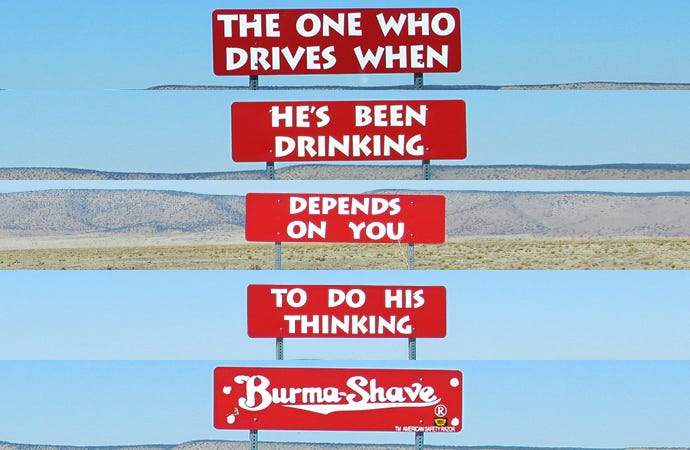
Andrew Gelman defines objects of the class “Foghorn Leghorn” as parodies that are well remembered while the people and things they were making fun of her long since forgotten. Someone analogous might be the class "Burma-Shave," long gone products that continue to hang around in the public imagination due to memorable advertising campaigns.
Burma-Shave sign series first appeared on U.S. Highway 65 near Lakeville, Minnesota, in 1926, and remained a major advertising component until 1963 in most of the contiguous United States. The first series read: Cheer up, face – the war is over! Burma-Shave.[2] The exceptions were Nevada (deemed to have insufficient road traffic), and Massachusetts (eliminated due to that state's high land rentals and roadside foliage). Typically, six consecutive small signs would be posted along the edge of highways, spaced for sequential reading by passing motorists. The last sign was almost always the name of the product. The signs were originally produced in two color combinations: red-and-white and orange-and-black, though the latter was eliminated after a few years. A special white-on-blue set of signs was developed for South Dakota, which restricted the color red on roadside signs to official warning notices.
This use of a series of small signs, each of which bore part of a commercial message, was a successful approach to highway advertising during the early years of highway travel, drawing the attention of passing motorists who were curious to learn the punchline.[3] As the Interstate system expanded in the late 1950s and vehicle speeds increased, it became more difficult to attract motorists' attention with small signs. When the company was acquired by Philip Morris, the signs were discontinued on advice of counsel.[4]
...
A number of films and television shows set between the 1920s and 1950s have used the Burma-Shave roadside billboards to help set the scene. Examples include Bonnie and Clyde, A River Runs Through It, The World's Fastest Indian, Stand By Me, Tom and Jerry, Rat Race, M*A*S*H and the pilot episode ("Genesis") of Quantum Leap. The long-running series Hee Haw borrowed the style for program bumpers, transitioning from one show segment to the next or to commercials.
The Flintstones episode "Divided We Sail" has Barney Rubble reading messages on a series of buoys that say, "If You're Queasy riding on the wave, just open your mouth. Shout Terra Firma Shave."
The final episode of the popular television series M*A*S*H featured a series of road signs in Korea "Hawk was gone, now he's here. Dance til dawn, give a cheer. Burma-Shave".
This verse is on display at the Smithsonian.

No comments:
Post a Comment