If this were happening with human beings, if a number of people were independently coming up with the same character name for a fictional character with remarkably similar traits and backstory, it would feel like the premise of a particularly creepy science fiction/horror story. In fact, it is remarkably similar to one of my favorite Doctor Who episodes with perhaps my favorite cliffhanger climax.
It’s not quite so inexplicable in the world of large language models, though it is an interesting and informative example. We will be coming back to this one.
From Who is Elara Voss?
by Max Read
There are, as of this writing, 62 books credited to an “Elara Voss” available on Amazon: ... What’s more, there are hundreds of books on Amazon and other self-publishing platforms that feature a character named “Elara Voss,” among them Veil of the Bloodwight Syndicate, Gynarchy’s Collar, and Starlight Nexus by Kylian Quinn:
...
What’s so odd about this is that--for a name now so common across the megaplatforms--before 2023, “Elara Voss” did not exist. There is no person named Elara Voss in the United States. No birth certificate has ever been issued under that name; if you search for it in public records databases, you’ll turn up no results. There aren’t even any characters named “Elara Voss” in any book published before 2023. Until two years ago, the two words didn’t ever appear next to each other even by accident.
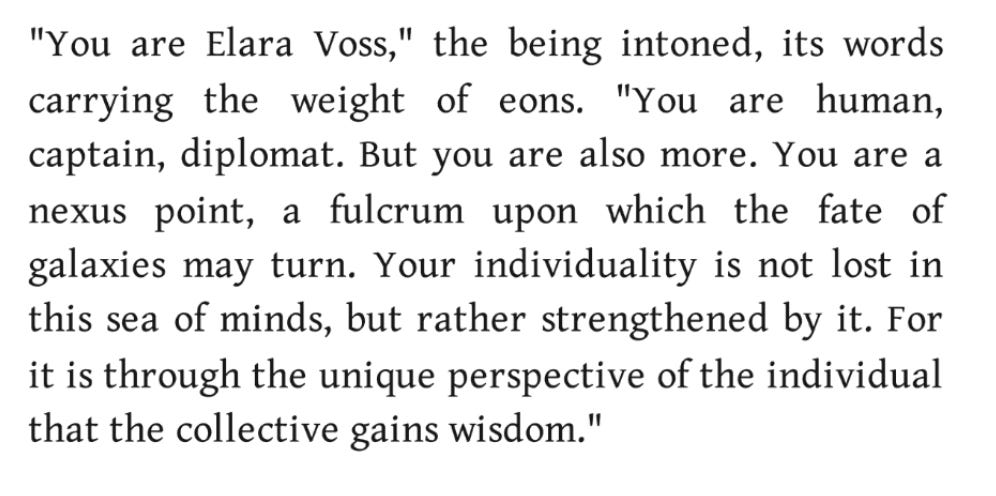
But if you direct almost any L.L.M. to generate a sci-fi story or narrative for you, it will name the main character “Elara Voss”--or a similar variation like “Elara Vex,” “Elena Voss,” or “Elias Vance”--with an alarming degree of frequency.
...
When, exactly, “Elara Voss” and its cognates emerged from the latent space to dominate the Kindle Unlimited store is hard to say. I’ve seen some people on Twitter hazily suggest that Elara and kin--let’s call them promptonyms, to coin a phrase--were present in GPT 3.5 (released in November 2022), but the earliest instance of the names I can find online dates back to August 2023, when an account “exploring realms through #AIStorytelling & #AIConceptArt” posted a character sketch of a “visionary physicist and AI researcher” named “Dr. Elara Voss.” (A “Dr. Elara Finch” and a “Dr. Elara Solis” each appear a few months earlier.) Voss appears a handful more times on Twitter in similar contexts over the next few months, and pops up on a fan-authored Warhammer 40k wiki as the name of the “highly respected leader of the Inanis 23rd Voidstalkers.”
But by the same time next year, Elara, Elena, and Elias Voss, Vex, and Vance had become inescapable, to the point that frequent users and A.I.-powered writing apps began to develop specific prompts to avoid them. The promptonyms reportedly appear in every major L.L.M.: GPT, Claude, Gemini, LLaMA, DeepSeek, and Grok. An A.I. tinkerer on Reddit playing around with L.L.M. benchmarks last August found that Google’s lightweight Gemma model used the name Elara “39 times in 3 separate stories,” and Elias “29 times in 4 separate stories.” None of the commenters were surprised: “every time I try using any models for creative writing, doesn't matter whether it's gpt-4, mistral, llama, etc, always the same names come up like Elara or Whispering Woods, etc.,” one wrote. (Alongside “Whispering Woods,” you can file “Eldora” as the name of a magic kingdom.) Elara Voss seems to be the promptonym generated most often, others like “Aris Thorne” (“Why is Dr. Aris Thorne everywhere?” one Redditor wondered) and “Elias Vance” are found frequently too:
In fact, a whole host of tropes and concepts seem to accompany Dr. Elara wherever she’s found. The prototypical “Elara Voss,” as described by a text generator, is a doctor, usually a physicist but sometimes a linguist or biologist. (Other times, she’s a spaceship captain.) She’s generally on the verge of a major breakthrough or discovery (often cosmic or even metaphysical in nature), or is researching some kind of “anomaly,” but is isolated, troubled, and sometimes “haunted” by what she’s learning. She’s often found “trembling” or her heart is racing; instruments near her are usually “pulsing.” The name “Erebus” often appears in Dr. Elara stories: a “Project Erebus” on which Dr. Elena Vex is working, or a mining colony named “Erebus-IX” to which Dr. Elias Vance must travel, or even a “rogue A.I.” called Erebus, “neutralized” by Dr. Elara Voss.
...
Admittedly, I too have a hard time not giving in to the spooky pleasures of imagining a pantheon of A.I. tulpas emerging from the latent space, a new mythos derived from the hidden structures of our culture. But there are also less occult ways of accounting for the frequency with which Elara and her fellow promptonyms appear. As many people have pointed out, there’s a significant character in World of Warcraft named “Lilian Voss,” and the volume of text publicly available online about the WoW universe in the form of wikis, walk-throughs, and YouTube transcriptions likely gives the lore a gravitational pull in most models. If you trace back, e.g., Gemma’s decision-making process you can see that “character names,” as well as “science fiction” and “fantasy,” are all closely linked in the model to a “text about World of Warcraft” neuron, as Abram Jackson shows here and a user called beowulf shows here. (Similarly, there’s a character named “Elara Dorne” in Star Wars: The Old Republic, a voluminously covered M.M.O.R.P.G. like WoW. It’s a good reminder that L.L.M.s reflect “culture” in the narrow sense of “the culture of text publicly available on the internet in great volume.”)
As for her ubiquity across models, that’s almost to be expected. All the largest models are trained on effectively the same corpus--i.e., “almost all publicly available text”--and the processes by which they are made smooth and sanitary for public release sand down particular differences even further. (They’re also likely training on each other’s responses, which should lead to additional convergence.)
So you might say that Dr. Elara Voss is an emergent legend whose qualities reflect a deep mathematical structure underlying our culture. You might also say she’s a statistical agglomeration of science-fiction cliché borne of oversampling video-game wikis. I’m not sure that either of those views is wrong, precisely! What I do know is that we should enjoy her while she lasts: By the next generation of models, she’ll almost certainly have been eliminated. As much as we might enjoy the idea of A.I. lore, the companies selling the tech (as fiction-writing software, among other things!) don’t like the kind of consistency that points to something other than total magic occurring under the hood.

I just had 3 ai model's come up with a similar character when I mistakenly named my fictional character Dr Elara Voss, so that name's definitely appropropriate & in the LLM lexicon
ReplyDelete