Wednesday, January 11, 2017

They lose money on every ride but they make it up in volume

On one level, ride sharing is a good idea -- using smartphones to connect passengers with underutilized drivers has potential to provide significant benefits on both sides of the transaction -- but, as mentioned before (see here and here for a couple of recent examples), the bullshit narratives and mystical thinking of both investors and journalists have taken something that could have been an innovative business model and turned it into something damned close to a Ponzi scheme

As you would expect from a Gawker remnant, Jalopnik has been the go-to site for Uber coverage, both firsthand and through useful links to and summaries of essential reporting and analysis elsewhere.

Here, Ryan Felton directs us to an important piece of analysis by Hubert Horan,

Uber is currently the most highly valued private company in the world. Its primarily Silicon Valley-based investors have a achieved a venture capital valuation of $69 billion based on direct investment of over $13 billion. Uber hopes to earn billions in returns for those investors out of an urban car service industry that historically had razor-thin margins producing a commodity product. Although the industry has been competitively fragmented and structurally stable for over a century, Uber has been aggressively pursuing global industry dominance, in the belief that the industry has been radically transformed into a “winner-take-all” market.

...

For Uber (or any other radical industry restructuring) to be welfare enhancing, it would have to clearly demonstrate:

    The ability to earn sustainable profits in competitive markets large enough to provide attractive returns on its invested capital

    The ability to provide service at significantly lower cost, or the ability to produce much higher quality service at similar costs

    That it has created new sources of sustainable competitive advantages through major product redesigns and technology/process innovations that incumbent producers could not readily match, and

    Evidence that the newly-dominant company will have strong incentive to pass on a significant share of those efficiency gains to consumers.

Unlike most startups, Uber did not enter the industry in pursuit of a significant market share, but was explicitly working to drive incumbents out of business and achieve global industry dominance. Uber’s huge valuation was always predicated on the dramatic growth towards global dominance. Thus if Uber’s valuation and industry dominance were to be welfare enhancing, Uber’s efficiency and competitive advantages would need to be overwhelming, and there would need to be clear evidence of Uber’s ability to generate large profits and consumer welfare benefits out of these advantages.

...

As shown in Exhibit 2, for the year ending September 2015, Uber had GAAP losses of $2 billion on revenue of $1.4 billion, a negative 143% profit margin. Thus Uber’s current operations depend on $2 billion in subsidies, funded out of the $13 billion in cash its investors have provided.

Uber passengers were paying only 41% of the actual cost of their trips; Uber was using these massive subsidies to undercut the fares and provide more capacity than the competitors who had to cover 100% of their costs out of passenger fares.

Many other tech startups lost money as they pursued growth and market share, but losses of this magnitude are unprecedented; in its worst-ever four quarters, in 2000, Amazon had a negative 50% margin, losing $1.4 billion on $2.8 billion in revenue, and the company responded by firing more than 15 percent of its workforce.[4] 2015 was Uber’s fifth year of operations; at that point in its history Facebook was achieving 25% profit margins.[5]

...

There is no evidence that Uber’s rapid growth is driving the rapid margin improvements achieved by other prominent tech startups as they “grew into profitability.”

Assuming that the unusual spike in EBITAR margin in the first half of 2014 (157%) was due to one-time events or accounting anomalies, Uber has been steadily producing EBITAR margins worse than negative 100% since 2012, and the absolute magnitude of losses has been increasing.

Uber corporate revenue for the year ending June 2015 was over 500% higher than the year ending June 2014, but the EBITAR margin barely changed, moving from negative 115% to negative 108%. Uber had a negative $1.2 billion EBITAR contribution in the first half of 2016, suggesting full year GAAP losses approaching $3 billion. Uber’s EBITAR contribution margin improved from negative 108% in the first half of 2015 to negative 62% in the first half of 2016, but this margin improvement is entirely explained by Uber imposed cuts in driver compensation. As shown in Exhibit 3, Uber only allowed drivers to retain 77% of each passenger dollar in 2016, down from 83% in 2014-15[6]. If drivers had retained 83% of 2016 passenger payments, Uber’s EBITAR contribution would have been negative $1.8 billion, and its EBITAR margin would have fallen to negative 122%. Uber’s EBITAR margin did not improve because its productive efficiency or market performance was improving; capital was simply claiming a higher share of each revenue dollar and giving less to labor.

If rapid growth could not drive major margin improvements between 2012 and 2016, there is no reason to believe that Uber will suddenly find billions in scale economies going forward. Fundamentally digital companies like Amazon, EBay, Google and Facebook had massive operating scale economies because the marginal cost of expanded operations was close to zero. Aggressive pricing fueled the growth that drove major margin improvements and also created major consumer welfare benefits.

By contrast, in the hundred years since the first motorized taxi, there has been no evidence of significant scale economies in the urban car service industry. That explains why successful operators never expanded to other cities and why there was no natural tendency towards concentration in individual markets. Drivers, vehicles and fuel account for 85% of urban car service costs. None of these costs decline significantly as companies grow. As the P&L data above demonstrates, Uber has not discovered a magical new way to drive down unit costs.
...

Uber’s refusal to consider an IPO may best be explained by the recognition that publishing detailed, audited financial data confirming these massive losses and the complete lack of progress towards profitability could undermine public confidence about its inevitable march to industry dominance.

There have been hundreds of articles claiming that Uber has produced wonderful benefits, but none of these benefits increase consumer welfare because they depended on billions in subsidies. Uber is currently a staggeringly unprofitable company. Aside from the imposition of unilateral cuts in driver compensation, there is no evidence of any progress towards breakeven, and no one can provide a credible explanation of how Uber could achieve the billions in P&L improvements needed to achieve sustainable profits and investor returns.


Tuesday, January 10, 2017

NTA – the first Fox Television Network

One of the great ironies of the story of American media is that when broadcast television was virtually the only game in town in terms of home entertainment outside of music, numerous attempts to start a fourth television network all crashed and burned. It was only after television received what was widely seen as the death sentence of cable and satellite that additional networks became viable.

DuMont was the first and the only one to truly achieve network status, but there were lots of other attempts, some in partnership with major studios (relationships the FCC tended to frown upon back when the FCC had frowning muscles). All of these are vanishingly obscure now. I'd entirely forgotten about NTA until I came across a reference to it looking up when rural states got their first TV stations.
The NTA Film Network was an early American television network founded by Ely Landau in 1956. The network was not a full-time television network like CBS, NBC, or ABC. Rather, it operated on a part-time basis, broadcasting films and several first-run television programs from major Hollywood studios. Despite attracting over 100 affiliate stations and the financial support of Twentieth Century-Fox (which purchased a 50% share of NTA in November 1956) the network proved unprofitable, and was discontinued by 1961. The NTA Film Network's flagship station, WNTA-TV, is now WNET, one of the flagship stations of the Public Broadcasting Service (PBS).

...

In October 1956, NTA launched the NTA Film Network, a syndication service which distributed both films and television programs to independent television stations and stations affiliated with NBC, CBS, or ABC (DuMont had recently gone out of the network business). The ad-hoc network's flagship station was WNTA-TV, channel 13 in New York. The NTA Network was launched as a "fourth TV network", and trade papers of the time referred to it as a new television network.

Unlike the Big Three television networks, the local stations in the NTA Film Network were not connected via coaxial cable or microwave relay. Instead, NTA Film Network programs were filmed and then mailed to each station in the network, a method used by television syndicators in the 1950s and 1960s. However, many local stations agreed to broadcast NTA Film Network programs in pattern (simultaneously). Landau's claim to network status was based on the simultaneous airing of the programs.

The NTA Film Network launched on October 15, 1956, with over 100 affiliate stations. In November 1956, it was announced that 50% of the network had been purchased by Twentieth Century-Fox, which would also produce original content for the network. The film network grew to 128 stations. In September 1957, the network purchased KMGM-TV (now Fox O&O KMSP-TV) in Minneapolis.


The NTA Film Network aired both films and television series. Among its 1956–1957 offerings were 52 Twentieth Century-Fox films. Premiere Performance, a prime time block of Twentieth Century-Fox films, aired from 1957–1959. Other film blocks included TV Hour of Stars and The Big Night (both 1958–1959).
Most of the original programming was deeply forgettable, but there were some notable exceptions, such as Mike Wallace's first national show and the still impressive Play of the Week.


Monday, January 9, 2017

Urban Priviledge

This is Joseph.

Eschaton discusses cars and children:
If most of your dailyish and regular baby needs (food, pharmacy, daycare if using, doctor) are within a 15 minutes walk, being without a car is fine. Cars are useful things, of course, but you say a lot of money by not having one and even if only half of that is whittled away on extra taxis/car share/weekend car rentals, then you come out ahead. Bulk buying/delivery (either from supermarket services or amazon) can ship diapers and similar to you (one of the big objections people make, weirdly - how will you carry home all of those diapers?? that one is easy).
Basically, this argument is one of a specialized environment.  If you have a very dense urban environment then there is a lot that becomes possible without a car.  I've lived in a large city with reliable public transit without a car in the city core.  It was a great experience.  But I've lived in small cities with unreliable public transit, too. 

Do you know who has no sense of humor about being late?  Day-care.  Consider this late fee policy:
Parents are charged $1 a minute late fee if they pick up after the scheduled pick up time.
And getting into the daycare of your choice may be hard --  which directly impacts the ability to avoid a late fee and the ability to choose one in a short walking distance. 

Now cars can be subject to delays, too.  But nothing is worse than the every 30 minutes bus that just does not come (see living in small cities with unreliable transit).  If this happens often, you end up paying a ton of late fees and may also be let go by your daycare (an epic disaster if your work isn't flexible).  I have had taxis just decide not to come after waiting an hour in one of the cities that I lived in.  It was awful.  It makes the taxi cost seem small relative to the time spent cooling one's heels, and parents of small children are often time constrained.

Now I am not saying that people cannot make this work.  Many do.  And daycare pickup doesn't require 2 cars, which many couples have.  But the structure of childcare really is a rational driver of car ownership.  Reforming that would have much larger positive effects, but it is going to be a pretty marginal group that is able to take advantage of reliable transit and densely clustered services.  And that is without engaging in issues like the underlying transit pattern and how well it connects three locations (work, home, and daycare).

Now I welcome a conversation on how to make parenting and modern North American culture work better together.  But I think we have to acknowledge how hard it would be to generalize these sorts of proposals beyond the "existence proof" level (i.e. that it would be at last a possible way to arrange things). 


Friday, January 6, 2017

Yes, I do plan to keep harping on this

As previously mentioned, recent events have reinforced my belief that journalism has gotten so bad that journalism has gotten so bad that it constitutes one of the primary threats to everything from the environment to technological progress to the democratic process. One of the reasons behind this dangerous decline is the practice of journalists uncritically reporting flattering and often factually challenged stories to maintain access to the rich, famous, and powerful.

When it came to maintaining healthy and well-informed skepticism and maintaining independence, Gawker Media had arguably the cleanest hands in 2016. Therefore, it is not surprising that the Gawker remnant Deadspin was the one to spot this egregious example of source-stroking.

Over at Sports Illustrated, you can read an article about Tom Brady’s new line of sleepwear for A Company That Makes Stretchy Workout Stuff. The article contains the following lines:
  • “The TB12 Sleepwear line includes full-length shirts and pants—and a short-sleeve and shorts version—with bioceramics printed on the inside.”
  • “The print, sourced from natural minerals, activates the body’s natural heat and reflects it back as far infrared energy...”
  • “The line, available in both men’s [link to store for purchase] and women’s [link to store for purchase] sizes, costs between $80 to $100 [link to store for purchase].”
  • “[A Company That Makes Stretchy Workout Stuff]’s bioceramic-printed sleepwear uses far infrared energy to promote recovery...”
(There are quotes in the article, mostly from people with financial stakes in you buying these products. An actual sleep expert is quoted. He does not endorse or even reference the products discussed in this article, nor the science behind said products. His contribution to this article can be summed up as saying sleep is important.)
This is an advertisement, in every aspect save the one where money changed hands in exchange for its publication. (We think. This would honestly be a lot less embarrassing for SI to run if it were sponsored content and they just forgot to label it as such.) These sorts of advertisements, where certain types of reporters eagerly type up press releases because it’s quick and easy, are everywhere.

Deadspin also sends us to this truly disturbing piece of sports related pseudoscience.

Thursday, January 5, 2017

Cracked has some fun with the lottery

I suspect pretty much everyone reading this blog already knows the facts laid out here, but it's still worth watching this just to spend a bit more time with Roger.


Wednesday, January 4, 2017

"The New Frontier In Stadium Ripoffs"

This Deadspin piece from Drew Magary (which I somewhat reluctantly bleeped in a couple of places to keep our blog's PG rating) is a great, if infuriating, read. It also hits on some of the most ominous concerns of 2016 -- abuse of concentrated economic power (particularly involving monopolies), a willingness to subsidize the rich, growing social and journalistic acceptance of the unacceptable -- and it reminds us of how important the remnants of Gawker Media continue to be.

In case you missed it last week, the great Jason Gay over at the Wall Street Journal covered the opening of the Cowboys’ new practice facility in Frisco, Texas—a wealthy exurb located 30 miles due north of Dallas. Of course, this being the Cowboys, we’re not talking about a mere practice facility. No, this joint—christened The Star—features a high school football stadium, a health research center, a shopping center, a dining concourse, a members-only country club ($4,500 to join, plus $350 a month in dues), a hotel, a rooftop pool, a parking garage, and a fucking golf course. The total price tag for the whole development is $1.5 billion, an estimated $300 million HIGHER than the cost of the Cowboys’ stadium itself.

It will not shock you to learn that the Cowboys didn’t pay for this all by themselves. In fact, the team staged a bidding war between Frisco and Arlington (home to Jerryworld and an outrageously unnecessary future ballpark for the Texas Rangers) for the privilege of hosting The Star, with Frisco offering somewhere between $90 and $115 million to help foot the tab, with $30 million of that money coming directly from the local school district. Of course, that doesn’t factor in the potential tax breaks that Jerry Jones will probably get for charitably lending the spoiled brats of Frisco a field to play on.

This is not the first time a pro sports team has squeezed an eager town out of money for something other than a stadium. Just this year, the city of Richmond cut a $360,994 check to Dan Snyder and the Skins for the privilege of hosting the team’s summer training camp, as part of a deal in which the city built the team a $10 million facility and then, bafflingly, pays them a yearly stipend to use it. Turns out that this was not a wise investment. In order to build Snyder his training camp, the city of Richmond and the Skins conspired to seize land (oh, the irony) from a local school district, land valued at $7.5 million that could have been used to build additional school facilities, or sold off to boost revenue. Instead, it was gifted to an asshole football team that plays 100 miles away.

Any team can f**k a town over to build a stadium. The new hotness is thinking of ancillary facilities besides a stadium and then f**king over a second town for THAT, too. And since Jerry Jones owns the richest team with the largest fanbase—in a wealthy area where brains and good taste aren’t at a premium—he has managed to engineer a new crown jewel of boondoggles, a standard of monstrous waste that all other teams will now aspire to.

Tuesday, January 3, 2017

Blacker is the new black -- more adventures in intellectual property


For the record (I started to say "just to be clear" but that didn't seem entirely appropriate), what Surrey NanoSystems and Anish Kapoor are doing seems reasonable. Vantablack is certainly suitable for patent protection and I don't think anyone's right to artistic expression is being compromised here. That said, there's definitely something 'ridiculous' (as Alex Cranz puts it in Gizmodo) about the whole debate.
Vantablack, created by the British company Surrey NanoSystems, is the blackest known substance on earth, absorbing 99.965 percent of all visible radiation. Originally just a remarkable feat of science, Vantablack has slowly rolled into production being deployed for use in the military and aerospace sector. But it was only in February of this year that Surrey NanoSystems made the substance available for other, more whimsical, uses.

Specifically, it was made available for use in artwork, and Anish Kapoor, the sculptor behind that big silvery bean in Chicago’s Millennium Park, secured the exclusive rights. According to Surrey NanoSystems, Kapoor maintains exclusivity because Vantablack “requires specialist application to achieve its aesthetic effect. In addition, the coating’s performance beyond the visible spectrum results in it being classified as a dual-use material that is subject to UK Export Control.”

What all that fancy jargon means is that Vantablack’s use in the aerospace and military industries severely limits how and why you can export it—all samples currently released for exhibition purposes (such as for a school or museum) are to be set in a glass case and only a minute amount is shipped.

Surrey NanoSystems also feels special training is required to use Vantablack for aesthetic (art) reasons, and rather than set up a training program so artists can learn to work with the pigment, just like other artists have learned to work with red hot metal or blinding lasers, Surry NanoSystems would rather train one studio—specifically Kapoor’s studio. How he jumped to the head of the class over other artists has not been revealed.

And specifically that exclusive and secretive relationship with Kapoor has left other artists pretty upset. The hashtag #SharetheBlack on Instagram and Twitter has been filled, for months, with annoyed artists and art fans.

Monday, January 2, 2017

Pushing privatization too far

This is Joseph.

This article from the New York Times, illustrates the problems of not paying for services via taxation:
Corey Statham had $46 in his pockets when he was arrested in Ramsey County, Minn., and charged with disorderly conduct. He was released two days later, and the charges were dismissed.
But the county kept $25 of Mr. Statham’s money as a “booking fee.” It returned the remaining $21 on a debit card subject to an array of fees. In the end, it cost Mr. Statham $7.25 to withdraw what was left of his money.
The argument for the card were kind of weak:
In its appeals court brief, the county said the debit cards were provided “for the convenience of the inmates,” who might find it hard to cash a check. 
It seems unclear to me why one could not return the contents of the person's wallet unmolested.  That would avoid this problem.  Or perhaps they could look into this technology called the "cash register"/  It solves the need to cash checks very effectively.

The cards themselves were riddled with fees:
He did get a debit card for the remaining $21. But there was no practical way to extract his cash without paying some kind of fee. Among them: $1.50 a week for “maintenance” of the unwanted card, starting after 36 hours; $2.75 for using an A.T.M. to withdraw money; $3 for transferring the balance to a bank account; and $1.50 for checking the balance.
Is this the sort of card agreement you would sign?  Why would we accept the state agreeing to this on behalf of the person arrested, especially after a $25 fee?

But this shows the real paradox of trying to adopt a private sector model for law enforcement.  The person being arrested is not the customer.  The society enforcing laws like "disorderly conduct" are the customers.  We have taxes to prevent free-riding -- if we, as a society, decide that we should enforce these rules then we should all contribute to the costs of enforcement.

But charging an "arrest fee" walks a very narrow line towards extortion.  What if somebody could not pay these costs?

In the case of bad conduct there is at least a argument (a bad argument but an argument) for recovering costs.  But where is the presumption of innocence here?  Furthermore, even if there is a process to recover costs (the article was unclear on this point), why does it make sense to have a complex process to return seized property.

I think some serious thought about these decisions would be sensible.  

Sunday, January 1, 2017

You can’t condemn the outcome and condone the process

There are lots of people in this country (arguably a plurality) who are deeply disturbed by the results of this election. We have had more than our share of dire predictions and frightening analogies, but what we have not had nearly enough of it is serious discussion of the process that brought us here. This is in no small part because the figures in the media who have the most influence over the conversation are generally the ones with the most culpability for what just happened.

While virtually everyone was caught off guard by just how badly things went wrong, a number of us tried our best to call out the bad practices and declining standards that brought us here. I won’t list the specifics now -- if you’d like a taste, just search this blog for the terms like “journalism,” “Trump,” and “the New York Times” -- but I will say that the list is long and damning.

Put bluntly, journalism has gotten so bad that it constitutes a clear and present danger to the republic. It misinforms the public, promotes bad science and technology, distorts markets, comforts the comfortable, afflicts the afflicted, and, as mentioned before, undermines the democratic process. Until we demand and get better from the profession, things are only going to get worse.

Friday, December 30, 2016

The coolest part is when it makes its own planes

Joseph had a serious and rather depressing post scheduled for today, but I'm going to push it back to 2017. For the rest of this year I'm going to step back, take a deep breath, and watch things like paper plane machine guns.

From our good friends at Gizmodo:
Stick 200 sheets of A5 paper into the back of this machine gun and instead of firing bullets when you pull the trigger, it will unleash a barrage of up to 120 paper airplanes every minute.


Thursday, December 29, 2016

The war on data heats up

We've been writing about for a long time. What we're seeing now is, in many ways, the logical conclusion of what we were writing about, but I had always assumed we'd come to our senses before this.


Sophie Kleeman writing for Gizmodo:

Over the weekend, our President-elect fingered South Carolina congressman Mick Mulvaney to lead the Office of Management and Budget. If confirmed, Mulvaney will wield a significant amount of power over virtually every federal agency—and that should make anyone who values science very, very uneasy.

...

Mulvaney’s track record blends in quite nicely: He thinks climate change is a myth, and he has consistently voted against pro-environmental bills. He also voted for a bill that prevented the Environmental Protection Agency from regulating greenhouse gases, and questioned the nthe logical ee,  d for federal funding for Zika research.

There is one key difference between Mulvaney and the rest of Trump’s team of appointments, however. Rather than limiting his damage to one individual agency, Mulvaney gets to defecate on all of them.  


The Office of Management and Budget is the largest arm of the executive office of the president, and possesses a correspondingly huge amount of power. It helps develop and execute the federal budget, oversees agency performance and management, and reviews “all significant federal regulations by executive agencies.”
For someone who will soon lord over government funding and the agencies that depend on it, Mulvaney is almost religiously opposed to federal spending. The New York Times notes that he’s totally cool with being part of the “Shutdown Caucus,” because of his “willingness to shut the government down” rather than raise the debt limit. He’s also continuously advocated for cuts to federal spending, and has repeatedly butted heads with his own party on spending issues.

All of this spells bad news for federal agencies and programs in general, but particularly those in the science, health, and environmental realms. Trump and his lackeys have already made clear their opposition to funding entire fields of scientific research—Bob Walker, a senior adviser, even suggested scrapping NASA’s Earth science division. Combine this staggering level of disregard with Mulvaney’s belt-tightening approach to federal spending, and the prospects for government-funded science research appear dimmer by the day.
...

“The White House Office of Management and Budget is central to good government—including its role overseeing science-based public health, safety and environmental protections,” Andrew Rosenberg, director of the Center for Science and Democracy at UCS, said in a statement. “[Mulvaney] has backed legislation to change the regulatory process in ways that would give an even stronger influence to industry, increase political interference and undermine science-based decision-making.”

Chief among Rosenberg’s concerns is Mulvaney’s support for bills like the Regulatory Improvement Act of 2015, which would “[create] a commission tasked with eliminating and revising outdated and redundant federal regulations.” Notably, the bill was intent on protecting business interests, and was championed by the National Association of Manufacturers and the National Federation of Independent Businesses, among others.

While slashing “outdated and redundant federal regulations” may sound prudent on the surface, Rosenberg, a former regulator, says it’s often a smokescreen that can be used to block policy measures protecting public health and the environment.

“You can’t overturn the Clean Air Act, so you just mess up the process [by which it’s implemented],” Rosenberg told Gizmodo. He likened it to the battle over reproductive rights: There may not be enough support to overturn Roe v. Wade (yet), but that hasn’t stopped state legislators from inserting procedural roadblocks at every other step of the way.


Wednesday, December 28, 2016

If Soylent actually were people, it would probably be easier on the digestion

Both in blogging and conversation, I can't think of a topic with which I've managed to offend more people than Soylent. I can't help but wonder if some of the fans who sprang to the product's defense later regretted their purchase. 

Eve Peyser writing for Gizmodo:
As you may recall, Soylent ended up recalling its Food Bar a month after releasing it when Gizmodo reported that it was causing customers to have “uncontrollable diarrhea” and vomiting, sending some to the emergency room. Soon after, Soylent halted sales of the 1.6 version of its powdered formula after people reported similar symptoms. The company eventually concluded it was the high-tech algal flour in the bars and powder that caused the illness, and vowed to remove it from future products.

Tuesday, December 27, 2016

Now that I think of it, maybe all tech reporters should be satirists

[I really need to get around to watching that show]

If you follow the tech industry or the discussions about employment and the treatment of workers, you definitely need to be following Dan Lyons, best known these days as a writer for the satirical show  Silicon Valley. Lyons is sharp and insightful and funny as hell and he does a great job cutting through the bullshit of the Augean Stables of today's tech journalism:
Making hiring and firing decisions based on age is illegal, but age discrimination is rampant in the tech industry, and everyone knows it, and everyone seems to accept it. What other industry operates like this? What would the world be like if doctors, lawyers, or airline pilots — or anyone, really, other than professional athletes — had to accept the idea that their career would end at age 40, or 50?

The standard defenses of this practice make no sense in terms of business
One excuse for pushing out older workers is that technology changes so fast that older people simply can’t keep up. Veteran coders don’t know the latest programming languages, but young ones do. This is bunk. There’s no reason why a 50-year-old engineer can’t learn a new programming language. And frankly, most coding work isn’t rocket science.

What’s more, most jobs in tech companies don’t actually involve technology. During my time at HubSpot fewer than 100 of the company’s 500 employees were software developers. The vast majority worked in marketing, sales, and customer support. Those jobs don’t require any special degree or extensive training. Anyone, at any age, could do them.

The actual reasons do make business sense, but they aren't what you'd call pretty [emphasis added].
People born after 1980 do not possess some special gene that the rest of us lack. But Silicon Valley venture capitalists and founders somehow seem to believe this is the case. I suspect the truth is that tech startups prefer young workers because they will work longer hours and can be paid less.

Age discrimination is just the beginning.
Twenty years ago, when venture capitalists invested in young founders, they usually insisted that founders team up with older, seasoned executives to provide “adult supervision.” Lately the conventional wisdom has been that it’s better to let young founders go it alone. The consequences have been predictably disastrous. Young male founders hire young male employees, and spend huge money building kooky office frat houses.

In the tech industry the practice of bros hiring bros is known as “culture fit,” and it’s presented as a good thing. The problem with “culture fit” is that unless you’re a twenty-something white person, you don’t fit. People of a certain age, people of color, and women — most of us, in other words — are often unwelcome. This huge, dynamic industry, which is generating so much wealth, has walled itself off from most of the workforce, telling millions of people that they cannot participate. This situation obviously shortchanges a lot of workers, but it also hurts tech companies by depriving them of talent.

Age bias goes hand-in-hand with other forms of bias. HubSpot had many female employees, but few in top management positions. The company was run (and still is) mostly by white men. As far as I could tell, there were no African-American employees. Once, after sitting through a company all-hands meeting and being stunned by the ocean of white faces, I wrote to a woman in HR asking if the company had any statistics on diversity. HubSpot prided itself on possessing numbers for everything, and being a “data-driven organization.” I received a terse reply: “No. Why?”

Hiring by “culture fit” has a way of crowding out hiring by competence. Partially as a result, it is disturbingly easy to find multi-billion dollar tech companies with high level executives who are dumb as a big ol' box of rocks.
I lasted 20 months at HubSpot. My time there was filled with incidents in which colleagues demonstrated they shared Halligan’s low regard for older workers. After I left the company, I announced I was writing a memoir about my experience as a 50-something guy trying to work in startup land. Apparently some of the company’s executives freaked out about what might be in the book, and they did something so crazy that I still almost can't believe it.

According to the FBI, which investigated, these executives tried to hack into computers to steal the manuscript, and also tried to prevent publication of the book by engaging in extortion. No criminal charges have been filed, but the hacking, extortion, and ensuing cover-up raised questions about HubSpot’s culture and the trustworthiness of its leadership. HubSpot's board fired the CMO, and sanctioned Halligan, the CEO. A vice president resigned before the board could decide whether to terminate him. The board still won't tell me what happened.

Monday, December 26, 2016

The wonderful thing about age discrimination is that eventually we all get a chance to share the experience


[Following up on our previous piece on Dan Lyons.]

Though ageism has started getting more coverage, It is still almost invariably presented as a problem for the old (keeping in mind that, in this context, “old” is very much a relative term). This is a deeply flawed framework for what should be fairly obvious reasons. When it comes to discrimination, all of the other protected classes are more or less permanent – – your race, religion, sexual orientation, gender will generally stay with you for life – – but, barring sudden death, all of us will go through all classifications of age.

We therefore need to approach this problem in terms of overall career paths. If we do, it becomes apparent that, not only are younger workers also victims of age discrimination, they very well may be baring the brunt of it in today's employment market. Those younger employees are the ones turning in 60 hour weeks for less money than they merit as part of an implicit contract that will almost certainly be broken.

We have undermined the concept of deferred compensation – – often suggesting that the employee who expects the employer to make good on agreements is greedy and possibly dishonest – – while clinging to models that implicitly and sometimes explicitly rely on the idea that hard work and loyalty now will translate into rewards in the future.

If anything, the notion of "paying your dues" is even more entrenched in today's attitudes toward work. New employees are often expected to put in what would have been considered impossible hours. Freelancers are routinely expected to deliver professional level products for little or no money. Everyone is expected to borrow money to finance their own job training. All of these things are based on an implicit investment model.

But these sacrifices have come to look less and less like an investment over the past three or so decades, particularly compared to the 50s and 60s, when getting an education and/or putting in your time almost guaranteed a comfortable and stable middle-class lifestyle. Partly as a reaction to the upheavals of the 30s and 40s, the Postwar Era saw a wide array of institutional, regulatory, and cultural guarantees that these investments would be made good in the long term.

Now, nearly all of these guarantees have broken down. In terms of individual employers, there is no longer any pressure, official or unofficial, to show loyalty towards workers. Journalists now routinely portray calls for job security as protections for the "lazy" and treat as unreasonable and selfish the notion that employees have a right to collect agreed-upon pensions. In terms of overall industries, age discrimination violates the implicit contract of "paying dues." Rather than your hard work and sacrifices translating to a better job in the future, they translate to no job at all.

The 50-year-old engineer who can't get a position in the tech sector is a victim of age discrimination. So is the 29-year-old with huge college loans to repay who is about to discover he or she will be much less employable in six years. The only difference is, one of them doesn't know it yet.

Sunday, December 25, 2016

Saturday, December 24, 2016

Friday, December 23, 2016

Bad reporting continues

This is Joseph

This is . . . remarkable:
Indeed Carolina does so poorly on the measures of legal framework and voter registration, that on those indicators we rank alongside Iran and Venezuela. When it comes to the integrity of the voting district boundaries no country has ever received as low a score as the 7/100 North Carolina received. North Carolina is not only the worst state in the USA for unfair districting but the worst entity in the world ever analyzed by the Electoral Integrity Project.
Of course matters are not helped by this reporting from the Los Angeles Times:
After North Carolina lawmakers refused to repeal House Bill 2, the law that curbs legal protections for LGBT people and has cost the state millions of dollars in boycotts and lost jobs, Democrats and Republicans took to a predictable pattern: blaming each other for the unraveling of the deal. 
This is the lead sentence.  Just how does the opposition party factor into this in any sensible way?  Do the Republicans not currently have the Governor and a super-majority of seats in the legislature?  Have they not been willing to pass other laws on short notice

The Los Angeles Times then has this quote:
“It may have been doomed from the beginning,” said Michael Bitzer, a politics professor at Catawba College in Salisbury, N.C., who noted that many rural Republicans, who face re-election next year, would face outrage from their constituents if they repealed HB2. “It started off with both sides wanting a pound of flesh from the other side, and it just went downhill from there.”


Look, there is a lot of blame to give to Democrats, over a great many bad decisions that have been made in the past few decades.  But I am not sure how this works as the lead for the story -- the most important element of the story is that both sides blame each other?  Even the New York Times did better.  Clearly, if repealing HB2 had been a priority for the current administration then they could have done so, with no Democrat interference.  How does a "blame both sides" narrative work here?  One side could have done this repeal, all by themselves.  Sure, it is possible that the opposition was not helpful, but I find this sort of reporting very misleading.  Even when one side is shut out from power, it is blamed for not somehow not  . . . inspiring? . . . the governing party? 


Christmas Greetings from Slumberland

From the great Winsor McCay.


Thursday, December 22, 2016

Our annual Toys-for-Tots post

[Slightly modified from previous years.]

A good Christmas can do a lot to take the edge off of a bad year both for children and their parents (and a lot of families are having a bad year). It's the season to pick up a few toys, drop them by the fire station and make some people feel good about themselves during what can be one of the toughest times of the year.

If you're new to the Toys-for-Tots concept, here are the rules I normally use when shopping:

The gifts should be nice enough to sit alone under a tree. The child who gets nothing else should still feel that he or she had a special Christmas. A large stuffed animal, a big metal truck, a large can of Legos with enough pieces to keep up with an active imagination. You can get any of these for around twenty or thirty bucks at Target, Wal-Mart or Costco. Toys-R-Us had some good sales last year;

Shop smart. The better the deals the more toys can go in your cart;

No batteries. (I'm a strong believer in kid power);*

Speaking of kid power, it's impossible to be sedentary while playing with a basketball;

No toys that need lots of accessories;

For games, you're generally better off going with a classic;

No movie or TV show tie-ins. (This one's kind of a personal quirk and I will make some exceptions like Sesame Street);

Look for something durable. These will have to last;

For smaller children, you really can't beat Fisher Price and PlaySkool. Both companies have mastered the art of coming up with cleverly designed toys that children love and that will stand up to generations of energetic and creative play.

* I'd like to soften this position just bit. It's okay for a toy to use batteries, just not to need them. Fisher Price and PlaySkool have both gotten into the habit of adding lights and sounds to classic toys, but when the batteries die, the toys live on, still powered by the energy of children at play.

Among living Americans, there are only two "generations"

 "The ________ Generation” has long been one of those red-flag phrases, a strong indicator that you may be about to encounter serious bullshit. There are occasions when it makes sense to group together people born during a specified period of 10 to 20 years, but those occasions are fairly rare and make up a vanishingly small part of the usage of the concept.

First, there is the practice of making a sweeping statement about a "generation" when one is actually making a claim about a trend. This isn't just wrong; it is the opposite of right. The very concept of a generation implies a relatively stable state of affairs for a given group of people over an extended period of time. If people born in 1991 are more likely to do something that people born in 1992 and people born in 1992 are more likely to do it than people born in 1993 and so on, discussing the behavior in terms of a generation makes no sense whatsoever.

We see this constantly in articles about "the millennial generation" (and while we are on the subject, when you see "the millennial generation," you can replace "may be about to encounter serious bullshit" with "are almost certainly about to encounter serious bullshit"). Often these "What's wrong with millennial's?" think pieces manage multiple layers of crap, taking a trend that is not actually a trend and then mislabeling it as a trait of a generation that's not a generation.

How often does the very concept of a generation make sense? Think about what we're saying when we use the term. In order for it to be meaningful, people born in a given 10 to 20 year interval have to have more in common with each other than with people in the preceding and following generations, even in cases where the inter-generational age difference is less than the intra-generational age difference.

Consider the conditions where that would be a reasonable assumption. You would generally need society to be at one extreme for an extended period of time, then suddenly swing to another. You can certainly find big events that produce this kind of change. In Europe, for instance, the first world war marked a clear dividing line for the generations.

(It is important to note that the term "clear" is somewhat relative here. There is always going to be a certain fuzziness with cutoff points when talking about generations, even with the most abrupt shifts. Societies don't change overnight and individuals seldom fall into the groups. Nonetheless, there are cases where the idea of a dividing line is at least a useful fiction.)

In terms of living Americans, what periods can we meaningfully associate with distinct generations? I'd argue that there are only two: those who spent a significant portion of their formative years during the Depression and WWII; and those who came of age in the Post-War/Youth Movement/Vietnam era.

Obviously, there are all sorts of caveats that should be made here, but the idea that Americans born in the mid-20s and mid-30s would share some common framework is a justifiable assumption, as is the idea that those born in the mid-40s and mid-50s would as well. Perhaps more importantly, it is also reasonable to talk about the sharp differences between people born in the mid-30s and the mid-40s.

There are a lot of interesting insights you can derive from looking at these two generations, but, as far as I can see, attempts to arbitrarily group Americans born after, say, 1958 (which would have them turning 18 after the fall of Saigon) is largely a waste of time and is often profoundly misleading. The world continues to change rapidly, just not in a way that lends itself toward simple labels and categories.

Wednesday, December 21, 2016

Tuesday, December 20, 2016

Two Napoleons and a Potemkin village

I wish I remembered the exact context, but a few years ago I was listening to a radio interview on the subject of delusion. At one point, the reporter asked "what happens when two mental patients who both think they are Napoleon meet each other?" The expert replied, "After careful consideration, both patients come to the correct conclusion: the other guy is crazy."

That anecdote came to mind recently when reading this piece in New York magazine by Benjamin Wallace profiling the troubles at Hyperloop One. [Longtime readers will remember this is not the first time we've called out New York's Hyperloop coverage.]

There is, course, another "hyperloop" company in the news. Hyperloop Transportation Technologies, but as Shervin Pishevar (venture capitalist and co-founder of Hyperloop One) told the generally credulous reporter, the other company didn't really have a serious chance of building anything of consequence.
[a] crowdsourced, volunteer-staffed company with a confusingly similar name, Hyperloop Transportation Technologies. It was perhaps not a serious long-term threat — the company was run by a former Uber driver and a former Italian MTV VJ — but Hyperloop Transportation Technologies had a few months’ head start over Hyperloop Technologies, and the amateurish nature of his rivals didn’t help Pishevar in the credibility game, which he recognized was, at this point, the entire game.

The dismissive tone might have had a bit more resonance if it hadn't been followed almost immediately by this description of how Hyperloop One prepared for its big moment in the sun

[Emphasis added]

Pishevar knew the power of a well-placed media exclusive to lubricate the creation of something from nothing. In fact, he had been keeping Forbes technology editor Bruce Upbin up to date on every development of his new venture since its infancy. “Shervin mentioned the Forbes piece early, maybe even the first day I met him,” BamBrogan remembers. By early 2015, Pishevar’s company was a few steps further along, having hired a general counsel (Pishevar’s brother Afshin, who was bunking in BamBrogan’s spare bedroom) and raised $7.5 million, primarily from Pishevar’s Sherpa Capital and from Formation 8, a VC firm run by the investor Joe Lonsdale. But the company was still in BamBrogan’s garage, with no health insurance, no company insurance, no HR processes, no website, and no office space. The only thing holding it together, at this point, was Pishevar’s estimable sales skills. With a big Forbes story now slated for imminent publication, the company was in a race to acquire enough of a patina of substantiality to merit prominent coverage in America’s most famous business magazine. “It was crazy,” BamBrogan recalls. “We’re spending time finding the right industrial space that we want to grow into but also that we can do for this Forbes shoot.”

A recently hired director of operations knew the landlord of a large campus in downtown L.A., and at the end of the month, BamBrogan and his handful of colleagues moved into a sliver of the space, a 6,500-square-foot former ice factory, before they had secured a lease. With the magazine deadline looming, the skeleton crew were unrolling carpets, BamBrogan was making repeated trips to Ikea in his Audi sedan to buy 16 Vika Amon tables and 64 Vika Adil legs, and the company was buying 25 computers and 50 monitors. Some of the computers had only one graphics card and couldn’t actually run two monitors, but the super­fluous equipment beefed up the apparent size of the company. The day of the shoot, BamBrogan and his co-workers scheduled a flurry of job interviews in the office so that more people would be around.

As if this weren't bad enough, the article then goes on to quote engineers for the company admitting what many of us have been saying all along: that the incredibly over-hyped demonstration was entirely limited to the parts of the technology everyone already knew worked. Rather than being a test, it was, in reality, little more than a glorified science fair exhibit.

In case I was a bit obscure in the title...
In politics and economics, a Potemkin village (also Potyomkin village, derived from the Russian: Потёмкинские деревни, Russian pronunciation: [pɐˈtʲɵmkʲɪnskʲɪɪ dʲɪˈrʲɛvnʲɪ] Potyomkinskiye derevni) is any construction (literal or figurative) built solely to deceive others into thinking that a situation is better than it really is. The term comes from stories of a fake portable village, built only to impress Empress Catherine II during her journey to Crimea in 1787. While some modern historians claim accounts of this portable village are exaggerated, the original story was that Grigory Potemkin erected the fake portable settlement along the banks of the Dnieper River in order to fool the Russian Empress.

Monday, December 19, 2016

Charter schools and astroturf

There's nothing particularly exceptional about the following story – if anything, it's pretty much par for the course – but it is a reminder of something that we all know on some level but often fail to acknowledge. There is a huge imbalance in the per-school money available for charters versus traditional public schools. This would always be a concern but under the current system it is nothing short of a fatal flaw. Today, schools with large lobbying budgets for getting funding approved and large advertising budgets for attracting students (particularly those who are likely to improve the schools' test scores) are at such an advantage that they can easily push other schools into a death spiral of budget cuts and dwindling enrollment.

If we want to have charters as a part of a functioning education system, we need to reform that system in a way that minimizes the impact of deep pockets rather than amplifies it.

The cost to bus charter school students and advocates to rallies: $87,870.

The cost of providing them food from Subway: $14,040.

The cost of launching a media blitz including a new wave of television advertisements after state legislators failed to recommend funding new charter schools: $300,429.

The impact on students “trapped in failing schools” if this campaign drives funding to greatly expand charter school enrollment: Priceless, says Families for Excellent Schools, the nonprofit organization behind the effort.

According to spending reports filed with the Office of State Ethics Monday, the organization spent $413,000 in April — more than double what the organization spent during the first three months of the legislative session. This brings the organization’s spending to $667,000 so far this year. Add in what other groups advocating for charter schools are spending, and the total nears $1 million.

Saturday, December 17, 2016

The future of Faraday Future is questionable

Exceptional work by Raphael Orlove of Jalopnik.(the spirit of Gawker lives on). The whole article is highly recommended.

Sources close to Faraday Future, including suppliers, contractors, current, prospective and ex-employees all spoke to Jalopnik over a number of weeks on conditions of anonymity and said the money has been M.I.A., the plans are absurd and the organization verges on the dysfunctional.

A year ago, things seemed very different. In late November of 2015, Faraday Future burst onto the scene with promises as big as its name was mysterious.

Staffed by prominent industry figures poached from companies like Tesla, Apple, Ferrari and BMW, FF made bold, unprecedented promises: an electric car that could not only drive itself but connect to its owner’s smartphone and learn from their daily habits to become the ultimate personalized vehicle. And if ownership didn’t suit their lifestyle, fine; the company was eager to expand into ride-sharing and autonomous fleet services.

With a $1 billion facility in Nevada, the company promised production by 2017. Forget what you know about cars, the teaser videos proclaimed. A revolution is coming and we would see it at the CES trade show in Las Vegas. Everyone anticipated an actual car that could live up to these claims.

Then January and CES rolled around and the company revealed that yes, that wild rocket-looking supercar that leaked onto the internet via an app really was Faraday Future’s show car. But not its actual production car. That would come later, the company swore after an embarrassing debut that laid the hype and the buzzwords on thick but had seemingly little to back it up. In the meantime the company promised a “skateboard” modular electric platform that could be adapted to suit several different body styles.

But everything would be fine, right? After all, FF was getting $335 million in state tax incentives and abatements from Nevada for its plant, and it was sponsoring a Formula E team. And in the company’s own words, it would do for cars what the iPhone did for communications in 2007. And Faraday Future is funded by Jia Yueting, a tech mogul in China known for starting the country’s first paid video streaming service. It’s often nicknamed “The Netflix of China,” and it brought Jia the billions he needed to start a whole tech empire, selling everything from smartphones to TVs to cars.

What could go wrong?

That was in January. FF spent the next several months in the news over and over again, almost always for reasons no company wants to be in the news. There was the lag on payments to the factory’s construction company, the senior staffers jumping ship, the confusing debut of a seemingly competing car from the company helmed by its principal backer, the lawsuits from a supplier and a landlord who said they weren’t getting paid, the work stoppage on the factory, the state officials in Nevada who said Jia didn’t have as much money as he claimed (something that Jia denied in a haters-are-my-motivators statement), and the fact that leaders in that state copped to never really knowing much about FF’s financials before approving that incentive package.

...
I wish I could say this in front of every sentence I write about Faraday Future, but from everything I’ve seen there is good and serious engineering work getting done at the company.

If anything, Faraday Future has too many people working on one of the most interesting cars we’ve seen in years, engineers crammed computer to computer, even on fold up-picnic tables as one anonymous interviewee told Jalopnik. All-electric, eyes on autonomy, with incredible performance and design. “There’s a lot of good people there,” one source noted. “That’s the worst part.”

But you can’t have this engineering side without a solid business to back it up, and the good work at Faraday Future seems like it has been constantly undone by the unrealistic demands of its top leadership and a money gulf across the Pacific.

Friday, December 16, 2016

Despite what Munroe says about the industry group, it's still less effective at lobbying than Disney's

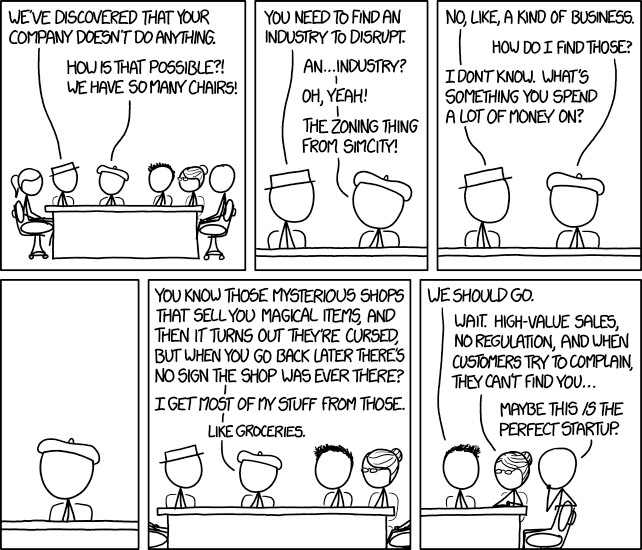
Remember this?

The thinking of business writers has become so muddled and, in places, so overtly mystical that the important fundamental drivers are completely lost in the discussion. Words like "disruptor" or "transformative" have such tremendous emotional resonance for the writers (and investors) that they blind them to the underlying business forces.

I've been meaning to work up a thread on magical thinking in business culture and journalism. Leave it to XKCD to get there first.


Thursday, December 15, 2016

"Disruption" is now officially a dead metaphor


DYING METAPHORS. A newly invented metaphor assists thought by evoking a visual image, while on the other hand a metaphor which is technically ‘dead’ (e. g. iron resolution) has in effect reverted to being an ordinary word and can generally be used without loss of vividness. But in between these two classes there is a huge dump of worn-out metaphors which have lost all evocative power and are merely used because they save people the trouble of inventing phrases for themselves. Examples are: Ring the changes on, take up the cudgel for, toe the line, ride roughshod over, stand shoulder to shoulder with, play into the hands of, no axe to grind, grist to the mill, fishing in troubled waters, on the order of the day, Achilles’ heel, swan song, hotbed. Many of these are used without knowledge of their meaning (what is a ‘rift’, for instance?), and incompatible metaphors are frequently mixed, a sure sign that the writer is not interested in what he is saying. Some metaphors now current have been twisted out of their original meaning without those who use them even being aware of the fact. For example, toe the line is sometimes written as tow the line. Another example is the hammer and the anvil, now always used with the implication that the anvil gets the worst of it. In real life it is always the anvil that breaks the hammer, never the other way about: a writer who stopped to think what he was saying would avoid perverting the original phrase.

George Orwell
We've been heading toward this for a long time. From the beginning, the idea of disruption never explained nearly as much as it was supposed to. There were always as many exceptions as cases and much of the appeal of the idea could be attributed to the way it played into popular narratives about visionary innovators.

By now, the term has been so overused that it has lost all meaning. Here's  Jill Lepore writing for the New Yorker.
Ever since “The Innovator’s Dilemma,” everyone is either disrupting or being disrupted. There are disruption consultants, disruption conferences, and disruption seminars. This fall, the University of Southern California is opening a new program: “The degree is in disruption,” the university announced. “Disrupt or be disrupted,” the venture capitalist Josh Linkner warns in a new book, “The Road to Reinvention,” in which he argues that “fickle consumer trends, friction-free markets, and political unrest,” along with “dizzying speed, exponential complexity, and mind-numbing technology advances,” mean that the time has come to panic as you’ve never panicked before. Larry Downes and Paul Nunes, who blog for Forbes, insist that we have entered a new and even scarier stage: “big bang disruption.” “This isn’t disruptive innovation,” they warn. “It’s devastating innovation.”

Obviously, sense has been draining away for a long time, but the term officially flat-lined when the heads of AT&T and Time Warner headed to DC to defend the indefensible.  From the must-read Gizmodo piece by Michael Nunez.

In front of the Senate subcommittee today, AT&T CEO Randall Stephenson brazenly dismissed concerns of potentially anticompetitive behavior. The bespectacled executive, according to a New York Times report, told lawmakers that the merger would “disrupt the entrenched pay-TV models” and give customers more options.

The truth is a little more complicated than that. AT&T is already the second-largest US telecommunications company (with 133.3 million subscribers) and the largest pay-TV service in the US and the world. If it merged with Time Warner, the second-largest broadband provider and third-largest video provider in the US, it would create a media conglomerate with unspeakable power. Critics say it would be a conglomerate that many companies just couldn’t compete with. 

We are truly into Newspeak territory here. The sole purpose of this type of mergers is to entrench position and prevent the industry from being disrupted. Those at the top quite accurately view disruption as a serious and possibly existential threat to the status quo. If you can now use the term to describe a mega-merger, it has no meaning left at all.


Wednesday, December 14, 2016

Vanishing overhead bins in the upsell economy

From Matt Novak
United has announced a “new tier” of ticket, as the company calls it. The airline’s cheapest flights will now be called Basic Economy, and if you want to store something in the overhead bin, that’ll cost you extra. Passengers will be able to bring a carry-on that fits underneath the seat in front of them. But don’t even think about putting something above you. That’s for people who paid more.

Of course, the airline is positioning this move as providing “more options” for customers. But it seems like providing more “choice” always comes with a fee for something customers used to get for free.

“Customers have told us that they want more choice and Basic Economy delivers just that,” Julia Haywood, executive vice president at United said in a hilarious news release. “By offering low fares while also offering the experience of traveling on our outstanding network, with a variety of onboard amenities and great customer service, we are giving our customers an additional travel option from what United offers today.”

Want to hear another fun aspect of “choice” that Basic Economy provides? Passengers won’t get an assigned seat until the day they depart.

I don't have access to the actual numbers, of course, but as a former marketing guy, I strongly suspect that real money here is not coming from that 20 bucks or so you pay to put a carry-on bag in the overhead compartment. Instead, it comes from the way that policies like this screw with consumers' decision-making ability.

This works on at least three levels:

1. Fees make pricing more opaque. Sometimes, additional costs may be completely unexpected – you go to pay your bill and find its much larger than what you thought you had agreed to – but even when you know something is coming, those fees make it difficult to know exactly how much you will be handing over.

2. These policies greatly complicate the calculations consumers need to perform. Despite what you might occasionally hear from some freshwater economist, the human brain has finite computing power. If the computations required to determine the optimal purchase get too long and involved, people are more likely to resort to shortcuts or simply start making mistakes.

3. A crappy product is the first step in the road to upgrade riches. This is not all that different from classic bait-and-switch scam we are all familiar with, but the potential payoff is much greater. Tiered systems offer enormous potential for convincing people to pay way too much money for things they don't particularly want. By making that bottom level product sufficiently unattractive, you can get a lot of customers into the upgrade habit. Just ask your local cable company.

Tuesday, December 13, 2016

Thomas Friedman blogging IV – – good tech is friendly tech


Though it is a bit of a side issue, there is another flaw in Thomas Friedman's argument that I'd like to address, as much for future reference as anything else (I plan on getting back to some of these larger questions).

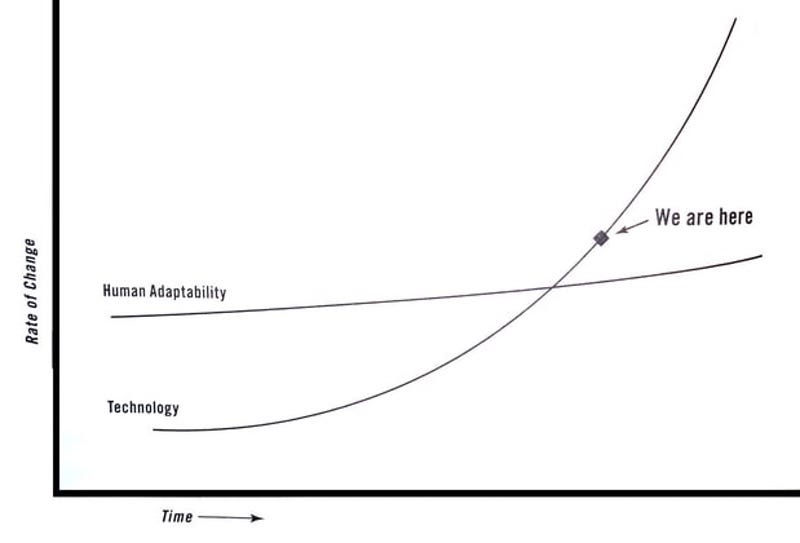
As is been noted previously by others, Friedman's technology is a big, generic, undefined thing. A mysterious godlike force which must be accommodated lest ye be afflicted with Luddite cooties. Commentators like Friedman seldom think of technology as a set of tools, but that's exactly the appropriate framework.

The idea that human adaptability needs to be proportional to technological change is wrong in multiple ways. Advances in technology should produce tools that are more powerful, cheaper, and generally easier to use. All other things being equal, better tech should require less adaptability than less sophisticated tech. Whether we are talking about automatic transmissions or USB ports or natural language processing, the objective is to make things easier.

It's important to step back for a moment at this point and distinguish between the adapting that an individual has to do and what a society has to do collectively. Even the most tech savvy among us struggle now and then with a new development, but if we really are talking about an advance, the learning curve on the new technology should be better than the learning curve on the old.

More excellent work from Adam Conover

Yet another example of a comedian producing better journalism than most journalists.


Monday, December 12, 2016

Thomas Friedman blogging III – – a few words from Matt Novak

I don't buy all of Novak's take on this (more on that later if I get around to it), but, on the whole, this is an exceptionally sharp analysis:


Rolling Stone’s Matt Taibbi first flagged the graph in a blog post today. The graph shows technology (which is never defined) and its rate of change (which is never defined) and human adaptability (which is never defined). It’s the kind of thing you might see scrawled in feces in Ted Kaczynski’s prison cell but it’s now been conveniently committed to paper and given a much wider audience.

...

The truth is that technological adoption isn’t necessarily speeding up. Just look at consumer goods like television. In 1950 just 8 percent of Americans had a TV. Four years later, in 1954, a whopping 59 percent of American households had a TV. Here we are on the cusp on 2017 and I’m having a hard time thinking of any consumer technology that made any comparable jump since 2012.

Or let’s go back further. The Great Depression was a desperate time for most Americans. But technological leaps didn’t stop. Look at the mechanical refrigerator as another example of rapid change in a relatively short period of time. Just 8 percent of American households had a fridge in 1930. By the end of the decade roughly 44 percent had one. People much smarter than myself have argued that refrigeration did more to shape the United States than most other technologies of the 20th century. Yes, smartphones are revolutionary. But refrigeration tech arguably changed America as much, if not more.


The adoption rates of early and mid-20th Century consumer technology are even more impressive when you consider infrastructure. I'd argue that the percentage of American households with mechanical refrigerators in 1939 is, in many ways, less relevant than the percentage of electrified households with refrigerators that year. By the same token, a large part of the country didn't get TV stations until the mid-50s and yet we still hit 59%. Viewed this way, consumers were considerably more eager to adopt new technology in the mid-2oth Century than they are today.


Friday, December 9, 2016

Cracked's interesting but self-refuting argument


"Why Pop Science Matters - Lowest Common Dominator"


I've got some thoughts on this, but to avoid any spoilers, we'll talk about it after the break.


Thursday, December 8, 2016

Essential tech reporting at Gizmodo [Facebook edition]


William Turton has a series that you really need to be following. The first and the third articles address Facebook's fake news problem. The second describes how the company managed to spin a failed test of a major initiative as an unqualified success.

In a related article, Michael Nunez describes how the company slow-walked its response to the fake news problem due to fear of conservative backlash.


Ordinal wealth and the bigger pie fallacy

Picking up on Joseph's recent post (which in turn picked up on Jared Bernstein's earlier post), specifically this part:

When the benefits of trade are broadly spread then everyone benefits.  But capturing all of the benefits and then using that political power to seize additional benefits is a great way to get very powerful but it runs the risk of undermining the political calculation.  After all, if trade is the way that the "rich get richer" and the "poor get even less" then it starts to look like a very bad deal.
Let's focus on the first sentence. This is a completely conventional assertion and it's entirely valid if you make certain standard (and always implicit) assumptions about what it means to benefit from a transaction. Unfortunately, the reasoning does not stand well when wee start tweaking that assumption.

A few years ago, we ran a post discussing different ways of viewing wealth. One of the approaches we covered was ordinal wealth, the idea that, in some situations, total wealth might be less important (or a less useful metric) than wealth-rank. In terms of social status, political power, and personal satisfaction, being the richest man in town with say $10 million in the bank might be preferable to having $15 million but not breaking the top five.

There is no obvious reason why absolute wealth should be a better central metric than ordinal wealth and other relative measures – you can almost certainly find cases where each is appropriate – but if we do allow for the possibility that relative measures might sometimes work better, all sorts of cherished economic truths start to look fairly shaky.

Maybe I'm missing something, but pretty much all the assurances we've heard about how enlightened self interest will keep us on the right track seem to assume that rational actors will seek to optimize absolute wealth. If the rich and powerful are more concerned with maximizing relative position, it's difficult to see where that enlightenment would come in.