Tuesday, January 14, 2025

AT&T Archives - The Viewtron System and Sceptre Videotex Terminal (1983)

I have a longtime fascination with technological prototypes, early attempts and failed alternatives, but I'll admit this one was new to me.

Viewtron was an online service offered by Knight-Ridder and AT&T from 1983 to 1986. Patterned after the British Post Office's Prestel system,[1] it started as a videotex service requiring users to have a special terminal, the AT&T Sceptre. As home computers became important in the marketplace, the development focus shifted to IBM, Apple, Commodore and other personal computers.[2]

Viewtron differed from contemporary services like CompuServe and The Source by emphasizing news from The Miami Herald and Associated Press and e-commerce services from JCPenney and other merchants over computer-oriented services such as file downloads or online chat. Intended to be "the McDonald's of videotex," Viewtron was specifically targeted toward users who would be apprehensive about using a computer.


Monday, January 13, 2025

You'll see a lot of finger pointing in the coverage of the fires but almost no real coverage of the mistakes that got us here.

I apologize for the all the reposts, but this has gotten very relevant.

Monday, December 28, 2020

The handling of the Western mega-fires is another reminder we live in a solution-phobic society

We've had some nice showers recently. We're supposed to get more tomorrow (Monday) with winter storm warnings promising snow in the mountains. It is, of course, welcome. The West always needs water and we've had a fairly dry fall which in recent years has meant fire season threatened to stretch into the winter.

But while the rains are bringing a respite from the mega-fire, they are also a tragically wasted opportunity. Despite a virtually absolute scientific consensus as to the steps we desperately need to be taking, almost nothing is being done and very few people seem to care.

Writing for the LA Times, Bettina Boxall has an excellent account of the depressing details.

When COVID-19 blew a hole in California’s spending plans last spring, one of the things state budget-cutters took an axe to was wildfire prevention.

A $100-million pilot project to outfit older homes with fire-resistant materials was dropped. Another $165 million earmarked for community protection and wildland fuel-reduction fell to less than $10 million.

A few months later, the August siege of dry lightning turned 2020 into a record-shattering wildfire year. The state’s emergency firefighting costs are expected to hit $1.3 billion, pushing the California Department of Forestry and Fire Protection’s total spending this fiscal year to more than $3 billion.

The numbers highlight the enormous chasm between what state and federal agencies spend on firefighting and what they spend on reducing California’s wildfire hazard — a persistent gap that critics say ensures a self-perpetuating cycle of destruction.

 ...

Fire scientists have long called for a dramatic increase in the use of prescribed fire — that is, controlled burns that trained crews deliberately set in forests and grasslands during mild weather conditions.

They have urged federal agencies to thin more overgrown stands of young trees in the mid-elevation Sierra Nevada and let nature do some housekeeping with well-behaved lightning fires in the backcountry.

They point to the dire need to retrofit older homes to guard against the blizzard of embers that set neighborhoods ablaze in the most destructive, wind-driven fires.

Yet year after year, state and federal funding for such work remains a pittance compared to the billions of dollars spent on firefighting. 

...

[Jessica Morse, deputy secretary of the California Natural Resources Agency, which oversees Cal Fire] cited an August agreement between the state and the U.S. Forest Service in which they each committed to annually treating 500,000 acres [a fraction of what researchers say we need to be doing. -- MP] of California forest and rangelands by 2025 with a variety of fuel-reduction practices, including prescribed fire, thinning overgrown woodlands, timber harvest and grazing.

Yet this memorandum of understanding is non-binding and includes neither money nor staffing.


Friday, January 10, 2025

"if people in the paths of these fires is one of, perhaps the major obstacle to the solution, then we need to have a serious debate about where we encourage (or even allow) new housing and development."


5 dead as Eaton fire explodes to 10,600 acres — hundreds of structures destroyed or damaged

Evacuations ordered for all of La Canada Flintridge as blaze burns.

 Before we get to the repost, here's a relevant excerpt from another post we did around the same time (emphasis added):

The three areas that have long been in heavy rotation with the California YIMBYs are, in order, San Francisco, Santa Monica and Venice Beach. Trailing the pack, the NYT has singled out La Cañada Flintridge and Matt Yglesias did a post on Beverly Hills. I'm not cherry-picking here, at least not consciously. With the possible exception of some gentrification battles in majority-minority neighborhoods like Boyle Heights, these are all the places that come to mind.

...

While the fixation on San Francisco is odd, the focus on Santa Monica and Venice is simply bizarre. Tiny (covering combined about twelve of LA County’s four thousand square miles), out-of-the-way, cut off by ocean to the west and mountains to the north. Scoring miserably on places readily accessible by public transit (the E line is terrible though proposed upgrades may improve this somewhat). A big chunk of SM is designated a wildland-urban interface. Venice, while safe from fires, is one of the few parts of LA low-lying enough to be threatened by rising sea levels. 

La Cañada Flintridge, in addition to being tiny and isolated, is almost uniquely menaced by megafires with wild-land on both north and south.


Monday, August 23, 2021

It's not just we're going to have more fires; it's that we need more fires.

There is a tendency to treat global warming and Western megafires as one thing when they are two related but distinct crises requiring,  in a sense, opposite approaches. With the climate crisis, we need to do what it takes to reverse the trends toward higher temperatures and ocean acidification. In the West, we actually need more but better fires.  

As Elizabeth Weil explains in her Pulitzer-worthy Propublica piece (which we discussed earlier  here). [emphasis added]

Yes, there’s been talk across the U.S. Forest Service and California state agencies about doing more prescribed burns and managed burns. The point of that “good fire” would be to create a black-and-green checkerboard across the state. The black burned parcels would then provide a series of dampers and dead ends to keep the fire intensity lower when flames spark in hot, dry conditions, as they did this past week. But we’ve had far too little “good fire,” as the Cassandras call it. Too little purposeful, healthy fire. Too few acres intentionally burned or corralled by certified “burn bosses” (yes, that’s the official term in the California Resources Code) to keep communities safe in weeks like this.

Academics believe that between 4.4 million and 11.8 million acres burned each year in prehistoric California. Between 1982 and 1998, California’s agency land managers burned, on average, about 30,000 acres a year. Between 1999 and 2017, that number dropped to an annual 13,000 acres. The state passed a few new laws in 2018 designed to facilitate more intentional burning. But few are optimistic this, alone, will lead to significant change. We live with a deathly backlog. In February 2020, Nature Sustainability published this terrifying conclusion: California would need to burn 20 million acres — an area about the size of Maine — to restabilize in terms of fire.

...

[Deputy fire chief of Yosemite National Park Mike] Beasley earned what he called his “red card,” or wildland firefighter qualification, in 1984. To him, California, today, resembles a rookie pyro Armageddon, its scorched battlefields studded with soldiers wielding fancy tools, executing foolhardy strategy. “Put the wet stuff on the red stuff,” Beasley summed up his assessment of the plan of attack by Cal Fire, the state’s behemoth “emergency response and resource protection” agency. Instead, Beasley believes, fire professionals should be considering ecology and picking their fights: letting fires that pose little risk burn through the stockpiles of fuels. Yet that’s not the mission. “They put fires out, full stop, end of story,” Beasley said of Cal Fire. “They like to keep it clean that way.”


Why is it so difficult to do the smart thing? People get in the way. From Marketplace.

Molly Wood: You spoke with all these experts who have been advocating for good fire for prescribed burns for decades. And nobody disagrees, right? You found that there is no scientific disagreement that this is the way to prevent megafires. So how come it never happens?

Elizabeth Weil: You know, that’s a really good question. I talked to a lot of scientists who have been talking about this, as you said, literally, for decades, and it’s been really painful to watch the West burn. It hasn’t been happening because people don’t like smoke. It hasn’t been happening, because of very well-intended environmental regulations like the Clean Air Act that make it harder to put particulate matter in the air from man-made causes. It hasn’t happened because of where we live. You don’t want to burn down people’s houses, obviously.

From this follows some equally obvious conclusions. If wildfires are both unavoidable and a natural part of the life-cycle of forests, if trying to suppress them only delays and compounds the problem and if people in the paths of these fires is one of, perhaps the major obstacle to the solution, then we need to have a serious debate about where we encourage (or even allow) new housing and development.

I don't want to get sidetracked by discussions about fire-adapted communities and wildland–urban interfaces. These are important topics but not the conversation stoppers people seem to think they are. The first is roughly equivalent to social distancing, smart preventative steps but hardly absolute protection. The second brings up images of of isolated mountain villages suggesting developed areas don't need to worry about this sort of thing. The reality of WUIs is more U than you might expect. 

"The US Forest Service defines the wildland-urban interface qualitatively as a place where 'humans and their development meet or intermix with wildland fuel.' Communities that are within 0.5 miles (0.80 km) of the zone are included."

Here's a shot of L.A.

Lots of yellow here, particularly in areas noted for heated NIMBY/YIMBY debates, such as a big chunk of Santa Monica...


And pretty much all of La Cañada Flintridge.


 Western megafires are an incredibly complex topic, but there are a couple of simple but important points we can make here.

1. We need more good fire, either through controlled burns or by simply choosing not to fight certain wildfires.

2. The more people who live in an area, the more difficult it is to pull the trigger on those good fires.

Thursday, January 9, 2025

Housing YIMBYs/fire NIMBYs and the Not-Enough-Fire Paradox

When you get past the fundamentally dishonest framing of build vs. don't build, and focus on the real question of where to build, you immediately run into the hard fact that we need to get our forests back in equilibrium and that can only happen with more fires. This means we can have less development in these areas and/or be more willing to ignore the pleas of homeowners when there houses are threatened (something especially difficult in wealthy enclaves like Pacific Palisades). .

We are in this crisis in large part because of the No Fire In My Backyard crowd and the NYT YIMBYs are literally adding fuel to these fires.

Wednesday, June 22, 2022

If we need to burn off an area the size of Maine, the Mill Valleys are expendable


A bit more background on one of reasons the New York Times housing article we've been discussing made me so angry (though in fairness, it is actually a significant improvement over what we've been seeing from the NYT on the subject).

Western mega-fires fall into that distressingly familiar category of dire crises with obvious solutions that people have alarmingly little interest in fixing. There is no real disagreement over what needs to be done (there hasn't been for decades), but the magnitude is stunning. [emphasis added]


Yes, there’s been talk across the U.S. Forest Service and California state agencies about doing more prescribed burns [a.k.a. controlled burns -- MP] and managed burns. The point of that “good fire” would be to create a black-and-green checkerboard across the state. The black burned parcels would then provide a series of dampers and dead ends to keep the fire intensity lower when flames spark in hot, dry conditions, as they did this past week. But we’ve had far too little “good fire,” as the Cassandras call it. Too little purposeful, healthy fire. Too few acres intentionally burned or corralled by certified “burn bosses” (yes, that’s the official term in the California Resources Code) to keep communities safe in weeks like this.

Academics believe that between 4.4 million and 11.8 million acres burned each year in prehistoric California. Between 1982 and 1998, California’s agency land managers burned, on average, about 30,000 acres a year. Between 1999 and 2017, that number dropped to an annual 13,000 acres. The state passed a few new laws in 2018 designed to facilitate more intentional burning. But few are optimistic this, alone, will lead to significant change. We live with a deathly backlog. In February 2020, Nature Sustainability published this terrifying conclusion: California would need to burn 20 million acres — an area about the size of Maine — to restabilize in terms of fire.

...

[Deputy fire chief of Yosemite National Park Mike] Beasley earned what he called his “red card,” or wildland firefighter qualification, in 1984. To him, California, today, resembles a rookie pyro Armageddon, its scorched battlefields studded with soldiers wielding fancy tools, executing foolhardy strategy. “Put the wet stuff on the red stuff,” Beasley summed up his assessment of the plan of attack by Cal Fire, the state’s behemoth “emergency response and resource protection” agency. Instead, Beasley believes, fire professionals should be considering ecology and picking their fights: letting fires that pose little risk burn through the stockpiles of fuels. Yet that’s not the mission. “They put fires out, full stop, end of story,” Beasley said of Cal Fire. “They like to keep it clean that way.”


Why is it so difficult to do the smart thing? People get in the way. From Marketplace.

Molly Wood: You spoke with all these experts who have been advocating for good fire for prescribed burns for decades. And nobody disagrees, right? You found that there is no scientific disagreement that this is the way to prevent megafires. So how come it never happens?

Elizabeth Weil: You know, that’s a really good question. I talked to a lot of scientists who have been talking about this, as you said, literally, for decades, and it’s been really painful to watch the West burn. It hasn’t been happening because people don’t like smoke. It hasn’t been happening, because of very well-intended environmental regulations like the Clean Air Act that make it harder to put particulate matter in the air from man-made causes. It hasn’t happened because of where we live. You don’t want to burn down people’s houses, obviously.


For better than a hundred years, we’ve been setting too few fires and putting out too many. It wasn’t always like this. The indigenous tribes mastered fire as a forest management tool and used it extensively until the European settlers criminalized the practice, thus setting us up for the disaster facing us today.

The result has been a tinder bundle the size of Maine. Clearing it out is California’s second most serious environmental challenge (after global warming) and is the most urgent problem we face, period. Solving it requires a level of focus and political will that our current governor simply does not have (particularly compared to his predecessor). It’s up to the rest of us to keep this top of mind.

There are huge externalities to these projects, almost none of which can be easily addressed though a conventional regulatory framework. I would need to reach out to experts to be sure, but I doubt environmental impact laws even apply here since we aren’t worried about the direct damage the developments cause to the forests; we’re worried about the damage we’ll cause to the forests trying to protect those developments.

Every dwelling an a forest-adjacent wildland urban interface has got to be treated as, to some degree, expendable, or at the very least, the people who live there need to accept that they are on their own. When frequent controlled burns fill their neighborhoods with smoke, they shouldn't be able to file complaints. When those fires become uncontrolled (as they sometimes inevitably do), they should not have the option of suing.

It would be different if these upscale forested developments had any real possibility of having a substantial impact on the housing crisis, but we're talking about badly situated and trivially small pieces of land in the third largest state in the country. They arguably cause more problems than they solve and the disproportionate focus on them distracts us from a situation where we cannot afford distraction.

Wednesday, January 8, 2025

An unquiet night

Fires tear through Pacific Palisades, Altadena, Pasadena and Sylmar; gusts of up to 99 mph reported

For those of you back east, it's important to keep in mind the scale of this place. As far as I know, the fires are in the county but not the city, and the county of LA covers around three million acres, much of it forested. Three thousand acres on fire is a big deal, but we're talking about about a percent here and most of it lightly populated. It could get worse (things have been very dry around here and this windstorm has been fierce),  but for the vast majority of us, the fires are something we see on TV, smell in the air, and perhaps spot as a faint glow in the distance. 

The Santa Anas, on the other hand, have been unavoidable. The National weather service used the phrase “life-threatening and destructive” to describe the predicted storm and it has lived up to the hype. I'm sitting in an apartment lit only by the screen of my laptop. The blackout covers a major part of the county and has been going on for hours with no assurance of power by daybreak. 

A stretch of the 101 is being shut down along with countless smaller roads. Within a block of my place two massive trees came down, one demolishing a car parked on the other side of the street and sheering off the concrete base of a street light. No one was hurt but the road and both sidewalks are blocked and it will be sometime tomorrow when the crews get to it.

So far, I haven't heard of any casualties. There will be a few but hopefully the number will remain small. 

The wind finally seems to be settling and I should probably get to bed.


Tuesday, January 7, 2025

"and barely concealed hostility toward orthogonality"

 [This is one of those topics I keep meaning to get back to then go five years without mentioning.]

Thursday, January 23, 2020

Rhetorical Orthogonality

I'm about to do one of those things that annoys the hell out of me when other people do it, namely taking a well-defined technical concept and trying to generalize it in order to make some big sweeping statements. So I start with apologies, but I think this goes to the heart of many of the problems we've been seeing with journalism and the public discourse (and also explains much of the difficulty that a lot of us run into when we tried to address those problems).

If we think of orthogonal data in the broad sense as something that brings in new information, it gives us a useful way of thinking about the discussion process. I'm thinking in a practical, not a theoretical sense here. Obviously a mathematical theorem does not technically bring any new information into a system, but in practical terms, it can certainly increase our knowledge. By the same token, a new argument may simply present generally known facts in a new light, but it can still increase our understanding. (You might argue at this point that I'm conflating knowledge and understanding. You'd probably be right, but, in this context, I think it's a distinction without a difference.)

My hypothesis here is that (putting aside literary considerations for the moment), good journalism should be judged mainly on the criteria of accuracy and orthogonality, with the second being, if anything, more important than the first. Instead, we often see indifference to accuracy and barely concealed hostility toward orthogonality. We do see a great deal of lip service toward diversity of opinion, but the majority of that "diversity" is distinctly non-orthogonal, falling on the same axes of the previous arguments, just going the opposite direction.

For example, imagine a disgruntled employee locked in an office with a gun. "He's willing to shoot."/"He's not willing to shoot" are nonorthogonal statements even though they contradict each other. By comparison, "he doesn't have any bullets" would be orthogonal. I'd put most of the discussion about liberal bias in the mainstream media squarely in the nonorthogonal category, along with every single column written by Bret Stephens for the New York Times.

Nonorthogonal debate has become the default mode for most journalists. What's more, they actually feel good about themselves for doing it. Whenever you have an expert say "is," you are absolutely required to find another who will say "is not." This practice has deservedly been mocked in cases where one of the arguments is far more convincing than the other (as with global warming), but even when there's some kind of rough symmetry between the positions, it is still a dangerously constrained and unproductive way of discussing a question.

Monday, January 6, 2025

Six years ago at the blog -- reposted just because it's cool

The phrase "those thrilling days of yesteryear" became part of the popular vernacular a few years after the turn of the century daredevils described below thanks to the introduction to the Lone Ranger radio show.

On a related note, a few years later various people including Dan Rather were credited with the observation that an intellectual was someone who could hear the William Tell Overture and not think of the Lone Ranger. 

Now hearing the piece and thinking about the masked man just means that you're old.


Friday, May 11, 2018

"Those thrilling days of yesteryear"

 
I keep getting the feeling that there is some bigger, more profound lesson I should be drawing from these examples of the turn-of-the-century fascination with stunts and daredevils. Surely, the desire to see men and women (there was a surprising degree of gender balance) risk their lives in these elaborate contraptions tells us something about the mentality of the time, but damned if I know what it is.

I do know, however, that these pictures from Scientific American (1903/07/18 and 1905/10/14) were  simply too cool not to post.


And for those of you who caught the title reference...


Friday, January 3, 2025

"Libertarian Sea Pods: A Hilarious Aquatic Disaster"

Adam Something is an anonymous YouTuber who specializes in debunking silly engineering and transportation proposals, purely those retro future, Galaxy Magazine ideas so beloved by tech bros, for whom he seems to hold a special, if understandable, hatred. The video below is an excellent example of his output, made all the funnier because, unlike so many of these absurd "futuristic" business plans, this one actually made it past the CGI phase and into the disastrous prototype stage.

It is also a bit of a twofer, satirizing not only the technology but also the libertarian seasteading philosophy behind it.


Thursday, January 2, 2025

Apocalypse Deferred

[If this seems a bit dated in places it's because I wrote this a few years ago. I thought I remembered posting it at the time but I recently came across it in my draft folder. Other than missing a few more recent examples, it doesn't seem to have aged much.]

A few years ago, while driving through Oklahoma, I saw a Bible store selling water purification pills. The reason behind that sale was, and is a big story. It affected millions of Americans and continues to have a powerful influence on our politics and yet, with one notable exception, virtually no one in the national press corps noticed.

As some of you might have guessed, the year was 1998 or 1999 and the Bible store was selling water purification tablets because a large part of its clientele thought it was likely that civilization was going to collapse on December 31, 1999.

The best contemporary account probably came from the Wall Street Journal's Lisa Miller:

RAYTOWN, Mo. -- The Rev. Steve Hewitt, an evangelical Christian, preaches a controversial message: The Y2K computer bug is no big deal. "I'm at war to stop the panic," he says.

In the world of conservative Christianity, that stance makes Mr. Hewitt somewhat unorthodox. Some colleagues are prophesying blackouts, martial law, even apocalypse when computers' internal calendars roll over to the year 2000. Meanwhile, Mr. Hewitt, editor and founder of Christian Computing magazine in Kansas City, Mo., is riding the national church circuit counseling people to chill out.

"Airplanes are not going to fall from the sky," he thunders from the front of Spring Valley Baptist Church in Raytown, near Kansas City. "Your car will start. Fire engines will start."

As they did a thousand years ago, some Christians believe that Jesus will come back to Earth around the turn of the millennium accompanied by much tribulation. Suddenly, they are heralding Y2K, which may cause some of the world's computers, power stations and building-control systems to go berserk, as one of the trials that could portend the end of the world.

Meanwhile, evangelists across the nation are advising parishioners to prepare for what Rev. Pat Robertson, of the "700 Club" television program, calls "serious dislocations." A spokeswoman for Mr. Robertson says people might "want to have a little cash on hand, some food, some medicine and some necessary supplies." Around Christmastime, James Dobson, founder of Focus on the Family, increased employee bonuses by about $200 to about $500, and suggested that, among other things, the extra cash could go to Y2K preparations. On his radio show, Dr. Dobson has said he puts himself in the "camp of those who think there will be some tough times before we're through with it."

The warnings are more dire on the Internet, where Web sites linking Y2K to the Second Coming are proliferating. "I've never seen anything grow so fast," says Charles Henderson, who studies religious sites for the Internet guide MiningCo.com (miningco.com ). Michael S. Hyatt, associate publisher at the country's biggest religious publishing house, Thomas Nelson Inc., wrote a book called "The Millennium Bug: How to Survive the Coming Chaos," which is now No. 70 on Amazon.com's weekly bestseller list.

The clergy, often untutored in the arcana of technology, find themselves sifting through the news to arrive at an official position on the computer bug. Morris H. Chapman, chief executive officer of the Southern Baptist Convention's executive committee, told Baptist leaders in September to pray on this question: "If significant disruptions occur, will I be prepared to provide for my family?"

Of course, there are many Christians -- from the most traditional Protestants to the most fundamentalist evangelicals -- who refuse to listen to the alarms. The Rev. Ron Sisk, who leads a Baptist congregation in Louisville, Ky., calls the link between Y2K and the end of time "hooey." The Assemblies of God, a Pentecostal denomination known for speaking in tongues, released a statement in October advising constituents "not to engage in activities such as hoarding food, withdrawing money from banks, believing doomsday scenarios."

But among today's visible and media-savvy evangelical leaders, practically no one preaches a take-it-easy approach. When a few parishioners began to ask the Rev. Larry Heenan, pastor of Spring Valley church here, to buy generators and cots to prepare for Y2K, there was only one person he could think of to calm the masses: Mr. Hewitt.
And about those water purification tablets...
Indeed, an entire industry devoted to helping Christians prepare for Y2K has blossomed. The Joseph Project, a Web site (www.josephproject2000.org ) selling freeze-dried soups and vegetables in bulk, recently advised shoppers that "Y2K awareness has caused a mountain of orders"; a 20-pound bag of carrots costs $115, including shipping. Many Christian Y2K books are cropping up, such as "The Millennium Meltdown" by Grant Jeffrey and "Y2K=666?" by Noah Hutchings.

On his Web site (www.familyinteractive.net/millennium.html ), Mr. Hyatt, author of "The Millennium Bug," sells the "Countdown to Chaos Protection Kit," a six-audiotape set plus an accompanying handbook, complete with "recommendations, checklists, and the essential resources and supplies you'll need to survive this looming crisis"-for $89. And in Sacramento, Calif., Derek Packard came out of retirement to produce "National Y2K Readiness Seminars," a package of three live satellite broadcasts for churches for $1,495 with a satellite dish, or $995 for churches that already own one. (Mr. Packard says he has applied for nonprofit status.)
There have always been a apocalyptic element in Christianity, dating back to the earliest days of the church. Even putting aside Revelations, it is an essential part of the religion, particularly with the evangelical denominations I grew up around.

I say "around" because, as a lapsed Presbyterian, my childhood memories of church have none of this


and lots of this


But for many friends and classmates, end times was something that was a part of their religion. I do want to emphasis that it usually was not a large part. For most, it was far-away and half-believed, mainly background noise.

I haven't made any kind of serious study of this but sometime in the late Nineties, I started to notice that things had changed. For people naturally inclined to see portents, there seemed to be signs everywhere. There was the end of the millennium. There were news reports of massive systemic collapse. The Nineties also saw the rise of a right-wing media establishment that made extensive use of implicitly apocalyptic language and imagery (often hinting at impending race and class wars). The relationship between evangelical Christianity and conservative media is quite complex and deserves a few posts of its own, but for now, let's just say that watching Fox News and listening to Rush Limbaugh didn't help.

Though the distinction may not show up that clearly on surveys and other social science tools, there is a huge difference between saying you believe the end of the world is coming and saying that the end of the world is coming next Thursday. In the late Nineties, for the first time, so far as I know, a large segment of mainstream American churches started treating the events described very vaguely in the book of revelations as something specific and immediate. The Y2K bug was expected to trigger a series of cataclysms that, for those who knew what to look for, would clearly fit with biblical prophecies. Up until the late 90s, even most hard-core fundamentalist had only kind of sort of believe this because "it's in the Bible so you have to. "Now it was something real enough to send you to the Bible store for survival gear.

Once again, I'm no expert but I do know that there is a great deal of literature out there on the subject of into the world Colts, going all the way back to When Prophecies Fail.

It would be great if we could get an expert on cognitive dissonance to weigh in here, but strictly from a layman's perspective, it certainly seems reasonable to conclude that this widespread belief in the Y2K catastrophe has continued to have an effect . People on the far right are clearly predisposed to see the coming upheaval. Tune in to Glenn Beck or watch a Ron Paul infomercial and the message is painfully obvious. A Fox News segment on Muslims or the rise of minorities and the lower classes is only slightly more subtle.

There is considerable overlap between in the world believers and conspiracy theorists. This overlap can partially be explained by a similar mentality. Both groups are constantly on the lookout for patterns and both have the ability to accept as evidence what would seem to be contradictory positions. Fiat money, secular one world government, sharia law , and a bilingual America may not seem to have much in common to you, but to those with the proper mindset, they all tell fundamentally the same story.

Wednesday, January 1, 2025

Season's greetings from Windsor McCay.

[Updated with a higher resolution copy.]


Tuesday, December 31, 2024

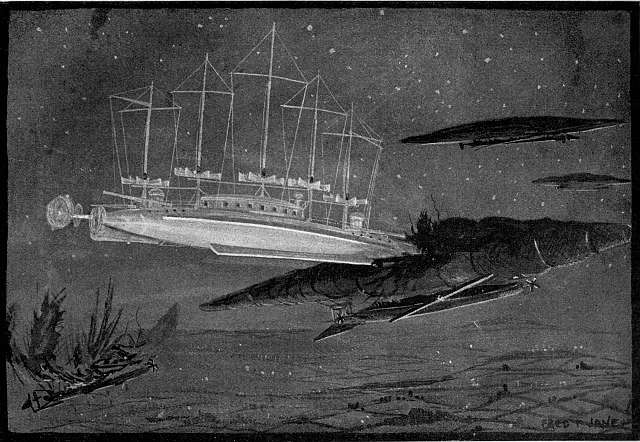
More airships from the "English Jules Verne"

We'll be back to serious blogging in 2025, but for now I'm taking it easy. See you on the other side.

Today's dose of retro-future comes from George Griffith's Olga Romanoff, an 1894 sequel to his 1893 novel The Angel of the Revolution (see last Friday's post). That's a world-destroying comet in the background of the last illustration. Griffith liked a big finish.


Monday, December 30, 2024

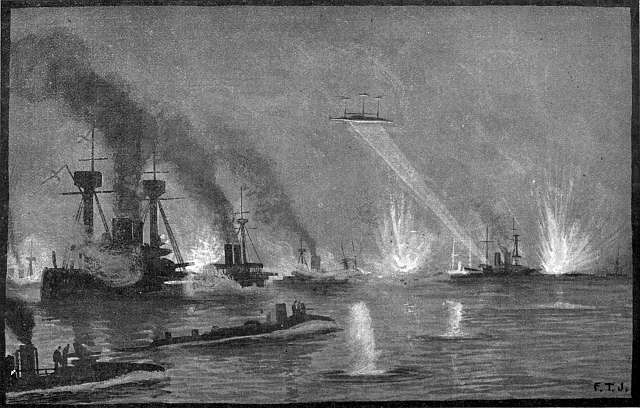
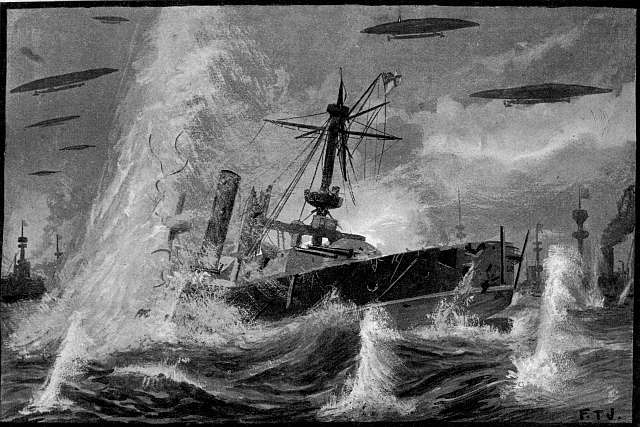
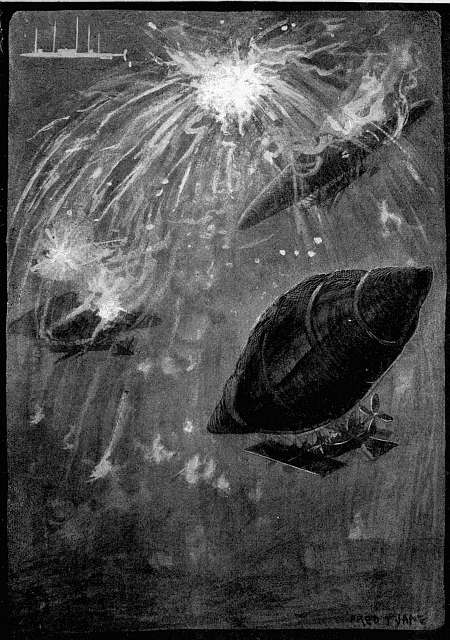
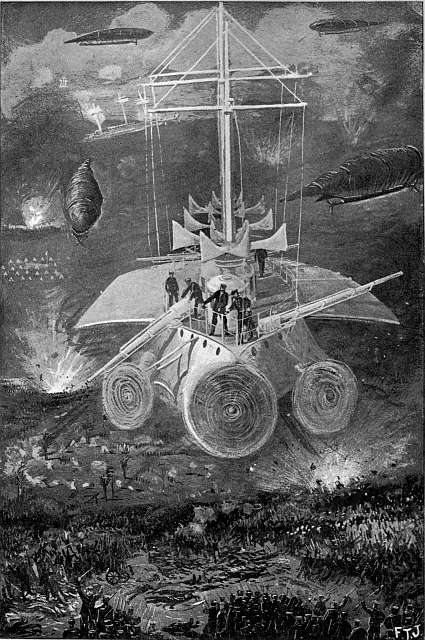
Cool pictures from the "English Jules Verne"

The Angel of the Revolution: A Tale of the Coming Terror (1893) is a science fiction novel by the English writer George Griffith. It was his first published novel and remains his most famous work.
Griffith was hugely successful in his day but is now all but forgotten. I only came across him because he popped up as a featured article on Wikipedia. The modern consensus seems to be he just wasn't that good of a writer. Certainly nothing I saw made me want to read more than a few lines. I did, however, enjoy the illustrations. 

Angel came out seven years after Verne's Robur the Conqueror, which was itself beaten to the punch by Frank Reade Jr., and His Queen Clipper of the Clouds.  All of these were in the helicopter family though dirigibles were also a popular option. I'm sure an actual expert could come up with numerous other examples. The genre even inspired an early UFO mania in the 1890s.

THE ANGEL
OF THE
REVOLUTION

A Tale of the Coming Terror

BY
GEORGE GRIFFITH

WITH ILLUSTRATIONS BY FRED. T. JANE

FIFTH EDITION

LONDON
TOWER PUBLISHING COMPANY LIMITED
91 Minories, E.C.
1894


Friday, December 27, 2024

You should check out Tom Scott

Another YouTube recommendation. 

Scott made an astounding number of entertaining and informative little videos. He recently announced he was taking a break, but with more than 700 already in the can, those new to the channel won't run out any time soon.

"Why sci-fi alien planets all look the same"


"This giant model stopped a terrible plan"

(Students of Post-War hubris will want to read more about the Reber Plan.)


"The UK's last aerial ropeway uses no power, moves 300 tonnes a day, and will be gone by 2036."


"I thought the Schmid Peoplemover was impossible"

Thursday, December 26, 2024

Strandbeesten

Still taking it easy for holidays and posting more cool videos.

Created by Theo Jansen. You'll want to watch this in full screen.


Wednesday, December 25, 2024

Monday, December 23, 2024

I miss CollegeHumor

 We'll get back to the serious stuff Monday, I promise.


My favorite Katie Marovitch sketch.


Friday, December 20, 2024

Thursday, December 19, 2024

Sixties television was filled with heart-warming Christmas episodes often featuring orphans

The Untouchables got a lot of criticism during its original run for its depictions of violence. Can't imagine why.


[Taking it easy with lots of reposts this holiday season but we have big plans for the blog in 2025.]

Wednesday, December 18, 2024

Eight years ago at the blog -- Evangelicals have always been passionate about the war on Christmas. They just used to be on the other side.

[December 1, 2016]

Tom Hanks, creepy CGI Santa Clauses, and the theological canary in the coal mine

I've been making the point for a while now that the evangelical movement that I grew up with in the Bible Belt is radically different from the evangelical movement of today. I was aware that something was changing for a while, but the nature and the extent of the change crystallized for me when I read this 2004 article from Slate:

Next Stop, Bethlehem?
By David Sarno

The Polar Express is the tale of a boy's dreamlike train ride to the North Pole to meet Santa Claus. Like all stories worth knowing, it's rich enough in image and feeling to accommodate many interpretations. Chris Van Allsburg, the author of the book, calls his story a celebration of childhood wonder and imagination. William Broyles Jr., one of the screenwriters of this year's film version, calls it a kind of Odyssey in which a hero undertakes a mythic, perilous journey of self-discovery. And Paul Lauer, who is a key player in the film's marketing apparatus, sees The Polar Express as a parable for the importance of faith in Jesus Christ.

Lauer's firm, Motive Entertainment, is best known for coordinating the faith-based marketing of The Passion of the Christ. Motive helped spread early word of mouth about the filmby holding screenings for church groups and talking the movie up to religious leaders. When The Passion took in a stunning $370 million at the box office, making it the highest-grossing R-rated film in history, Lauer and his cohorts got a lot of the credit. Earlier this year, Motive was hired by Warner Bros. to promote The Polar Express to Christians. But wait, is The Polar Express an evangelical film?

You'd certainly think so, considering the expansive campaign of preview screenings, radio promotion, DVDs, and online resources that Lauer unfurled in the Christian media this fall. This Polar Express downloads page includes endorsements from pastors and links to church and parenting resources hosted by the Christian media outlet HomeWord. There are suggestions for faith-building activities and a family Bible-study guide that notes, for example, the Boy's Christ-like struggle to get the Girl a train ticket. "The Boy risked it all to recover the ticket," the guide observes. "Jesus gave His all to save us from the penalty of our sins."

HomeWord Radio, which claims to reach more than a million Christian parents daily, broadcast three shows promoting the film. At one point, the show's host wondered excitedly if the movie "might turn out to be one of the more effective witnessing tools in modern times." Motive also produced a promotional package that was syndicated to over 100 radio stations in which Christian recording artists like Amy Grant, Steven Curtis Chapman, and Avalon talked about the movie as they exited preview screenings.


Some audience members—and a few Christian film critics—would argue that Santa Claus isn't necessarily a stand-in for Jesus Christ. Last month, Lauer told the Mobile Register that he sees The Polar Express as a parable, "not a movie about belief in God." But when Lauer speaks to a Christian audience, he tells a different story. Lauer told HomeWord Radio that when he asked Robert Zemeckis about all the biblical parallels he was seeing in the film, the director "winked and said, 'Nothing in a movie this big ends up in the script by accident.' " (Zemeckis was traveling and wasn't available for comment.)

This is a spectacular example of getting the pertinent details of the story right and yet completely missing the point. In another piece, the understatement of “Santa Claus isn't necessarily a stand-in for Jesus Christ” would be sharply comic but Sarno seems to be completely oblivious to the joke.

I know we overuse the clip of the minister gunning down Santa in the middle of a children's sermon, but it illustrates an important point.

 [Clip missing because Viacom feels that fair use laws don't apply to them.]

Over the past few years the evangelical movement has abandoned the majority of its most deeply held theological beliefs (think of how doctrinal differences with Catholics and, even more notably, Mormons have been put aside). It is not at all coincidental the beliefs that were abandoned were uniformly inconvenient from a political standpoint. The conservative movement has both weaponized and secularized the evangelical movement with remarkable success.

Traditionally, evangelicals were more concerned with the potential corruption of their own religion (frequently to the point of paranoia) than with what others were practicing. Christmas was a particularly hot-button issue. In the eyes of several good Southern Baptist ministers, the holiday had become unacceptably commercial, cultural rather than religious, and, in many ways, pagan. Most of the music, imagery, and traditions had nothing to do with the nativity, the "reason for the season." Often, this general hostility toward secular Christmas celebrations focused on Santa Claus.

Like many religious practices, the no-Santa rule could look a bit silly when viewed from the outside, but there's nothing unreasonable about adherents of a particular faith wanting to maintain what they see as the original meaning of a religious holiday. Growing up, I found these attitudes and the little lectures that often accompanied them painfully annoying, but, even though I disagreed, I could see where they were coming from from a theological standpoint.

Now evangelicalism is a religious movement stripped of its religious elements. There is no scriptural foundation for tax cuts for the rich, deregulating greenhouse gases, or Donald Trump, but those are the defining issue of the movement of today.

Of course, evangelicals are not monolithic. There are many within the movement, some in positions of authority, who object to these obvious deviations from their original core principles. There are indications that the resistance is gaining momentum, and it is entirely possible that in a few years we will have to rethink our assumptions about evangelical Christians and politics. For now, though, this is a cultural (social reactionary) and political (far right) movement, not a religious one, and trying to think of it in any terms that these is misguided.

Tuesday, December 17, 2024

Lord Peter Wimsey on the enshittification* of Tonka trucks -- a Toys for Tots follow-up

* Being a bit loose with the definition of the term.

[Updated with cooler and longer video clip including Tonka truck as spare tire.]

As mentioned before, I always celebrate Christmas with a Toys-for-Tots haul, looking for nice toys that will stand up to lots of hard play. Metal Tonka trucks were an excellent option and I usually cleared out the store's stock. 

The trucks were originally marketed as being nearly indestructible.


This year through, as I was loading my purchases into my car, I noticed that the trucks (which had been rebranded "Steel Classics") were now almost entirely made of plastic other than the bed.


I also noticed this claim on the box: MADE WITH METAL


This called to mind a passage from Dorothy L. Sayers' Murder Must Advertise.

“Hum!” said Parker. “Pretty extensive injuries for a fall of that kind.”

“So I thought, before I saw the staircase. To proceed. On the day after this occurrence, the sister of deceased sends to Mr. Pym a fragment of a half-finished letter which she has found on her brother's desk. It warns him that there is something of a fishy nature going on in the office. The letter is dated about ten days previous to the death, and appears to have been laid aside as though the writer wanted to think over the wording a bit more carefully. Very good. Now, Mr. Pym is a man of rigid morality—except, of course, as regards his profession, whose essence is to tell plausible lies for money—”

“How about truth in advertising?”

“Of course, there is some truth in advertising. There's yeast in bread, but you can't make bread with yeast alone. Truth in advertising,” announced Lord Peter sententiously, “is like leaven, which a woman hid in three measures of meal. It provides a suitable quantity of gas, with which to blow out a mass of crude misrepresentation into a form that the public can swallow. Which incidentally brings me to the delicate and important distinction between the words 'with' and 'from.' Suppose you are advertising lemonade, or, not to be invidious, we will say perry. If you say 'Our perry is made from fresh-plucked pears only,' then it's got to be made from pears only, or the statement is actionable; if you just say it is made 'from pears,' without the 'only,' the betting is that it is probably made chiefly of pears; but if you say, 'made with pears,' you generally mean that you use a peck of pears to a ton of turnips, and the law cannot touch you—such are the niceties of our English tongue.”

“Make a note, Mary, next time you go shopping, and buy nothing that is not 'from, only.' Proceed, Peter—and let us have a little less of your English tongue.”


Monday, December 16, 2024

Twelve years ago -- serious news outlets were still taking seriously a plan to colonize Mars with a reality show...

And as far as I can tell, none have apologized since then.

Friday, December 5, 2014

Mars One -- libertarian ideology, ddulite fantasies and the decline in journalistic standards

There is a lot to complain about in the coverage of science and technology and, God knows, I do my share of bitching about the way the NYT et al. report on topics like driverless cars. Just to be clear, though, my complaints are generally meant to be focused on specific problems that tech journalists tend to overlook, usually involving issues like implementation, compatibility, scalability and infrastructure. For example, Google's autonomous car is a tremendous piece of engineering, but it currently requires road-data that cannot be gathered cheaply on a large scale. Google appears to have gotten stuck on this and a handful of other problems that effectively keep the technology from being commercially viable.

Most tech stories play out like that. They start with interesting, even promising ideas from smart, serious people, then the journalists covering them either choose to ignore or don't understand the subtleties and caveats. The researchers aren't always completely innocent here -- there's often a temptation to feed the hype -- but in their primary role they are doing respectable work.

Not all of these stories are cases of good research badly reported. Sometimes the rot goes all of the way down with lazy writers uncritically reporting bad technology and questionable science. Elmo Keep is neither lazy nor credulous. Writing for Medium, she has produced a devastating take-down of one of the most notable of these bullshit stories:
I will have to tell him that from everything I can find, Mars One doesn’t appear to be in any way qualified to carry off the biggest, most complex, most audacious, and most dangerous exploration mission in all of human history. That they don’t have the money to do it. That 200,000 people didn’t actually apply. That, with all the good faith one can muster, I wouldn’t classify it exactly as a scam—but that it seems to be, at best, an amazingly hubristic fantasy: an absolute faith in the free market, in technology, in the media, in money, to be able to somehow, magically, do what thousands of highly qualified people in government agencies have so far not yet been able to do over decades of diligently trying, making slow headway through individually hard-won breakthroughs, working in relative anonymity pursuing their life’s work.
I started to excerpt a few paragraphs of Keep's article but you really need to read the whole thing to grasp just how unlikely it is for this enterprise to go beyond the asking for money stage. Every single aspect collapses under scrutiny, from the unrealistic funding model to the wildly optimistic cost estimates to the nonexistent specs and contracts to the unresolved technical issues.

There is no excuse for a respectable news organization to treat this as a serious and yet we still get articles like this from Vibeke Venema and the BBC:
Could you leave everyone you love for the chance to settle on Mars? Sonia Van Meter describes herself as an "aspiring Martian" - she hopes to be one of the first humans on the planet in 10 years' time. But it would mean never seeing her husband again.

"I don't think you can apply for something like this and not be the tiniest bit insane," says Sonia Van Meter. "But this is the next great adventure, and I'm going to do absolutely anything I can to be a part of this."

The 35-year-old political consultant from Austin, Texas, is one of 705 people in the running to form a 20- to 40-strong human colony on Mars - a group whittled down from 200,000 who sent applications to Dutch not-for-profit organisation Mars One last year.

"I thought: 'Shoot, this sounds like fun!'" she says. "I didn't think there was the slightest chance that I would be selected, I just wanted to be a part of it."

For her husband Jason Stanford, her application - and the fact that she now appears to have a 35-to-one chance of leaving forever - evoked mixed emotions.

"Like any good red-blooded American male, at first I thought this was all about me. I thought: you're leaving me," he says.

Over time he changed his mind. "The more she talked about it, the more I realised she was doing this for the right reasons - she was doing this to show humanity what we can all do if we work together," he says.
There is one quick cover-your-ass 'if' buried deep in the piece ("The mission, if it goes ahead, will be dangerous, some say suicidal."), but even in that single brief sentence, the possibility of it not happening is just an aside. There is no real effort to put this in a realistic context. Instead, we're given figures like that 35-to-one chance; it's almost certainly false but it makes for a good story.

The press likes to maintain the convenient fiction that it is "open to all voices." This is an obviously absurd proposition – – even though the Internet has greatly expanded what news organizations like the BBC can offer, they can still only cover a tiny fraction of the information and opinions out there – – but it serves the purpose of absolving journalists and, more to the point, editors and publishers from taking responsibility for what they present to the public.

When something appears in a major news outlet, particularly when it is presented noncritically, that outlet is implicitly endorsing the story; it is, in effect, saying that this story is something important enough to spend time learning about. I have seen numerous stories on this proposed Mars One mission but Keep's article is the first of those to make any real effort to address the sheer silliness of the proposal.

Friday, December 13, 2024

And you thought the space hotel was embarrassing*


From CNN:

Now an Austrian company wants to extend this opportunity for deep-dive delights to the world of superyachts, by building customized private submersibles that can descend 250 meters (820 feet) beneath the ocean surface and remain submerged for up to four weeks.

Migaloo has revealed its ambitious plans for what it claims will be the “world’s one and only private submersible superyacht,” offering “a not-yet-existing alternative to large privately owned surface vessels.”

This submarine, named M5, would measure 165.8 meters in length and 23 meters across at its widest point, with a range of around 15,000 kilometers and a speed of up to 20 knots when surfaced (or 12 knots when underwater). However, says Migaloo, “The wished dimensions of the submarine-yacht hybrid, the exterior styling and the interior design are up to the owners’ preferences.”

So, like any billionaires’ superyacht worth its salt, the default design includes a helipad, a swimming pool and spa, a gym, art gallery cinema, party area with DJ booth, along with plenty of spaces to lounge or dine. Optional extras include a hot air balloon and underwater shark-feeding station.

 It's also a practical place to keep your valuables in case of pirates, solar flares, pole shifts.

Also suitable for Ice Station Zebra cosplay.


CNN had lots of competition on this story.


It took me at most ten minutes on LinkedIn to establish that this company claiming it could design and build the civilian equivalent of an Ohio class submarine was a transparent fraud. This company doesn't have the resources to design a functioning toy sub for your bathtub.


Amber DaSilva of Jalopnik had the same thought, pointing out that CEO Christian Gumpold was the only listed employee. DaSilva also went the extra mile and dug up more than anyone needed to know about the company.

Migaloo’s website dates back to 2013, according to WHOIS records, but the oldest version archived is from 2015. Back then, the company was offering “submersible superyachts” in cooperation with a company called Starkad Technologies OÜ, which provided “technical development.” Starkad does show up in Estonian business records, but the company’s 2023 annual report shows just one employee — and an annual operating budget of just under $2,700. The company’s official contact email is a Hotmail account. 

...

Rather than creating actual submarines for the world’s richest few, Migaloo appears to create pictures of submarines for magazines read by those richest few (and, of course, NFTs.) It’s unclear what the company would even do if a Bezos or a Musk called them up with $2 billion in hand — it’s unlikely a single person in Estonia could actually assemble anything the company proffers.


 The standard comeback is what's the harm? Some guy creates some silly images borrowed from a post-war issue of Galaxy magazine and we all have fun pretending. The trouble is our weakness for hoary sci-fi fantasies, our willingness to accept laughable pitches for obvious snake oil has created large fortunes for con artists, diverted resources from promising tech and real solutions, and distorted our sense of the future.

And the CGI really isn't that good.

*OK, maybe this is more embarrassing.