Wednesday, February 21, 2024

Josh Marshall eviscerated Ezra Klein, but he did miss one or two major organs

Marshall is a common ground kind of guy so it is unusual for him to go after a colleague, particularly in one as respected as Klein without conceding that at least one are two secondary points have some merit, but he's not giving any ground here ("No. Ezra Klein is Completely Wrong. Here’s Why.")and quite rightly so.  Barring a few examples from writers with obvious ideological axes to grind, this may be the worst piece of political analysis I have ever seen from the New York Times, a paper which in recent memory has told us that Obama was toast in 2012, Trump couldn't possibly get the nomination in 2016, DeSantis was unstoppable in 2022, and Nikki Haley was building up real momentum in late 2023.

Klein starts out by arguing that Biden has been an excellent president and is completely up to the job, strongly implying, perhaps even saying outright (I'd need to go back and double check) that he is the best choice for governing.  This goes on for about a third of the essay before taking a sharp left turn and claiming that our only hope of keeping Trump of the White House is for Biden to step down and to have the Democratic nominee decided by what Josh Marshall calls a thunderdome convention.  

I use the word claim because you can't really call this an argument.  It is, at best, an argument-shaped thing like what you might get from chat GPT on a bad day.  It is a concatenation of strawmen, anecdotes that don't actually address the matter at hand, and underwear gnome planning.  Probably the most interesting and possibly important aspect of this essay has little to do with the points being made in the original piece and more to do with how something this bad could be penned by someone as intelligent an experienced as as for climb and how so many otherwise smart people could take it so seriously.

I'll try to come back to that in another post.  For now, there are a couple of major flaws with the thunderdome argument which Marshall does not get around to addressing (and you really should read Marshall's piece before going any further).

Let's start with Klein's description of how he thinks the process might go:

Still, it is the party’s job to organize victory. If Harris cannot convince delegates that she has the best shot at victory, she should not and probably would not be chosen. And I don’t think that would rip the party apart. There is a ton of talent in the Democratic Party right now: Gretchen Whitmer, Wes Moore, Jared Polis, Gavin Newsom, Raphael Warnock, Josh Shapiro, Cory Booker, Ro Khanna, Pete Buttigieg, Gina Raimondo [Be honest. Was I the only one who had to look this one up? -- MP], Alexandria Ocasio-Cortez, Chris Murphy, Andy Beshear, J.B. Pritzker — the list goes on.

Some of them would make a run at the nomination. They would give speeches at the convention, and people would actually pay attention. The whole country would be watching the Democratic convention, and probably quite a bit happening in the run-up to it, and seeing what this murderer’s row of political talent could actually do. And then some ticket would be chosen based on how those people did.

Could it go badly? Sure. But that doesn’t mean it will go badly. It could make the Democrats into the most exciting political show on earth. And over there on the other side will be Trump getting nominated and a who’s who of MAGA types slavering over his leadership. The best of the Democratic Party against the worst of the Republican Party. A party that actually listened to the voters against a party that denies the outcome of the elections. A party that did something different over a party that has again nominated a threat to democracy who has never — not once — won the popular vote in a general election.

That seems like an OK contrast to me.

The might-not-go-badly standard isn't all that reassuring, especially given that in 2024 bad = disastrous. One could argue that the 1968 Democratic Convention was the most exciting political show on earth. Bitter fights and deep rifts make for great ratings. Klein acknowledges that '68 was a disaster, then waves away the possibility of history repeating itself despite a militant anti-war faction once again being a problem for the party.

Given this and all the other ways that a thunderdome convention can go badly, I'd personally give the possibility of a dumpster fire better than even money, but even if the convention goes smoothly, is this process likely to give us the most electable candidate? 

There are lots of reason to be skeptical, but I'll focus on just one, vetting. Who on that "murderer’s row of political talent" has the nation actually taken a good look at?  Booker, Buttigieg, and Ocasio-Cortez are the only names that jump out at me. The there are a couple of famous unknowns, Whitmer and Newsom, politicians who have been widely seen but not widely scrutinized.

Like most people, I don't actually know that much about Whitmer, but I have had a chance to study Newsom and, as mentioned before, vetting is not his friend.

Really not his friend.


Newsom can't be the only one on Klein's list who looks better from a distance, but how likely are we to be able to distinguish the gilded from the gold in a few rushed and chaotic days driven by an ever growing sense of panic and guided by a press corps that has gotten virtually every major political story wrong for the past decade or so?

Tuesday, February 20, 2024

Libertarianism

This is Joseph.

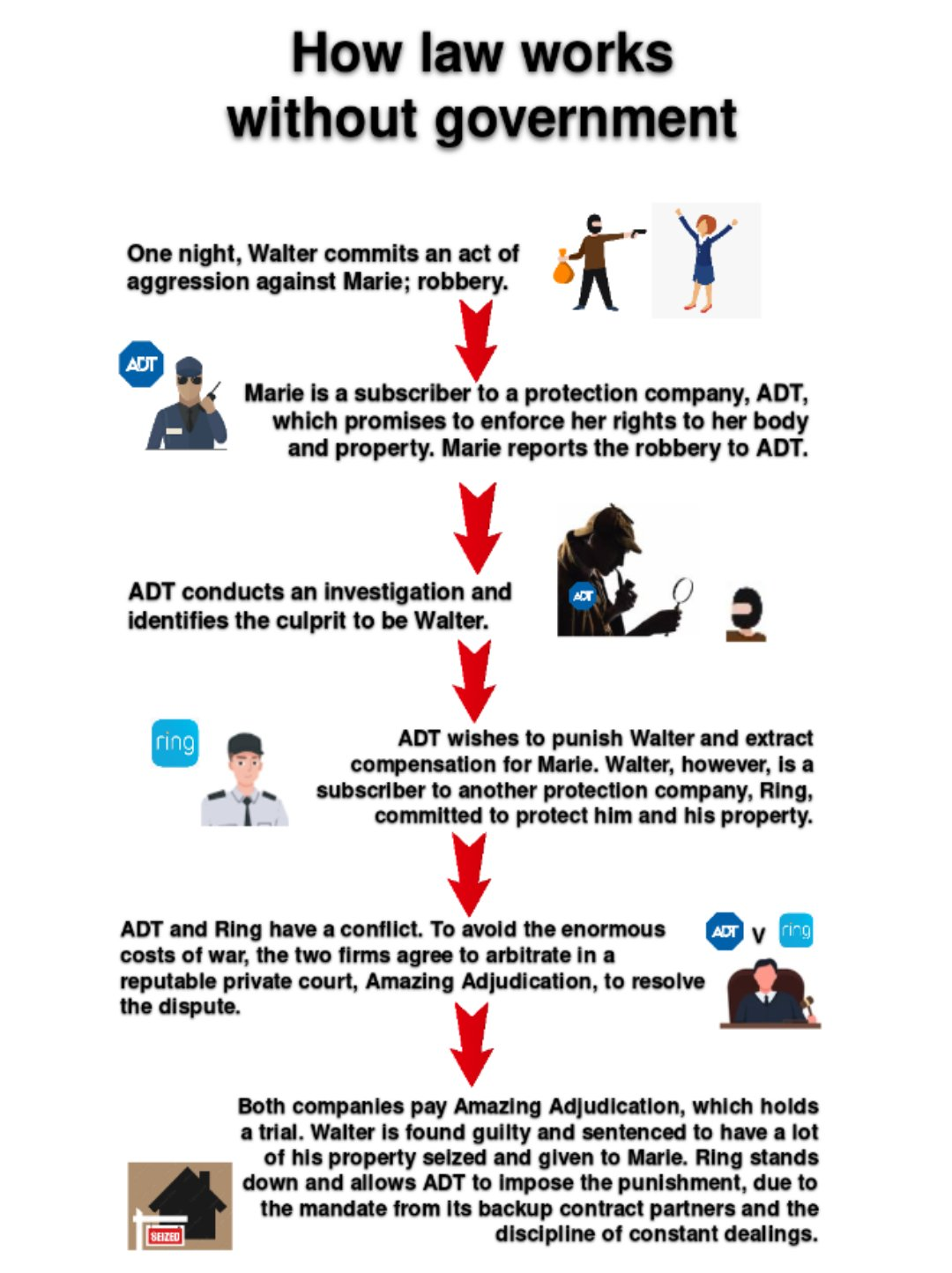
This little chart has been making the rounds


It is so incredibly naive about how the world would actually work. It basically presumes that you can pass the duties of government to private corporations. Here are just a few of the obvious failure points:

  1. It presumes that Ring and ADT (the private security companies) are relatively equal in strength. Otherwise war (or just refusing to participate) might be cheaper. What if it is suicidal for ADT to attack Ring for one subscriber?
  2. It presumes that the investigation will be fair given that information may not be shared and that the Walter character is able to be investigated by an outside company. 
  3. Relevant to point one, it presumes that one company getting larger will not end up dominating the market. Once a company is large enough, it can start ignoring the smaller companies so everyone needs to subscribe to the big one. This is a failure point of decentralized legal systems (e.g., Medieval Iceland) across history. 
  4. It assumes that anybody involved cares about a fair arbitrator. What if they are unfair? What is the recourse?
  5. In the end, the other key point is that you need a regulated market to enforce all of these contracts. Who is regulating the market? Because if it is the government then you don't need the companies. 
  6. Relevant to point 5, just refusing to pay is a hard thing to counter in this set-up. What if Ring decides that it is good for its marketing not to allow Walter to be punished? Don't we end up in a war? 
  7. Finally, this is a recipe for fragmentation. The whole idea of personal loyalty, reputation, and interpersonal connections is how the middle ages worked. It's going to struggle if it meets a unified state. It's also a terrible idea for a large country (like the United States). It isn't an accident that decentralized law shows up in Iceland. By 1700, the population was only 50,000 (which is smaller than a small US city) which makes a fragmented personal relationship society much more viable (the whole country is one large town). 
Anyway, this was so bad I felt the need to add comments. But as the original post noted, this was demolished by the original libertarian theorists, who were well aware of how warlords and criminal gangs worked. 

Monday, February 19, 2024

To Russia, with Love

As previously mentioned, the GOP has spent a couple of weeks being very nice to Vladimir Putin, between tossing Ukraine to the wolves, threatening NATO, and Tucker Carlson wrapping up his Russia, land of enchantment series.


Though it should be noted, this has created some surprising rifts within the party.


And sadly, this MAGA love has gone largely unrequited.


That's where we were last week. With a handful of exceptions, the party had very publicly gone all in on Russia, which made it a particularly bad time for Putin to shock the world with an especially evil act like...


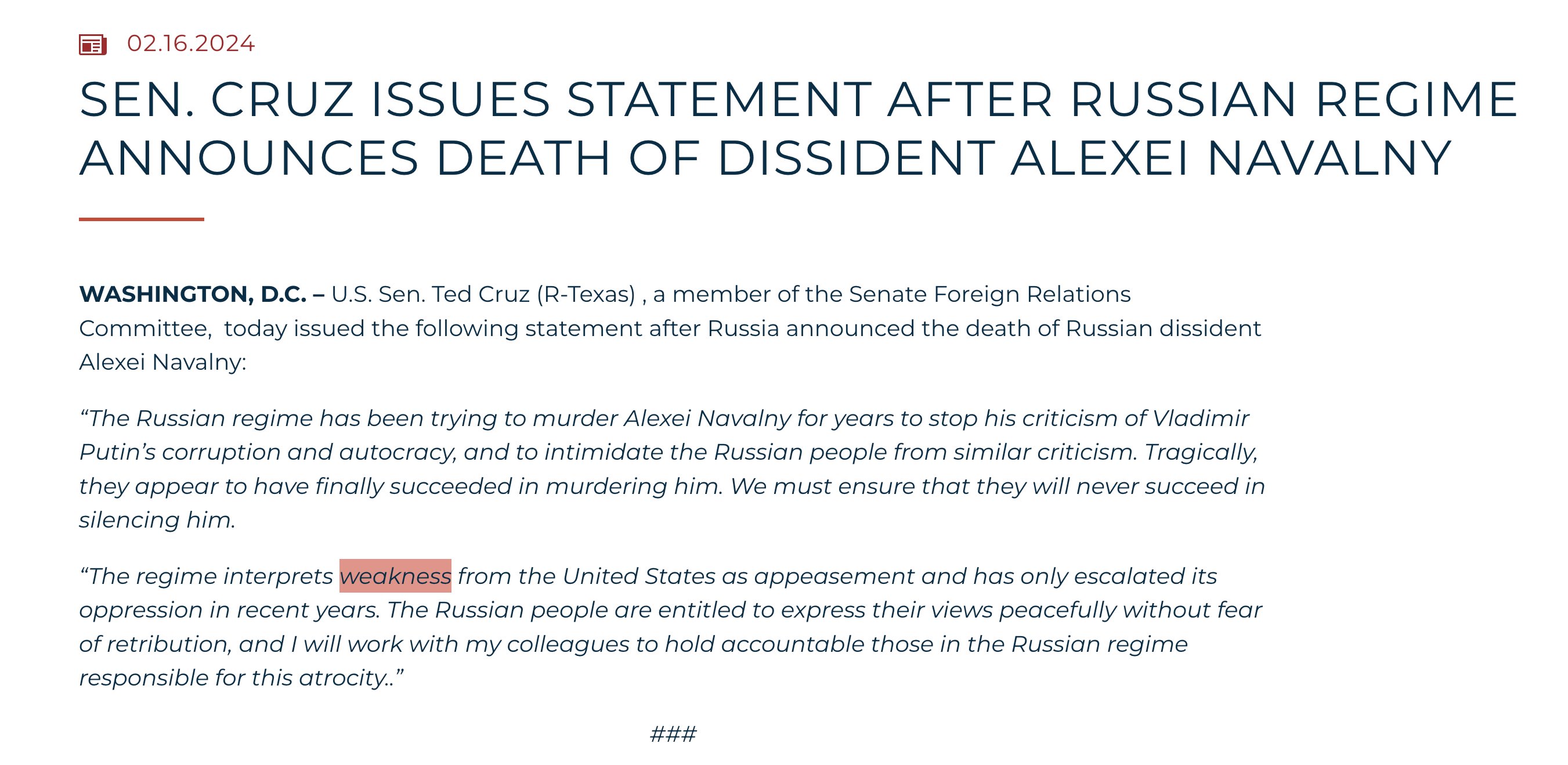
Republicans (with the aforementioned handful of exceptions) have responded with one of the following:

1. Deafening silence


2. What murder?


3. Yeah, but what about Biden?

As noted by Bradley P. Moss "Navalny was poisoned on Trump’s watch, and imprisoned again on Trump’s watch."


On a related note,the horseshoe tip of the far left has weighed in.


And finally...

4. Good riddance to a woke Nazi


Noted Brexiter.

Murdoch favorite.

We'll close with this reminder of where the Republican Party used to be. .

Friday, February 16, 2024

Performers have been complaining about political correctness for a long time

I have to confess I was never that big of a fan of Freberg. While clever, compared to his contemporaries Bob and Ray and the Goons, his material feels dated, but perhaps for that reason, his work gives a much better read on the post-war era.

1957 Stan Freberg - Elderly Man River (with Daws Butler & Billy May orch.)


Thursday, February 15, 2024

Bothsides is an easy way to score points but ignore the main points

This is Joseph.

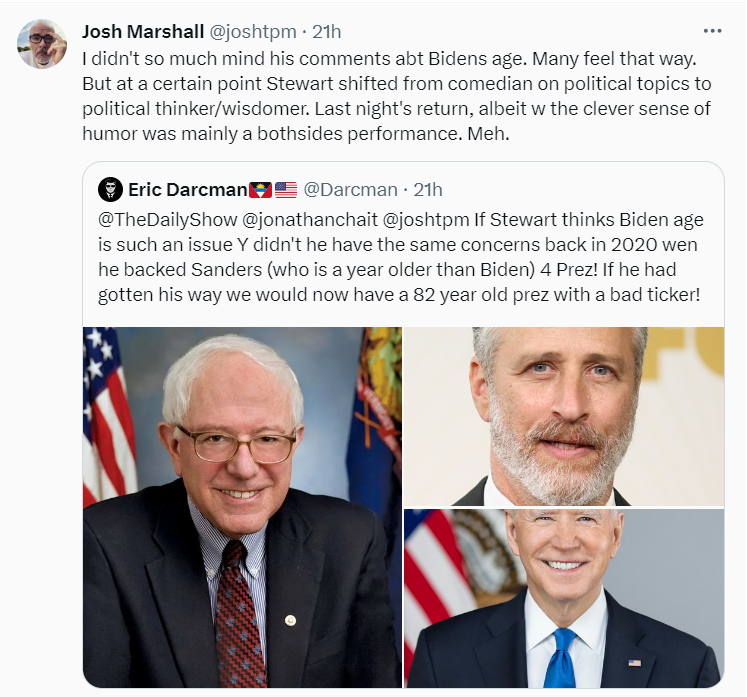
I am a bit puzzled at the recent discourse going into the next US presidential election. Here is Jon Stewart managing to create an equivalence narrative between Joe Biden and Donald Trump:


It is not that the Biden age issue isn't a point. I am getting older and it is sad to see my options and opportunities go away. I think, though, that the policy stakes are being really underplayed here and the focus is instead on the one issue that the two parties can both be criticized on.

Mark pointed this post out:


It's a little harsh but not completely unfair. 

Here is Josh Marshall:

The challenge of Bothsideism is that it makes you look wise and considered but at the cost of obscuring the issues. Ironically, the best line of attack here has been from Nikki Haley who has tried to portray both candidates as too old in the context of nominate her and not Trump. It probably isn't a terrible argument for a partisan Republican to make (highlighting her strengths) but the argument about age ignores many other contentious issues that the Trump presidency raises. 

I hope that we see better in the days to come. 

Wednesday, February 14, 2024

When threads collide...

This New York Magazine profile hits lots of our old friends.

There is, of course, Bill Ackman.

Then there's Avi Loeb, formerly noted astrophysicist, now UFO loon.

Plus Vivek Ramaswamy and Robert F. Kennedy Jr.

That night, Ackman and Oxman hosted a dinner at their Upper West Side apartment, a gathering of World Minds, an “invitation-only community” funded by the media conglomerate Axel Springer that is a kind of rotating series of Davos-lite dinner parties — the kind of places where VIPs discuss the world’s problems over cocktails (Oxman is a member of the group’s advisory board). The featured guests were two members of the World Minds network: David Petraeus, former CIA director and current partner at the private-equity firm KKR, and Avi Loeb, an Israeli astrophysicist at Harvard. The war in Gaza had been raging for a month, and Petraeus gave a dispiriting talk about the broader geopolitical fallout. Later in the evening, in a call for dialogue among different tribes, Paola Antonelli, a curator at MoMA, offered a thought. “Love the aliens!” she said.

Loeb took the idea and suggested looking for hope from above. “My personal belief is that the Messiah will arrive, not necessarily from Brooklyn, as some Orthodox Jews believe, but rather from outer space,” Loeb told the group. The extraterrestrial Messiah’s message, he said, would be to stop fighting over territory here “because there is much more real estate available throughout the universe.” Back on Earth, Loeb listened while Ackman said he was hopeful that Gay would respond to his letter. “I’m a theoretical physicist, so I get paid to make predictions, and I said to him, ‘I don’t think you will,’” Loeb told me. “The last thing Harvard would do is admit their mistakes.”

Ackman believes that our lives are often fated from birth. “I have a view that people become their names,” he told me. “Like, I’ve met people named Hamburger that own McDonald’s franchises.” We’d been talking for nearly an hour and a half when Ackman asked me what my name was, hoping to offer a diagnosis. After he seemed momentarily stumped by my surname, I offered him my first name, which he misheard as Reed. “Read … write,” he said, before turning back to himself. “So, my name is Ackman — it’s like Activist Man.”

...

On Martin Luther King Jr. Day, Ackman joined a Twitter Spaces conversation with Elon Musk and Dean Phillips, the Minnesota representative running a long-shot campaign against Joe Biden for the Democratic nomination. Ackman had endorsed Phillips, and he told the 20,000 listeners, including the accounts for Marjorie Taylor Greene and @EndWokeness, that he was “ashamed” of today’s Democratic Party. He has predicted that Trump will win if Biden is the Democratic candidate. Before settling on Phillips, Ackman had looked for alternatives in Harvard graduate Vivek Ramaswamy, Harvard graduate Robert F. Kennedy Jr., and Harvard graduate Jamie Dimon, whom he had encouraged to make a run. Would Ackman, another Harvard graduate, ever consider running himself? Some of his friends think he might. “He’s going through a period of growth — a period of expansion — because it turns out this political activism is quite fun, and I believe the adulation he feels will push him to do a lot more of it,” the longtime Ackman associate told me. “I wouldn’t be surprised if we see him running for office. And if you ask what office, you don’t know Bill Ackman.” Ackman himself said in December that “if the country wanted me at some point, I would be open to it.”

The profile also links to a fun Vanity Fair piece that includes the following.

“Ackman seems to have this ‘Superman complex,’ ” says Chapman Capital’s Robert Chapman, who was one of the investors on the other side of Ackman’s bet. “If he jumped off a building in pursuit of super-human powered flight but then slammed to the ground, I’m pretty sure he’d blame the unanticipated and unfair force of gravity.”


Tuesday, February 13, 2024

High-speed rail circa 1907

An interesting look at how people looked at advances in transportation around the turn of the last century. From the 1907/03/09 Scientific American. [Emphasis added]


Monday, February 12, 2024

If your mental model of the 2024 far right doesn't address their infatuation with Putin, you need to go back to the drawing board.(told in tweets)

(The far left tankies' continued loyalty is a topic for another day.)


This is a good place to get up to speed on the interview itself.
And now on to the reaction, starting with a couple of US senators.


Friday, February 9, 2024

Are you ready for some football (-related insane conspiracy theories)?

A reminder that when you talk about politics in 2024 this is today's GOP.


Johnson is not a fringe figure. He has millions of followers...

... and has been on the staff of the following:

Breitbart

The Blaze

BuzzFeed

The National Review

Independent Journal Review (IJR)

The Daily Caller.

Newsmax


Nor is he the only prominent Republican pushing bizarre Swift/Superbowl conspiracies.


To be fair, not all of the crazy reaction are Biden-focused.


Thursday, February 8, 2024

Breaking the rules with "one simple trick"

This is Joseph.

One under-rated part of the Donald Trump phenomenon is how he seems to be able to flout rules and norms rather aggressively. He skips debates, for example, and still has no trouble winning the nomination. As a result, this has led politicians to start trying to ignore norms, as well, in hopes of being able to pull this type of immunity from rules off. Let's look at two examples of how it is working.

Lauren Boebert has a problem. She won her district (Colorado 3rd) by a thin margin (50.08% to 49.92%) against a strong challenger in a non-presidential year where Republicans tend to do better. Then she had a number of public events that tarnished her image -- such as an incident during a play. That means she'll have less favorable odds and a new scandal to dilute support. Even worse, this opens up room for a primary challenge in her own district. So what does she do? Why not simply switch from a safe Republican district to an even safer one, replacing somebody who is retiring. That way she will benefit from the partisan leanings of the district to overcome these obstacles (and maybe draw a weaker challenger). So how is is going?

Not well:
She got 12 votes in the poll, according to The Denver Post. Logan County Commissioner Jerry Sonnenberg topped the poll with 22 votes, followed by State Representative Mike Lynch with 20, conservative radio host Deborah Florida with 18 and State Representative Richard Holtorf with 17.
Now maybe she will prevail on name recognition (although that could be a two edged sword) but it isn't an optimistic start among the insiders in her new district. The primary is the real battle here and there are now four people who see beating her as a chance for a long term congressional role. 

On the other side of the isle we have Krysten Sinema. Facing a serious primary challenge after she alienated her own party in a high profile way, she switched to independent. No more primary. The democratic party does work with independents (Bernie Sanders and Angus King) so it looked like a smart move. But the trick to being an independent is to be vastly personally popular. It is the same way that Lisa Murkowski managed to survive as an Alaskan senator. Instead, she left the party without a solid well of support, gambling that Democrats would cede the field to prevent a vote split that would give the seat to the GOP. 

So how is this going? Well, she is way behind on even getting on the ballot:
The report also revealed Sinema had spent no money on signature-gathering through the end of 2023. To qualify for the ballot as an independent, she needs to get 42,303 valid signatures by April 8, according to Arizona’s secretary of state office ― a task Arizona Democrats think only gets harder by the day.
Her press is focused on her spending and lack of fundraising. Her numbers are rough. To pick a recent poll, we have Gallego (D) 39%, Lake (R) 40%, and Sinema (I) 13%. Obviously there are things that could happen. Perhaps Sinema finds a way to get the Republican nomination? But the odds are very much not in her favor. It's like Nikki Haley versus Donald Trump -- it isn't that victory is impossible but that the path to it is very, very narrow and almost certainly involves a serious lucky break (or, more like 5 or 6 lucky breaks).

Anyway, it remains the case that the Donald Trump story is not a sign that all political rules are gone. Instead it is the much older story that a dedicated political following and a strong base of support allow for greater freedom of action. Without that, all of the rules of political gravity re-emerge.  


Tuesday, February 6, 2024

If you want to save the planet, start by learning how to use your damned microwave

Americans have a problem with solution phobia. We have become like children, fascinated with the toy weave just heard about but utterly disinterested in the ones we actually have. Another analogy might be the person who is convinced that the next piece of exercise equipment they buy will make them lean and toned while a ton of perfectly good equipment is collecting dust and spider webs in the garage.

Or in this case, the kitchen.

Microwaves may well be the most misused and under used cooking methods in most households. For starters, they are wonderfully energy efficient.

From CNET


And that doesn't count the double whammy of using an oven in the summertime.

The other great upside of the microwave is that it annoys foodies, a group that has been on a crusade to make cooking as expensive, inaccessible and onerous as possible. I've noticed that people who really know about food seldom have this mindset, particularly when it comes to making things faster and easier. 

This video from the reliable America's Test Kitchen is a great example. I thought I was fairly knowledgeable on the subject but I learned a lot, including the fact that microwaves don't work on ice and that you can use them to fry foods.


While we're on the subject, I never would have thought about poaching eggs in a microwave, but the people at the Good Housekeeping test kitchen did, and they were surprisingly happy with the results. 

And, yes, bacon (just don't mess with anything labeled "as seen on TV").


In addition to the video above, America's Test Kitchen appears to have done a whole episode on the subject. Here's an excerpt.


Monday, February 5, 2024

Twelve years ago at the blog -- Amity and the Bunnies

For a while there, Amity Shlaes was everywhere, from the Daily Show to Marketplace. More recently, her star seems to have faded somewhat with her career settling into comfortable conservative media sinecures with organizations like the National Review. Her arguments seem to be largely the same more than a decade later, though to be honest, I didn't feel motivated to look that closely this time.


Wednesday, February 1, 2012

Block that metaphor!

Marketplace has been looking for a conservative commentator to replace David Frum. Here's an excerpt from Amity Shlaes' latest audition:
Obama wants to reward companies that create jobs here in the United States. One of the carrots is a tax credit for companies that move operations back here. Another would double tax breaks for high-tech factories making products here.

These are juicy carrots. But the sticks put forward by Obama are hefty. The president wants to eliminate a tax break for moving expenses when a company ships operations overseas. He also wants to close a tax loophole that allows companies to move some types of profits to overseas tax shelters.

The president figures that businesses will tolerate the pain of the sticks for the reward of the carrots. He thinks if he pokes the stick in one corner, they'll hop over to the corner where the carrots are.

But the trouble with this argument is that the U.S. economy is not a rabbit cage. And business people -- entrepreneurs especially -- don't respond well to prods from a stick. Any stick. If they get a glimpse of the rod, they'll leap away for sure -- but it might just be to somewhere outside the United States. Our cage. And the carrots of cheaper labor there overseas might even be tastier.

Maybe the president is forgetting the goal, which is making the economy grow faster. Enough carrots, and businesses will grow. And they'll create jobs. But pick up even just a few sticks, and you won't get recovery. Instead, we'll all be looking at an empty cage and asking: Where are the rabbits?
Putting aside the argument that eliminating "a tax break for moving expenses when a company ships operations overseas" will encourage companies to ship operations overseas (is there a paragraph missing somewhere?), what caught my eye was the way Shlaes tortures this poor metaphor.

It doesn't help that the proverbial carrots and sticks were used to motivate proverbial mules and other large and stubborn beasts of burden. As an old country boy, I can tell you that getting big animals to go where they don't want to go is a challenge. I haven't had that much experience with bunnies, but I have to think it's a bit less daunting. I don't even believe I'd need a stick.

But Shlaes' odd allegorical choice is in keeping with the even odder dichotomy in the way conservative rhetoric has come to treat entrepreneurs and business leaders. Half the time they're bold and decisive figures, the spiritual descendants of our frontier forefathers; the rest of the time they are as delicate as a hothouse flower and as timid as a woodland creature (like, for example, a rabbit).

Shlaes has entrepreneurs leaping away at just "a glimpse" of a rod (and given that she describes closing a couple of tax loopholes as "hefty" penalty, it's fair to say that she really does mean it when she says any stick). Other conservative commentators have speculated that business leaders are slow to invest because they can't deal with the uncertainty caused by a possible return to Clinton era tax rates. We've even heard some argue that the recovery was slowed because the president keeps saying hurtful things about bankers and CEOs.

It's a bit like Dr. Jekyll and Mr. Hyde but with John Galt and Elmo.

Marketplace really needs to get Frum back.


Thursday, February 1, 2024

You notice how we haven't had an embarrassing UFO story for a while?

That doesn't mean they haven't been happening.

From Jason Colavito:

This week Carlson launched a subscription streaming service for his own far-right content, complete with a logo designed after the “red pill” MAGA enthusiasts use to symbolize right-wing radicalization. To promote the service, Carlson appeared on Redacted, a right-wing podcast hosted by Clayton Morris, a former Fox News anchor. During the discussion, Morris said that he and Carlson used to discuss UFOs when both worked at Fox News.
 
Carlson told Morris that the UFO story was one of only two that “bothered” him and left him with unanswered questions that ate at his soul. He said that he believes UFOs are non-human craft. He called the story spun by ufology “dark” and suggested that he believes there are unexposed levels of conspiracy and evil beyond the mythology of flying saucers. Carlson said that there is a “spiritual component” to UFOs and implied that he thinks they may be demons. 

...

Carlson went on to cite “paintings” and ancient texts in revealing that he is an ancient astronaut theorist and implied that the “darkness” had something to do with the suggestion that humanity was created or controlled by what are presumably demons. Carlson previously appeared on Ancient Aliens and has frequently played host to prominent UFO advocates, including Lue Elizondo and Garry Nolan.


Wednesday, January 31, 2024

Willy Wonka and the money-printing machine

[more January IP blogging]

I noticed this box of cereal the other day while shopping. My first thought was they are still squeezing money out of a 50 year old film and the image of a star who has been dead since 2016


 [Next to a box of cereal featuring sixty year old cartoon characters, but that's a topic for another post.]


The example was even more striking after I did a little research. This wasn't just a fifty-year-old film; it was a fifty-year-old flop.


The idea for adapting the book into a film came about when director Mel Stuart's ten-year-old daughter read the book and asked her father to make a film out of it, with "Uncle Dave" (producer David L. Wolper, who was not related to the Stuarts) producing it. Stuart showed the book to Wolper, who happened to be in the midst of talks with the Quaker Oats Company regarding a vehicle to introduce a new candy bar from its Chicago-based Breaker Confections subsidiary (since renamed the Willy Wonka Candy Company and sold to Nestlé). Wolper persuaded the company, which had no previous experience in the film industry, to buy the rights to the book and finance the picture for the purpose of promoting a new Quaker Oats "Wonka Bar".

 ...

Willy Wonka & the Chocolate Factory remained in obscurity in the years immediately following its original release. When the distribution rights lapsed in 1977, Paramount declined to renew, considering it not viable. The rights defaulted back to the Quaker Oats Company, which was no longer involved in the film business, and therefore sold them to Warner Bros. for $500,000. Wolper engineered the rights sale to Warner, where he became a corporate director after selling his production company to it the previous year.

By the 1980s, the film had experienced an increase in popularity due to repeated television broadcasts, and gained cult status with a new audience in home video sales. In 1996, there was a 25th anniversary theatrical re-release which grossed the film a further $21 million. In 2003, Entertainment Weekly ranked it 25th in the "Top 50 Cult Movies" of all time. The tunnel scene during the boat ride has been cited as one of the scariest in a film for children, for its surreal visuals, and was ranked No. 74 on Bravo's The 100 Scariest Movie Moments. The scene has also been interpreted as a psychedelic trip, though director Stuart denied that was his intention.

...

Willy Wonka & the Chocolate Factory was released by Paramount Pictures on June 30, 1971. The film was not a big success, eventually earning $4 million worldwide on a budget of $3 million, and was the 24th highest-grossing film of the year in North America.

A few important points here both about the business of entertainment and about why most of the coverage of that business is so bad.

First off, every story of this industry is an IP story, both in who owns it and the curve of its money-making potential. Warner picked up the rights to this film for what was, even at the time, a song. Since then it has grown far more profitable and, to point out the obvious, that's all gravy. You don't need to spend any money on production or acquiring rights and, in a sense, its advertising budget is negative since you get paid for product placements to keep it in the public eye.

As we've discussed before, certain intellectual property has legs. It will continue to produce, often becoming even more popular, for decades after its creation. It is no coincidence that every few years armies of lobbyists from Disney and other big media companies descend upon Washington to get Congress to push back the expiration dates on copyrights.

Certain properties remain culturally relevant seemingly forever, and that relevance translates to multiple streams of revenue. They will be sold directly, remade or covered, streamed, licensed, and will serve as the basis for derivative works.

Universal's Frankenstein is over ninety years old and you will still see Jack Pierce's copyrighted makeup every Halloween. At the height of the pandemic, people watched over a billion hours of the  Andy Griffith Show, a series that ran from 1960 to 1968. Artists are constantly covering the songs of Hank Williams, a songwriter who died seventy years ago. Frankenstein, The Andy Griffith Show, and Hank Williams catalog were all enormously profitable at the time (Griffith was the number one show in the country the year it went off the air), but all ended up making far more money afterwards.

Looping back to the original subject, one place where one frequently finds IP with legs is the children's market. Kids are voracious consumers of media, have an extraordinary tolerance for repetition, and are frequently not all that discerning. Better yet, if your target audience is any age band Under 10, every few years it will completely refresh itself so you can just haul out the same old product. In one notorious example, Hanna-Barbera would crank out a single season of shows like The Jetsons, Johnny Quest, or Space Ghost and then run them in constant rotation on Saturday mornings for decades.

Television basically created the children's market, but it was home media that cranked it into high gear. I remember an interview with Robert Altman where the director of films like mash, McCabe and Mrs Miller, Nashville, and the Player said the film that had made him the most money was Popeye.

 Journalists covering the streaming industry, particularly East Coast based journalists, have done an embarrassingly bad job with the IP aspect of the industry, which is probably the single worst thing they could screw up. Disney and Warners lost billions saturating the market with expensive shows that provided little incremental value -- how many additional subscribers do you think the $150 to 200 million investment in Moon Knight brought in? - - while the majority of viewers were there for their already incredibly rich catalogs. At the same time, these journalists did a piss poor job reporting on which "Originals" Netflix actually owned the rights to and, perhaps more importantly, how few of the shows that they did on had any kind of legs.

Tuesday, January 30, 2024

Twelve years ago at the blog -- The Devil's Candy with added Kael

We were talking a lot about education costs at the time so the analogy of cost spirals was a bit more obvious then than it is now. 

A few years after posting this, I came across this passage from a Pauline Kael essay spelled out that what went wrong with Bonfire a decade before the film was made.


Monday, January 30, 2012

The Devil's Candy -- movie bombs and college budgets

The recent discussion of higher education costs got me thinking about other spiraling budgets and about one of my favorite case studies on the subject, Julie Salamon's excellent, The Devil's Candy, an account of the making of the movie adaptation of Bonfire of the Vanities.

Salamon, already a well established journalist, was given almost unprecedented access to the production. I say 'almost' because there is one other similar book, Picture, by Lillian Ross of the New Yorker, which describes John Huston's filming of Stephen Crane's Red Badge of Courage. Huston's film has grown in critical stature over the years, but it was a notorious commercial flop, which should, perhaps, have been a warning to Brian DePalma and the other people behind Bonfire.

Of course, Hollywood is a world of its own, but there are some general lessons in The Devil's Candy. One is that enterprises have a right size and if you try to scale past that size, things can go very wrong. As DePalma (who deserves serious points for forthrightness) put it:

"The initial concept of it was incorrect. If you're going to do The Bonfire of the Vanities, you would have to make it a lot darker and more cynical, but because it was such an expensive movie we tried to humanize the Sherman McCoy character – a very unlikeable character, much like the character in The Magnificent Ambersons. We could have done that if we'd been making a low-budget movie, but this was a studio movie with Tom Hanks in it. We made a couple of choices that in retrospect were wrong. I think John Lithgow would have been a better choice for Sherman McCoy, because he would have got the blue-blood arrogance of the character."

Another lesson is that, viewed individually, each of the disastrous decisions seemed completely reasonable. There's something almost Escher-like about the process: each decision seems to be a move up toward a better and more profitable film but the downward momentum simply accelerates, ending with a critically reviled movie that lost tens of millions of dollars. I suspect that survivors of similar fiascos in other fields would tell much the same story.

Finally there's the way that the failure to control costs in one area limits the ability (or willingness) to control it in other areas. You might that excessive spending on a cast would encourage producers to look for ways to spend less on something like catering, but the opposite often seems to happen when you have this kind of budget spiral. It's a delusional cousin of dynamic scoring: people internalize the idea that anything that might directly or indirectly improve box office performance will pay for itself, no matter how expensive it may be. Pretty soon you're bleeding money everywhere.


___________________________________________


From Why Are Movies So Bad? Or, The Numbers

If a big star and a big director show interest in a project, the executives will go along for a $14,000,000 or $15,000,000 budget even if, by the nature of the material, the picture should be small. And so what might have been a charming light entertainment that millions of people all over the world would enjoy is inflated, rewritten, to enlarge the star’s part, and overscaled. It makes money in advance and sends people out of theatres complaining and depressed. Often, when people leave theatres they’re bewildered by the anxious nervous construction of the film—by the feeling it gives them of having been pieced together out of parts that don’t fit. Moves have gone to hell and amateurism. A third of the pictures being made by Hollywood this year are in the hands of first-time directors, who will receive almost no guidance or help. They’re thrown right into a pressure-cooker situation, where any delay is costly. They may have come out of sitcoms, and their dialogue will sound forced, as if it were all recorded in a large, empty cave; they may have come out of nowhere and have never worked with actors before. Even if a director is highly experienced, he probably has certain characteristic weaknesses, such as a tendency to lose track of the story, or an ineptness with women characters; he’s going to need watching. But who knows that, or cares enough to try to protect the picture? The executives may have hired the director after “looking at his work”—that is, running off every other reel of one of his films. They are busy people. Network executives who are offered a completed movie commonly save time by looking at a fifteen-minute selection from it—a précis of its highlights—which has been specially prepared for them. God forbid that they should have to sit through the whole thing.


Monday, January 29, 2024

..."was later murdered by a vengeful dentist."

[Keeping with our IP theme for January.]

Marketplace's Sabri Ben-Achour has a good segment on the patent battle over the Apple Watch, complete with some very cool historical details. Both Joseph and I are always up for one of these stories, but I have to admit I'm mainly posting this one for the title.

Apple’s patent battle is just one in a long chain going back hundreds of years in the United States.

America had a patent law before it had a Bill of Rights.

“Even while the Constitution was being drafted, there were rival steamboat inventors lobbying members of the Constitutional Convention for patents,” said Christopher Beauchamp, a professor of law at Brooklyn Law School. The biggest patent wars in U.S. history actually happened 150 years ago. 

...

Alexander Graham Bell sued every company that used a telephone without his permission, Beauchamp said. A similar thing happened with waterwheels, sewing machines, barbed wire.

“The inventor of rubber dentures sued every dentist in the country and made basically thousands of people pay to use rubber dentures or face lawsuits,” said Beachamp.

The head of the company was later murdered by a vengeful dentist. In the 20th century, as innovation was controlled by fewer and bigger companies, patent wars were less common, Beauchamp said. But recently they’ve increased again.

“Technology itself has become more complex,” said Rob Merges, author of “American Patent Law” and a professor at the University of California, Berkeley. “There’s more components in a lot of our products.”


Friday, January 26, 2024

As we've said before, if you want to understand the Republican party of 2024, you first have to understand feral disinformation in 2024.


Just in case you're not up to date on your conspiracy theories...

The High-frequency Active Auroral Research Program (HAARP) is a University of Alaska Fairbanks program which researches the ionosphere – the highest, ionized part of Earth's atmosphere.

The most prominent instrument at HAARP is the Ionospheric Research Instrument (IRI), a high-power radio frequency transmitter facility operating in the high frequency (HF) band. The IRI is used to temporarily excite a limited area of the ionosphere. Other instruments, such as a VHF and a UHF radar, a fluxgate magnetometer, a digisonde (an ionospheric sounding device), and an induction magnetometer, are used to study the physical processes that occur in the excited region.

Initially HAARP was jointly funded by the U.S. Air Force, the U.S. Navy, the University of Alaska Fairbanks, and the Defense Advanced Research Projects Agency (DARPA).[1] It was designed and built by BAE Advanced Technologies. Its original purpose was to analyze the ionosphere and investigate the potential for developing ionospheric enhancement technology for radio communications and surveillance.[2] Since 2015 it has been operated by the University of Alaska Fairbanks.[3]

 ...

HAARP is the subject of numerous conspiracy theories. Various individuals have speculated about hidden motivations and capabilities of the project. For example, Rosalie Bertell warned in 1996 about the deployment of HAARP as a military weapon.[36] Michel Chossudovsky stated in a book published by the Committee on Monetary and Economic Reform that "recent scientific evidence suggests that HAARP is fully operational and has the capability of triggering floods, hurricanes, droughts and earthquakes."[37] Over time, HAARP has been blamed for generating such catastrophes, as well as thunderstorms, in Iran, Pakistan, Haiti, Turkey, Greece and the Philippines, and even major power outages, the downing of TWA Flight 800, Gulf War syndrome, and chronic fatigue syndrome.[8][38][39]

 With apologies for repeating a point we've made before, a majority of the GOP believes in conspiracy theories and a substantial segment of the party bases its decisions on them.


When we talk about rational decision-making we inevitably are making some pretty big assumptions about beliefs and available information.  If you believe there is an all powerful group that covertly rules the world and you believe that the military industrial complex possesses and has used a secret weapon that can control the weather, it is not all that unreasonable to speculate that a freak weather event of which might help the candidate with the strongest establishment ties was engineered by that group.

We're not talking about the fringe here.  These are beliefs held by much, often most of the party and endorsed by influential figures.  Every time you see a think piece about what Republicans really want, it needs to start with a section on what Republicans really believe.


Wednesday, January 24, 2024

Five years ago at the blog -- critiquing political journalism is basically a long term gig with the Sisyphean landscaping company.

On the bright side, I can save so much time by recycling old posts.  

Monday, January 14, 2019

"Why Horse-Race Political Journalism Is Awesome" is prime Shafer

As mentioned before, Jack Shafer has always been a reliably obsequious sycophant when approaching those high placed in the establishment hierarchy while being a genuinely mean-spirited bully toward outsiders and other safe targets. Even under the best of circumstances, this would make him an odious character, but these are not the best of circumstances. The stakes are now much higher.

It was perhaps inevitable that, when he weighed in on the issue of horse race political coverage, he would do so in an attempt to undermine the work of reformers like Jay Rosen and Margaret Sullivan.

Horseracism might be scary if the campaign press corps produced nothing but who’s up/who’s down stories. But that’s never been the case. American newspapers overflow with detailed stories about the issues and the candidates’ positions. At the end of the 2008 campaign, Washington Post ombudsman Deborah Howell sorted Post political coverage over the previous year and found 1,295 horse-race stories compared with 594 stories about the issues. This ratio seems defensible, seeing as the who’s up/who’s down of the horse race can change daily. Issue stories don’t need that sort of constant revisiting, especially if they’re done well.
...
Horse-race coverage also helps clarify the voters’ minds when candidates converge on the issues, as happens regularly in the Democratic presidential derbies. If there’s little difference between the views of the candidate you favor and the leader’s, horse-race coverage helps optimize your vote by steering you toward the politician most likely to implement your views. Pundits aren’t the only ones who worry about a candidate’s electability. 
For the main election, these arguments are obviously inapplicable, but even on the primary level, his case is weak and sometimes self-contradictory. The very fact that Shafer, who has built much of his career defending the indefensible in the service of the journalistic establishment, falls back to the “seems defensible” standard tells us he knows he’s got a weak hand.

How weak? For starter, while there is some value in helping voters determine electibility and that polls play a role in this (though not a large one, early numbers mainly tell us about name recognition, and that's not really a factor in the general), it is dwarfed by the importance of helping voters understand the problems facing us and how each candidate plans to address them. What’s more, these questions are enormously complex. This means that journalists were spending less than half of their time on topics that were both more important and needed to be explored in greater depth. 

But it gets worse. Horse-race stories are primarily about prediction, who is more likely to win, and any prediction that swings wildly back and forth is, at best, chasing noise and is by definition bad. Even that is too generous a reading. The primary horse-race coverage that Shafer terms awesome didn’t just waste time and muddy the water by reporting every meaningless fluctuation as a trend, it also managed to get the actual trends wrong. Reporters and editors wanted badly to make the Democratic race seem more competitive than it was (at least, in part, to justify more horse-race stories). More to the point, they desperately wanted to convince themselves that Trump wasn’t the GOP front-runner.

On some level, this descent into denial was based on the knowledge that the rise of Trump was bad for the country, but there was another, less praiseworthy motive. The establishment media had invested heavily in false balance, both-siderism and radical centrist positions. The Trump candidacy required either painful soul-searching like we saw from the Washington Post, or a debilitating level of cognitive dissonance like we are still seeing from the New York Times.

Tuesday, January 23, 2024

Eight years ago at the blog -- back before Time Warner ruined "Adam Ruins Everything" (more IP blogging)

It was the fallout from the disastrous AT&T acquisition that killed the show. WB has been horribly mismanaged for years. Its successes despite this incompetence owed a lot to its fantastic IP and the same extension of copyrights Conover talks about in this segment.   

Monday, January 11, 2016

When threads converge -- "How Mickey Mouse Destroyed the Public Domain"

 For a while now we've been telling you to keep an eye on Adam Conover (and everybody else at CollegeHumor) and we've been bitching about the state of IP laws almost as long as we've been blogging.

For those reasons alone, we'd pretty much have to post this segment from Adam Ruins Everything even if it sucked, but we're safe on that score. This is one of Conover's best efforts, particularly for those in the audience nerdy enough to catch the steady stream of reference to classic animation.