Wednesday, April 14, 2021

Another example of the non-prophesies of science fiction: The first newscast happened earlier than you thought (unless you're a regular reader)


Picking up from last time.

Science fiction can be a great place to discuss the social and psychological impact of technological advances, but its ability to predict otherwise unforeseen developments is not actually that clear.  Arguably most commonly cited science fiction prophesies are simply slight extrapolations of contemporary technology and widely discussed proposals, the result of a tendency, particularly among 21st century commentators, to underestimate the sophistication of previous generations.
Case in point. Here's an excerpt from an article National Geographic ran on the predictions of Jules Verne:
In an 1889 article, "In the Year 2889," Jules Verne described an alternative to newspapers: "Instead of being printed, the Earth Chronicle is every morning spoken to subscribers, who, from interesting conversations with reporters, statesmen and scientists, learn the news of the day." The first newscast didn't happen until 1920, according to the Associated Press—nearly 30 years after Verne imagined it. The first network-television newscast would have to wait another 28 years, according to CBS News. By 1974 millions were able to watch U.S. President Richard Nixon resign on TV.

Putting aside the quibble that Verne's son probably wrote most of "In the Year 2889," this gets the facts wrong and completely misses the larger context. Here's the pertinent paragraph [emphasis added]: 

Every one is familiar with Fritz Napoleon Smith's system—a system made possible by the enormous development of telephony during the last hundred years. Instead of being printed, the Earth Chronicle is every morning spoken to subscribers, who, in interesting conversations with reporters, statesmen, and scientists, learn the news of the day. Furthermore, each subscriber owns a phonograph, and to this instrument he leaves the task of gathering the news whenever he happens not to be in a mood to listen directly himself. As for purchasers of single copies, they can at a very trifling cost learn all that is in the paper of the day at any of the innumerable phonographs set up nearly everywhere.

Now some context. This wasn't a bold claim. Edward Bellamy had made a similar prediction the year before. More importantly, to readers in the late 1880s, neither man was saying anything particularly surprising here. Lots of people were discussing these ideas and engineers in the orbits of Bell and Edison were working on adapting the telephone for broadcasting with the first newscast happening not in 1920 but in 1890.
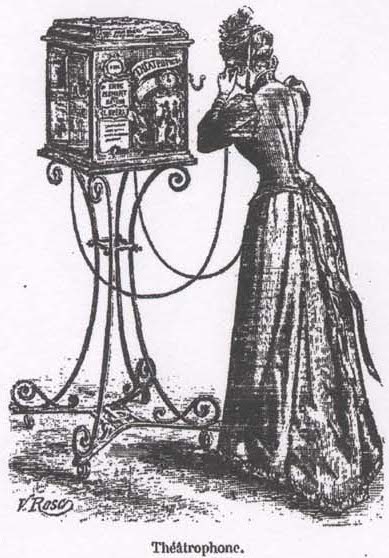

From Wikipedia:

The origin of the théâtrophone can be traced to a telephonic transmission system demonstrated by Clément Ader at the 1881 International Exposition of Electricity in Paris. The system was inaugurated by the French President Jules Grévy, and allowed broadcasting of concerts or plays. Ader had arranged 80 telephone transmitters across the front of a stage to create a form of binaural stereophonic sound. It was the first two-channel audio system, and consisted of a series of telephone transmitters connected from the stage of the Paris Opera to a suite of rooms at the Paris Electrical Exhibition, where the visitors could hear Comédie-Française and opera performances in stereo using two headphones; the Opera was located more than two kilometers away from the venue. In a note dated 11 November 1881, Victor Hugo describes his first experience of théâtrophone as pleasant.

...

In 1890, the system became operational as a service under the name "théâtrophone" in Paris. The service was offered by Compagnie du Théâtrophone (The Théâtrophone Company), which was founded by MM. Marinovitch and Szarvady. The théâtrophone offered theatre and opera performances to the subscribers. The service can be called a prototype of the telephone newspaper, as it included five-minute news programs at regular intervals. The Théâtrophone Company set up coin-operated telephone receivers in hotels, cafés, clubs, and other locations, costing 50 centimes for five minutes of listening. The subscription tickets were also issued at a reduced rate, in order to attract regular patrons. The service was also available to home subscribers.

French writer Marcel Proust was a keen follower of théâtrophone, as evident by his correspondence. He subscribed to the service in 1911.


Full scale "telephone newspapers" followed shortly.

From Wikipedia:

The Telefon Hírmondó (also Telefonhírmondó, generally translated as "Telephone Herald") was a "telephone newspaper" located in Budapest, Hungary, which, beginning in 1893, provided news and entertainment to subscribers over telephone lines. It was both the first and the longest surviving telephone newspaper system, although from late 1925 until its termination in 1944 it was primarily used to retransmit programmes broadcast by an affiliated radio station.

...

The Telefon Hírmondó was founded by Tivadar Puskás (a few reviews translated his name as "Theodore Buschgasch"), an engineer and inventor who had worked with Thomas Edison. In view of the ever-increasing pace of living, especially in major cities, Puskás recognized that daily newspapers, even with multiple editions, could no longer effectively keep up with developing events. He decided that this problem could be rectified through the introduction of a regularly updated audio news source.


Given what was going on at the time, these predictions from Bellamy and Verne were  not about the technology (which was already largely in place) but about the adoption of that technology, and on those terms, they were simply dead wrong. There were never that many telephone newspapers and with the exception of Telefon Hírmondó, most were short lived. 

Like we said before, the most celebrated cases of prophetic science fiction usually come down to modern audiences' flawed understanding of contemporary audiences.

Tuesday, April 13, 2021

While I'm being a killjoy... retconning sci-fi predictions

Following up on yesterday's post.

Science fiction can be a great place to discuss the social and psychological impact of technological advances, but its ability to predict otherwise unforeseen developments is not actually that clear.  Arguably most commonly cited science fiction prophesies are simply slight extrapolations of contemporary technology and widely discussed proposals, the result of a tendency, particularly among 21st century commentators, to underestimate the sophistication of previous generations. This is nowhere more true than with Twenty Thousand Leagues Under the Seas

Before we go on, take a look at this picture.


If you saw this without any context, you might assume it was Verne's famous Nautilus. You'd be close but off by about a decade. By the same token, if a French reader picked up a copy of Verne's book hot off the presses in 1870, he or she would immediately have thought of the Plongeur.

In 1859 the Board of Construction (Conseil des travaux) called naval engineers for designs for a submarine and reviewed three, choosing that submitted by Siméon Bourgeois (later Admiral) and Charles Brun, naming the project Plongeur with the code name Q00.

...

The submarine was armed with a ram to break holes in the hull of enemy ships, and an electrically fired spar torpedo, fixed at the end of a pole though later, Admiral Bourgeois who was, after 1871, chairman of the Commission on Submarine Defences opposed to the use of torpedoes as the primary weapon in commerce warfare.

The submarine was 43 m (140 ft) long and 381 t (420 tons) in displacement.

...

On 18 February 1864, Plongeur was towed to La Pallice and dived to 9 m (30 ft).

...

A model of Plongeur was displayed at the 1867 Exposition Universelle, where it was studied by Jules Verne, who used it as an inspiration and 3 years later published his novel Twenty Thousand Leagues Under the Sea.

For its original audience, the premise of the novel was what if a brilliant revolutionary/outlaw were to build a bigger, faster Plongeur. There was little in the book that was particularly speculative; if anything, just the opposite. Unlike Wells a generation later who who built each of his fantastic tales around some incredible breakthrough, Verne stayed close to the technology of the day. The accuracy is a hotly contentious point (with at least one fan making a dubious stand on Wikipedia), but, except for the scale, there's little tech in the book that wasn't either in use or widely speculated about, and that little hasn't aged well. 

With a few exceptions (possibly including Clarke's telecommunication satellites), most supposed cases of science fiction predicting the future involve concepts that were in the air at the time of the writing. This in no way detracts from the intellectual or artistic value of the genre. It's just a reminder that like all art, science fiction works tell us mainly about the times they came  from. What it tells us about today is normally something we bring to it.

Monday, April 12, 2021

How to be a 21st century tech visionary in two easy steps

1. Allude to something from an old science fiction movie or TV show

2. Claim that the technology to make it possible is just around the corner


Martian cities, maglev vactrains, superfast tunneling machines, cures for aging, and of course, flying cars. These just-around-the-corner stories, often credulously reported by journalists who should know better, are framed as serious proposals and announcements of major technological breakthroughs, but when you dig into the claims, there is almost invariably nothing of substance, just images and tropes from old sci-fi magazines and shows and comic books.

Almost all of these ideas are at least pushing fifty with some well over a hundred. The explanations of the advances that will make these wonders possible are never convincing and more often than not, simply expose the visionary's weak grasp of the problem. Musk and his acolytes (of whom Neuralink's Hodak is very much a member) may be the most visible propagators, but this phenomena is a defining trait of Silicon Valley/VC culture and has been for at least a decade. 

With that in mind, you might even argue that Elon and company are performing a public service. Hodak's tweet  or his boss's latest about impossible timelines for landing on Mars really aren't that much sillier the typical article on biohacking, but these tweets are so naked in their lack of seriousness that we should be safe from anyone actually believing them (we aren't but we should be).


Friday, April 9, 2021

The sad part is this makes me ever-so-slightly homesick


Thursday, April 8, 2021

This has to be peak something

We've heard lots of questionable crypto-based business plans, but as far as I know, this is the first one to actually have "alchemy" in its name. 

Wednesday, April 7, 2021

Vaccine passports

This is Joseph.

Mark and I were discussing this tweet and how many assumptions it makes.


First, it looks at a case which is true for basically no actual vaccine, treatment, or protocol. What is 100% safe in life? Financial assets, even those backed by governments, can become worthless.  Just consider 1913 Russian government bonds or shares in Enron. Cars are not 100% safe, which is why we make other cars follow rules. Similarly, what medical treatment is 100% effective? Even very minor medical treatments can have complications. Statins save lives, but rhabdomyolysis does occasionally injure a user of statins. 

I am being pedantic because the assumption of no crossover requires perfect efficacy and safety (so that it can be treated as not having any positive herd effects). Furthermore, it presumes that all parties have access to a vaccine, all parties (even infants) can take the vaccine, and that there is no benefit in dropping the prevalence of the disease to reduce variants emerging. 

So, to be clear: the vaccines are not 100% effective and nobody has claimed otherwise. Pfizer, for example, is 95% effective against mild and moderate disease. Very happy to concede this point. Safety is a bit trickier, as we are still learning about the vaccines, but nobody disputes allergic reactions happen

It is a general principle of public health that requiring vaccinations is a great way to reduce disease spread. For example, it isn't a passport but you need proof of vaccination against measles to attend school. Or to take University classes as a student in health sciences. International travel used to require smallpox vaccinations and even today vaccinations are required for some countries. In other words, cases were a person could be a serious concern as a disease spreader have always been an issue, usually via quarantine in time periods prior to vaccinations

In other words, this stuff is just nuts. Wait until people find out about seatbelts. Until universal vaccinations are a reality then passports are just a good way to reduce disease spread, improve public safety, and rebuild confidence in public gatherings. 

Tuesday, April 6, 2021

The Three Sillies

I've been thinking a lot about the way so many of our recent discourse over a range of desperately important issues gets sucked into discussions of improbable possibilities while imminent threats and viable solutions are downplayed or ignored entirely. 

When I finally get around to writing about this, I'll have a literary reference handy.

The opening to "the Three Sillies" from English fairy tales, collected by J. Jacobs

ONCE upon a time there was a farmer and his wife who had one daughter, and she was courted by a gentleman. Every evening he used to come and see her, and stop to supper at the farmhouse, and the daughter used to be sent down into the cellar to draw the beer for supper. So one evening she had gone down to draw the beer, and she happened to look up at the ceiling while she was drawing, and she saw a mallet stuck in one of the beams. It must have been there a long, long time, but somehow or other she had never noticed it before, and she began a-thinking. And she thought it was very dangerous to have that mallet there, for she said to herself: 'Suppose him and me was to be married, and we was to have a son, and he was to grow up to be a man, and come down into the cellar to draw the beer, like as I'm doing now, and the mallet was to fall on his head and kill him, what a dreadful thing it would be!' And she put down the candle and the jug, and sat herself down and began a-crying.

Well, they began to wonder upstairs how it was that she was so long drawing the beer, and her mother went down to see after her, and she found her sitting on the settle crying, and the beer running over the floor. 'Why, whatever is the matter?' said her mother. 'Oh, mother!' says she, 'look at that horrid mallet! Suppose we was to be married, and was to have a son, and he was to grow up, and was to come down to the cellar to draw the beer, and the mallet was to fall on his head and kill him, what a dreadful thing it would be!' 'Dear, dear! what a dreadful thing it would be!' said the mother, and she sat down aside of the daughter and started a-crying too. Then after a bit the father began to wonder that they didn't come back, and he went down into the cellar to look after them himself, and there they two sat a-crying, and the beer running all over the floor. 'Whatever is the matter?' says he. 'Why,' says the mother, 'look at that horrid mallet. Just suppose, if our daughter and her sweetheart was to be married, and was to have a son, and he was to grow up, and was to come down into the cellar to draw the beer, and the mallet was to fall on his head and kill him, what a dreadful thing it would be!' 'Dear, dear, dear! so it would!' said the father, and he sat himself down aside of the other two, and started a-crying.

Now the gentleman got tired of stopping up in the kitchen by himself, and at last he went down into the cellar, too, to see what they were after; and there they three sat a-crying side by side, and the beer running all over the floor. And he ran straight and turned the tap. Then he said: 'Whatever are you three doing, sitting there crying, and letting the beer run all over the floor?' 'Oh!' says the father, 'look at that horrid mallet! Suppose you and our daughter was to be married, and was to have a son, and he was to grow up, and was to come down into the cellar to draw the beer, and the mallet was to fall on his head and kill him!' And then they all started a-crying worse than before. But the gentleman burst out a-laughing, and reached up and pulled out the mallet, and then he said: 'I've travelled many miles, and I never met three such big sillies as you three before; and now I shall start out on my travels again, and when I can find three bigger sillies than you three, then I'll come back and marry your daughter.' So he wished them good-bye, and started off on his travels, and left them all crying because the girl had lost her sweetheart. 

Monday, April 5, 2021

At least it's less than the Netherlands


Jamie Powell writing for FT Alphaville explains why Tesla's recent bitcoin investment is raising questions about the company's environmental priorities. 

Tesla: carbon offsetting, but in reverse

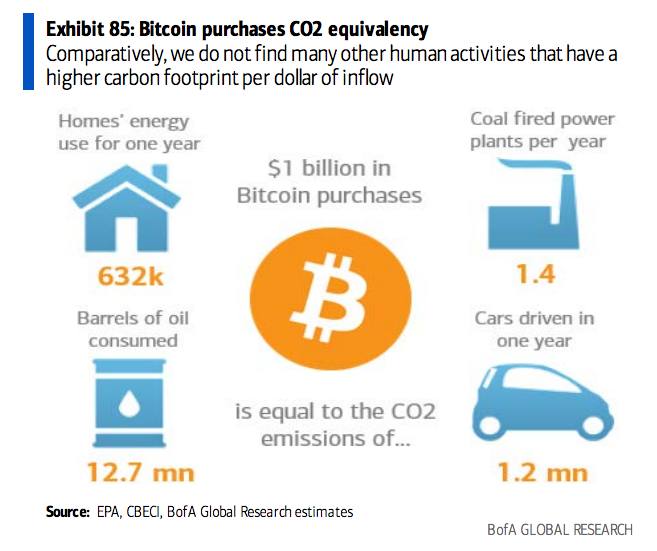
We’re not the first to point this out by any means, but bitcoin is dreadful for the environment. Still don’t believe it? Well Bank of America published an excellent report last week (which can be found on David Gerard’s blog), on the dominant digital coin. And, in particular, its carbon impact. 

 Here are a few choice stats. 

 Bitcoin -- or to be more precise, bitcoin mining -- currently consumes more energy than Greece, and a touch less than the Netherlands. In theory, it wouldn’t be so much of an issue if mining was powered by renewable energy, but 72 per cent of mining is concentrated in China, where nearly two-thirds of all electricity is generated by coal power. 

 For the moment then, bitcoin has carbon emissions that sit comfortably between American Airlines’s output, the world’s largest airline which currently carries 200m passengers per year, and the entire US Federal government. 

 Perhaps the most relevant stat of all, however, is this one:


A spiked pedrail would be really cool


 Should have mentioned H.G. Wells was a fan.


Wednesday, July 10, 2019

If not for the development of the caterpillar tread, these would have been big.

Another cool technology with the bad luck to come in second.

From Wikipedia:

 The pedrail wheel was invented in 1903 by the Londoner Bramah Joseph Diplock. It consists in the adjunction of feet (Latin radical "ped") to the rail of a wheel, in order to improve traction and facilitate movement in uneven or muddy terrain. Sophisticated pedrail wheels were designed, with individual suspension for each foot, which would facilitate the contact with uneven terrain.


Scientific American 1903-04-18


Friday, April 2, 2021

"Hydrodynamics is what a five-year old would do, if a five-year old had a PhD."


 Brendan Greeley writing for FT Alphaville (which you should definitely sign up for) explains the physics behind the recent traffic jam at the Suez Canal. 

Sailors talk about hydrodynamics the way CEOs talk about macroeconomics: they either treat it with mystical reverence, or they claim to understand it and are wrong. Unlike with macroeconomics, though, if you know what you’re doing you can test the propositions of hydrodynamics on actual, physical models in a lab. As in: you build little boats and then you drag them through the water, in a towing tank. Hydrodynamics is what a five-year old would do, if a five-year old had a PhD.

Lataire works with Flanders Hydraulics Research at what he calls the world’s most accurately constructed shallow-bottom tow tank. He’s currently helping build an even bigger tank, to generate more data for a ship simulator to certify pilots. The tanks are shallow-bottomed, because hydrodynamics in shallow water are different. When a boat moves through the water, it pushes the water out of the way — it displaces it. “Where the water needs to be displaced, in a deep ocean it can go under the ship and that’s not a problem,” says Lataire. “But if it needs to go into shallow water, like the Suez, the water simply cannot go under and around.” 

The Suez Canal is basically just a 24m-deep ditch dug in the ground to let the ocean in. When a ship comes by and displaces the water, the water has nowhere to go; it gets squeezed in between the ship’s hull and the floor and the sides of the ditch. A ship in a canal can squat, for example — it can dig its stern into the water. When water gets squeezed between a ship’s hull and a sand floor, it speeds up. As water flow speeds up, its pressure drops, pulling the hull down to fill the vacuum. The effect is more pronounced at the stern, and so the ship settles into a squat: bow up, stern down. 

Lataire wrote his dissertation on a similar phenomenon as a ship passes close to a bank: the bank effect. The water speeds up, the pressure drops, the stern pulls into the bank and, particularly in shallow water, the bow gets pushed away. Stern one way, bow the other. A boat that had been steaming is suddenly spinning. It’s a well-identified phenomenon; in 2009 Ghent University’s Shallow Water Knowledge Centre put together a whole conference about it. Clever pilots on the Elbe, according to Lataire, will use it to shoot around a bend. 

However: the more water a ship displaces, the stronger the effect. And the closer the side of the hull is to the shore, the stronger the effect. The bigger the ship, the faster the bow shoots away from the bank.


Thursday, April 1, 2021

The almost perfect 2021 business story: funded by the likes of Andreessen Horowitz, feted by goop, it was a massive fraud built around a literal shit company

If only they could have gotten Musk and Thiel involved.


SF poop-testing startup, once compared to Theranos, charged in $60M fraud scheme

Zachary Schulz Apte and Jessica Sunshine Richman, co-founders of defunct microbiome testing company uBiome, are accused of bilking their investors and health insurance providers, federal prosecutors said. They were indicted Thursday on multiple federal charges, including conspiracy to commit securities fraud, conspiracy to commit health care fraud and money laundering.

...

Apte, 36, and Richman, 46, founded uBiome in 2012 as a direct-to-consumer service called “Gut Explorer.” Customers would submit a fecal sample that the company analyzed in a laboratory, comparing the consumer's microbiome to others' microbiomes, prosecutors said. The service cost less than $100 initially.

The company grew to include “clinical” tests of gut and vaginal microbiomes, which were aimed to be used by medical providers so uBiome could seek up to $3,000 in reimbursements from health insurance companies. The federal indictment states that uBiome sought upwards of $300 million in reimbursement claims from private and public health insurers between 2015 and 2019. The company was ultimately paid more than $35 million for tests that “were not validated and not medically necessary."

Apte and Richman met in San Francisco in 2012 through the California Institute for Quantitative Biosciences Garage, an incubator used by UCSF. Together, they founded uBiome and received funding from Silicon Valley investors like 8VC in San Francisco and  Andreessen Horowitz in Menlo Park, which hold 22% and 10% stakes in uBiome, respectively, according to court documents.

For a time, they were the latest up-and-coming business determined to disrupt the medical testing industry. In 2018, Richman was even named an "innovator" winner in Goop's "The Greater goop Awards" and at its peak, uBiome was valued at $600 million.

Wednesday, March 31, 2021

"Every fool aspired to be a knave"

If you can't spot the relevance of this excerpt from Charles Mackay's Extraordinary Popular Delusions and the Madness of Crowds, you haven't been following the markets.

Exchange Alley was in a fever of excitement. The Company's stock, which had been at a hundred and thirty the previous day, gradually rose to three hundred, and continued to rise with the most astonishing rapidity during the whole time that the bill in its several stages was under discussion. Mr. Walpole was almost the only statesman in the House who spoke out boldly against it. He warned them, in eloquent and solemn language, of the evils that would ensue. It countenanced, he said, "the dangerous practice of stockjobbing, and would divert the genius of the nation from trade and industry. It would hold out a dangerous lure to decoy the unwary to their ruin, by making them part with the earnings of their labour for a prospect of imaginary wealth." The great principle of the project was an evil of first-rate magnitude; it was to raise artificially the value of the stock, by exciting and keeping up a general infatuation, and by promising dividends out of funds which could never be adequate to the purpose. In a prophetic spirit he added, that if the plan succeeded, the directors would become masters of the government, form a new and absolute aristocracy in the kingdom, and control the resolutions of the legislature. If it failed, which he was convinced it would, the result would bring general discontent and ruin upon the country. Such would be the delusion, that when the evil day came, as come it would, the people would start up, as from a dream, and ask themselves if these things could have been true. All his eloquence was in vain. He was looked upon as a false prophet, or compared to the hoarse raven, croaking omens of evil. His friends, however, compared him to Cassandra, predicting evils which would only be believed when they came home to men's hearths, and stared them in the face at their own boards. Although, in former times, the House had listened with the utmost attention to every word that fell from his lips, the benches became deserted when it was known that he would speak on the South Sea question.

The bill was two months in its progress through the House of Commons. During this time every exertion was made by the directors and their friends, and more especially by the Chairman, the noted Sir John Blunt, to raise the price of the stock. The most extravagant rumours were in circulation. Treaties between England and Spain were spoken of, whereby the latter was to grant a free trade to all her colonies; and the rich produce of the mines of Potosi-la-Paz was to be brought to England until silver should become almost as plentiful as iron. For cotton and woollen goods, with which we could supply them in abundance, the dwellers in Mexico were to empty their golden mines. The company of merchants trading to the South Seas would be the richest the world ever saw, and every hundred pounds invested in it would produce hundreds per annum to the stockholder. At last the stock was raised by these means to near four hundred; but, after fluctuating a good deal, settled at three hundred and thirty, at which price it remained when the bill passed the Commons by a majority of 172 against 55.


It seemed at that time as if the whole nation had turned stockjobbers. Exchange Alley was every day blocked up by crowds, and Cornhill was impassable for the number of carriages. Everybody came to purchase stock. "Every fool aspired to be a knave." In the words of a ballad, published at the time, and sung about the streets, "A South Sea Ballad; or, Merry Remarks upon Exchange Alley Bubbles. To a new tune, called 'The Grand Elixir; or, the Philosopher's Stone Discovered.'"

Tuesday, March 30, 2021

Even if scoundrels and fools get huge returns, that doesn't mean the reasons for avoiding scoundrels and fools no longer apply


This is way out of my field, but you'd think that in a time of SPACs, billion dollar unicorns that lose money on every transaction but hope to make it up in volume, meme stocks, insane volatility, investor cults of personality and P/Es over a thousand, putting aside concerns might be a bad idea.

From Bloomberg:


Bill Hwang, a former hedge fund manager who’d pleaded guilty to insider trading, was deemed such a risk by Goldman Sachs Group Inc. that as recently as late 2018 the firm refused to do business with him.

Those misgivings didn’t last.

Wall Street’s premier investment bank, lured by the tens of millions of dollars a year in commissions that a whale like Hwang paid to rival dealers, removed his name from its blacklist and allowed him to become a major client. Just as Morgan Stanley, Credit Suisse Group AG and others did, Goldman fueled a pipeline of billions of dollars in credit for Hwang to make highly leveraged bets on stocks such as Chinese tech giant Baidu Inc. and media conglomerate ViacomCBS Inc.

Now Hwang is at the center of one of the greatest margin calls of all time, his giant portfolio in a messy and painful liquidation, and Goldman’s reversal has thrust it right into the mayhem.


Monday, March 29, 2021

Vitamin D

This is Joseph

There seems to be an odd discussion of micronutrients that suggest that large doses are beneficial. I first encountered this via Linus Pauling who posited large benefits to large doses of vitamin C. Now people are positing that vitamin D might help versus covid-19 infections. Now, it is clear that vitamin malnutrition is horrible and it is possible that large doses of vitamins are helpful but I want to do an analogy for why I am pretty sure that there needs to be a high level of evidence. Consider these two paragraphs:

Adequate levels of vitamin D are essential to human health. There are many places where inhabitants may have low levels of vitamin D due to environmental issues and this may adversely impact human health (muscle weakness, pain, fatigue and depression are bad). Therefore, it is clear that the more vitamin D we can get people to consume the better.

Adequate levels of macronutrients (calories) are essential to human health. There are many places where inhabitants may have low levels of macronutrients (calories) due to environmental issues and this may adversely impact human health (starvation is bad). Therefore, it is clear that the more macronutrients (calories) we can get people to consume the better.

Obviously, while starving in bad, overeating isn't ideal either. I am always a bit amazed that the default conversation for appropriate intake of micronutrients is not "adequate intake" and not "more is better". Like there is no reason to presume that macro and micro-nutrients necessarily work the same, but one is amazed that the assumption that they are so completely different is so common. 

Friday, March 26, 2021

AstraZeneca dust-up

 This is Joseph

Statement from AstraZeneca was titled (emphasis mine):

AZD1222 US Phase III trial met primary efficacy endpoint in preventing COVID-19 at interim analysis

Gave results of:

79% vaccine efficacy at preventing symptomatic COVID-19

100% efficacy against severe or critical disease and hospitalisation

Comparable efficacy result across ethnicity and age, with 80% efficacy in participants aged 65 years and over

Statement from NIAID

Late Monday, the Data and Safety Monitoring Board (DSMB) notified NIAID, BARDA, and AstraZeneca that it was concerned by information released by AstraZeneca on initial data from its COVID-19 vaccine clinical trial. The DSMB expressed concern that AstraZeneca may have included outdated information from that trial, which may have provided an incomplete view of the efficacy data. We urge the company to work with the DSMB to review the efficacy data and ensure the most accurate, up-to-date efficacy data be made public as quickly as possible.

Full results from AstraZeneca:

76% vaccine efficacy against symptomatic COVID-19

100% efficacy against severe or critical disease and hospitalisation

85% efficacy against symptomatic COVID-19 in participants aged 65 years and over 

So a few points. One, the data was from the interim analysis, even though it was definitely out of date at the time of publication. Still, it was one of two reportable numbers. Noah Haber discusses this here, including noting that the protocol is publicly available

Two, the media framing looks terrible. Unless the results are misreported, the interim analysis was 3% high in the overall and 5% low in the over 65 participants. These are small changes and kind of average out, given that efficacy in over 65 year old participants was a concern because of under-participation in the earlier AstraZeneca trials. But this framing seems excessive:

Federal officials were taken aback by the board’s allegations. One said the way that AstraZeneca handled the results was the equivalent of “telling your mother you got an A in a course, when you got an A in the first quiz but a C in the overall course.” Another said the disclosure by the board would inevitably hurt the company’s credibility with U.S. regulators.

I am not sure I would consider the two reports materially different. Certainly, I do not see them as being the difference between an A and C (probably I would call them both B's, compared to other trials and the degree of change between them). Since they were doing frequentist statistics, looking at numbers between the two prespecified analyses seems like a bad plan (p-hacking concerns arise). That said, why is the analysis plan not Bayesian? 

That said, unless these numbers are false in some way, how is this a major change? 

Finally, why doesn't the United States just give up on approving AstraZeneca and agree to allow it to be exported. It is pretty clear that US regulators have decided that they aren't interested in the product but the export restriction is blocking shipping it to other places that could actually use it. Why not be honest, say they won't need it (they don't) and allow it to be exported to other places across the globe who are desperate for vaccines. Isn't it in everybody's best interests to reduce variants by increasing resistance to covid-19 infections globally? 

How is this the best plan? 

Thursday, March 25, 2021

Repost: I wonder where Republicans got the idea that they could get away with using false claims about election fraud to justify voter suppression

 TUESDAY, MAY 3, 2016

Context only counts if it shows up in the first two dozen paragraphs

The New York Times has a good piece on the impact of voter ID laws but I do have a problem with a few parts (or at least with the way they're arranged).

Stricter Rules for Voter IDs Reshape Races

By MICHAEL WINES and MANNY FERNANDEZ MAY 1, 2016

SAN ANTONIO — In a state where everything is big, the 23rd Congressional District that hugs the border with Mexico is a monster: eight and a half hours by car across a stretch of land bigger than any state east of the Mississippi. In 2014, Representative Pete Gallego logged more than 70,000 miles there in his white Chevy Tahoe, campaigning for re-election to the House — and lost by a bare 2,422 votes.

So in his bid this year to retake the seat, Mr. Gallego, a Democrat, has made a crucial adjustment to his strategy. “We’re asking people if they have a driver’s license,” he said. “We’re having those basic conversations about IDs at the front end, right at our first meeting with voters.”

Since their inception a decade ago, voter identification laws have been the focus of fierce political and social debate. Proponents, largely Republican, argue that the regulations are essential tools to combat election fraud, while critics contend that they are mainly intended to suppress turnout of Democratic-leaning constituencies like minorities and students.
In the third paragraph, we have two conflicting claims that go to the foundation of the whole debate. If election fraud is a significant problem, you can make a case for voter ID laws. If not, it's difficult to see this as anything other than voter suppression. This paragraph pretty much demands some additional information to help the reader weigh the claims and the article provides it...

More than twenty paragraphs later.

Mr. Abbott, perhaps the law’s most ardent backer, has said that voter fraud “abounds” in Texas. A review of some 120 fraud charges in Texas between 2000 and 2015, about eight cases a year, turned up instances of buying votes and setting up fake residences to vote. Critics of the law note that no more than three or four infractions would have been prevented by the voter ID law.

Nationally, fraud that could be stopped by IDs is almost nonexistent, said Lorraine C. Minnite, author of the 2010 book “The Myth of Voter Fraud.” To sway an election, she said, it would require persuading perhaps thousands of people to commit felonies by misrepresenting themselves — and do it undetected.

“It’s ludicrous,” she said. “It’s not an effective way to try to corrupt an election.”

I shouldn't have to say this but, if a story contains claims that the reporter has reason to believe are false or misleading, he or she has an obligation to address the issue promptly. Putting the relevant information above the fold is likely to anger the people who made the false statements, but doing anything else is a disservice to the readers.

Wednesday, March 24, 2021

He came to extend the light of consciousness to the stars and we accused him of having a messiah complex


And no, this does not appear to be a joke.

Tuesday, March 23, 2021

There's also a Laffer connection if you follow the links

Cathie Woods,  the founder, CEO, and CIO of ARK Investment Management is probably the most prominent and possibly the most influential of the Tesla bulls. Lots of investors, particularly retail investors, put a great deal of weight in her pronouncements, including this one projection.


That target has inspired some skepticism.


That 300% suggests that Tesla will have to find new worlds to conquer. The report lists insurance as a growth opportunity. If you're up for a lesson in how the insurance industry works, this long but dense thread explains why that ain't happening.
FT Alphaville makes many of the same points.


But the Ark projections haven't been falling entirely on critical ears.


Woods and many other analysts have done very well embracing Tesla, crypto, and all the other disruptors and their defenders invariably resort to "look at the results" arguments when critics question the projections. With that in mind, let's close with this.


Monday, March 22, 2021

E.W. Niedermeyer points out an important paradox with autonomous systems -- if Tesla's FSD didn't suck so much, it would be dangerous

Those who follow Tesla Twitter, particularly from the critical side, have been seeing quite a bit of this.

Here's the entire video.


Road and Track has a painful play-by-play.

But E.W. Niedermeyer explains how a pretty good autonomous driving system would actually be more dangerous.


For an even more disturbing example, check out this from Jalopnik.


Friday, March 19, 2021

When we said drones will revolutionize the industry, we should have been more specific

Go back eight or ten years and take a look at the predictions for drone delivery services. You'll see that we aren't nearly as far along as the optimists expected we'd be, but that doesn't mean drones haven't had a huge impact elsewhere. In fields like entertainment and journalism, camera drones are routinely doing things that had been prohibitively expensive and in some cases simply impossible.


And then there's this industry being disrupted.


Thursday, March 18, 2021

The story is "Tesla has one message for customers and investors, and another one for legal authorities." The meta-story is that the bastion of conventional wisdom is telling this story.


Regardless of where it's reported, this is big news (and potentially grounds for one hell of a class action lawsuit). Still, it's worth noting that highly skeptical coverage of Tesla and Musk is no longer limited to a few voices in the wilderness like Lopez of Business Insider and Hiltzik and Mitchell of the LA Times.

From Axios:

Tesla recently told California regulators that the "Full Self-Driving" beta software it's testing with select customers doesn't make them autonomous — nor will it any time soon.

Why it matters: The company is charging $10,000 extra for the not-really-self-driving, might-arrive-someday addition to its standard Autopilot adaptive cruise-control and lane-keeping feature.

  • Meanwhile, CEO Elon Musk is selling investors on the notion that its full self-driving tech will enable Teslas to become money-generating robotaxis.

Our thought bubble: Tesla has one message for customers and investors, and another one for legal authorities.

Catch up quick: Legal transparency website PlainSite this week released a year's worth of correspondence between Tesla lawyers and the California Department of Motor Vehicles, which regulates autonomous vehicles.

  • The agency had been pressing Tesla for details about the technology's evolving capability since late 2019 while reminding the company that it does not have a permit to deploy autonomous vehicles in California.

Wednesday, March 17, 2021

I love LA... Penultimate Snow

Last week and this past Monday, the weather included some late winter storms, very probably the last of the year. The snow line got down to twenty-five hundred feet. To put that in perspective, the highest point in the city of LA is just over five thousand feet and highest point in the county is just over over ten. 

My standard joke about LA is that we have all the weather you could want; we just drive to it, so this weekend, I headed up the Angeles Crest not far from my place to catch the last snow of the season. Next year, when traveling won't feel so risky, I'll get a cabin and do some hiking. For now, though, these views will have to hold me.


Tuesday, March 16, 2021

Vaccine nuance

This is Joseph.

Are all covid-19 vaccines precisely equal? No. Should you care very much which one you get? Also no. This seems like a contradiction until we think it through. 

Prior to the reporting of any phase 3 trials, the pre-specified efficacy for a useful vaccine was often cited as 50%. Here is an NPR story discussing this prior to Pfizer results. It is worth noting, as Bill Miller states, that even a weak vaccine likely reduces severity:

"That's certainly the case with the influenza vaccine," Miller adds. "People who get the vaccine may still get the flu, but, for the most part, their disease is milder than if they hadn't had the vaccine."

So how do the US vaccines stack up to this standard? For the trial endpoints, Pfizer is 95%, Moderna is 94%, and Johnson and Johnson is 72%. Even the lowest efficacy vaccine is almost exactly at the 75% Dr. Fauci pre-specified as what he was hoping for, even if he was unsure it was realistic.  Further, there are other trade-offs between the vaccines, including price, storage requirements, or number of doses. The lower efficacy option has better storage properties, is cheaper and is only a single dose. The newer vaccines that might yet be approved also look good, AstraZeneca is 70% and Novavax is 89%, so there are a growing number of options far more effective than the pre-specified level needed for a useful vaccine. 

Based on this, there are only safe and effective options available in the United States. I suppose that there might be some customer preferences, but everything is safe and works, based on the trial data. 

So what can real world evidence add? 

Well, we can try to find rare side effects. There was some concern about the AstraZeneca vaccine (not available in the US) and blood clots, at least until people noticed that the rate was lower than would be expected by chance. One of the sanest voices in the pandemic points out that this might be lower than by chance:

Professor Sir David Spiegelhalter, a statistician from the University of Cambridge, urged caution over the decision to pause the AstraZeneca vaccine rollout in some countries, saying it could be doing "more harm than good".

But it is important to monitor for problems. For example, if there were big ones with the Pfizer vaccine then you'd expect Israel to have noticed by now. Spoiler: there weren't any.

We can also measure the population level effects on disease. So we know that the AstraZeneca (AZ) vaccine appears to reduce population rates of hospitalization by 95%, which was higher than that seen post-vaccination by Pfizer, at 84% (this was based on 1.14 million vaccinations in Scotland) -- although this was mostly comparing single dose Pfizer to single dose AZ (results could differ after 2 doses). Both vaccines are mitigating the human cost of the pandemic, which is the reason the pandemic was a crisis to begin with. 

So how does this all link together? All of the evidence suggests all of the vaccines are good. Scotland's real world evidence muddies the waters as to the precise rank ordering (as it is unlikely that the populations being vaccinated were terribly different) but that doesn't change the underlying message: none of the vaccines is showing concerns as to safety or efficacy. I would gladly be randomized to any of the three US available options or to AZ. Even if it was done with a biased die. 

Finally, if I did have to do any sort of prioritization then I would do it via focusing on high risk populations. Give the mRNA vaccines to older and minority groups, who suffer more from the disease. Focus the adenovirus vaccines on the young and high SES crowd. That said, vaccines in arms is the most important variable and every person vaccinated does make the community, as a whole, safer. 

Looking at Mar 15 data, you would rather be the US (21% with 1+ dose), Israel (57% with 1+ dose), or the UK (37% with 1+ dose) and not somebody like Canada (4.7% with 1+ dose). And the number of doses given is vastly more important than the type of vaccine used, provided it is one of the five above with extensively reported phase three clinical trial data. 

Monday, March 15, 2021

If David Wallace-Wells was all that concerned about vaccine hesitancy, maybe he shouldn't have promoted the myth of a West Hollywood autism epidemic

 I've been meaning to do an in-depth thread on David Wallace-Wells -- the issues of climate change, megafires and global pandemics are far too serious to let this clown lead the discussion -- but until then, here's another reminder that DWW has absolutely no credibility on vaccine hesitancy. 

What If Herd Immunity Is Out of Reach? [emphasis added]

A few months ago, these developments might have suggested the true endgame of the pandemic was in sight—and indeed the likely vaccination of 100 million or more by late spring does suggest a dramatic change in the country’s experience of the disease, with those vaccinated feeling safe from hospitalization and death and the disease in retreat. But thanks to a combination of higher herd-immunity estimates, stubbornly high vaccine “hesitancy,” and the arrival of new coronavirus variants that render existing vaccines less effective, the second year of the American pandemic is beginning to look less like a page-turning, book-slammed-shut bang and more like a long and indefinite whimpering into the future — in which many are protected but the disease, undefeated, still circulates, perhaps forever. That the coronavirus would become endemic, like the common cold, has always been one possible outcome, though less appealing than true elimination. The arrival of new variants has made that kind of near-term future, with enduring reservoirs of virus throughout the country, seem less appealing still.

Who do we know with a history of spreading anti-vaxxer talking points?


Tuesday, July 18, 2017

David Wallace-Wells, autism and bad science

David Wallace-Wells has been catching a lot of flack (most of it richly deserved) for his recent New York Magazine article on climate change. It is a hugely troubling sign when the very scientists you were claiming to represent push back against your article.

This controversy illustrates a larger problem with science reporting at the magazine. We already have a post in the queue discussing the neutral-to-credulous coverage of topics ranging from homeopathy to magic crystals to Gwyneth Paltrow's goop empire. The Wallace-Wells piece takes things to another level and goes in a very different but arguably worse direction. Rather than giving bad science a pass, he takes good science and presents it so ineptly has to do it a disservice.

I am not going to delve into that science myself. The topic has been well covered by numerous expert and knowledgeable writers [see here and here]. The best I could offer would be a recap. There are some journalistic points I may hit later and I do want to highlight a minor detail in the article that has slipped past most critics, but which is perfectly representative of the dangerous way Wallace-Wells combines sensationalism with a weak grasp of science.

Other stuff in the hotter air is even scarier, with small increases in pollution capable of shortening life spans by ten years. The warmer the planet gets, the more ozone forms, and by mid-century, Americans will likely suffer a 70 percent increase in unhealthy ozone smog, the National Center for Atmospheric Research has projected. By 2090, as many as 2 billion people globally will be breathing air above the WHO “safe” level; one paper last month showed that, among other effects, a pregnant mother’s exposure to ozone raises the child’s risk of autism (as much as tenfold, combined with other environmental factors). Which does make you think again about the autism epidemic in West Hollywood.


No, David, no it doesn't.

I want to be painstakingly careful at this point. These are complex and extraordinarily important issues and it is essential that we do not lose sight of certain basic facts: by any reasonable standard, man-made climate change is one of the two or three most important issues facing our country; the effect of various pollutants on children's mental and physical development should be a major concern for all of us; high ozone levels are a really bad thing.

But the suggestion that ozone levels are causing an autism epidemic in West Hollywood is both dangerous and scientifically illiterate. You'll notice that I did not say that suggesting ozone levels cause autism is irresponsible. Though the study in question is outside of my field, the hypothesis seems reasonable and I do not see any red flags associated with the research. If Wallace-Wells had stopped before adding that last sentence, he would've been on solid ground, but he didn't.

Autism is frightening, mysterious, tragic. This has caused people, particularly parents facing one of the worst moments imaginable, to clean desperately to any explanation that might make sense of their situation. As a result, autism has become a focal point for bad science, culminating with the rise of the anti-vaccination movement. There is no field where groundless speculation and fear-mongering are less welcome.

So, if ozone and other pollutants may contribute to autism, what's so bad about the West Hollywood claim? For that, you need to do some rudimentary causal reasoning, starting with a quick look at ozone pollution in Southern California.

Here are some pertinent facts from a 2015 LA Times article:

EPA Administrator Gina McCarthy selected a limit of 70 parts per billion, which is more stringent than the 75 parts-per-billion standard adopted in 2008 but short of the 60-ppb endorsed by environmentalists and health advocacy groups including the American Lung Assn. The agency’s science advisors had recommended a limit lower than 70 -- and as low as 60.

...


About one-third of California residents live in communities with pollution that exceeds federal standards, according to estimates by the state Air Resources Board.


Air quality is worst in inland valleys, where pollution from vehicles and factories cook in sunlight to form ozone, which is blown and trapped against the mountains.


The South Coast air basin, which includes Los Angeles, Orange, Riverside and San Bernardino counties, violated the current 75-ppb ozone standard on 92 days in 2014. The highest ozone levels in the nation are in San Bernardino County, which reported a 2012-2014 average of 102 parts per billion.


Now let's look at some ozone levels around the region. West Hollywood, it should be noted, is not great.


But just over the Hollywood Hills, the situation is even worse.


Go further inland to San Dimas and the level is even higher…


Higher still in Riverside ...


Though still far short of what we find in San Bernardino.


If you look at autism rates by school district and compare them to ozone levels, it is difficult to see much of a relationship. Does this mean that ozone does not contribute to autism? Absolutely not. What it shows is that, as with many developmental and learning disabilities, the wealthy are overdiagnosed while poor are underdiagnosed. It is no coincidence that a place like Santa Monica/Maibu (a notorious anti-vaxxer hotspot) has more than double the diagnosis rate of San Bernardino.

The there's this from the very LA Times article by Alan Zarembo that Wallace-Wells cites [emphasis added]:

 Irva Hertz-Picciotto, an epidemiologist at UC Davis, suspects that environmental triggers such as exposure to chemicals during pregnancy play a role. In a 2009 study, she started with a tantalizing lead — several autism clusters, mostly in Southern California, that her team had identified from disability and birth records.

But the hot spots could not be linked to chemical plants, waste dumps or any other obvious environmental hazards. Instead, the cases were concentrated in places where parents were highly educated and had easy access to treatment.

Peter Bearman, a sociologist at Columbia University, has demonstrated how such social forces are driving autism rates.

Analyzing state data, he identified a 386-square-mile area centered in West Hollywood that consistently produced three times as many autism cases as would be expected from birth rates.

Affluence helped set the area apart. But delving deeper, Bearman detected a more surprising pattern that existed across the state: Rich or poor, children living near somebody with autism were more likely to have the diagnosis themselves.
Living within 250 meters boosted the chances by 42%, compared to living between 500 and 1,000 meters away.

The reason, his analysis suggested, was simple: People talk.
They talk about how to recognize autism, which doctors to see, how to navigate the bureaucracies to secure services. They talk more if they live next door or visit the same parks, or if their children go to the same preschool.

The influence of neighbors alone accounts for 16% of the growth of autism cases in the state developmental system between 2000 and 2005, Bearman estimated.

In other words, autism is not contagious, but the diagnosis is.


Friday, March 12, 2021

This is getting dumb

This is Joseph

Matt Yglesias commenting on the NYT:


Also noted by Alex Tabbarok

AZ has on the order of 50 million doses nearly ready to go and can produce in the US around 25 million doses a month so over a year that production is worth over $100 billion to the world economy, far higher than the modest cost of production! Instead of idling this capacity we should expand it even further as part of a plan to vaccinate the world.

 I think we need to have a very careful reality check. What could possibly be the reason for not allowing the export of the vaccine? People keep pointing out that Astra-Zeneca has not done the paperwork for an emergency use authorization, but what is the point of letting it sit unused when the company would like to export it. 

If it works, why would the United States not want to use it? If it is inferior to current vaccines why should we deny it to countries dealing with large outbreaks? I understand not immediately authorizing it because the US has vaccines with good data already approved but then it should be exportable. I also understand wanting to use it domestically to speed up vaccination rates but then there should be hard questions asked about why the company is not applying to the FDA. 

But the current course of action seems to make no actual sense. What am I missing? What is the value in letting the doses expire due to an export ban? 

Defunding the police

This is Joseph.

I am a big fan of reading history. While I admit I have a Western European and Classical period bias in my reading, it isn't limited to just these periods. Every once in a while you hear an argument that really has no good analogue in how societies have tried things in the past. It doesn't mean that the past is a prison, but that I would like to consider ideas about how to use past ideas as a starting point for current problems.

Whenever I hear about "Defund the Police", I have questions. Now, the same slogan covers a wide range of policies, some of which are extremely good ideas. Militarized police is a step backwards to when the main peacekeepers were military, and that was definitely helped by a town guard that was less violent. You didn't want the same soldiers who sack cities to be keeping the peace in a town or city that you really care about. 

But if it means abolish the police, which occasionally it does, then I want to bring up my favorite example of a society without police: medieval Iceland. It is a very good example and has actually been brought up as a possible model by Libertarians from time to time (see the linked David Friedman article for an example). But it does raise a serious concern for a large society like the United States or Canada -- even in a small and highly interdependent society like Iceland you had a serious problem with blood feuds that eventually led to power imbalances and the fall of the Icelandic Commonwealth.  There does seem to be a huge advantage in a relatively neutral arbiter of the law.

That said, that does not mean that we cannot focus on improving the quality of the police and the strength of civilian governance. Our institutions are what holds a society together and it is an obvious point of improvement to diversify police functions and to find ways to improve policing outcomes. This is an obvious win-win. But I have some bad news -- most of the time the effort to improve a government function requires actual resources. It is quite rare that something is so overfunded that funding cuts actually improve efficiency. 

Thursday, March 11, 2021

The sad part is this actually makes the first one look rational...

It's back...


There was at least an initial logic to the first Gamestop bubble. If successfully executed, it is possible to make a great deal of money out of a short squeeze. This time, however, we are in pure delusional money territory.

“It’s a marathon, not a sprint. Whatever happens resist the urge to sell. The longer we hold the higher it goes,” said @catchme1fyoucan, an Italy-based user of retail trading platform eToro, in a discussion on GameStop.

For many, perhaps most, of the investors this time around, the lesson of the first bubble was exactly the wrong one. They believe they drove the stock up because of the rightness of their cause and the power of their will,  and the only reason it went back down was a loss of faith.

The details of this surge don't do much to help clear things up for us non-believers.

One explanation was a tweet from activist investor Ryan Cohen, who is a major shareholder in GameStop and was appointed as a board member as part of an attempt to reverse the company’s ailing fortunes.

Mr Cohen is known as “Papa Cohen” on the Reddit forum, and is known to have a significant holding in the company. That means that his tweets have a particular pull for those who follow the stock – even if they might be largely incomprehensible to others.

One such tweet was posted by Mr Cohen on Wednesday evening. It showed a McDonald’s ice cream cone and was accompanied by a frog emoji.

Soon after that post, the shares began to surge. It is impossible to say definitively whether there is any connection between the stock price and Mr Cohen’s tweet, but it at least focused new attention on the GME shares.


In case you were wondering if the description leaves something out...


While we don't want to push the analogy too far, we live in a time of movements based on finding hidden messages in cryptic tweets. By the QAnon standard, buying Gamestop at $265 hardly seems crazy at all.

As I type this, it is snowing in the City of Los Angeles

At least in the parts above 2,500 feet. The highest point in the city is just over 5,000 feet so the snow line will cover a lot of square miles, even more in the eastern part of the county. The mountains will be beautiful.