Monday, August 29, 2016

The logical result of an illogical policy

[I plan to come back when I have more time and fill in some detail, but for now I think the short version does have a certain pithy quality.]

Due to a largely recent (think 21st Century) cover-your-ass definition of balance, the ethical concerns about then Secretary Clinton meeting with a Nobel Peace Prize winner merits more coverage than Donald Trump being in bed with not one, but two of the five families of the New York Mafia.


Nancy LeTourneau
But here is where the AP blew their story. In an attempt to provide an example of how this becomes an “optics” problem for Hillary Clinton, they focused much of the article on the fact that she met several times with Muhammad Yunus, a Clinton Foundation donor. In case you don’t recognize that name, he is an economist from Bangladesh who pioneered the concepts of microcredit and microfinance as a way to fight poverty, and founded Grameen Bank. For those efforts, Yunus won the Nobel Peace Prize in 2006, the United States Presidential Medal of Freedom in 2009 and the Congressional Gold Medal in 2010.

The connection the AP tries to make is that SoS Clinton met with Yunus because he was a Clinton Foundation donor. What they didn’t mention is that their relationship goes back over 30 years to the time Hillary (as first lady of Arkansas) heard about his work and brought him to her state to explore the possibility of implementing microfinance programs to assist the poor.

During the time that Clinton was Secretary of State, the government of Bangladesh was trying to discredit Yunus and remove him from leadership at Grameen Bank due to the fact that he was seen as a political threat.

Matt Yglesias:

According to their reporting, Clinton spent a remarkably large share of her time as America’s chief diplomat talking to people who had donated money to the Clinton Foundation. She went out of her way to help these Clinton Foundation donors, and her decision to do so raises important concerns about the ethics of her conduct as secretary and potentially as president. It’s a striking piece of reporting that made immediate waves in my social media feed, as political journalists of all stripes retweeted the story’s headline conclusions.

Except it turns out not to be true. The nut fact that the AP uses to lead its coverage is wrong, and Braun and Sullivan’s reporting reveals absolutely no unethical conduct. In fact, they found so little unethical conduct that an enormous amount of space is taken up by a detailed recounting of the time Clinton tried to help a former Nobel Peace Prize winner who’s also the recipient of a Congressional Gold Medal and a Presidential Medal of Freedom.

Here’s the bottom line: Serving as secretary of state while your husband raises millions of dollars for a charitable foundation that is also a vehicle for your family’s political ambitions really does create a lot of space for potential conflicts of interest. Journalists have, rightly, scrutinized the situation closely. And however many times they take a run at it, they don’t come up with anything more scandalous than the revelation that maybe billionaire philanthropists have an easier time getting the State Department to look into their visa problems than an ordinary person would.


And Scott Lemieux:

There is a liberal critique of the Clinton Foundation, which as recently as last month I found fairly credible, that even if they weren’t doing anything wrong, it created the unnecessary potential appearance of corruption. The view of the Clintons is apparently that literally anything they do will be treated as scandalous so if they think the Clinton Foundation is a net positive it’s worth doing. I suppose both can be true, but the ridiculous reporting this week makes me think that the latter position is more accurate.

Friday, August 26, 2016

Déjà vu all over again

At the risk of repeating myself...

Check out these two ads.


Here's what the Clinton campaign released this week.


And here's one from the Democratic candidate of a few years ago. [Warning: offensive language.]


Thursday, August 25, 2016

Adam's back

With the perfect topic for my last week in the Studio City adjacent section of North Hollywood.


Wednesday, August 24, 2016

When I have time I need to come back to this

This observation from Paul Krugman is both accurate and important:

But most of all, this kind of punditry, while ostensibly praising the Real America, is in fact marked by deep condescension. One pats the simple folk on the head, praising their lack of exposure to quinoa or Thai food — both of which can be found in food courts all across the country. Sorry, but there are no country bumpkins in modern America. Most of us, in all walks of life, have a pretty good sense of the full range of things our culture offers, even if too many can’t afford to participate in some of it. You might even say that the only segment of our society that seems truly unaware of how others live is a certain segment of the commentariat, blinded by its simultaneous romanticization of and contempt for working-class white America.

Tuesday, August 23, 2016

Light posting for a awhile

Light posting for the nest day or two due to a well-timed move. I say the timing was good because, starting a week ago, this was the view from my apartment's bedroom window (commencing at seven every morning).


Here's the view from my new bedroom. 


This is a couple of miles from downtown LA and less than a mile from Sunset Blvd. Steep hills make for confusing maps but I don't mind the sacrifice.


Monday, August 22, 2016

College Humor -- "If Internet Ads Were Salesmen "

I keep meaning to do a post about the terrible state of targeted marketing. When I get around to it, remind me to embed this. At least half of the points I want to hit are illustrated here.


Pre-update:

After I scheduled this in the form above, Josh Marshall posted a piece on internet advertising and the death of Gawker. It contains an informative primer on how this stuff works.

Many people think that the more popular a publication gets the more ads it will sell. The bigger the audience, the more eyeballs, the more ads wanting contact with those eyeballs. That's not how it works.

There are a million dimensions to the advertising economy, just as many ways of describing it. But you can understand a whole lot about how the whole thing works by thinking in terms of three factors: 1) endemic sales proposition, 2) controversy and 3) influence.

Let's talk first about endemic sales proposition. Because I think it may have played some role in Gawker's demise (on-going legal liability may have played more of a factor or have been the entirety of the issue). A site about clothes has an endemic sales proposition: selling clothes. A site about books: books. You may say well, I only read sites about news and sports but I still buy a lot of clothes so ... Not how it works.

For a variety of reasons, some good and evidence based, others silly, advertisers want to sell you their product when you are thinking about it and in the mindset to buy. This doesn't just mean impulse purchases, but buying in general. In many cases that makes a lot of sense.

For instance, aside from people being really into tech, why do you think there are so many tech sites? Right, because there's a ton of money in video games, devices, computers, everything under the sun. People also tend to buy those things online. Again, we're not just talking about impulse buying. It can be more nuanced and less direct. But if you stand up a site about tech, gaming, computers, etc. and it does well, you have a ready made channel for ad sales. And in the case of tech an extremely lucrative one.

Sometimes it's a little more amorphous but no less ad driven. Why so many 'lifestyle' publications? Well, we all need a lifestyle, of course. And general interest magazines cover many interesting topics. But by and large that's because you're aiming for an audience of people who are affluent and want to read about cool things affluent people do: travel, toys, aspirational personal development. Not that there's anything wrong with that, as they used to say on Seinfeld. But that's what it's about.

Next, controversy. This largely speaks for itself. Advertisers don't want to be around things that upset people or divide people. They want to be everyone's friend. They don't want negative ideas or stories to rub off on them. This isn't an absolute of course. Plenty of sites which court controversy sell tons of ads. Gawker's a prime example. But controversy is always a constraint on ad sales. You just may have other factors that overcome it.

Next, influence. This is an inherently small and nebulous part of the equation. But it's key for many publications. Many ads aren't trying to sell you anything directly. They're trying to tell you stories, shape your thinking, advocate positions. Political ads are like this. But they're mass market since obviously everyone can vote - at least in states without Republican governors and Secretaries of State. But where the money is is with people who are considered influential in various communities, so-called "opinion-leaders".

Here's an example. Go to the subways in New York you'll see ads for storage rentals, lawyers, grocery deliveries, breast augmentations, ESL courses. Go to Washington DC and you'll see ads for ... Kazakhstan or Northrup Grumman or PhRMA or well ... you get the idea. There are lots of people who care a lot about what people in the nation's capital think. And yes, TPM very much plays in that ad space. TPM and similar sites lose big on #1 and #2. But #3 is where there's a business that can drive ad sales.
As a marketing statistician, I'd like to emphasize the point about "reasons, some good and evidence based, others silly." Most of the people buying these ads, including high-level executives at Fortune 500 companies, have a very weak grasp of how targeted advertising works.

Friday, August 19, 2016

What a 12-year-old in the early Fifties expected the 21st Century to look like


The year was 1951, the Publisher was Ziff-Davis, the artist was Murphy Anderson, and the improbable title was "Lars of Mars."

Thursday, August 18, 2016

The back of the queue is packed; front is almost empty -- updated

Busy, busy days (details to follow), but we can always count on the Trump's campaign for something to pass the time.


For something less amazing but more disturbing we turn to Marketplace and a profoundly annoyed Kai Ryssdal.


Comment would be superfluous.

UPDATE:

From Yahoo:
In a conversation with Yahoo News shortly after the conversation aired, Michael Cohen, an executive vice president and attorney at the Trump Organization, said he believed he “controlled the interview” with Brianna Keilar.

“I think I unraveled her,” Cohen boasted.

Earlier comment on comment still holds.

Wednesday, August 17, 2016

If James Whitmore were alive alive he'd be booked solid


I don't want to get too deeply into this (we have too many threads running already) but Ken Levine (Writer/director/producer of may be two thirds of the television, you've ever seen) has an excellent post up on the economics of theater, both in general and specific to Los Angeles.

Anyone who has any interest in the politics of organized labor should dig a bit further into the Actors' Equity story, if just for the strange bedfellows moment of seeing Tim Robbins on the anti-union side of the debate.


In her Playbill bio, Ms. Mode notes that since 2001 FULLY COMMITTED has been one of the ten most produced plays in the United States. Very impressive. And not to take anything away from it…

But…

It’s one actor, one desk, and two phones. It also must be one of the ten cheapest plays to produce in the United States. The actor gets quite a workout, but still, it’s very doable. Especially if a theatre is planning its season and has another play that requires say...actual costumes.

The theatre scene is really run today on a tight budget. When I wrote my first play it was extremely well received and got big laughs during staged readings. But the late Garry Marshall summed it up. He read the play, called me, and said: “Very funny. Too many people.” Neophyte that I was, I had written a play with seven characters. In today’s world, that was like writing LES MISERABLES on spec.

The requirements today (unless you’re Tony Kushner or Tom Stoppard) are this: No more than four actors, preferably one set or just a few props that can suffice for a set, and not a lot of wardrobe or effects. I feel bad for us playwrights because that severely limits the kinds of plays we can write, but I feel worse for the actors. Twenty years there were a lot more parts out there for thesps. And unlike writing where all we need is an idea and Final Draft, actors have to be hired in order to practice their craft.

... 

Getting a play on Broadway, even a modest one, requires a bankable star. If Jesse Tyler Ferguson was in THE MINDY PROJECT, as sensational as he is in FULLY COMMITTED, no chance does he do that play on Broadway.

In Los Angeles, we have the added hurdle of the ridiculous Equity mandate that actors be paid minimum wage for all performances and rehearsals for shows playing in venues of 99 seats or less. Two-thirds of their membership voted NOT to enact that provision but the Equity board in New York ignored them and instituted it anyway. 


Tuesday, August 16, 2016

New article

This is Joseph

Here is an interesting article on Education Reform that might be worth looking at.  One of the authors should be familiar to our readers. 

I grew up with a lot of Trae Crowders

And they're still easier to find than you might think.


Monday, August 15, 2016

Test-based education reform -- when a means to an end becomes the end itself

From 11-year-old Peyton Mears:


From Valerie Strauss writing for the Washington Post [emphasis added]:
In Florida (you knew it was Florida, didn’t you?), some third-graders — including honor students — are being forced to retake third grade because their parents decided to opt them out of the state’s mandated standardized reading test this past spring.

An undetermined number of third-graders who refused to take the Florida Standards Assessment in reading have been barred from moving to fourth grade in some counties. A lawsuit filed by parents against state education officials as well as school boards in seven Florida counties says counties are interpreting the state’s third-grade retention law so differently that the process has become unfair. Test participation, therefore, is more important than student class academic achievement.

On Friday, Leon County Circuit Court Judge Karen Gievers held a hearing in the suit about the third-grade retention law, which was passed years ago, when Jeb Bush was governor and at a time when there was no movement among parents to opt their children out of standardized tests. Now the opt-out movement is growing, and officials in Florida as well in other states are trying to figure out how to handle students who won’t take mandated standardized tests. It is unclear how many students in Florida opted out of the 2016 test, though in New York state, 21 percent of public school students did.
There are few decisions that conscientious educators take more seriously than whether or not to have a child retake or skip a grade. Sometimes it turns very badly (the resulting anxiety stayed with Charles M. Schulz for the rest of his life); other times it's the best thing that could happen to a kid. Children have different abilities and they develop at different rates. Being held to some Procrustean standard can be unimaginably stressful.

To hold back kids who are performing at or above grade level, to take them away from their friends, to make them slog through a year of mind-numbing boredom just to punish certain parents is perhaps the most inexcusable policy decision I've ever seen. If this goes through, it will be a traumatic experience for most, possibly all, of these children and will do permanent damage to their educations. 

For the record, the vast majority of people who go into education (even those who disagree with me) do so for the best possible motives. I'm sure this applies to these Florida state education officials, but I'm equally sure that the officials' good intentions will be damned little comfort to a ten-year-old who has to pay for these decisions. 

Friday, August 12, 2016

Sad

When someone makes the inevitable movie of this campaign, they should make sure to include Trump tweets in the scene breaks. These 140 character glimpses into the id have added greatly to the surrealism of the past year.


Thursday, August 11, 2016

Calling all political science grad students

I don't know how well this is been explored in the past, but something interesting is happening in California this election and there might just be a paper or thesis topic in it for someone.

Phil Willon writing for the LA Times:

Republican voters taking a pass on California's U.S. Senate race, poll finds

Half of California’s likely Republican voters and a third of independents said they wouldn't vote for either candidate in the state’s U.S. Senate race this November, according to a new poll by the Public Policy Institute of California.

The survey found that 28% of all likely California voters said they didn’t support state Atty. Gen. Kamala Harris or Orange County Rep. Loretta Sanchez, and 14% said they were undecided. Harris and Sanchez are Democrats.

...

The two Democrats will face off in the November election, setting the stage for the highest-profile contest between two members of the same party since California adopted a top-two primary election system.

In the June 6 primary, Harris received 40% of the vote and Sanchez nabbed 19% among the 34 candidates on the Senate ballot. Duf Sundheim, a former chairman of the California Republican Party, landed in third place with 8%.

Since no candidate won more than 50%, the top two advanced to the runoff.

Bill Carrick, a political consultant for the Sanchez campaign, has said the congresswoman is trying to build a coalition that will “cross party lines, cross regional lines — every kind of line you can imagine” to overtake Harris before November.

To do so, Sanchez will likely need support from Republicans and independents because, according to the PPIC poll, Harris leads Sanchez by a 2-to-1 margin among Democratic voters.

Harris also leads among independents. Sanchez leads Harris among likely Latino voters.

Among likely Republican voters, 50% said they would not support either candidate and 19% said they were undecided.

I would be hesitant to infer too much from any election involving Donald Trump, but you could at least get some interesting preliminary results looking at the following question:

Consider definitely non-purple states with open primaries. We can often get the situation we have now in California where voters in the minority party know that their vote for the president will almost certainly have no impact on the outcome and they have no option to vote for a member of their own party in one or more major state-wide race. What impact might this have on minority party districts in the state?


Wednesday, August 10, 2016

With Trump, everyone gets their own scandal

Talking Points can explore the Russian connection (and other many stories).

Politico can dig into the mafia associations.

The Washington Post can uncover a history of fraudulent charities.

USA Today can recount the hardships of tradesmen who assumed Trump was good for his debts.

The NYT can find all the material it can handle in Trump University.

Now Vanity Fair takes a deep drive into Trump's finances.

From Nicholas Shaxson:

But Malone also touched on another topic, which opens up a new and very different set of questions. Although she wouldn’t discuss any financial details for the course, she didn’t dispute my observation that its accounts for 2014 showed a loss-making operation. The observation was almost “asinine,” she says, because projects routinely make losses in the early years. This was a “legacy project” for Donald, she says. “This is about the love of the game of golf, the love of the land, and memory of his mother,” who was born and grew up in Scotland. The official accounts filed at Companies House (the British version of the S.E.C.) show, in fact, that for the calendar year 2014, the operating company Trump International Golf Club Scotland Limited showed a net loss of £1.1 million ($1.8 million) on revenues of £2.8 million ($4.4 million).

But Trump’s disclosure in July 2015 to the U.S. Federal Election Commission (F.E.C.), under the “income” heading, showed a profit of precisely $4,349,641. We aren’t quite comparing apples with apples here, because the F.E.C. disclosures cover the calendar year 2014 plus preceding months in the current year. This scenario would make sense only if the loss-making operation in 2014 suddenly surged into profit in early 2015, when the course was closed for winter until April 1, then returned (as Malone suggests) to its loss-making ways more recently. Or it could just be an error: mistakes are only human.

But let’s look further. For the Trump Turnberry golf resort, on the Scottish west coast, his F.E.C. disclosures record a profit of $20,395,000—but the accounts for 2014 show a loss of £3.6 million ($5.6 million) on revenues of £9.2 million ($14.6 million). It’s the same story again at his Doonbeg course in Ireland, where he told the F.E.C. his profit was $10,755,683—again, very precise—while Irish company accounts show a loss of 2.5 million euros ($3.3 million) on revenues of 4.2 million euros ($4.7 million).

This looks like a pattern: in each case a loss for 2014 in the company filings morphs into a large profit (for 2014 plus a few extra months) in his F.E.C. filings. This would be compatible with other analyses suggesting Trump is prone to hyping his wealth and income. Shawn Tully at Fortune magazine, using rough but reasonable calculations, estimated in March that Trump had been putting in gross revenues in his disclosures, where he should have been putting income, after stripping out costs, and that his true income was probably between a third and a half of the £362 million ($514 million) he claimed in his July 2015 disclosure.

When I pressed Trump on the discrepancy between the Scottish and Irish filings and what he had reported, he said that the disclosure was “a revenue number: it is not a profit and loss number.” His C.F.O., Allen Weisselberg, who was also on the phone line, echoed that this was a “revenue” number. Yet, in February, Trump told Bloomberg News that these same Scottish and Irish numbers on his disclosures represented “projected future income”—a different thing again, which is certainly not what the F.E.C. asked for.

Tuesday, August 9, 2016

Quote of the Day

This is Joseph.

Nice quote on CEO pay from Stumbling and Mumbling:
Of course, £5.5m is tiny in the context of companies worth £30bn+. But then, so is employee pilfering. Does that thereby become acceptable?
It points out that the magnitude of a problem (in terms of economic impact) does not influence the morality.  It also kind of suggests that if we ignore small problems (pilfering, escalating pay) then they might become larger problems.

The loss of plausible deniability

One important point to keep in mind while following this years election is that, of the truly objectionable things about the Trump campaign, very few are actually new. Instead, we have all sorts of practices that have always been unacceptable, but which are now being presented in a way that makes them undeniable.

If you remember the elections of 2000 and 2004, you will probably recall talk of Karl Rove and his mastery of "political jujitsu." It was generally discussed as if it were some sort of mystical Jedi mind trick that allowed Rove to make strings into weaknesses and weaknesses into strengths. Mainly, it came down to the realization that most reporters would respond to obvious lies with straight faces and no follow-up questions.

In 2004, I remember Republican operatives making the argument that George W. Bush's military record compared favorably with that of John Kerry. Just to review, Kerry was a legitimate war hero in terms of courage, sacrifice, and effectiveness. On the other side of the ledger, even if we push aside all of the accusations and contested points about favoritism and completion of requirements, there is a relatively cushy stint in the National Guard.

These and other clearly untrue statements were usually allowed to stand largely because this was a symbiotic relationship. It was in both the source's and the journalist's interests to keep this relationship going and not to push the boundaries in either direction.

The lies we've been hearing recently are not necessarily that much more blatant, but Trump and associates are no longer observing the social conventions that traditionally went with them. If a reporter asks about your candidate's military service and you reply by saying all sorts of nice things about the National Guard, that reporter can move onto the next question without looking like a complete moron. If you look reporters in the face and tell them that twice cheating on then dumping your wife for a younger, more glamorous woman qualifies as a sacrifice, you leave the reporters looking like asses just for letting you get the words out of your mouth.

Which brings us to (from TPM):
Khizr Khan, the father of the Muslim soldier, said in his speech at the Democratic convention last week that Trump had "sacrificed nothing." And Trump hit back over the weekend, saying that he's "made a lot of sacrifices," like creating jobs.

During a CNN panel discussion Sunday, Trump surrogate Scottie Nell Hughes defended Trump's comments.

"Mr. Trump was responding to the fact of sacrificing. Nowhere ever did he ever say that his sacrifice was equivalent or more or even close to what the Kahn’s had given up," she said.

CNN host Fredricka Whitfield then asked, "Is creating a job considered a sacrifice?"

"You know what, creating jobs caused him to be at work, which cost him two marriages,” Hughes said in response. “Time away from his family to sit there and invest.

Clinton surrogate Bernard Whitman jumped in to say, "infidelity cost him."

"No, actually being away from his family, he’s admitted it,” Hughes insisted. "That is the spin of the media and ongoing bias."
 "Creating jobs" normally implies actually paying the people who do work for you, but we can save that for another day.

Monday, August 8, 2016

Some of the scariest stuff doesn't even involve Trump

You'll notice that fairly consistently the people least caught off guard by recent events (Ornstein & Mann, Krugman, Chait and particularly Marshall) have all been insisting for years that journalists have got to start honestly addressing the state of the GOP and the conservative movement. These writers were strongly criticized, even ostracized for these positions.

Now all but the most doctrinaire of radical centrists have acknowledged that, at least in the past few years, Republican extremism has become a serious concern, but the focus is still often limited to incidents involving the curreent GOP presidential candidate. A group of Trump supporters chanting racist slogans makes the news while the press (other than scrappy independents like TPM) still largely ignores stories like this:
Sen. Ron Johnson (R-WI) compared those mounting the efforts to address climate change to Joseph Stalin and Hugo Chavez, while claiming that it has been "proven scientifically" that the climate is not in fact warming. He suggested in a radio appearance that progressives' concern about climate change was driven by their desire for government control of Americans lives.

"The whole climate change debate gives, and there are all kinds of quotes from adherents of and promoters of climate change, the reason they're doing it is it's such a great opportunity to control, you know, pretty much, government, and control your lives," Johnson said Monday, on the Glenn Klein Show on the WRJN radio show. "There's an arrogance of power there that they're utopians, that they really think they can create heaven on earth, and where it's failed in the past, those people like Stalin and Chavez and the Castros, the nutcases in North Korea--by the way, if you want equal results, go to North Korea, you have equal misery."
You really need to read that passage two or three times for it to fully soak in. There is so much packed in here: the stunning scientific illiteracy; the arrogance; the paranoia (they're doing this to "control your lives"); the sheer hatred toward those who disagree with him. People who accept the overwhelming consensus opinion of researchers are accused of wanting to establish a totalitarian state and are compared with not just one or two, but with four notorious dictators.

This is not a fringe stance. Though the rhetoric is more subdued, you can find the same sentiments in every third George Will column. It has become mainstream opinion within the GOP. There was a time not so long ago that prominent Republicans could propose carbon taxes or cap-and-trade plans. Now simply acknowledging the problem is a career killer.

Sunday, August 7, 2016

Weekend blogging -- Moondog

I know you know this -- I know everyone knows this -- but it's still worth taking a moment now and then to try to absorb the accessibility of music in the 21st Century. With only a tiny number of exceptions, any piece of music you can name or just describe is a few keystrokes away.

I've been trying to take advantage of this remarkable opportunity to explore everything from punk to funk, rockabilly to avant-garde. When I mentioned that last one to a musically literate friend, he suggested two influential but highly listenable composers, Harry Partch and the unbelievably colorful Moondog.

Louis Thomas Hardin (May 26, 1916 – September 8, 1999), better known as Moondog, was an American composer, musician, poet and inventor of several musical instruments. He was blind from the age of 16. In New York from the late 1940s until he left in 1972, he could often be found on 6th Avenue between 52nd and 55th Street wearing a cloak and Viking-style helmet, sometimes busking or selling music, but often just standing silent and still.

He was widely recognized as "the Viking of 6th Avenue" by thousands of passersby and residents who weren't aware of his musical career

...

The music of Moondog of the 1940s and 50s is said to have been a strong influence on many early minimalist composers. Philip Glass has written that he and Steve Reich took Moondog's work "very seriously and understood and appreciated it much more than what we were exposed to at Juilliard."


Friday, August 5, 2016

Of course, Jeff Zucker's standard for doing a really nice job might be different than yours and mine

Jeff Zucker is the subject of one of the blog's oldest threads. In all the reading I did on the subject, I cannot think of an example where Zucker was more than competent and I can think of lots of cases where he was disastrously inept . Remember, this is the man who took the first place powerhouse NBC down to fourth place in shockingly little time. As a case study of bad management, it should be mandatory reading in every business school.

If you or I seriously damaged one of the world's most venerable brands, it would leave a black mark on our resume, but those who climb high enough reach the post-accountability level. For instance, Zucker is now considered qualified to run to a major network because he ran one in the past. True, he was arguably the worst network head ever, but that doesn't seem to be important in this situation. Zucker's record at NBC Universal convinced the people at Time Warner that he was the right man to take charge of CNN.

Which is where the Zucker thread crosses the Trump thread.
CNN president Jeff Zucker had only good things to say about former Trump campaign manager and newly-minted CNN commentator Corey Lewandowski in an interview with Variety published Tuesday.

"The reason we hired Corey is that now that we are in the general election, I think it’s really important to have voices on CNN who are supportive of the Republican nominee," Zucker said. "It's hard to find a lot of those."

He disagreed with criticism that Lewandowski continues to act as a Trump campaign spokesman rather than an analyst.

“I actually think he’s done a really nice job,” Zucker added, according to Variety. “He’s come under a much greater spotlight because of who he is, and the relationship he’s had with the media. As a result, people are going to be more critical.”

Even under the best of circumstances, hiring a former campaign manager to help cover the race only days after being fired is risky. Hiring Lewandowski, with his history of racism, unprofessional behavior, physical aggression against a reporter, conspiracy-mongering, and general sleaziness, was simply asking for the kind of disaster that can do irreparable damage to a journalistic institution's reputation.


The day after Zucker defended him, Lewandowski dove back into the birther sewer and pulled CNN down with him.

Thursday, August 4, 2016

"On any other day, that might seem strange"

[I didn't realize it until I started doing the background reading, but the parts about the Collegiate Network fit nicely with the origins-of-conservative-media-in-the-seventies thread that started yesterday and will continue when I get around to commenting on this.]

If, like me, you're spending way too much time on political news lately, you certainly heard about this report from ABC's Jonathan Karl:
Republican officials are exploring how to handle a scenario that would be unthinkable in a normal election year: What would happen if the party's presidential nominee dropped out?

ABC News has learned that senior party officials are so frustrated — and confused — by Donald Trump's erratic behavior that they are exploring how to replace him on the ballot if he drops out.


As the reliable Josh Marshall has pointed out, there is no direct evidence from the Trump camp that the candidate has any thoughts of dropping out. These rumors look something like trial balloons, albeit an odd one, since the event in question is unlikely and, more to the point, the people floating the balloon have no say in whether it happens.

Rather than speculate on the intent of the message (hint, empty threat, groundwork for intervention, blowing off steam -- I'm kidding about that last one), I think it's more interesting to thinkk about the path this and other stories take to get to our news feeds. In situations like this, the source of the rumors is often more telling than the content. In this case, that would be Karl, and that is remarkably informative.

Karl is not just a conservative journalist, he is a carefully cultivated product of a decades-long, highly successful conservative movement media initiative.

The Collegiate Network (CN) is a non-profit tax-exempt 501(c)(3) organization that provides financial and technical assistance to student editors and writers of roughly 100 independent, conservative and libertarian publications at leading colleges and universities around the United States. The CN estimates that member publications have a combined annual distribution of more than two million[citation needed]. Since 1995, the CN has been administered by the Intercollegiate Studies Institute (ISI), headquartered in Wilmington, Delaware

...

In 1979, the Institute For Educational Affairs (IEA) responded to the request of two University of Chicago students for start-up funding for a new conservative newspaper, Counterpoint. By 1980, the grant program had been expanded and named the Collegiate Network, and by 1983, under the continuing administration of the IEA, had added both internships and persistent operating grants for conservative campus newspapers. In 1990, the Madison Center for Educational Affairs merged with the IEA to maintain funding for what had expanded to 57 conservative student publications. The Intercollegiate Studies Institute took over operations in 1995 and has since administered the CN from Wilmington, Delaware.


Take a look at a few of his fellow alumni: Matthew Continetti, Ann Coulter, Dinesh D'Souza, Laura Ingraham, Rich Lowry, John Podhoretz, Ramesh Ponnuru, and Peter Thiel.


Here's a characteristically blunt take on the relationship from Charles Pierce back in 2013:
Long ago, Congresswoman Marcy Kaptur of Ohio once told me that she thought my craft went bad when it became the province almost exclusively of the over-educated, that it had professionalized itself out of its traditional role, that she wished there were a few more people practicing journalism who'd first worked on a loading dock, or in a mine, the way people used to come to the job. Here, with Karl, we apparently have a perfect product of the well-financed and staggeringly successful network of conservative institutions and programs launched more than 40 years ago by The Powell Memo. Assuming the FAIR report is accurate, then Jonathan Karl was not trained as a journalist, because the Collegiate Network doesn't produce journalists. It produces partisan warriors. He was not trained as a reporter, because the Collegiate Network doesn't produce reporters. It produces propagandists. He was not trained as a newsman, because the Collegiate Network doesn't produce newsmen. It produces hacks.

This is, of course, indelicate for someone in my business to say but, at every level of his steady rise in the business, some executive should have looked at Karl's resume, seen The Collegiate Network there, and then shitcanned the thing before the interview process even began. Are there conservatives who are good reporters? Absolutely. But all the ones that I know came up the same way I did, and none of them came up through the coddled terrariums of the activist Right. They learned their craft. They were not trained to be spies in the camp of the enemy. They were not trained to be moles. And every damn one of them would have checked those phony e-mails before throwing them out to the public, and most of them wouldn't have fallen for them, because they are journalists, reporters, and newsmen. They are not partisan warriors, propagandists, or hacks. If Jonathan Karl doesn't like being called a hack, then he should stop being a hack. Here's one way to do it.


Like many successful journalists including Woodward and Bernstein, Karl's career is largely based on his close relationship with a network of well-placed contacts. In this case, the contacts are overwhelmingly in the Republican Party and the conservative movement. At the risk of putting too fine a point on it, when Jonathan Karl breaks the story, it is usually something that the leadership of the GOP would like to get out there.

So it would appear that, in August of the election year, we have a political party not so subtly suggesting that its nominee should drop out. Even if nothing comes of it, that is an extraordinary development.

But these  are strange times.

Wednesday, August 3, 2016

To understand Trump, you have to understand right-wing media. To underestand right-wing media, you have to understand...


It is a fairly safe bet that nobody knows more about the business of comedy in the mid-20th century than Kliph Nesteroff. No one has conducted more interviews. No one has researched the subject so deeply. A few years ago, Nesteroff wrote a fascinating, in-depth piece on the widely known but little discussed relationship between the show Laugh-In and the Nixon White House.

If you have any interest in politics or media, you should read the whole thing( including the end notes and comments), but if you're in a hurry, I've pulled a few sections that are particularly relevant to our recent discussion of the 2016 election.

The Comedy Writer That Helped Elect Richard M. Nixon


Laugh-In is commonly considered a reflection of the late sixties youth sensibility, but closer examination reveals a much different picture. It was, in essence, an establishment show, profiting from the anti-establishment sentiment running through America. Moderated by the comedy team of Dan Rowan and Dick Martin, Laugh-In was old in style, but draped in the popular fashion of the day.  ...   Whereas Tom Smothers found himself on Nixon's enemies list, Rowan and Martin found themselves on Nixon's guest list.   ...   In 1969 Dan Rowan said of Laugh-In's chief scribe [Paul Keyes], "President Nixon calls him four or five times a week and when he's in San Clemente, Paul's always there. He is very close to the administration on a personal and on a political basis." A generation of vociferous anti-Nixonites, enraptured by everything Laugh-In had to offer each Monday night, was none the wiser.

...


Laugh-In debuted on January 22, 1968. The show's format was conceived by George Schlatter and featured an odd melding of fast editing in the vintage Olsen and Johnson Hellzapoppin' milieu alongside a colorful "Summer of Love" design. The hosts were the comedy team Rowan and Martin, who had been busily plodding through show business with minor success   ....   "George Schlatter wanted Digby Wolfe for head writer," remembered Dick Martin. "We said, 'No, no, no, no. No way.'   ...  We brought in Paul Keyes from The Dean Martin Show ... we insisted that he be the head writer." And contrary to the earnest insistence of some, Laugh-In was innocuous as far as political satire was concerned.5 Richard Nixon was referenced, but the show never dared to take him to task for the aggressive foreign policy enraging the nation. Compared to other political television comedy of the decade like That Was the Week That Was or The Smothers Brothers Comedy Hour, Laugh-In possessed a toothless bite.

...
But the left-wing and right-wing jokes that Laugh-In showcased were very tame considering the upheaval in the country at the time. The Smothers Brothers appeared to be speaking truth to power whereas Laugh-In was simply speaking. Perhaps a contemporary analogy is the difference between Stephen Colbert's roasting of President Bush at the White House Correspondents Dinner and the following year's performance by Rich Little.

...

The "sock it to me" bit in question was conceived for Laugh-In's 1968-69 season premiere, less than two months before election day. "He would do anything to get elected," says George Schlatter. "Paul Keyes convinced him that it was good for his image to appear in the midst of this kind of avalanche, this tsunami of youth and vitality." Erickson explained that Nixon "showed up surrounded by his staff, whom he consulted about everything. Asked to say [Laugh-In catchphrase] 'What's a bippy?' Nixon huddled with his entourage and decided against it - he didn't know what 'bippy' meant, and really didn't want to find out. Likewise vetoed was 'Good Night, Dick.' After much deliberation, 'Sock it to me?' was the one Dick Nixon finally approved." It aired September 16, 1968. Schlatter recalls the afternoon with trepidation and not just because it was difficult to direct the cardboard candidate.

...

Scholarship remains undecided about whether the "sock it to me" bit actually pushed Nixon over the top, but the argument is largely irrelevant. Nixon's "sock it to me" was simply the culmination of a year's worth of work orchestrated by Paul Keyes and his savvy team of media manipulators.   ...   Officially, Keyes was merely a joke contributor, but the reality was much more. The forty-four-year-old was Richard Nixon's new master of media control along with an impressive team of Marshall McLuhan adherents that included Raymond Price, Harry Treleaven and a twenty-eight-year-old producer from The Mike Douglas Show named Roger Ailes; the future wunderkind behind Fox News.

Raymond Price joined Nixon's media stalwarts after a long tenure as an editorial writer for The New York Herald Tribune. Price was hired as Nixon's speechwriter, but he was quickly consumed less with Nixon's words and more with his image. Price, too, was a devotee of Marshall McLuhan and wasted no time in applying his theories to the hopeless candidate. Speaking about the nation's aversion to the withered politico, Price said, "The response is to the image not the man. It's not what's there that counts, it's what's projected ... it's not what he projects but rather what the voter receives. It's not the man we have to change, but rather the received impression." Professor McLuhan would have awarded Price a gold star. Unable to cure an awkward man, the Price-Keyes strategy was to make sure Nixon acknowledged his maladroit persona.
...

Roger Ailes was hired by Nixon after the two hit it off during the politician's 1967 appearance on The Mike Douglas Show, which Ailes had been producing. Ailes says his objective from day one was to put to rest the public's impression that Nixon was "a bore, a pain in the ass ... Let's face it, a lot people think Nixon is dull ... [That he] was forty-two years old the day he was born ... Now you put him on television, you've got a problem right away. He's a funny-looking guy. He looks like somebody hung him in a closet overnight." Marshall McLuhan's treatise Understanding Media was immediately circulated to everyone in the office with a key passage highlighted: "The success of any TV performer depends on his achieving a low-pressure style of presentation, although getting his act on the air may require much high-pressure organization."

Tuesday, August 2, 2016

Just when I was about to back off from all the "black swan" references

If we start seeing lots of headlines like this...


‘Is Donald Trump plain crazy?’ Big-name writers now questioning GOP nominee’s sanity


... then a lot of outcomes we've filed under "virtually impossible" will move to the "definite maybe" pile.

Today's classic movie clip

Events have now got me checking Talking Points Memo three or four times a day.

Here's the latest from Josh Marshal:
It may not seem terribly important right now with all the stories roiling the campaign. But I think there's a good chance it's the most important. Over the last 48 hours Trump's allies, surrogates and now Trump himself have forcibly injected the topic of voter fraud or 'election rigging' into the election.

...

Vote fraud is clearly the aim in what is coming from Trump allies. But Trump's own comment - "I'm afraid the election's gonna be rigged, I have to be honest" - seems to suggest some broader effort to manufacture votes or falsify numbers, to allude to some broader conspiracy. Regardless, Trump is now pressing this issue to lay the groundwork to discredit and quite possibly resist the outcome of the November election.

...

It's true that Republicans have been very disingenuously pushing the 'voter fraud' con for years, especially as the power of minority voting has grown over the last two decades. However, as bad as that has been, there's a major difference. Republicans to date have almost always used bogus claims of 'voter fraud' to rev up their troops and build support for restrictive voting laws, largely focused on minority voters. A number of those laws have been overturned by federal courts in the last week. A notable case was North Carolina where the Court found that the changes were intentionally designed to limit voting by black North Carolinians.

What Republicans politicians have virtually never done was use this canard to lay the groundwork for rejecting the result of a national election. This is Donald Trump, not a normal politician. You should not be surprised if he refuses to accept the result of an electoral defeat or calls on his supporters to resist it.


Monday, August 1, 2016

Explaining Trump in Four Words

We are currently suffering through an endless stream of bloated think pieces about the Trump campaign, all trying to unravel whatever deep malady in the American soul has doomed our democracy. Maybe it's not that complicated. What if we can explain the whole thing in four simple words?

Republicans believe Fox News.

Of course, we would have to throw in the occasional caveat about no group being monolithic and no major phenomenon having a single explanation, but if we limit ourselves to the core voters and proximal causes, I think this may be all we need.

Try a thought experiment.

Chances are if you are reading this blog, you find publications like the New York Times, the Washington Post, or the LA Times fundamentally reliable. I'm not saying that you always consider them accurate or honest or unbiased, but that you believe they are generally making a reasonable effort to get things right. Obviously this varies somewhat from writer to writer and story to story, but on the whole, your default setting is to give a high credence to what you read there.

I suspect that, by the same token, you do not extend that same assumption of trust to most conservative media, probably not Fox News and almost certainly not to the more extreme ideological outlets.

Now imagine things were reversed. You have a high degree of trust for things you see on Fox and a low degree for things you read in the New York Times and similar publications.

Think about what your world looks like.


Global warming is a hoax

The government and the media are hostile to Christians

Food-stamp recipients live on steak and lobster

While America is the most taxed nation in the world

The financial crisis was caused by government policies that required loans to be made to poor minority members

The 2008 election was probably stolen

President  Obama's birth records are possibly fraudulent, the product of a massive cover-up

President Obama is certainly anti-American 

As are most Democrats

Voter fraud is rampant

Islamic terrorist are on the verge of major attacks on Americans

America is in decline

If you believe all of these things then Trump becomes not only a rational choice, but perhaps the only rational choice.

I realize I am being somewhat flippant with my tone but I'm completely serious about the thesis. I'm arguing that all of the deep think pieces, the long reflections on the American character ("Democracy: Dying or Doomed?"), and probably everything David Brooks is going to write between now and November are destined to reach the wrong conclusions because they are asking the wrong question.

We don't need public intellectuals trying to figure out why a substantial portion of the electorate is gripped with a strange, unreasoning hatred and anger and fear. We already know the answer – – they watch Fox News. We also know that for the past 40+ years, Roger Ailes and Company have been looking at ways to cultivate these emotions for political gain. The basic assumption was the more intense the better as long most of the negative emotions were directed at the other side. For a while the system worked very well.

The conservative movement also declared all-out war on sources of trustworthy data like the census or meteorological research. While all this was happening, the mainstream press largely ignored and occasionally even encouraged this behavior, perhaps in part because their own walls at this point had an awfully high glass-to-brick ratio. A culture of inaccuracy, meme-whoring, groupthink, laziness, and cowardice had left the profession incapable of standing up to the assault on journalistic standards. Other than a few satirists, almost no one was willing and able to point out the obvious until it was too late.

We should not be asking how did Trump supporters get the way they are, but rather how was the process that made them what they are tolerated for so long?

Friday, July 29, 2016

A fifty-one year old view of the future of high-speed rail


This advocacy pamphlet/comic book from the Brotherhood of Railroad Trainmen is interesting for any number of reasons, ranging from the art from the legendary EC Comics artist Al Williamson to the mid-60s take on labor unions, but the relevant part for one of our recent threads is this section on experimental high-speed trains.


Technology and infrastructure were moving at a fantastic pace in 1965. It is safe to say that the majority of the people reading this at the time assumed that those trains would go from experimental to commonplace by the end of the next decade (which was, for those keeping count, 36 years ago).


Thursday, July 28, 2016

Aspect Dominance or just reporters loking for a man biting a dog?

The neverhillary crowd certainly can be vocal and they get a lot of press, but how much of a factor are they? 

Harold Meyerson writing for the American Prospect (via Lemieux) [emphasis added]:
As the convention began, a new Pew poll showed that 88.5 percent of voters who’d consistently backed Sanders throughout the primary season now favored Clinton. A majority of the Sanders delegates in the hall in Philadelphia also back Clinton, but a loud Blinkered minority has managed to command disproportionate media coverage, which ever favors the loud. This disconsolate fringe—not just delegates but also the demonstrators lined up outside the convention area’s fencing—is almost entirely white and non-immigrant, people, that is, with less reason than some to fear a Trump presidency will overturn their lives. Nor are the demonstrators I’ve talked to preponderantly local, but rather have come from across the country to shout their rage and discontent. In short, the Blinkered are a fraction of the left, the Naderites come again. They are people who wouldn’t normally be involved either in Democratic politics or real-world progressive organizations, who hitched their wagon to Sanders’s star while many more experienced progressive activists failed to grasp Sanders’s potential for moving the world further in their direction than any political phenomenon in years.


Obviously, it is dangerous to infer too much from the decidedly nonrandom sample of "people you know," but I am Southern California based and I work with a program that relies heavily on millennial volunteers -- pretty much Bernie ground zero -- and this is entirely in line with what I've seen. Not only did all of the Bernie Sanders supporters I knew say they would support Hillary Clinton if she won the nomination, almost all of them found the thought of doing anything else laughably absurd. Everyone I talked to considered the difference between Sanders and Clinton somewhere between minor and vanishingly small compared to the difference between either and Trump.

As mentioned above, it is dangerous to infer too much from personal experience, but when that experience is backed up with both common sense and polling data, it is okay to infer a little. Specifically. I'd  suggest that the political press has overstated the size and strength of this segment of the party.

[insert sarcastic comment about the recent performance of the political press here.]

Wednesday, July 27, 2016

Catching up on Tesla

This story has had a bit more legs than I expected, probably in part due to the way it was handled by the company. Tesla, like its founder, has always been exceptionally good at working sympathetic and (let's be frank) credulous reporters, but it has a horrible record of overreacting to even mild criticism. Of course, a large sale of stock between the time of the accident and its announcement did not help either.

I suspect that had we seen a more low-key response and fewer angry demands that reporters "do the bloody math," recent developments in the story would get less press.

For example:
The National Transportation Safety Board today issued the preliminary report of its investigation into the May 7th accident which involved a Tesla Model S operating in Autopilot mode. The crash resulted in the death of the driver, Joshua Brown, who was 40 years old. The agency found that Brown’s car was traveling nine miles over the posted speed limit at the time of the crash, and the report also includes the first officially released images of the accident.

Brown’s car was traveling at 74 miles per hour before it made impact with a tractor trailer that was crossing its path, according to the NTSB. The posted speed limit on the divided highway where the accident took place — US Highway 27A, near Williston, Florida — was 65 mph. The NTSB states findings don’t contain "any analysis of data" beyond that, and the agency says that probable cause has yet to be officially determined. Tesla has stated that a combination of the "high, white side of the box truck" and "a radar signature that would have looked very similar to an overhead sign" are what caused the car's automatic braking not to fire, but the company declined to comment on the NTSB's preliminary report.


With this or any other complex story, it is important we guard against thinking too much in terms of scalars and linear relationships. Specifically, we need to push past the simplistic "is this technology better or safer than human drivers" and start asking what does the technology do best when should we use it and how can we best incorporate it into our transportation system?

We've all seen optical illusions that prove how easy it can be to deceive the eye, but the flipside of that is that there are also situations where humans are remarkably good at extracting information from visual data. It is entirely possible that a human being actively engaged in driving would've done a better job distinguishing between a large white corrugated metal box and a bright blue sky.


This is by no means a damning criticism of Tesla's Autopilot. Even if autonomous systems were overwhelmingly superior on average, we would expect to find at least a few special situations where humans performed better.

What is far more troubling is when an autonomous system screws up something and autonomous system ought to do well. Maintaining a safe and legal speed would be high on that list.

This may be another one of those cases where people think they're discussing technology when, in fact, they are actually focused on policy and public relations. You would think that limiting the cars in autonomous mode to the posted speed limit would be a fairly trivial matter. If so, this would  appear to have been a policy choice, and one with potential legal ramifications in the casse of a wrongful death suit.

Tuesday, July 26, 2016

And now a brief musical interlude

With all the talk of Russia and Putin trying to influence this year's Democratic national convention, it seems appropriate to take a look at a fascinating piece in this week's new Republic by James Cockayne on the role the Mafia played in the 1932 convention.


Seabury quickly exposed significant Tammany graft in the New York administration. The city sheriff had amassed $400,000 in savings from a job that paid $12,000 a year. The mayor had awarded a bus contract to a company that owned no buses – but was happy to give him a personal line of credit. A judge with half a million dollars in savings had been granted a loan to support 34 “relatives” found to be in his care. Against the backdrop of Depression New York, with a collapsing private sector, 25 percent unemployment and imploding tax revenues, this was shocking profligacy and nepotism.

By September 1932, the mayor had resigned and fled to Paris with his showgirl girlfriend. In early 1933, Roosevelt moved into the White House and broke off the formal connection between Tammany Hall and the national Democratic Party for the first time in 105 years. He even tacitly supported the election of the reformist Republican Fiorello La Guardia as New York mayor.


This call to mind a song I heard years ago called "Little Tin Box." I didn't know anything else about it (including the fact it was from the Pulitzer Prize winning musical Fiorello – – I'm not much of a musical theater person), but with the miracle of Google, a name or a lyric or even a vague description can bring you multiple versions of almost any song you can think up.


Monday, July 25, 2016

Everyone looks good compared to someone

Rick Perlstein has an exceptional piece of historical analysis up at the New Republic comparing and contrasting (mainly contrasting) the acceptance speeches of Nixon in 1968 and Trump last week. Trump does not fare well.

The whole thing is well worth your time, but  there is one point I'd like to single out. First is the odd disconnect between the often apocalyptic rhetoric of the convention and the actual conditions in the country.


The crux of the similarity between Trump’s speech and Nixon’s was supposed to be its grand law-and-order theme. But in 1968, Nixon could reasonably speak of “unprecedented lawlessness” and “unprecedented racial violence” because these things were unprecedented. Nixon spoke four months after the riots following Martin Luther King Jr.’s assassination, including one in Chicago that burned two straight miles of Madison Street to the ground. Compare that to Trump followers cowering in terror at violence like last March’s in Baltimore, which left a single burned CVS in its wake. The number of violent crimes in the U.S. in 1960, according to the FBI, was 288,460. In 1968, it had exploded to more than twice that, 595,010. Now? The murder rate is down from eight homicides per 100,000 people in 1995, to under six in 2006, to four-and-a-half now.
You can argue that the voters of 1968 were over reacting to crime, social unrest, and political violence, but there actually was a significant amount of crime and social unrest and political violence to react to.

Even in the small chunks of the Republican national convention that I listen to, there were numerous doomsday images and references to the "dark times" the country was facing. The people in the stadium found these statements credible because that's what they had been told on Fox and on the other right wing media sources they got their news from. Once you factor in the state of conservative media, the rise of Trump is neither that surprising nor that interesting.

That's a perfect segue to this excellent piece on the prehistory of Fox News by Gawker (thanks again, Peter Thiel), but we'll save that discussion for another post.


Friday, July 22, 2016

When catharsis becomes an end to itself

Ed Kilgore does a good job summarizing an important aspect of the GOP convention.
On Wednesday night, Team Trump deliberately provoked what can only be described as a lose-lose confrontation with Ted Cruz that created a nasty and divisive scene overshadowing the maiden speech of the vice-presidential nominee. With each such decision, you get the impression the people in charge of this convention have forgotten that the real "arena" is the general election, and that their real audience is an electorate far beyond this bowl seething with unaccountably angry delegates.

Otherwise it's hard to credit the constant, interminable, over-the-top feeding of red meat to the crowd, beginning with Willie Robertson's first-night taunting of people who are not "real Americans." It may be understandable that speakers are tempted to interact with the people on the floor howling for Hillary Clinton's incarceration, but the job of convention managers is to remind them that these people are TV props — ignore them and remember the whole world's watching!

It's almost as though the Trump people are treating the convention as the culmination of the mogul's campaign: an opportunity to glory in their extremely unlikely conquest of one of America's two major parties, to gloat over the shattered Establishment that's being forced to accept them, and to shake their fists at the unbelievers who still mock their orange-tinted champion. That there is still a difficult election ahead and that this convention is a priceless earned-media opportunity to reach out beyond their own ranks seems to be lost on this wild show's organizers and participants.


This unwillingness or inability to shift the focus from the base to a broader audience is something we've been discussing for a long time. Here's a representative post from last year.


Planned Parenthood, channeled information and catharsis

This recent TPM post about the looming government shut-down ties in with a couple of ideas we've discussed before. [Emphasis added]

Facing a Sept. 30 deadline to fund the government, GOP leaders in both chambers decided they would fast-track standalone anti-abortion bills in an effort to allow conservative Republicans to express their anger over a series of “sting” videos claiming to show that Planned Parenthood is illegally harvesting the tissue of aborted fetuses. The leadership hoped that with those votes out of the way, the path would be clear for long-delayed bills to fund the government in the new fiscal year, even if those bills contained money for Planned Parenthood.

But anti-abortion groups and conservative House members are not backing down from their hard line. They are reiterating that they will not vote for bills that include Planned Parenthood funding under any circumstances, despite the maneuvering by leaders to vent their outrage over the videos. If anything, anti-abortion groups are amping up the pressure on lawmakers not to back down from the fight.
Here's what we had to say about the GOP reaction to those videos a month ago.

Fetal tissue research will make most people uncomfortable, even those who support it. If you were a Republican marketer, the ideal target for these Planned Parenthood stories would be opponents and persuadables. By contrast, you would want the videos to get as little play as possible among your supporters. With that group, you have already maxed out the potential gains – – both their votes and their money are reliably committed – – and you run a serious risk of pushing them to the level where they start demanding more extreme action.

With all of the normal caveats -- I have no special expertise. I only know what I read in the papers. There's a fundamental silliness comparing a political movement to a business -- it seems to me that in marketing terms, the PP tapes have been badly mistargeted. They have had the biggest viewership and impact in the segment of the voting market where they would do the least good and the most damage (such as pushing for a government shutdown on the eve of a presidential election).
[I really should have said "causing supporters to push," but it's too late to worry about that now.]

I haven't followed the press coverage that closely, but based on what I've come across from NPR and the few political sites I frequent, I get the feeling that the center-left media is more likely to discuss the doctoring of the tapes than to focus on the gory specifics of harvesting fetal tissue. I'd need to check sources like CNN before making a definitive statement, but it appears that the videos are having exceptionally little effect on what should have been their target audience.

Instead, their main impact seems to have been on the far right. The result has been to widen what was already a dangerous rift. The pragmatic wing looks at defunding as a futile gesture with almost no chance of success and large potential costs. The true believers are approaching this on an entirely different level. It has become an article of faith for them that, as we speak, babies are being killed, dismembered and sold for parts. They demand action, even if it's costly and merely symbolic, as long as it's cathartic.

I've been arguing for quite a while now that we need to pay more attention to the catharsis in politics (such as with the reaction to the first Obama/Romney debate), particularly with the Tea Party.  Conservative media has long been focused on feeding the anger and the outrage of the base while promising victory just around the corner. This has produced considerable partisan payoff but at the cost of considerable anxiety and considerable disappointment, both of which produce stress and a need for emotional release.

There's a tendency to think of trading political capital for catharsis as being irrational, but it's not. There is nothing irrational about doing something that makes you feel better. That's the real problem for the GOP leaders: shutting down the government would be cathartic for many members of the base. It would be difficult to get the base to defer their catharsis, even if the base trusted the leaders to make good on their promise that things will get better.

For now, the Tea Party is inclined to do what feels good, whether it's supporting an unelectable candidate or making a grandstanding play. It's not entirely clear what Boehner and McConnell can do about that.

Thursday, July 21, 2016

First it was Andrew Gelman* with the clickbait titles...

...then the GSA


While on the subject, Ken Levine recently collected a number of representative  Huffington Post headlines. As he put it, "Why write comedy when I can just cut and paste this?"
Morons Charged After Stomping On Iconic Yellowstone Hot Spring

Naked Jennifer Lawrence Pelted By BB Gun While, Of Course, Peeing

Turns Out Matthew McConaughey Is Really Good At Making Weird Noises

Kim Kardashian Vows To Keep Breaking The Internet With Nude Selfies

Meet Kim Kardashian: A Spy Intent On Corrupting Iranian Youth

Stunning Photos Finally Give Cat Ladies Their Due

How To Live An Orgasmic Life When You Don't Have A Sexual Partner

Texas Republican Wants Schools To Decide How To Police Bathrooms -- Unless They Decide Wrong

Congress Is Using Zika To Weaken Truck Safety

This Couple Decided To Take Their Engagement Pictures At Costco

Lawmaker Briefly Proposes Regulation To Keep Strippers Young, Trim

It Turns Out That Having Sex In A Self-Driving Car Is Kind Of Dangerous

Proof That George Washington Would Be Ashamed Of Trump

The 8 Avocado Hacks You Want And Need

Mysterious 'Ghost' Voice Turns Out To Be A Guy In The Chimney

* Actually, Andrew seems to have since dropped the fake clickbait title, but given the time lag for his blog queue, he can't very well complain about my posts being out of date.

Wednesday, July 20, 2016

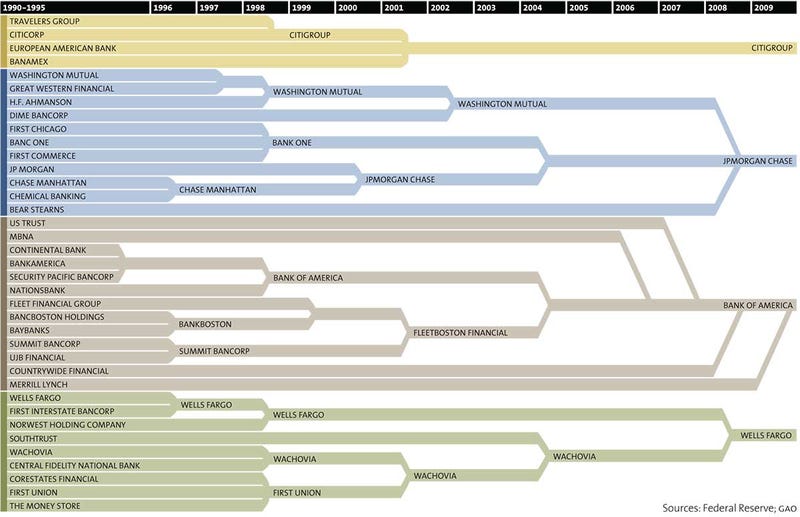
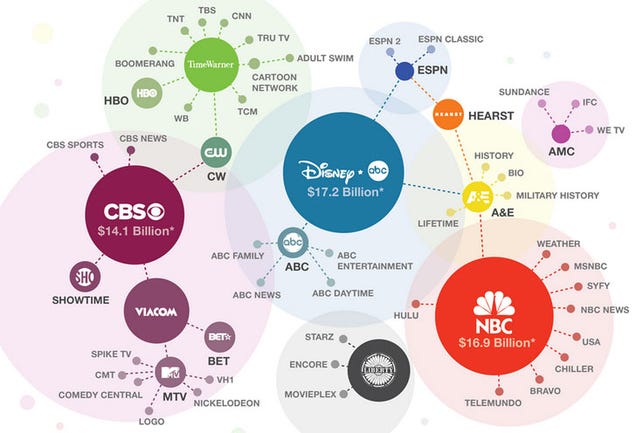
Son, there used to be these things called antitrust laws

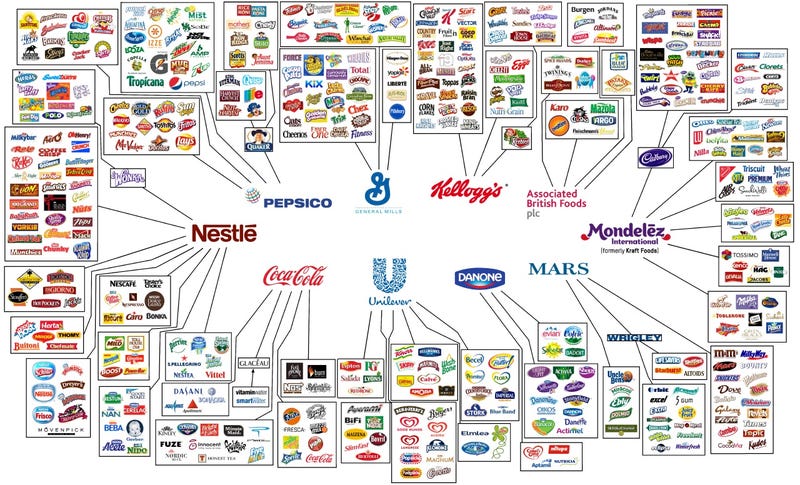
From a fascinating set of graphics from the good people at Gawker Media.


These last two connect to one of our long-running threads. One of the reasons I push the terrestrial superstation story so hard is because of the way it both contradicts and supports the message of these two graphics. We are talking about a highly profitable and rapidly growing industry segment that was virtually invented by the small and nimble Weigel Broadcasting. Not only did it take majors like NBC, Fox and CBS years to catch up, but the latter two actually made a deal with Weigel to essentially run their superstations (Movies! and Decades) for them.

So it is possible for a small but smart and aggressive media company to disrupt and dominate the industry, but the obstacles are daunting. Most journalists are completely oblivious to little companies without massive PR budgets. Despite being one of the most interesting business stories of the past decade (at least of those involving well-run businesses), Weigel is almost unheard of outside of Chicago. Worse yet, the entire terrestrial superstation industry under the potential death threat of lobbyists trying to sell off that chunk of spectrum.

The little guy who has the better idea and the faster reflexes can sometimes still beat the big players, but only by overcoming a system stacked against him.

Tuesday, July 19, 2016

Charter school financing has a way of getting complicated


Via LGM.


I know I've made this point before, but emotions run hot in the education reform debate so it's important not to demonize people  on the other side. Most people starting and operating charter schools, like most people working in traditional schools, are primarily there to do good.

But it is also important to remember that, in its current form, the charter school system has tremendous amounts of money changing hands often through complex and opaque financial deals, with no-bid contracts between connected players, lucrative sinecures, questionable metrics and frequently misaligned incentives.

Here, the Charlotte Observer's Ann Doss Helms walks us through a not-that-unusual example of funding.

When the Thunderbird board got approval to open in 2014, it signed a contract with Banyan Strategics, a Mecklenburg firm that provides support for charter and private schools. The founders were involved in starting Lake Norman Charter in the late 1990s.

...

During the first school year, the relationship between Thunderbird and Banyan fell apart. Mojica declined to discuss details, saying the separation agreement prohibits it, and Banyan couldn’t be reached for comment. But the Thunderbird board ended up borrowing $450,000 to pay a penalty for breaking that contract.

...


The rest came from ALK Angel Holdings of Virginia, which gave Thunderbird a $250,000 line of credit, with interest-only payments of $4,167 a month, or $50,000 a year. That’s the one that really raised eyebrows among state officials.


“That just seems like a bad loan,” said Steven Walker, an advisory board member who is also general counsel to Lt. Gov. Dan Forest. Walker pressed Mojica for details about Angel Holdings, including whether any Thunderbird board members did business with general partner Alex Karakozoff.


Mojica said Karakozoff is a venture capitalist with whom he had done business in the past.

...

In addition to paying off the Chinese investors and the three loans, Thunderbird pays rent to Vertex – under an agreement that also makes the school responsible for all maintenance and repairs.


Some of the classrooms flood during heavy rains, which means the school is paying to install a new drainage system and get rid of mold, which sparked parent complaints about health and safety. Families also complained to the Health Department about rats in the school; Thunderbird is hiring a pest control company.


Mojica says rent on the building is capped at 20 percent of the per-pupil allotment Thunderbird gets from taxpayers to run the school.


“We are within the norms. We might be on the high side of the norms,” he said. “It may not be the cheapest rent around.”


In 2014-15, the first year Thunderbird was open, expenses outstripped the money it took in. The 2015-16 audit isn’t due until October, but the school provided the state panel an informal report showing it had ended the year in the black.


But Alexis Schauss, the state Department of Public Instruction’s director of school business, said those numbers don’t seem to match what she has seen on monthly reports. “I don’t feel comfortable with the data I have,” she told the advisory board.

...

The Thunderbird board hired human resources consultants to screen candidates for the school’s volunteer board and the top job. The March decision to hire Emmanuel Vincent, an educator who had most recently worked at a Georgia charter school, over Andrea McKinney, a longtime local educator who had been hired as interim director, infuriated some families, who petitioned for Mojica to resign.


State charter board members said they want to see improvements on all fronts: relations with parents, healthy classrooms, board governance and financial reporting.


Mojica says that’s in the works – with more outside help. Even before last week’s meeting, Thunderbird had signed on two school leadership consultants to advise the board on academics and governing. A financial consultant will “audit the audit,” Mojica told the board, and Thunderbird is taking bids for a bookkeeping firm.


The board recently added two members and will continue working with the HR consultant to add two more, Mojica said.

Monday, July 18, 2016

Live fast, die young, leave a good-looking resume


It is important to remember that this ageism is part of a larger phenomenon. Though most of us don't have any adult memories of the Post-War period, it was not that long ago when having a shortage of science and technology workers actually meant a shortage. Companies like Texas Instruments were famous for being very flexible in their hiring and taking anyone who might be good at the job. Now when you hear employers in someplace like Silicon Valley complaining about a "shortage" of workers, what they mean is they can't find a large, ongoing supply of workers under the age of 30 with exactly the advanced degrees they need from top-ranked universities who are willing to work 60+ hours with no job security for good, but not great money until they burn out and have to be discarded.

It is also important to remember that those under-qualified and and over-protected workers of the Post-War era laid the technological foundation on which most of today's Silicon Valley fortunes are based.

From Dice.com:

In 2007, a fresh-faced Mark Zuckerberg famously ruffled feathers among some older colleagues when he suggested that tech companies should not hire people over 30. “Young people are just smarter,” the Facebook chief executive, then 22, told a crowd at Stanford University.

Nearly a decade after the public gaffe, some say little has changed in terms of how older workers are perceived in the tech industry. Despite making recent attempts to diversify their workforces through aggressive initiatives to attract more women and minorities, Silicon Valley firms still wear their disproportionately young ranks like a badge of honor, proudly flaunting a youth-focused culture in which 28 is seen as middle age and 35 over the hill.

While workers over 40 are protected by federal civil rights laws in the United States, the plight of older employees so rarely enters into conversations about workplace discrimination in tech that one would be forgiven for not realizing it’s an issue at all.

In fact, ageism is very prevalent. Just ask Dan Lyons, a technology journalist and writer for HBO’s “Silicon Valley.” As notably chronicled in his recent best-selling book “Disrupted: My Misadventure in the Start-Up Bubble,” Lyons lost his longtime position at Newsweek magazine when he was in his 50s and decided to switch gears by taking a marketing fellowship at the software company HubSpot. In his book, published earlier this year, Lyons describes the startup’s culture as a frat-like circus filled with Nerf gunfights and hookup dens.

To complement the book, Lyons also wrote a LinkedIn post in which he called out tech industry executives for their defiantly ageist rhetoric, including his old boss at HubSpot, who he said once called gray hair and experience “overrated.” The LinkedIn post went viral, and Lyons said it was at that moment that he realized how widespread the problem really is.

“I got this outpouring of emails from people,” Lyons told Dice Insights. “I don’t mean to toot my own horn—I don’t think it’s that the article was so good. It’s just that there are a s–tload of people out there who experienced this. It was upsetting really.”


Friday, July 15, 2016

Cracked: "Why Everybody Wins If Batman & Superman Are Public Domain "

I believe we can safely take this as a piece of devil's advocacy -- Warner Bros. would not really come out ahead on this  -- but it's well though-out and makes some excellent points. For instance, it points the self-evident absurdity of extending copyrights to encourage creativity when the old laws had recently produced an unprecedented wave of valuable commercial properties. It also points out that being in the public domain has not appreciably hurt and has arguably helped characters like Tarzan and Sherlock Holmes.