Monday, January 29, 2018

Tesla and the New York Times – – adding a historical component to the hype-and-bullshit tech narrative

This New York Times piece ["Tesla the Car Is a Household Name. Long Ago, So Was Nikola Tesla".
By John F. Wasik DEC. 30, 2017 ] is so bad it might actually be more useful than a better written article (such as this Smithsonian profile) would have been. Wasik provides us with an excellent example of the way writers distort and mythologize the history of technology in the service of cherished conventional narratives.

The standard tech narrative is one of great men leading us into a period of extraordinary, unprecedented progress, sometimes exciting, sometimes frightening, but always unimaginably big and just around the corner. In order to maintain this narrative, the magnitude and imminence of the recent advances is consistently overstated while the technological accomplishments and sophistication of the past is systematically understated. Credit for those advances that did happen is assigned to a handful of visionaries, many of the tragic, ahead-of-their-time variety.

These historical retcons tend to collapse quickly when held up against actual history. This is especially true here. Tesla always generated a great deal of sensationalistic coverage (more often than not intentionally), but more sober contemporary sources consistently viewed him as both a brilliant and important innovator and also an often flaky and grandiose figure, a characterization that holds up well to this day. This was the man who invented the induction motor; he was also the guy who claimed to hear interplanetary radio messages in his lab.

John F. Wasik plays the  ahead-of-their-time card extensively throughout the article.

He envisioned a system that could transmit not only radio but also electricity across the globe. After successful experiments in Colorado Springs in 1899, Tesla began building what he called a global “World System” near Shoreham on Long Island, hoping to power vehicles, boats and aircraft wirelessly. Ultimately, he expected that anything that needed electricity would get it from the air much as we receive transmitted data, sound and images on smartphones. But he ran out of money, and J. P. Morgan Jr., who had provided financing, turned off the spigot.


Tesla’s ambitions outstripped his financing. He didn’t focus on radio as a stand-alone technology. Instead, he conceived of entire systems, even if they were decades ahead of the time and not financially feasible.

Tesla failed to fully collaborate with well-capitalized industrial entities after World War I. His supreme abilities to conceptualize and create entire systems weren’t enough for business success. He didn’t manage to build successful alliances with those who could finance, build and scale up his creations.
Tesla’s achievements were awesome but incomplete. He created the A.C. energy system and the basics of radio communication and robotics but wasn’t able to bring them all to fruition. His life shows that even for a brilliant inventor, innovation doesn’t happen in a vacuum. It requires a broad spectrum of talents and skills. And lots of capital.

The trouble with this part of the narrative is that Tesla's Great White Whale (long-distance wireless power transmission) was simply a bad idea. It was not financially feasible because it was not feasible period. We've had over a century to consider the problem, not to mention more powerful tools and a far greater understanding of the underlying physical forces, and we can say with near absolute confidence that, even if long-distance wireless power transmission is developed in the future, it will not use Tesla's approach. No amount of funding, no degree of public support would have changed the outcome of this part of the story.

Just to be clear, even bad ideas can require brilliant engineering. That was certainly the case here, just as it was with other dead ends of the era such as mechanical televisions and steam powered aircraft. Even to this day, demonstrations of Tesla's system are impressive to watch.
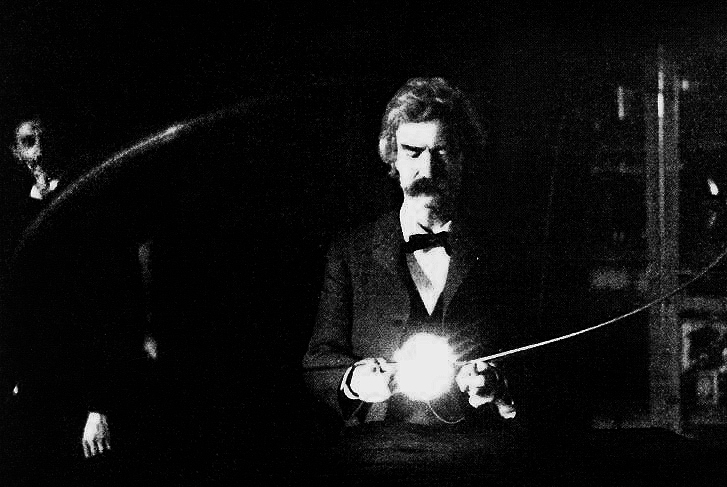

[Tesla understood the value of celebrity.]

Just as the if-only-he'd-had-the-money argument collapses under scrutiny, so does the lone-visionary-ahead-of-his-time narrative. If you dig through contemporary accounts, you'll find that Tesla was very much representative of the scientific and research community of his time in most ways. Both in terms of the work he was doing and the ideas he was formulating about the role of technology, he had lots of company.

Wasik consistently downplayed the work of Tesla's contemporaries, sometimes subtly (saying that the Supreme Court ruled in his favor in a 1943 patent dispute when in fact, he was one of three inventors who had their prior patents restored by the decision), sometimes in a comically over-the-top fashion as with this description of Tesla's remote-controlled torpedo.

Shortly after filing a patent application in 1897 for radio circuitry, Tesla built and demonstrated a wireless, robotic boat at the old Madison Square Garden in 1898 and, again, in Chicago at the Auditorium Theater the next year. These were the first public demonstrations of a remote-controlled drone.

An innovation in the boat’s circuitry — his “logic gate” — became an essential steppingstone to semiconductors. [This is a somewhat controversial claim. We'll try to come back to this later – MP]

Tesla’s tub-shaped, radio-controlled craft heralded the birth of what he called a “teleautomaton”; later, the world would settle on the word robot. We can see his influence in devices ranging from “smart” speakers like Amazon’s Echo to missile-firing drone aircraft.

Tesla proposed the development of torpedoes well before World War I. These weapons eventually emerged in another form — launched from submarines.

Just to be clear, Tesla was doing important and impressive work, but as one of a number of researchers pushing the boundaries of the field of radio.

From Wikipedia:
In 1894, the first example of wirelessly controlling at a distance was during a demonstration by the British physicist Oliver Lodge, in which he made use of a Branly's coherer to make a mirror galvanometer move a beam of light when an electromagnetic wave was artificially generated. This was further refined by radio innovators Guglielmo Marconi and William Preece, at a demonstration that took place on December 12, 1896, at Toynbee Hall in London, in which they made a bell ring by pushing a button in a box that was not connected by any wires. In 1898 Nikola Tesla filed his patent, U.S. Patent 613,809, named Method of an Apparatus for Controlling Mechanism of Moving Vehicle or Vehicles, which he publicly demonstrated by radio-controlling a boat during an electrical exhibition at Madison Square Garden. Tesla called his boat a "teleautomaton"


The part about proposing the "development of torpedoes well before World War I" is even stranger. The self-propelled torpedo had been in service for more than 30 years by 1898, and remote-controlled torpedoes (using a mechanical system based on trailing cables, but still having considerable range and speed) had been in use for over 20.

It makes for a good story to credit Tesla as the lone visionary who came up with robotics and remote control by himself but was just too far ahead of his time to sell the world on that vision, but the truth is that lots of smart people were working along these lines (like Leonardo Torres y Quevedo)  and pretty much everybody saw the potential value.

Tesla's ideas about remote-controlled torpedoes would take years to be implemented because it would take years for the technology to catch up with his rhetoric. You can read a very good contemporary account from scientific American that spelled out the issues.

We've talked a lot here at the blog about about the mythologizing and bullshit that are pervasive in the 21st century technology narrative. It's worth noting that those same popular but dangerously false narratives color our perception of the past as well.


Friday, January 26, 2018

Add Adam Conover to the list of replication bullies

[Spelling error corrected.]

Most people in the news media missed the joke when Jon Stewart took over the Daily Show, or, more accurately, saw a joke that wasn't there. It took them a while to realize that while Stewart, the cast, and the writers of the show were trying to be funny, they generally weren't kidding.

The Daily Show was in that sense a very serious response to the disastrous state of turn-of-the-millennium journalism. As bad as things are now, it is easy to forget how much worse they were in the period roughly defined by Whitewater, Bush V Gore, and build-up to the Iraq war. The best of the new voices, such as Josh Marshall, were just beginning to be heard. The New York Times was pretty much the same, but now its devotion to practices like false balance, blind adherence to conventional narratives, and Clinton derangement syndrome have grown increasingly controversial with the rest of the media with papers like the Washington Post aggressively pushing back. In 1999, the rest of the press corps was seeing who could be the most like the NYT rather than criticizing it.

When the true nature of Stewart's Daily Show finally began to dawn on people, there was considerable bad feeling among journalists, lots of grumbling that Stewart, Colbert, and the rest had forgotten their place. Colbert's performance at the White House Correspondents' Dinner in particular hit a huge nerve. The people in that ball room were perhaps the last to realize that the satirical bits were driven by genuine contempt for a profession that had gone to hell.

Stewart and Colbert focused on press criticism because it was a ripe target for satire but also because it was something that needed to be done (God knows hacks like David Carr and Jack Shafer were not up to the job). The next generation, John Oliver, Samantha Bee, and in his new role, Stephen Colbert have shifted more toward news presented with a satirical bent once again filling in gaps left by conventional journalism.

Go forward another iteration (and another literal generation) and you get Cracked and College Humor who have taken those same basic instincts and applied them to less topical subjects, often focusing more on education than news.

One common thread that runs through all of the shows over the past almost 20 years is a reaction against the polite toleration of bullshit that it come to dominate mainstream journalism. It is worth noting that Adam Conover squarely placed himself in the pro-replication camp and has made citing sources and acknowledging errors a prominent part of Adam Ruins Everything.


Thursday, January 25, 2018

A Turn of the Century Childhood's End

This may go against conventional wisdom, but what we now call New Age beliefs (normally seen as children of the counter-culture) are largely a product of the late 19th and early 20th centuries. Parapsychology? Check. Ghosts and similar entities? Check. Fascination with paganism and arcane religions? Check. Space aliens? Check. And finally, the idea that humanity is on the verge of a huge evolutionary leap, a leap that might already be happening? Check.

The turn of the century probably also marked the peak respectability for these beliefs. It's difficult imagining something like this running in Scientific American in the 21sst century.


Wednesday, January 24, 2018

Where quack medicine meets political corruption meets pyramid schemes

This piece from the LA Times' indispensable Michael Hiltzik this excellent New Yorker article by Rachel Monroe

Orrin Hatch is leaving the Senate, but his deadliest law will live on – LA Times

Sen. Orrin Hatch (R-Utah) last made a public splash during the debate over the GOP's tax cut bill in December, when he threw a conniption over the suggestion that the bill would favor the wealthy (who will reap about 80% of its benefits by 2027).

Hatch subsequently announced his retirement from the Senate as of the end of this term, writing finis to his 40 years of service. In that time, he has shown himself to be a master of the down-is-up, wrong-is-right method of obfuscating his favors to rich patrons. That was especially the case with his sedulous defense for 20 years of his deadliest legislative achievement.

We're talking about the Dietary Supplement Health and Education Act of 1994, or DSHEA (pronounced "D-shay"). Hatch introduced DSHEA in collaboration with then-Sen. Tom Harkin (D-Iowa), but there was no doubt that it was chiefly his baby. The act all but eliminated government regulation of the dietary and herbal supplements industry. Henceforth, the Food and Drug Administration could not block a supplement from reaching market; the agency could only take action if it learned of health and safety problems with the product after the fact.

DSHEA, as it was written and as it was intended, facilitates the legal marketing of quackery.
...

The Government Accountability Office found the marketing of herbal supplements, especially to the elderly, to be rife with deceptive and dangerous advice; marketers were heard assuring customers that their products could cure disease and recommending combinations that were medically hazardous. The FDA told the GAO that, yes, those marketers shouldn't be saying these things, and they'd get right on it.
...

But one didn't have to drill down too deeply in the speech to discern what really drove the law's enactment. It wasn't the desire for "rational regulation," but that most common political drug of all, money. The dietary supplement industry had set up shop in Hatch's home state and plied him with pantsfuls of campaign cash; in 2010, for instance, Utah-based Xango LLC, which markets dietary supplements among other products, was Hatch's second-biggest contributor. (Herbalife ranked third.) Hatch's son, Scott, has worked as a lobbyist for the industry.

Thanks to DSHEA, the supplements industry grew from $9 billion in 1994 to more than $50 billion today. In Utah alone, it's worth more than $7 billion.

And the consumers often aren't the only victims.


Tuesday, January 23, 2018

The Grandiosity/Contribution Ratio

From Gizmodo [emphasis added]
Zuck and Priscilla laid out the schematics for this effort on Facebook Live. The plan will be part of the Chan Zuckerberg Initiative and will be called simply “Chan Zuckerberg Science.” The goal, Zuck said, is to “cure, prevent, or manage all diseases in our children’s lifetime.” The project will bring together a bunch of scientists, engineers, doctors, and other experts in an attempt to rid the world of disease.

“We want to dramatically improve every life in [our daughter] Max’s generation and make sure we don’t miss a single soul,” Chan said.

Zuck explained that the Chan Zuckerberg Initiative will work in three ways: bring scientists and engineers together; build tools to “empower” people around the world; and promote a “movement” to fund science globally. The shiny new venture will receive $3 billion in funds over the next decade.
...

“Can we cure prevent or manage all diseases in our children’s lifetime?” Zuck asked at one point. “This is a big goal,” he said soon after, perhaps answering his own question.

Obviously, any time we can get some billionaire to commit hundreds of millions of dollars a year to important basic research, that's a good thing. This money will undoubtedly do a tremendous amount of good and it's difficult to see a major downside.

In terms of the rhetoric, however, it's useful to step back and put this into perspective. In absolute terms $3 billion, even spaced out over a decade, is a great deal of money, but in relative terms is it enough to move us significantly closer to Zuckerberg's "the big goal"? Consider that the annual budget of the NIH alone is around $35 billion. This means that Zuckerberg's initiative is promising to match a little bit less than 1% of NIH funding over the next 10 years.

From a research perspective, this is still a wonderful thing, but from a sociological perspective, it's yet another example of the hype-driven culture of Silicon Valley and what I've been calling the magical heuristics associated with it. Two of the heuristics we've mentioned before were the magic of language and the magic of will. When a billionaire, particularly a tech billionaire, says something obviously, even absurdly exaggerated, the statement is often given more rather than less weight. The unbelievable claims are treated less as descriptions of the world as it is and more incantations to help the billionaires will a new world into existence.

Perhaps the most interesting part of Zuckerberg's language here is that it reminds us just how much the Titans of the Valley have bought into their own bullshit.

Monday, January 22, 2018

Arthur C Clarke and the futurist's inflection point

Clarke circa 1964:
Trying to predict the future is a discouraging and hazardous occupation because the prophet invariably falls between two stools. If his predictions sound at all reasonable, you can be quite sure that within 20 or, at most, 50 years, the progress of science and technology has made him seem ridiculously conservative. On the other hand, if by some miracle a prophet could describe the future exactly as it was going to take place, his predictions would sound so absurd, so far-fetched, that everybody would laugh him to scorn. This has proved to be true in the past, and it will inevitably be true, even more so, of the century to come.

The only thing we can be sure of about the future is that it will be absolutely fantastic.

So, if what I say to you now seems to be very reasonable, then I'll have failed completely. Only if what I tell you appears absolutely unbelievable, have we any chance of visualizing the future as it really will happen.


I can't quite recommend Paul Collins' recent New Yorker piece about the book Toward the Year 2018. Collins doesn't bring a lot of fresh insight to the subject (if you want a deeper understanding of how people in the past looked at what was formerly the future, stick with Gizmodo's Paleofuture), but it did turn me on to what appears to be a fascinating book (I'll let you know in a few days) which provides a great jumping off point for a discussion I've been meaning to have for a while.
If you wanted to hear the future in late May, 1968, you might have gone to Abbey Road to hear the Beatles record a new song of John Lennon’s—something called “Revolution.” Or you could have gone to the decidedly less fab midtown Hilton in Manhattan, where a thousand “leaders and future leaders,” ranging from the economist John Kenneth Galbraith to the peace activist Arthur Waskow, were invited to a conference by the Foreign Policy Association. For its fiftieth anniversary, the F.P.A. scheduled a three-day gathering of experts, asking them to gaze fifty years ahead. An accompanying book shared the conference’s far-off title: “Toward the Year 2018.”


“MORE AMAZING THAN SCIENCE FICTION,” proclaims the cover, with jacket copy envisioning how “on a summer day in the year 2018, the three-dimensional television screen in your living room” flashes news of “anti-gravity belts,” “a man-made hurricane, launched at an enemy fleet, [that] devastates a neutral country,” and a “citizen’s pocket computer” that averts an air crash. “Will our children in 2018 still be wrestling,” it asks, “with racial problems, economic depressions, other Vietnams?”

Much of “Toward the Year 2018” might as well be science fiction today. With fourteen contributors, ranging from the weapons theorist Herman Kahn to the I.B.M. automation director Charles DeCarlo, penning essays on everything from “Space” to “Behavioral Technologies,” it’s not hard to find wild misses. The Stanford wonk Charles Scarlott predicts, exactly incorrectly, that nuclear breeder reactors will move to the fore of U.S. energy production while natural gas fades. (He concedes that natural gas might make a comeback—through atom-bomb-powered fracking.) The M.I.T. professor Ithiel de Sola Pool foresees an era of outright control of economies by nations—“They will select their levels of employment, of industrialization, of increase in GNP”—and then, for good measure, predicts “a massive loosening of inhibitions on all human impulses save that toward violence.” From the influential meteorologist Thomas F. Malone, we get the intriguing forecast of “the suppression of lightning”—most likely, he figures, “by the late 1980s.”

But for every amusingly wrong prediction, there’s one unnervingly close to the mark. It’s the same Thomas Malone who, amid predictions of weaponized hurricanes, wonders aloud whether “large-scale climate modification will be effected inadvertently” from rising levels of carbon dioxide. Such global warming, he predicts, might require the creation of an international climate body with “policing powers”—an undertaking, he adds, heartbreakingly, that should be “as nonpolitical as possible.” Gordon F. MacDonald, a fellow early advocate on climate change, writes a chapter on space that largely shrugs at manned interplanetary travel—a near-heresy in 1968—by cannily observing that while the Apollo missions would soon exhaust their political usefulness, weather and communications satellites would not. “A global communication system . . . would permit the use of giant computer complexes,” he adds, noting the revolutionary potential of a data bank that “could be queried at any time.”


[Though it's a bit off-topic, I have to take a moment to push back against the "near-heresy" comment. Though most people probably assumed manned space exploration would have more of a future after '68, and it certainly would've gone farther had LBJ run for and won a second term (Johnson had been space exploration's biggest champion dating back to his days in the Senate), but the program had always been controversial. "Can't we find better ways to spend that money here on earth?" was a common refrain from both the left and the right.]

As you go through the predictions listed here, you'll notice that they range from the reasonably accurate to the wildly overoptimistic or, perhaps overly pessimistic, depending on your feelings toward weaponized hurricanes (let's just go with ambitious). This matches up fairly closely to what you find in Arthur C Clarke's video essay of a few years earlier, parts that seem prescient while others come off as something from that months issue of Galaxy Magazine.

It's important to step back and remember that it didn't used to be like that. If you had gone back 20, 50, one hundred years, and asked experts to predict what was coming and how soon we get here, you almost certainly would have gotten many answers that seriously underestimated upcoming technological developments. If anything, the overly conservative would probably have outweighed the overly ambitious.

The 60s seemed to be the point when our expectations started exceeding our future. I have some theories as to why Clarke's advice for prognostication stopped working, but they'll have to wait till another post.

Friday, January 19, 2018

Removing the senate

This is Joseph

I normally have great respect for Ezra Klein.  His stuff is awesome and I always click on his articles.  Which is why this article annoyed me

Consider the proposal:
Bennet has introduced the “Shutdown Accountability Resolution.” The effect would be that from the moment a shutdown starts, most members of the Senate would be forced to remain in the Senate chambers from 8 am to midnight, all day, every day. No weekends. No fundraisers. No trips home to see their families or constituents.
The proposal would not, itself, resolve the DREAMer debate that’s driving the federal government toward shutdown. But it would give the senators involved a powerful incentive to find a solution. This is a body that typically comes together in Washington a few days a week for only part of the year. The last thing they want is to be tied to the Senate floor day after day, for weeks or months on end.
Here’s how the resolution works: It would change Senate rules so that following a lapse in funding for one or more federal agencies — the technical meaning of a shutdown — the Senate must convene at 8 am the next day. Upon convening, the presiding officer forces a quorum call to see who’s present.
In the absence of a quorum, the Senate moves to a roll call vote demanding the attendance of absent senators. If a sufficient number are absent, the sergeant at arms will be asked to arrest them. This process is repeated every hour between 8 am and midnight until a bill passes reopening the government.
The result is that senators need to remain on or near the Senate floor for the duration of the shutdown. They can’t go wait it out in the comfort of their own home.
Perhaps they omitted the piece where the house of representatives is also penalized.  But a budget needs to be passed by both the House and the Senate, right?  So how does this prevent the strategy of the House passing a budget and then leaving for six weeks?  They aren't required to be present 8 am to midnight every day.  I read the whole thing and it seems awfully specific to senators.

So if the house passes something then the senate can rubber stamp it, or being sitting around until they do.  House members can be on the golf course. 

After all, if the senators make an agreement on a budget, doesn't it have to pass the house as well? 

It also hides the real story, which is that budget reconciliation would let a budget be passed with 50 votes.  There was a decision here to put a priority on tax cuts without working out a budget at the same time.  The idea that they would need to compromise now was baked into using the previous strategy for a tax cut.  But it doesn't help to then make the senate a hostage of the house. 

Similarily, what happens if a president vetoes the budget?  Punishing senators for other people's actions seems to result in a stable outcome of making the senate impotent.  Now this could be the goal, but that seems like a different conversation (should there be a senate). 

Feel kind of bad about making fun of Soylent now

Remind me to throw in some raw water jokes next time I write something about the culture of Silicon Valley.


Thursday, January 18, 2018

Double blind peer review

This is Joseph

I was reading this piece by Andrew Gelman and this led me to this other article in the comments.  The discussion was a journal being annoyed by preprints, and one reason that people wondered if it might be so was double blind peer review.  So the comments on the challenges of double blind peer review are well worth thinking about:

A related problem with mandatory DBPR, if the journal wants to actually attempt to enforce it (in my experience, many problems in any form of professional life start when someone creates a rule and then tries to be consistent in enforcing it, despite the messiness of the world), is that in addition to the assumption that the manuscript is not available through Google, it also assumes, more completely, that it has not previously been seen by the reviewers in an unblinded state.  That seems like a rather untenable assumption, especially in specialised fields.  PSPB is a well-respected journal by any measure, but like any journal ("Cell wouldn't take it? Let's try Nature!") it may not always be the first port of call for the authors who submit there.  Should the reviewer who has already seen the manuscript unblinded on behalf of another journal recuse herself because she knows who the author is, thus depriving the editor of an expert opinion (which, as a bonus, could presumably be provided very quickly

I am actually pretty good at guessing who the authors are when I review a double blinded paper, even if I am not specifically trying.  Part of it is that some pieces are informative -- a paper on the Framingham Heart Study has a limited pool of typical authors.  Journals ask people to include notes about ethical review (gives the institution).  And the citations are a pretty big clue if there is any building upon previous work.

Does this mean that I shouldn't review in areas where I know the field well?

It is not a trivial problem.  But I think I might err on the side of free information above strict blinding if I had to make a call.  But it's definitely an issue I want to think more about.  

Wednesday, January 17, 2018

Montclair SocioBlog makes a good point

This is Joseph

I don't completely agree with this sentiment, but I think it is worth deconstructing the underlying thinking pattern that the author identifies:
Last week, a New York Times op-ed about Medicare had a title that characterized the Republican approach: “You’re Sick. Whose Fault Is That?” The same idea applied to abortion would give us “You’re Pregnant. Whose Fault Is That?” It’s a great question if you are interested in assessing blame. The payoff comes in the currency of feelings – guilt (for those with illness or unwanted pregnancy), pride or righteousness for the healthy and virtuous. But if you’re interested in effective policy to improve people’s health or reduce abortion, “whose fault?” is the wrong question.Why not ask, “How can we help?”
There is a question about whether the question"how can we help?" is the best approach.  I think that it is terribly unhelpful to focus on judging others for their struggles, misfortunes, and challenges.  Everyone has a moment when they are down or require help.  If you don't believe that then ask how many infants are completely self-sufficient and don't require at least some degree of assistance.

Focusing on judging is a barrier to solving problems, both social and in in terms of public health.  It is a good thing to remember.

Tuesday, January 16, 2018

Infrastructure thoughts of the day

This is Joseph

Some thoughts on transportation and infrastructure.

Duncan Black points out a new proposal to create dedicated lanes for driverless cars.  I think it goes without saying that creating dedicated lanes will make any transportation system look good and that it says a lot that we are thinking about this for expensive cars but not buses.

In parallel, there is a nice article on how high speed trains can replace airplanes for medium distance trips.  To some extent this advantage comes from us deliberately making air travel inefficient.  Whether or not we need TSA screening, do we need long queues?  I like trains, I wish we had more of them, but I think the real barrier is the will to create efficient infrastructure projects. Should Paris be more efficient than New York?  

Mark Palko and Andrew Gelman are grappling with this inefficiency in the comments to this post.  Mark is assuming the stifling world of Los Angeles where even small improvements in density require huge amounts of political capital to change restrictive zoning and to reach out to the impacted communities.  Andrew asks the obvious question of why we can't just let construction companies fix these issues without central planning getting involved (via changing the zoning).  It's a good question.  My pet theory is that we've let house prices get so high that even small changes in value equal huge gains and losses, making local homeowners resistant to improved zoning.    

Too busy for a real post...

... but not too busy to give you a flying machine fix

Looks almost too pretty to fly, but it did.


Scientific American June 17, 1905. “It traveled at a high speed for over a mile, and then came slowly and steadily to the ground ... The experiment was attended with complete success, and testified to the efficiency of the design.”

Monday, January 15, 2018

When the YIMBYs don't have the answer

This is a bit LA specific but you can probably generalize the conclusions to other areas.

While there are certainly cases where simple solutions work with complex problems, you should always beware when the appeal rests disproportionately on that simplicity, particularly when combined with ideology and vested interests.

Recently in Los Angeles, we've seen a powerful alliance between utopian urbanists, free market advocates, and real estate developers. The rhetoric has been lofty, framing their initiatives as a battle against climate change, congestion, and urban decay. A look at the details, however, raises serious questions and perhaps reveals the fundamental flaw of the alliance, that utopianists who depend on market forces and business self-interests are perhaps bound to be disappointed.

Before we get into cases, let's review a few general principles. Building housing so that residents have access to good public transportation is generally a great idea, but it is important to define what constitutes "good" here. Since the objective is to reduce or even eliminate the need for cars, the public transportation options need to be reasonably competitive in terms of range of destinations, speed, convenience, and pleasantness, roughly in that order.

The first is particularly important in terms of jobs and commuting. The main problem with the naïve live-where-you-work model is that people often live in multi-income households and frequently change jobs. This also brings up an aspect of public transportation that is frequently forgotten by people who write about buses and trains but don't actually use them. While as-the-crow-flies distance is usually a pretty good indicator of travel time if you have a car or a bike, it can be almost meaningless when you are relying on other forms of transportation. In a place like Los Angeles, it is easy to find examples where one 10 mile trip will take 20 minutes while another will take two hours.

A good (albeit arbitrary) metric for evaluating public transportation as a commuting option would be to count the number of destinations that can be reached by bus, train, and bicycle within a half hour (maybe 45 minutes). Based on that metric and other factors such as available land and demand for middle and lower income housing, there are a number of spots in LA that would be ideal for development.

Chinatown would be perfect. In addition to having its own train station, it's within walking distance of Union Station, the major transportation hub for the county. Between the different bus and rail lines, you have a reasonable commute to much of greater LA. Another excellent candidate would be the section of the Green Line that connects the silver line in the blue line in South LA.

On the other end of the spectrum, if you were to look at the map of the LA train system and try to find the worst possible place for building housing around stations, you would very probably end up picking the Expo line to Santa Monica. While overall a good addition to the system and certainly better than nothing, the Expo line is a slow and exceptionally badly connected train. The commuter relying on it would have either a very small list of destinations or would face daunting travel times.

You can probably guess where this is going. The one place where everyone's talking about this new urban vision is the one place it's least likely to work, Santa Monica. There are vacant lots used for parking within walking distance of Union Station and a desperate need for good affordable housing in places like Watts. Train station housing developments in those areas make far, far more sense from a public transportation standard and from an economic development standard, but given the choice between a trendy, upscale beach neighborhood and Compton, where do you think the real estate the money is going to flow?

(Yes, I do realize that there's a trickle-down argument, but LA's a big place and the idea that lowering prices in fashionable beach communities will have a noticeable effect on the market in East LA seems unlikely.)

 At the risk of pounding home the obvious,bad housing regulations and zoning laws have done a lot of damage and NIMBYs bear a great deal of the blame. Under the right circumstances, intelligent deregulation and selective application of market forces could help alleviate some serious problems, but blind faith in those forces and in the enlightened self-interest of developers is foolish and dangerous.


Friday, January 12, 2018

Thursday, January 11, 2018

Linking health insurance and employment: does the saga ever end?

This is Joseph

Yesterday, I wrote about Matt Reed talking about unions.  He had an earlier post on how an aging work force was doing bad things to the health insurance costs at his institution.  His solution is pretty obvious from a policy perspective -- linking health insurance to employment is looking like less and less of a good idea over time.  Among other things, it reduces job mobility and insulates customers from directly seeing the relevant costs (a second payer causes problems).  But it also reduces the quality of life for older adults.

One of the commentators on the post had an excellent point about how it discourages things like early retirement for burnt out staff:

Here is how we think Matt: Retiring before 65 is economic suicide. Even if you have a decent pension and some serious savings, a quick look at the private health insurance market will dissuade you from even thinking about it. This is doubly the case if you have any known health problems. Those $2,000 a month premiums, $5,000 deductibles and $7,500 out-of-pocket maximums mean you are $30,000-some a year in the hole the day you walk out the door. If you become disabled and don't have private disability insurance that you bought when you were 20 it is even worse. I have known people who have been fired before age 65, but I don't know any that went out the door on their own. (Oh, and your chances of finding another job? Zero! Unless you like driving Uber.)
It's astonishing that costs of health insurance exceed that of many people's pensions.   It is also likely that we've long since hit the point of diminishing returns on trying to get people to pay more in deductibles.

Now I am not unaware of the risks and costs of transitioning to a single payer style of system, especially when health care costs are already high.  But it isn't absolutely clear to me that these high costs are necessarily helping improve health, overall, which is an issue.  But it is also clear that suddenly radically reducing compensation for a huge segment of the economy is likely to cause . . . disruption.

But it is a problem worth thinking about and it would likely pay large dividends to have a good policy plan for improvement.  I mean it isn't like there are nearby functional models that work in decentralized and diverse English speaking countries with a large immigrant population that manage to have a decent life expectancy.  Right?

Wednesday, January 10, 2018

Colleges and unions

This is Joseph

Matt Reed is worried about unions in discussions of the financial stability of colleges:
Internally, for instance, many public colleges (including my own) are unionized. Collective bargaining agreements, and sometimes state laws, can greatly narrow the strike zone for any prospective downsizing. When you have to do layoffs by seniority, and your salaries are mostly determined by seniority, the most expensive employees are the most protected. That makes the math harder.
While I get that this creates problems, there are bigger issues that everyone wants to ignore.  I want to talk later about health insurance costs, and how that creates a relatively large crisis.

But the idea that job security is a problem suggests that there is already an assumption of neoliberal ideals of a lack of security in life.  Keep in mind that wealth provides options and people with lots of money have an implicit security -- you have options if working is optional or if you can cover a gap without problems. Why have we evolved from seeing people as resources to liabilities?  Why would you not want to keep your most experienced employees?

It is also worth noting that institutional loyalty is much harder to develop if senior managers are constantly worried about high seniority employees.  How can you be loyal to a place that sees you as a barrier to efficient lay-offs.

Now I do get the main point -- that colleges are meant to be grown and shrunk in slow and organic ways.  It is not a style of organization that works well with either fast growth or fast shrinking.  This suggests that maybe stabilization of finding (both directions) should be a piece of the conversation.  After all, doesn't it make sense to be able to plan?

Tuesday, January 9, 2018

It took Coke a while to escape its patent medicine origins


As this July 6, 1907 issue of Scientific American demonstrates.


Monday, January 8, 2018

Self-driving cars would be wonderful

This is Joseph

Another new year topic seems to be that of self driving cars.  This is a nice piece on the subject, with a smart take on the problems of having a human driver ready to take over
First, as one might infer, the human who is suddenly asked to intervene is going to have to quickly asses the situation. The handoff delay means a slower response than if a human had been driving the entire time. Second, and even worse, the human suddenly asked to take control might not even see what the emergency need is. Third, the car itself might not recognize that it is about to get into trouble. Recall that Uber tried to blame a car accident when its self driving car was making a left turn on the oncoming driver, when if you parsed the story carefully, it was the Uber car that was in the wrong.
This is exactly correct.  Problems that can be foreseen well in advance really don't typically need a human driver.  It is the moment that things go wrong that you need a sense of judgment.  And I can't think of a more boring thing to be doing than constantly watching the car drive.  I would much rather either check out and do something else (e.g. read) or be accumulating information on issues like road surface slipperiness. 

Remotely located drivers are even worse (imagine a bad cellular connection during the driving emergency). 

If we have a way to make a self-driving vehicle work than I am an enthusiast, but I want to make sure that the new option is better than the current technology.  We might get there, but it is during an emergency that I want the enhanced reflexes of a computer the most. 

Friday, January 5, 2018

Bitcoin skepticism

This is Joseph

This is a very good critique of bitcoin and blockchain approaches in general.  It pairs with some recent work by Megan McArdle, who is also skeptical.  It's got to be a great solution for something if this part is even close to correct:
Plus, it’s not actually that good a payment system — Visa can handle sixty thousand transactions per second, while Bitcoin historically taps out at seven. There are technical modifications going on to improve Bitcoin’s efficiency, but as a starting point, you have something that’s about 0.01% as good at clearing transactions. (And, worth noting, for those seven transactions a second Bitcoin is already estimated to use 35 times as much energy as Visa. If you brought Bitcoin’s transaction volume up to Visa’s it would be using as much electricity as the rest of the world put together.)
I value privacy in my transactions but I also value fast and cheap, as well.  I am not sure what problem this solves that cash or gold can't solve, given that they also have the slow transaction problem.  Cash has the added advantage that things are priced in it, making it a bit easier to come to agreements about the cost of things (a volatile currency is a bad store of value).

So I suspect that this is one more case of a market showing irrational exuberance.  Which should get us to wonder about what other price discovery mistakes could be embedded in markets, and why it is key to think about how and why a market can fail.  Bitcoin is a small issue, but health care is a much bigger one and it is quite possible that we have similar issues of market failure there as well.  

So food for thought.  

Thursday, January 4, 2018

All of Ryan's speeches sound better in the original Newspeak

For years, Joseph and I have been arguing over the use of terms like “Orwellian.” His position was that certain comparisons (such as those to Hitler and the Nazis) were so emotionally charged and carried so much baggage that you could seldom productively employ them in a rational argument. My counterargument was that if the similarities were both fundamental and specific and the relationships were truly analogous, you should use the most apt comparison.

At the time I think he got the better of me in the debate, but conditions have changed and I am feeling stronger about my arguments. Certainly a reference to Orwell wouldn't be out of place in this excellent column by Michael Hiltzik.
One expects politicians to conceal their intentions behind a obfuscating scrim. The problem is that news organizations become complicit in their underhanded efforts to cut social program benefits by employing the benefit-cutters' terminology.

Just after Christmas, for example, Politico achieved a multi-fecta in an article about disagreements between House Speaker Paul Ryan (R-Wis.) and Senate Majority Leader Mitch McConnell (R-Ky.) over Medicaid and Medicare.

Reading from the top down, the article referred to "overhauling" the programs, to "reform," "welfare and entitlement changes" and "policy modifications." These are Republican terms for benefit cuts. There's no excuse for journalists repeating them without defining them. But one has to drill pretty deeply into the Politico piece to find the first mention of benefit "cuts" (to paragraph 12, actually).
Politicians aiming to cut Social Security and Medicare use weasel words to hide their plans. Let's call them on it.


Other weasel words often found creeping into what purport to be objective reports about social programs are "reshape," "revamp," "modernize" and especially "fix." As we've observed in the past, Republican plans for Medicaid, Medicare, food stamps and other such programs are "fixes" in the same sense that one "fixes" a cat or the Mafia "fixes" an informer.

I've mentioned (in another context) the warning delivered in a 1965 speech by the late Sen. Daniel Patrick Moynihan (D-N.Y.) about what he called "semantic infiltration" in policy debates: "If the other fellow can get you to use his words, he wins."

Wednesday, January 3, 2018

Retirement and the issue of social security

This is Joseph

Every once in a while I hear about how social security is a monster that will destroy the federal budget if it is not reigned in.  Seriously, just google about the social security trust fund and you will be amazed.  So I was curious as to what the average benefit looks like.

According to Social Security, itself, the average benefit in November 2017 for retired workers was $1,375.29.  It was less for people living on disability.  That averages out to about sixteen thousand dollars per year.  The poverty line, for one person, is twelve thousand dollars per year as of January 2017.

What this actually means is that there isn't actually a lot of room for cuts here. Remember, that is the average and many participants will end up with even less.  Even in low cost environments, this suggests that social security is mostly a hedge against actual starvation and homeless, more than a real plan to retire.

So keep this in mind when there is a discussion of the need to cut entitlement programs to handle the new deficit crisis.  There isn't really a lot here to cut without having very profound economic impacts on vulnerable senior citizens.  And it is not really a driver of increased costs:
According to the Congressional Budget Office, Social Security’s share of gross domestic product will rise by about 1.5 percentage points over the next three decades, to 6.4%. The share going to Medicare, Medicaid and the Childrens Health Insurance Program (if Congress ever gets around to reauthorizing CHIP) will rise by 3.3 percentage points, to 8.8%.
Now there is a looming problem with medical costs, but these apply to all forms of medical insurance and not just public programs

It's inexpensive and bare bones now.  Reform, other than maybe increasing pay-outs to recipients who end up below the poverty line is likely to do real harm for surprisingly small savings (and keep in mind that we recently enacted a huge tax cut that suggests that deficits are not an immediate concern).  Finally, undermining this program undermines the justification for the quite regressive payroll tax, which is a key piece of revenue now that we keep cutting income taxes.

Tuesday, January 2, 2018

Rethinking crossownership

[Warning, I'm pretty much shooting from the hip here. This is not an area where I am knowledgeable and I do not have the time to research the subject properly. As a result, this is very much written to the good-enough-for-blogging standard, so it would be wise to double check any of the following assertions before passing them on.]

As a general rule, I tend to be skeptical of "we need this to be competitive" arguments against regulation and antitrust enforcement. Usually these claims come down to an excuse for gouging the customer or an attempt by incompetent managers to survive by gaming the system. If you can't make a go of a business without monopoly/monopsony power, then you probably aren't very good at your job.

There are, of course, exceptions, cases where technological and economic changes really have made it difficult for even the best run companies to survive, even when those companies serve a real and necessary social good. Local journalism is a perfect case in point. Some of the best reporting I've seen over the past few years has come out of newspapers, and yes, television stations outside of the major markets of New York and LA. I particularly want to single out the TV reporters because, though we all tend to mock them, they've been responsible for some remarkably good work on stories that, though important, are often ignored by institutions like the New York Times.

John Oliver hit many of these same points in his excellent piece on Sinclair broadcasting.


.

Anything we can do to encourage more and better local journalism is worth pursuing. There are considerable synergies and cost savings from combining a newspaper and a television (and possibly even a radio) station. Furthermore, in an age of cable and the Internet, I am much less concerned with the potential abuses from having this kind of cross ownership.

The key word here (and it is absolutely essential) is "local." As soon as you start to scale up, the social benefits start to drop off while the potential for abuse increases exponentially. As the experience with Sinclair has shown us, ownership across many markets actually tends to decrease the amount of local journalism and, perhaps more importantly, the amount of local editorial control.

Put simply, the standard I have in mind is that crossownership is acceptable, perhaps even desirable, if you're talking about relatively small players in relatively constrained regions. If, on the other hand, you're talking about big players (particularly those like Sinclair with a history of stifling local journalistic autonomy), the tighter the ownership restrictions the better.

Monday, January 1, 2018

Sunday, December 31, 2017

Should we care that the congestion tax is regressive?

This is Joseph

Over at Vox, Matt Ygelsias very nicely hits on one of my pet peeves about people calling congestion taxes (and similarly gas taxes) regressive:

Again and again, one hears the objection that congestion fees are regressive, but I think this is doubly mistaken. Analytically, it's true that congestion fees let the rich off relatively easy, but it's also the case that it's poor people who are disproportionately likely to not own cars and to benefit from faster buses.
But more to the point, it's easy to alter your overall tax system to make a congestion charge clearly progressive. The two main options are either to use the revenue to finance a sales tax cut (sales taxes are extremely regressive) or to pay out a "congestion dividend" to all the city's residents.
 I think that the current conversation about taxes has poisoned people's ability to be objective about these things.  Every time there is a new source of revenue, there is a push to cut progressive taxes (like the income tax).  The recent cut of the top income tax bracket is a case in point.

But raising revenue can be used to provide income support and social services.  It is a two step process, although I can understand the confusion about this given how we seem to focus only on a "taxes are bad meme".

But Matt is completely correct that poor people don't always have cars.  And if good (i.e. fast and reliable) bus service made it possible for more families to live car-free then that would be a big win, both for road safety and pollution.  Or maybe safer roads make bicycles work (even greener and cheaper).  Now this requires a commitment to good public transit services (or bike lanes), but I remain puzzled as to why this is remotely controversial.

I also want to note that the people making this argument seem to have no trouble with regressive taxation in other contexts.  The payroll tax is more regressive than the income tax.  Want to bet which one we just cut? Sales taxes are regressive, but they show no signs of being targeted in favor of an increased capital gains tax (which is progressive).  I am not saying that there are not other considerations, but I always find it puzzling how regressive is brought out in this context and not any other.

I will become much more sympathetic to the "regressive" objection when it is applied more broadly.  At the margin a congestion tax can finish a family financially.  But so too can sales taxes, which could make the difference between sufficient and insufficient income.  So if we are going to discuss regressive taxes, can we start with the elephant in the room. It's really an astonishing example of details are just not thought through.  If this is the standard then I don't see regressive as a serious problem with a tax that can be a) remedied with the right spending decisions and b) has positive social consequences.  So can we drop this point? 

Please?

Friday, December 29, 2017

The Last Jedi and narrative risks *major spoilers*

This is Joseph

The last Jedi is visually amazing and has some great character moments.  The plot is not the best, although that has rarely been a strength of Star Wars movies.  But I did want to comment on how the plot was, in a very odd way, just as safe and conservation as the Force Awakens. 

Needless to say: SPOILERS

REALLY, no kidding, SPOILERS


The Force awakens was basically the plot of a New Hope rehashed for a new group of heroes.  It is not necessarily the wrong artistic choice -- bringing a series back to the basics can create a fertile ground for exploring new paths forward.  Unfortunately, the Last Jedi seems to have managed to mangle the plot. 

The main conceit of the new series is that they reverse expectations at every step, often just to reverse them:

  1. Luke is a grumpy old man and not a wise Jedi master
  2. The plans that the heroes try cost lives and don't save them (Finn's expedition leads to the death of most of the surviving members of the resistance)
  3. Poe's reckless actions make things worse, not better, and being a hot shot ends up being counter-productive
  4. Snoke is killed immediately
  5. Turning on his master doesn't redeem Kylo Ren
  6. Rey falls for Kylo not Finn
  7. Heroic self-sacrifice is stopped by another character, with no viable plan to prevent everyone from dying
I could go on, but the trick seems to be to reverse expectations at every turn and try to make it fresh and original as a result.  But what struck me is how they somehow managed to avoid all of the real narrative risks that they could have taken with the story.

And we end up with the status quo.  A resistance against an empire that is overwhelmingly strong and is led by a person strong in the dark side is being led by a small group of heroes.  None of the new people died.  Luke becomes a force ghost, just like Yoda. The situation at the beginning is exactly like the end and we don't really have new plot angles that take us in a new and fascinating direction.

If you are going to invert expectations then you should create new paths forward.  Instead we get the same set up and very little narrative payoff.  Maybe that isn't the main thing in a Star Wars movie, but it definitely detracted from the otherwise very beautiful piece of film.  

Robots reanimating dead musicians

From NPR (May 28, 2007)
Pianist Glenn Gould's classic 1955 recording of Bach's Goldberg Variations has never been out of print. Yet this week, Sony Classical will release a brand-new recording of it.

It’s actually a recording of a "re-performance" of the music, designed by a North Carolina software company called Zenph.

The idea is simple: Old recordings sound old. Decades of amazing musical performances are hidden behind the limits of audio technology at the time they were recorded.

The Zenph "re-performance" process isn't a remastering — that is, trying to fix an existing recording with equalization or noise reduction. Instead, it's a new recording of a performance that scientifically matches the earlier one. Zenph uses a Yamaha Disklavier Pro, an actual acoustic piano that can, with a computer's help, play back with microscopically accurate timing and sensitivity.
...
Zenph will be turning to jazz next, with a recording of “re-performances'” of Art Tatum, including a live concert performance they hope to re-create, with no one at the piano, at Shrine Auditorium in Los Angeles.


Thursday, December 28, 2017

And you think we're shrill

Ad running in Scientific American, 1905.


Wednesday, December 27, 2017

Merry Muskmas to all

[I've been going back and forth as to whether or not some of this is meant to be read as parody. If I missed some subtle wink from the author of the piece, pointed out in the comment section I will amend this post.]


I've been on the Elon Musk beat for quite a while now, and I thought I had a pretty good idea where the upper bound was for hype and journalistic credulity, but this Rolling Stone cover story by Neil Strauss really does set a new standard.

Musk will likely be remembered as one of the most seminal figures of this millennium. Kids on all the terraformed planets of the universe will look forward to Musk Day, when they get the day off to commemorate the birth of the Earthling who single-handedly ushered in the era of space colonization.
...
“Musk is a titan, a visionary, a human-size lever pushing forward massive historical inevitabilities – the kind of person who comes around only a few times in a century”


And that's pretty much the level of critical scrutiny you can expect from the entire piece.  It's not just the lack of skepticism – – we've seen plenty of that – – but the obliviousness to the need for skepticism.  Up until now, most reporters for major publications have at least acknowledged that some level of skepticism would have been appropriate. True, many of the disclaimers are little more than lip service, but the journalist on those stories understood that they should do at least the bare minimum.

Strauss is the first writer I can think of who addresses proposals like the Hyperloop completely without any mention of its critics and the serious questions about its viability.


The article even has a photo caption that reads 'Inspecting the Hyperloop, which will transport people from city to city in record time.' Not "may" or even "will probably," but "will" despite a widely held consensus among transportation and infrastructure experts that this is unlikely to be viable as anything more than a glorified amusement park ride in the foreseeable future.

We may come back to this article. There's a great deal of unintentional journalism here, insights into Musk's real and extraordinary gifts for motivation and promotion, talents that have led to some truly amazing accomplishments. There is also an interesting cautionary tale in the way Strauss lets his subject steer the narrative away from these genuinely important and impressive points and toward unquestioning acceptance of a self mythologizing narrative.

For now, though, I'm just going to let it stand with this. Frankly, reading a puff peace this inflated takes a lot out of me.

Kids and Cars 2

This is Joseph

At some point I thought there was a comment on my last post asking about walking to daycare.  It's actually closer than I thought in terms of time: 3.8 miles which Google maps thinks will take me 79 minutes.  With a jogging stroller this would work if I only did one pick-up or drop off a day. 

But I still wonder why it is such a huge deal to have daycares located near places of employment; does it make me a socialist to wonder why the extra commute works (and I am happy to pay marker rates of mid-twenty thousand per year -- it's the price of a kid). 

Tuesday, December 26, 2017

Kids and cars

This is Joseph

Duncan Black has another post up about how nice it is to live in a city, and have a lot of options to avoid driving.  I lived this way for much of my life.  But now I am trying to get a child into daycare.  After discovering that daycares in some cities (like mine) have wait lists that are years long (not a joke), the question of why don't you get a daycare near your house rather answers itself.  I am not sure why the coordination is so poor, but it makes a big difference.

So I decided to look at a commute from home to a daycare it is possible to get into (not easily) and then to work (and back).  Note that these times assume normal and fast flowing traffic (ha!), which can influence both buses and cars.

Home to daycare by car: 12 minutes
Home to daycare by bus (normal morning): 34 minutes

Daycare to work by car: 14-20 minutes (google maps gives a range)
Daycare to work by bus: 37 to 44 minutes (plus time to wait for a bus)

Presuming one spends 15 minutes doing kid drop-off and that you have exactly a median wait time for the bus on the way to work (15 minutes, as they typically come every 30 minutes) plus needing to be ten minutes early for the bus in the morning (because the bus coming early is an extra 30 minute wait) then the time to do a morning drop-off and get to work:

By car: 41 to 47 minutes
By bus: 111 to 118 minutes

Now, remember that this is doubled because you need to repeat it all at the end of the day.

A car is about 50 minutes and will likely be an hour with traffic and parking.  It's more expensive but it means that if I leave the house at 7 am then I can get back home at 6/6:30 pm or so, and have worked a full day, and have a buffer in case I am delayed so that I don't have to pay overtime rates at the daycare.

By bus, that's really 2 hours each way. This assumes that all of the buses come -- one bus that doesn't adds 30 minute increments. It is common at peak times of year for buses on campus to be full and not pick up any passengers.  In these cases, I might have to use a taxi occasionally, which definitely makes the cost savings seem less optimal (but noting compared to late fees).  If I aimed for opening of the daycare I would leave the house at 6 am, struggle to get to work at 8 am (see buses being 30 minutes apart and occasionally they get behind) and have to leave a 4 pm to make sure that I could make it all work (and not be late to daycare).  No lunch break is possible and now we have a 4 to 5 hour daily commute.  It's not that any leg is insane, it is that public transit needs to be exceedingly well designed to make it efficient to do a two location trip twice a day.

Now, you might ask about daycare at work.  It's at least a 3 year wait list for infant care and you get routinely bumped by priority groups (making 3 years very optimistic).  I guess some people are able to plan this well enough . . .  or are lucky enough to not be staff.  

Now, of course, an employer could make this a priority and get that waitlist dropped.  But that seems so . . . alien . . . to the way that places are run these days that I struggle to see it.

But so long as daycare is a requirement (and I am not wealthy enough to have either nannies or the ability to make one salary easily work) then it's really going to drive car ownership.  If you want to improve car reliance, then this seems like a very pertinent problem and a key place to start putting in some creative thinking.

Monday, December 25, 2017

Christmas Greetings from Slumberland

From the great Winsor McCay.


Sunday, December 24, 2017

Friday, December 22, 2017