I’ve been meaning to post more of Benn Jordan’s videos and to talk more about the exceptionally good work being done by 404 Media. This is a two-for-one.
You probably don’t realize how many cameras are watching you on a daily basis. You almost certainly don’t realize how widely available the data they gather is to governments, corporations, and reasonably competent hackers. When you factor in the people currently in charge of both these tech companies and the government, this becomes one of the more disturbing stories of 2025 — and that is a high bar to clear.
Breaking The Creepy AI in Police Cameras
We Hacked Flock Safety Cameras in under 30 Seconds.
This Flock Camera Leak is like Netflix For Stalkers
Friday, December 26, 2025
Dystopia Watch -- Surveillance State Edition

Thursday, December 25, 2025
Little Nemo Meets Lieutenant Kijé
Just over ten years ago, I was playing around with the very cool open-source video editor, Kdenlive and put together this video. The software has gotten considerably more powerful since then yet it's still remarkably intuitive and, you know, free.
The images are from Winsor McCay. The music is by Sergei Prokofiev, though you may know it better from the many artists like Greg Lake and Sting who have borrowed it over the years.
Wednesday, December 24, 2025
Tuesday, December 23, 2025
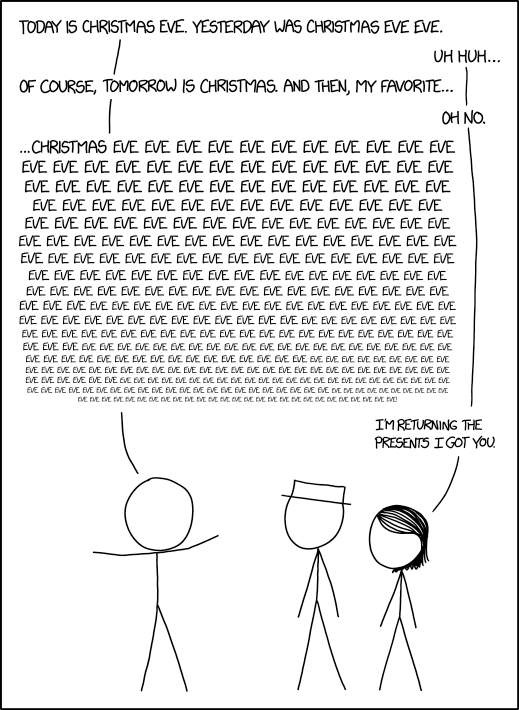
Christmas Eve Eve with the California Raisins — more on commerce and Christmas.
[We’ll be getting back to serious topics and horrible people next week. For now, I’m thinking more pleasant thoughts.]
A personal favorite here.
There have been many attempts to turn popular TV ads into media franchises (I actually had to Google the Mean Joe Greene ad to make sure I wasn’t just imagining that they actually aired a made-for-TV movie based on it). But A Claymation Christmas Celebration (1987) is probably the best of the bunch.
The reason it stands out is that Will Vinton Studios was an extraordinary operation filled with wonderfully gifted artists and animators. They never had either the cultural impact or, if you’ll pardon the expression, the commercial success they deserved. Nonetheless, they put out an exceptional body of work.
As charming and well animated as the titular raisins might have been, they easily could have worn out their welcome in a longer format. The producers of the Christmas special wisely chose to keep their appearance to a single musical number and instead filled out the rest of the half hour with a range of clever, funny, and—in one case—absolutely beautiful animation.
Monday, December 22, 2025
Fun little online poll from the people at Tech Won’t Save Us.
Though I do see some room for improvement.
While I don’t want to idealize Jobs or Gates—they both have plenty to answer for—I have to admit the issues I had with them back in the day seem rather quaint by 2025 standards. We really had no idea how bad things could get.
Likewise, Kara Swisher has probably done more harm than good in the grand scheme of things, but she has cleaned up her act—or at least attempted to whitewash her reputation—recently, distancing herself from the malignant culture of Silicon Valley she used to promote.
The inclusion of Gates and Swisher is particularly objectionable given the fact that some horrible people who are currently making things much worse were left off the original roster. Kevin Roose and Joe Lonsdale come immediately to mind.
The initial assignments were badly done. Most of the talent was concentrated on the left, with Musk and Zuckerberg the only heavy hitters on the other side. (Any ranking that doesn’t have Marc Andreessen in the final four -- probably in Zuckerberg's slot -- is deeply flawed.)
Otherwise, I can’t complain about how things turned out, either, with the final match-up coming down to Musk and Thiel, or with Elon winning in a close match.


Friday, December 19, 2025
The most famous reindeer -- more on Christmas and commerce
When I was writing the post on demographics and Christmas songs, I did some background reading and found myself going down the rabbit hole of the history of one of the most iconic Christmas songs, Rudolph the Red-Nosed Reindeer.
As with so many Christmas traditions, particularly those involving Santa Claus, this one had a marketing origin, specifically as a free promotion given out to kids whose parents were shopping at Montgomery Ward.
Compared to corporations today, which tend to cling to intellectual property like a miser clutching his shiniest coin, Montgomery Ward gave May the rights to the story, which was already doing good business in reprints.
The book and its sequels sold steadily for years afterwards. Its name recognition was still high enough in '48 to merit a Max Fleischer produced cartoon, later reedited to reference the song.
Rudolph The Red-Nosed Reindeer (1948)
In 1949, May’s brother-in-law, songwriter Johnny Marks, composed the version we’re all familiar with. Marks also wrote “Rockin’ Around the Christmas Tree” (God, I hate that song), “A Holly Jolly Christmas” (written two years before it was used in the TV special—the things you learn from Wikipedia), “Silver and Gold,” and “I Heard the Bells on Christmas Day.” He was also the great-uncle of economist Steven Levitt, which doesn’t seem very Christmasy.
From Wikipedia:
Gene Autry recorded the song on June 27, 1949,[6] and it was released as a children's record by Columbia Records in September 1949.[7] By November, Columbia had begun pushing the record to the pop music market. It hit No. 1 in the US charts during Christmas 1949.
The song had been suggested as a "B" side for a record Autry was making. He first rejected it, but his wife convinced him to use it. The official date of its No. 1 status was the week ending January 7, 1950, making it the first No. 1 song of the 1950s.[8] Autry's version of the song also holds the distinction of being the only chart-topping hit to fall completely off the chart after reaching No. 1. The success of the Christmas song gave support to Autry's subsequent popular Easter song, "Here Comes Peter Cottontail".[citation needed]
The song was also performed on the December 6, 1949, Fibber McGee and Molly radio broadcast by Teeny (Marian Jordan's little girl character) and the Kingsmen vocal group. The lyrics varied greatly from the Autry version.[9] Autry's recording sold 1.75 million copies its first Christmas season and 1.5 million the following year.[10] In 1969, it was awarded a gold disk by the RIAA for sales of 7 million, which was Columbia's highest-selling record at the time.[11] It eventually sold a total of 12.5 million. Cover versions included, sales exceed 150 million copies, second only to Bing Crosby's "White Christmas"
As big as the song was, it was the 1964 TV special that insured that the character would be synonymous with the holiday season. There have been countless parodies of Rudolph, both the song and the special.. My favorites were done by MADtv: Raging Rudolph and The Reinfather, based on Goodfellas and The Godfather, respectively. While I actually have a slight preference for the former classic, I prefer the second parody. There are simply so many more iconic moments to play off of.
Raging Rudolph - MADtv
The Reinfather - MadTV
Thursday, December 18, 2025
FT: "OpenAI is a money pit with a website on top."
Here's the headline and opening from the Financial Times:
"OpenAI needs to raise at least $207bn by 2030 so it can continue to lose money, HSBC estimates"
by Bryce Elder
OpenAI is a money pit with a website on top. That much we know already, but since OpenAI is a private company, there’s a lot of guesswork required when estimating the depth of the pit.
HSBC’s US software and services team has today updated its OpenAI model to include the company’s $250bn rental of cloud compute from Microsoft, announced late in October, and its $38bn rental of cloud compute from Amazon announced less than a week later. The latest two deals add an extra four gigawatts of compute power to OpenAI’s requirements, bringing the contracted amount to 36 gigawatts.
Based on a total cumulative deal value of up to $1.8tn, OpenAI is heading for a data centre rental bill of about $620bn a year — though only a third of the contracted power is expected to be online by the end of this decade.
The article goes into to detail if you're interested but the pictures alone tell a hell of a story.
Keep in mind, there are signs that while growth is still continuing, it is leveling off rather than accelerating, something which raises questions about the estimated revenue.

The bottom line is that if OpenAI doesn’t explode—absolutely explode—in
terms of revenue over the next few years, it is on target to burn
through hundreds of billions of dollars.

Add to this the dizzying maze of circular financing and the fact that a huge chunk of the markets depend on the sustained growth of OpenAI, and these graphs certainly give a fellow something to think about.
Wednesday, December 17, 2025
Three tweets and a picture presented without comment
(Bloomberg) - Tesla Inc.’s sales in California are poised to be suspended for 30 days as a penalty for allegedly misleading consumers about its driver-assistance technology, according to the head of the state’s motor vehicles department. $TSLA www.bloomberg.com/news/article...
— Carl Quintanilla (@carlquintanilla.bsky.social) December 16, 2025 at 4:27 PM
[image or embed]
“.. Tesla Robotaxis are crashing once every 40,000 miles, whereas the average human driver in the US crashes about once every 500,000 miles.” 🤡 @rani.bsky.social $TSLA @mims.bsky.social sherwood.news/tech/teslas-...
— Carl Quintanilla (@carlquintanilla.bsky.social) December 16, 2025 at 9:28 AM
[image or embed]
As my editor and I were just discussing, Elon Musk's net worth is now higher than the market cap of all but 8 companies. TSLA shares hit a record high on robotaxi hype despite EV sales slump... www.cnbc.com/2025/12/16/t...
— Lora Kolodny (@lorak.bsky.social) December 16, 2025 at 1:15 PM
[image or embed]


Tuesday, December 16, 2025
Asking the right question about the humanoid bubble
I need to do multiple posts on James Vincent's "Kicking Robots,"
which ran recently in Harper’s (breaking news — articles still appear
in Harper’s). This is one of the best overviews to date of what I've
been referring to as the humanoid bubble. Not perfect; it should have
dove deeper into the problems with the technology, but it did make a
reasonable effort to give the critics their say.
For now, I want
to single out one paragraph because it's easy to miss, despite the fact
that it raises implicitly the most important question around the entire
multi-billion-dollar industry.
Musk’s showcase captured perfectly the power of spectacle to mask technological shortcomings and bridge the gap between expectation and reality. But for those who’d been toiling away on humanoid robots for decades, Musk’s announcement was something more than a publicity stunt. “After Tesla Bot, the whole world sort of woke up to humanoids,” Jeff Cardenas, Apptronik’s co-founder and CEO, told me. The number of people working on the technology prior to Tesla’s AI Day pronouncement “could fit in a small room,” but Musk transformed the industry almost overnight, even if all the public had seen of the Tesla Bot was a slide deck and a gyrating man in a robot costume.
Immediately
after this paragraph, Vincent shifts back to his profile of Cardenas
and doesn't address the most important point in the entire piece: what
changed?
The reason that only a vanishingly small sliver of
roboticists were working on humanoids in August of 2021 was because,
other than novelty value and the opportunity to push the edge of certain
technologies that had a wider range of applications, the viable use
cases for these C3POs were all but nonexistent.
The arguments currently being
presented in defense of bipedal humanoid robots are silly, a combination
of naïve biomimicry, a laughable misinterpretation of convergent
evolution, the Cylon design fallacy and a bunch of warmed-over tropes from old sci-fi shows and
comic books. What's most significant, though, is not the absurdity of the arguments but
their age. Advocates for these designs had been making these same
defenses for decades and had convinced virtually no one until Elon's dancer in a robot suit.
What changed?
Musk's presentation did not mark any notable breakthrough in
the tech or shift in the economics. There was nothing even approaching a
new idea about how to make these designs viable in an industrial
setting. The entire concept remained what it had always been: a
cautionary tale of overengineering and putting the cool over the
functional.
The only thing he brought to the table — pretty
much the only thing he ever brings — was a massive, surging river of
hype, hype that drove venture capitalists into a spending frenzy, hype
that made respectable journalists credulous and stupid.
Unlike
the AI bubble, which at its core does represent an exciting and
potentially valuable technological advance, the humanoid bubble is pure
tech-visionary absurdity. It's possibly the most Musk thing Musk has
ever done.
Monday, December 15, 2025
I'm really starting to hate Last Christmas.
I was never a huge George Michael fan, but I always had a great deal of respect for his talent and have enjoyed some of his songs. That said, I think we can agree that Last Christmas was a decidedly minor entry into the artist’s catalog, which wasn't an issue until the Christmas muzak algorithm decided to play it very fifteen minutes.
From Wikipedia:
In December 2023, "Last Christmas" became Christmas number one. It also became the third-best selling UK single, with 5.34 million sales, including streams. As of December 2023, "Last Christmas" had sold over 1.93 million physical copies and downloads, making it the eighth-bestselling single ever in the UK. It was certified six-times platinum in December 2023. In 2024, it became the first song to be Christmas number one for two consecutive years. That year, PRS for Music estimated that "Last Christmas" generates £300,000 of royalties per year.
(Trivia buffs might remember that the perpetual royalties from a Christmas hit were a key plot point in both the book and the movie About a Boy.)
The definitive post on the persistence of Christmas songs that should have long since worn out their welcome wasn’t a post at all; it was this cartoon from XKCD.
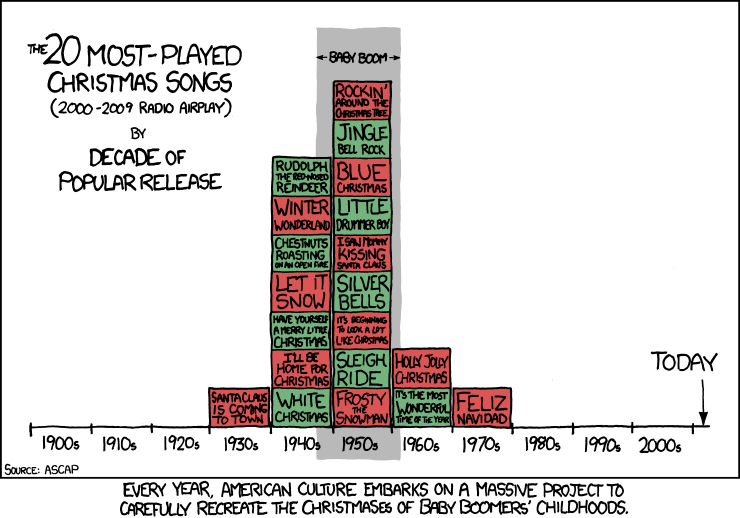
While Randall's point is valid, it does leave out a couple of arguably more important factors.
For decades, you could see popular media trying to appeal to some idealized viewer born circa 1952 because, like the man said about the banks, that was where the money was. The market was huge and everybody wanted a piece. Studios, record companies and publishers pumped out tons upon tons of content while going back to the previous decade to find more material to fill the pipeline (particularly for television). It helped that the forties was golden age for Christmas standards, written largely by Jewish songwriters like Irving Berlin.
By the end of the mid-sixties, media companies had an enormous catalog of Christmas songs, some of them very good, with a huge amount of name recognition, which led to the second factor: content accumulates, and between the craving for familiarity around the holidays and the eleven month breaks, the shelf life of of this genre was very long indeed.
We certainly can't blame boomer nostalgia for Last Christmas, but given that the age of that song today matches the age of Frosty and Holly Jolly in 2000, we can possibly blame old people in general.
Friday, December 12, 2025
It's Hollywood, you knew there'd be a cliffhanger.
What you'd expect to see if you prompted ChatGPT with the word nepo baby

Trump: "I think the people that have run CNN are a disgrace. I think it's imperative that CNN be sold because you certainly wouldn't want to just leave those people with some money so they can spend even more spending poison. It's lies. I wouldn't want to see the same company end up with CNN."
— Aaron Rupar (@atrupar.com) December 10, 2025 at 12:57 PM
[image or embed]
The saga continues. I live less than a mile from the gates of the Warner Brothers Studio. It makes this already strange story even more bizarre when you read about it sitting in a cafe patio then look up and see the actual WB water tower.
One of these days, I should probably do a post too about how disastrous mismanagement and ill-conceived financial deals put Warner Bros. in this position. It's a good story and one that has been largely untold by the big news organizations. If the studio had been competently run like, say, Columbia — which is in much better shape despite having fewer hits and a fraction of the IP — we would not be having this discussion.
Even a couple of years ago, the suggestion that Netflix buying WB would be the preferred outcome would have seemed absurd, but in 2023, we had no idea how bad an Ellison led Paramount would be, let alone the partners this new deal would involve..
From Josh Marshall:
Simply extraordinary stuff coming out this morning about the battle over what used to be Time Warner and now goes by the name Warner Bros Discovery (which includes CNN in addition to the more lucrative media stuff). The company had agreed to be acquired by Netflix. So Paramount — now the vehicle of the Ellison family successor and a Trump state media entity-in-the-making — has launched a hostile takeover effort to swoop in and gobble up WBD for itself. In its public pitch, it has openly advertised to shareholders that it is the better acquirer because the Ellisons are tight with Trump, and the White House will never let a Netflix deal go through. Trump, in comments yesterday, as much as agreed. Trump has refashioned antitrust oversight to be little more than a personal veto for the Trump family. Friends can do mergers; foes can’t. Indeed, the indifferent and uncommitted can’t either. You need to get right with the Trump family.
When you ask why so much of corporate America is beholden to Trump now, this is why. A big diversified corporation simply cannot compete and thus, in practice, can’t exist with a determinedly hostile administration.
Now we learn this: who else is part of the hostile takeover bid? None other than Jared Kushner. Yes, Jared — international M&A man when he’s not cutting “peace” deals in Israel-Palestine or Ukraine. And wait, there’s more! Just moments ago I saw that it’s not just Jared: the Saudis, Qataris and Emiratis are also in on the deal. Backstopping the deal is a fund, RedBird Capital, seen by many as a stalking horse for China.
At this point, perhaps our best hope is that events will lead to some events will lead to some belt-tightening around the Ellison household and the decision that they'll have to get by with only one studio.

Thursday, December 11, 2025
Still waiting for the episode where Don Draper pitches the Gilbert U-238 Atomic Energy Laboratory
Fun video for the admittedly narrow target audience of fans of classic toys, Mad Men era advertising, and the distinctive forced exuberance of a corporation trying to put a happy face on a desperate situation.
If you operated a toy store in 1965, you might have seen this promotional film with the new A.C. Gilbert toys for 1965. You will see television commercials that were to be aired nation wide showing the new line of Erector Sets: Erector Set 1,2,3,and 4, Erector Constructor 5 in 1, Ride-Em Erector, Gilbert Auto-Rama Power Steering Pit Stop slot cars, ChemLab Chemistry Set 1 to5, Gilbert Microscope Lab, Gilbert Telescope, and American Flyer Trains: The All Aboard, ready to go train sets. The commercials are great. A Carnival Barker, and Spokesperson for Gilbert add to the fun. "65: The Year To Go Gilbert" will also show what TV shows in the United States Gilbert will sponsor. A rare glimpse of the new toys you might have had under your Christmas tree in 1965. Sadly, after several failed attempts to market their existing toys and to create new lines of toys, the A.C. Gilbert Company ceased production in 1966 and declared bankruptcy in 1967. They couldn't keep up with the changing trends and competition in the toy industry. Transferred from 16mm color film, faded, color corrected.
Gilbert was a cool company that deserved better, particularly its line of Erector sets (though Lego has since filled most of the niche), but Alfred Carlton Gilbert (a remarkable character described by Wikipedia as "an American inventor, athlete, magician, toy maker and businessman") was the business and his death in 1961 pretty much sealed its fate.
And, no, I wasn't kidding about the Gilbert U-238 Atomic Energy Laboratory.
The set originally sold for $49.50[3] (equivalent to $650 in 2024[7]) and contained the following:[3][8][9]
- Battery-powered Geiger–Müller counter
- Electroscope
- Spinthariscope
- Wilson cloud chamber with short-lived alpha source (Po-210) in the form of a wire
- Four glass jars containing natural uranium-bearing (U-238) ore samples (autunite, torbernite, uraninite, and carnotite from the "Colorado plateau region")[3]
- Low-level radiation sources:
- "Nuclear spheres" for making a model of an alpha particle
- Gilbert Atomic Energy Manual — a 60-page instruction book written by Dr. Ralph E. Lapp
- Learn How Dagwood Split the Atom — comic book introduction to radioactivity, written with the help of General Leslie Groves (director of the Manhattan Project) and John R. Dunning (a physicist who verified fission of the uranium atom)[11][12]
- Prospecting for Uranium — a 1949 book published jointly by the Atomic Energy Commission and the United States Geological Survey
- Three C batteries
- 1951 Gilbert Toys catalog

If the lab had come out a few years later, Stan Lee could have gotten a few more origin stories out of it.
Wednesday, December 10, 2025
Funny how often a quote from Germany in the late Thirties seems appropriate these days.
“Housing shortage – Jews to blame," letter sticker, German Reich, 1938 zwangsraeume.berlin/en/context
— Zach Everson (@zacheverson.com) November 13, 2025 at 6:16 PM
[image or embed]
If you haven’t been following administration messaging closely, you might have missed this. It hasn’t gotten nearly the coverage it deserves.
The White House and its allies are lining up behind the argument that mass deportation would reduce—or even eliminate—inflation.
There are a few deeply disturbing aspects to this. First, the history of this particular argument is exceptionally ugly, with clear antecedents in Nazi Germany.
Second there's the comically blatant lie of claiming that there thiry million undocumented imigrants living here.
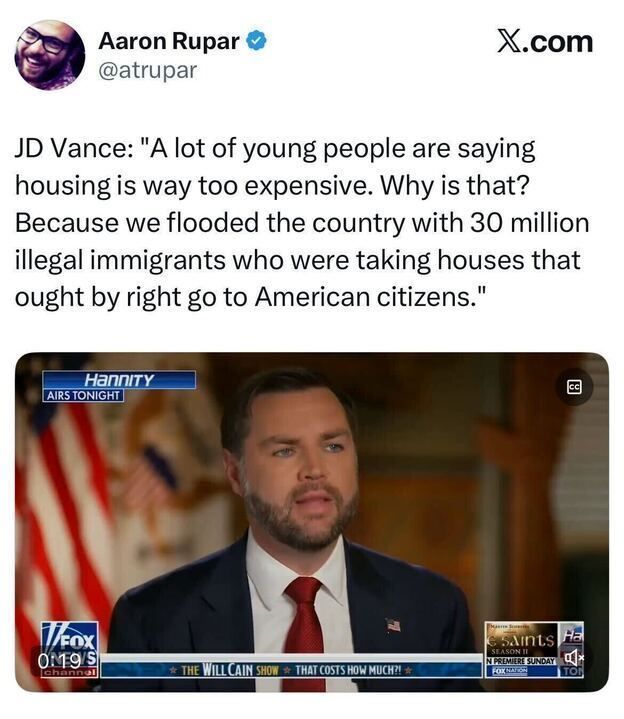

Third—and here I’m a bit out of my depth, so I hope Joseph or some of our regulars will jump in if I get something wrong—it also runs directly counter to conventional economic theory. While removing millions of immigrants, documented and undocumented, would reduce demand, these workers are disproportionately employed in sectors like construction and food harvesting and processing. Access to immigrant labor also helps prevent severe labor shortages, which are themselves inflationary.
Fed Governor Stephen Miran: "Cutting down net migration to 0, potentially even negative because of the deportations that have been occurring, I think is very deflationary."
— Aaron Rupar (@atrupar.com) November 14, 2025 at 12:05 PM
[image or embed]
Perhaps the most disturbing part of all this (outside of the “we got it from the Nazis” angle) is hearing this line of argument coming from a fed governor. I doubt Miran believes what he’s saying here any more than Bessent believes the claims he’s been pushing about tariffs.
Tuesday, December 9, 2025
Birthright citizenship
This is Joseph.
From Twitter:


I see two interesting things here. We are using post-legislative comments of a single senator as being more decisive then the history of legal interpretation of the constitution. One of the interesting challenges of the modern era's "one simple trick" style of legal reasoning is that they often take the words and interpret them in a very eccentric way.
The second is Andrew's good questions. It's obvious that illegal immigrants do not enjoy diplomatic immunity when present in the United States. Attempts to handle this are awkward:

So there are two different types of jurisdiction? In what other legal writing would they not define or expand upon this point. And I think it is pretty important that we think about this carefully, because the goal of the amendment was to enfranchise freed slaves. If there really were two types, don't you think people voting on the amendment would be the least bit curious as to which type it is?
This is also an important caveat about taking a single person's view of what the legislation means"
"It is to be assumed-by a sort of suspension of disbelief-that two-thirds of the Members of both Houses of Congress (or a majority plus the President) were aware of those statements and must have agreed with them; or perhaps it is to be assumed by a sort of suspension of the Constitution-that Congress delegated to that personage or personages the authority to say what its laws mean."I wonder if we could find single persons who had a different opinion on what the amendment meant? Now let's consider the word "jurisdiction".
Also, political jurisdiction:
Political jurisdiction means a city, county, township or clearly identifiable neighborhood.
Territorial jurisdiction is a court’s authority to preside over legal proceedings in a geographical area. Territorial jurisdiction is the scope of a federal and state court’s power and is determined by the governing laws and regulations of the area.
Here is a general legal definition:
1. The authority of a court to hear and decide a case. To make a legally valid decision in a case, a court must have both:
"subject matter jurisdiction," meaning the power to hear the type of case in question, and
"personal jurisdiction," meaning the power to make a decision affecting the parties involved in a case.
2. The power of a political body to make laws and govern.
3. The physical territory within, or within the control of, a political body.
It's obvious why diplomats and invading armies do not fall under the jurisdiction of the United States. And look at the wording of the 14th amendment itself:
All persons born or naturalized in the United States, and subject to the jurisdiction thereof, are citizens of the United States and of the State wherein they reside. No State shall make or enforce any law which shall abridge the privileges or immunities of citizens of the United States; nor shall any State deprive any person of life, liberty, or property, without due process of law; nor deny to any person within its jurisdiction the equal protection of the laws.
None of the comments made by the senator are reflected in the text, it uses the word jurisdiction and it seems deeply improbable that there is a different meaning to it. To use an analogy, look at this amendment:
A well regulated Militia, being necessary to the security of a free State, the right of the people to keep and bear Arms, shall not be infringed.
What if I argued that in the case of this amendment, what was actually meant was that people should be allowed to keep their arms (the flesh and blood ones) attached to their bodies but it clearly did not apply to weapons? This would be obviously crazy, right?
In the same sense, we have a common legal term and trying to use an eccentric definition (and creating a new area of law figuring out when the word jurisdiction is being used in different senses, or is it just this one inconvenient case?) seems like a poor way to build a legal system. But, as it is, you are stuck in a challenging position where you want the word to mean one thing in one context (are their children who are born in the United States citizens?) and another in a different context (are they subject to prosecution for crimes committed in the United States?).
Finally, all of this ignores the great power of this amendment to establish citizenship for current residents. Instead of trying to show a continuous pathway of some claim, you only need to trace a person back to their own birth certificate to establish citizenship. No concerns that old birth certificates could be lost or that the documentation standards in 1894 are up to 2025 standards. It's odd to want to get rid of this highly effective way of dealing with old records.
Monday, December 8, 2025
Notes on Netflix + WB -- in retrospect, my biggest mistake was not realizing what a dumpster fire Disney+ would be under Bob Chapek
We’ve been on the Netflix beat for over a decade, and one of the recurring points we’ve made for most of that time is that—despite what the press had been led to believe—the company’s catalog was incredibly thin and the widely accepted claim that Netflix was going to catch up simply by cranking out large numbers of “originals” was never credible. We argued that there were only two realistic outcomes: either the company would remain dependent on the major studios, or it would eventually have to buy one of their catalogs.
Both on the blog and on Twitter, we repeatedly floated Comcast as a possible acquisition target. Here’s what we were saying back in 2018. Much of it is no longer applicable, but a surprising amount still is.
Wednesday, August 1, 2018
Netflix Exit Strategies -- Comcast?
I apologize for writing these out of order, but one of the lessons I've
learned as a blogger is that, if you want to speculate on something, get
the post up quick because events have a way of moving faster than you
could imagine and a position can go from bold and provocative to
yesterday's news overnight.
For that reason, I want to jump ahead in the Netflix thread to exit strategies. Right now the company is sitting in a classic corporate throne of Damocles, king of the world but with a sword dangling over its head. Having a market cap bigger than Disney's is wonderful, but that stock price is based almost entirely on a highly questionable narrative. How do you gracefully cash out in such a situation?
One possibility I'd like to open up for discussion is some kind of merger or acquisition with Comcast (with the question of who would be acquiring whom rather bizarrely up in the air). There is something of a precedent here with AOL Time Warner, but Netflix and Comcast are a far better fit.
The two companies already have an extremely close working relationship. As previously mentioned, in the all important children's division, Netflix is largely dependent on licensing properties from the NBC/Universal library. NBC also produces (and apparently owns) one of Netflix's highest profile shows, Kimmy Schmidt.
Netflix also desperately needs guaranteed access to a major content library. We currently have a thread going about how the "plan" for Netflix to produce its way out of this problem is unworkable and probably insincere. Though not on par with Disney or Warners, NBC/Universal does have such a library.
The Disney Fox deal means that the House of Mouse now owns a controlling interest in Hulu. This has got to leave Comcast feeling somewhat out in the old. Pairing up with Netflix would put the company roughly on an even footing with its rival.
And finally, with the uncertain future of net neutrality, the business logic of the partnership is even stronger.
I'm writing and posting this in haste so I well may end up repenting it in leisure, but if we are on to something, I'd very much like to be to say you heard it (and discussed it) here first.
For that reason, I want to jump ahead in the Netflix thread to exit strategies. Right now the company is sitting in a classic corporate throne of Damocles, king of the world but with a sword dangling over its head. Having a market cap bigger than Disney's is wonderful, but that stock price is based almost entirely on a highly questionable narrative. How do you gracefully cash out in such a situation?
One possibility I'd like to open up for discussion is some kind of merger or acquisition with Comcast (with the question of who would be acquiring whom rather bizarrely up in the air). There is something of a precedent here with AOL Time Warner, but Netflix and Comcast are a far better fit.
The two companies already have an extremely close working relationship. As previously mentioned, in the all important children's division, Netflix is largely dependent on licensing properties from the NBC/Universal library. NBC also produces (and apparently owns) one of Netflix's highest profile shows, Kimmy Schmidt.
Netflix also desperately needs guaranteed access to a major content library. We currently have a thread going about how the "plan" for Netflix to produce its way out of this problem is unworkable and probably insincere. Though not on par with Disney or Warners, NBC/Universal does have such a library.
The Disney Fox deal means that the House of Mouse now owns a controlling interest in Hulu. This has got to leave Comcast feeling somewhat out in the old. Pairing up with Netflix would put the company roughly on an even footing with its rival.
And finally, with the uncertain future of net neutrality, the business logic of the partnership is even stronger.
I'm writing and posting this in haste so I well may end up repenting it in leisure, but if we are on to something, I'd very much like to be to say you heard it (and discussed it) here first.
Subscribe to:
Posts (Atom)