Wednesday, September 3, 2025

More (non)weird weather

We’ve been having one of those Labor Day heat waves so common in Southern California, so I spent the afternoon in the vicinity of the air conditioner and only ventured out when the sun was finally getting low and the temperature started to drop. Right before I left my apartment, I checked the current weather and saw this extremely unexpected forecast.


When I stepped outside 15 minutes before the promised shower, the skies were a bit hazy but basically cloudless. My destination was about a 10-minute leisurely walk. When I got there, I ordered an iced tea and picked a seat outside in the shade that seemed likely to catch some breeze. The sky still looked the same, as it did except for going from sunset to moonlight until I finally got back home. Not a single likely rain cloud the whole time. 

As previously discussed, I’ve been noticing lots of not just inaccurate but erratic and highly improbable forecasts from Google, The Weather Channel, et al., always showing up on just one site at a time. Maybe I’m just paying more attention these days, or maybe there’s a growing quality-control issue with the algorithms that drive these sites. It's probably too early to have anything to do with the decline and fall of NOAA, but I don't see that making things better. 


Tuesday, September 2, 2025

This is probably a non-story, old news about the president's health blown up by internet buzz and wishful thinking, but it's also a reminder of how strange and unstable the dynamic of this White House is and of the gaping double standard in recent press coverage.

From The Daily Beast

Conservative political consultant Rick Wilson says a “MAGA Hunger Games” is playing out in Washington as President Donald Trump, 79, shows his age.

Wilson said “rumors from the Trumpverse” indicate that Vice President JD Vance is “moving fast” in this shuffling of power behind the scenes, positioning himself to take over the MAGA movement sooner rather than later, according to Wilson’s Substack.

“Slow or fast, he’s headed down,” Wilson said of Trump. “The circle who knows what’s up is very, very small and very, very paranoid. JD Vance knows, and he’s moving fast.”

Wilson pointed to Vance’s interview this week with USA Today—in which he said he is prepared to take over the presidency, having received “on-the-job training” in the first seven months of this term—as further proof of jostling behind the scenes.

The White House did not respond to a request for comment. Reached by the Daily Beast, Vance’s office did not address the allegations made by Wilson.

Trump said in May that it was “far too early to say” who might succeed him. However, he noted that Vance was “doing a fantastic job” and that Secretary of State Marco Rubio was “great.” Of course, the 25th Amendment stipulates that, should anything happen to Trump during this term, Vance would become president.

This Daily Beast piece in still an outlier.  The establishment press has always been bizarrely reluctant to discuss Trump's health issues, going back at least to their deafening lack of interest in the 2018 diagnosis of a type of heart disease associated with dementia, a blink-and-you'll-miss-it story.

This is in sharp contrast to the nonstop speculations that marked Biden's time in office, even after he stepped down from the re-election campaign. The obsession ran so deep that Biden's health continues to be a major story, including a heavily promoted book by Jake Tapper. If anything, the former president's decline continues to get more attention than that of the current president.


Donald Trump’s rumored death raises new questions about Joe Biden’s health

— NY Times Pitchbot (@nytpitchbot.bsky.social) August 30, 2025 at 6:46 PM


While this far from the most egregious example of the Trump/Biden double standard, it may be the sharpest reminder of the strange POTUS/VPOTUS dynamic of the current administration. 

Here's a question I ran past a student of presidential history shortly after the Trump/Musk feud erupted: 

For months now, maybe even before the inauguration, we've been talking about how fundamentally unstable the dynamic in the White House was—having JD Vance, hand-picked candidate of Peter Thiel and Elon Musk, as the vice president. Now that Musk and Trump have had their unexpectedly fast but by no means surprising falling out, the tensions between the president and the vice president have gotten extraordinary.

My question for you is: have we ever seen anything like this before? Obviously there have been tense relationships and ideological differences between the two offices—Reagan and Bush, Kennedy and LBJ, going all the way back to Adams and Jefferson—but have we ever had a situation where the VP was not just a rival, but had the support of this powerful and ruthless a faction?

His reply:

And, while I don't know about pre-Civil War history, there has been nothing like this in my memory or knowledge.


 While many tickets are marriages of convenience, few if any have ever taken it to this degree. If you could tap into the private chats of Thiel, Musk, Andressen, et al., I suspect most of the conversations are about the 25th amendment and what they'll do after Vance takes the oath. 

It's too early to say if a Presidential health crisis is imminent, but if one does occur in the next three and a half years, given the players and the situation, it is certain to be... interesting.   


Monday, September 1, 2025

It's Labor Day, so we're taking time off and running a repost


Look for the Union Label

The ILGWU sponsored a contest among its members in the 1970s for an advertising jingle to advocate buying ILGWU-made garments. The winner was Look for the union label.[9][10] The Union's "Look for the Union Label" song went as follows:

    Look for the union label
    When you are buying a coat, dress, or blouse,
    Remember somewhere our union's sewing,
    Our wages going to feed the kids and run the house,
    We work hard, but who's complaining?
    Thanks to the ILG, we're paying our way,
    So always look for the union label,
    It says we're able to make it in the USA!

The commercial featuring the famous song was parodied on a late-1970s episode of Saturday Night Live in a fake commercial for The Dope Growers Union and on the March 19, 1977, episode (#10.22) of The Carol Burnett Show. It was also parodied in the South Park episode "Freak Strike" (2002).


Friday, August 29, 2025

Are LLMs a Langley steam plane? A Newhart airline? What's the best metaphor for the current state of AI?

The technology of the late 19th and early 20th centuries is filled with neglected but interesting bits. One that I come back to frequently is the steam-driven airplane. While the idea seems an obvious non-starter today, this was an active line of research which produced some surprisingly successful aircraft.

The most impressive of these were the unmanned aircraft of Samuel Pierpont Langley, which made multiple flights three to five times further and eight years earlier than the Wright brothers. Langley's plane may now be best known due to a slanderous TED Talk from a hack motivational speaker, but it was a marvelous piece of engineering. 

Here's how Scientific American put it in March of 1904.

In 1896, for the first  time in  history, a mechanical  structure, free of any attachment to the  ground and wholly without any supporting power but its own engines. made several flights of  over one-half mile each. Mr. Langley had at this point reached the original aim of his researches in  this direction---that of demonstrating, as a  question of mechanical engineering, first. the conditions for, and second, the possibility of accomplishing, mechanical flight. 

He was remarkably close to building the first working manned aircraft, and it's fun to speculate, in an alternative-history kind of way, about how things might have been had events broken more his way. But in terms of the history of aeronautics, it would have made little difference. Internal combustion was the future of flight. Steam was a dead end.

The Wright brothers' plane was the very opposite of a dead-end technology. The basic principles and design choices were all completely sound, and you can trace a fairly direct line from those first models to the passenger planes and military aircraft of two or three decades later.

That said, for all the excitement, no serious person looked at this and said this is commercially viable technology. As with Edison’s phonograph, which had also shocked the world 30 years earlier, while virtually everyone recognized this as a breakthrough, it was also clear that the technology would have to evolve considerably before it could be rolled out for widespread business or military applications.

On his seminal album The Button-Down Mind, Bob Newhart imagined a conversation between the Wright brothers and a post-war era corporation trying to monetize their breakthrough. The humor of the monologue came partly from the absurdity of trying to stack multiple passengers on the wing of the Wright Flyer or making a coast-to-coast trip taking off and landing every 105 ft, but much of it also came from the banality and shortsightedness of 60s-era corporate culture in the face of a stunning, world-altering step forward. It’s a comparison that’s, if anything, even sharper in the age of venture capitalism.

Which brings us around to the original question. Are LLMs a steam airplane—a wonderful piece of engineering and a major advance, but still a dead-end technology doomed to be pushed aside by something better before it makes its mark?

Are they Newhart’s airline—a viable and important technology that isn’t ready yet to support the commercial applications that people are trying to impose on it?

The mountains of money that are being poured into AI in 2025 are mind-boggling, and if either of these possibilities turns out to be true the economic implications are stunning.

I’m inclined to believe that one of these two possibilities is true (leaning more toward Langley than Newheart) , which would be very bad news for a lot of people—perhaps, depending on how it plays out, for most of us. Obviously that’s just an opinion, but given the stakes, these questions would seem to be worth asking.


Thursday, August 28, 2025

Shadowy surveillance company started by a reactionary Bond villain suddenly started trading at a P/E over 500 shortly after Trump was elected -- probably nothing to see here


In case you missed it.  


 Palantir is pretty much exactly the company you would expect from the cartoonishly evil Peter Thiel: ethically and morally questionable and badly run (if you’re doing all the sleazy things your competitors shy away from and you still can barely turn a profit, you’re probably not a business genius). But of course, Thiel has always made his money the old-fashioned way: getting people to give it to him, and Palantir has been spectacularly successful at attracting investors, first through funding rounds then very recently through the stock market.

As the Economist puts it:


 Palantir generally gets grouped in with the AI boom, and while that's reasonable, the real story here is clearly about Trump.Thiel is one of the most influential Republican donors. The vice president owes every aspect of his professional and government career since graduating law school to either Thiel or to the rest of the PayPal mafia. 

Palantir stock had been basically flat for the years since its IPO. It was only when the Trump/Vance ticket started gaining momentum that the company's valuation began to climb, with a notable jump the first week in November. 


The market is clearly anticipating that the administration will pay back its friends by pumping hundreds of billions of dollars into their coffers, and Palantir appears to be first in line.

This is an extraordinary story of corruption and conflict of interest, even by the Hieronymus Bosch standards of 2025. It's true that there's a lot going on out there, but there is still no excuse for how little attention this has gotten.


Wednesday, August 27, 2025

Whether it's due to battered spouse syndrome or dumb money, the entire stock market is now one big this is fine meme.


Monday night...

In a sane world, this kind of attack on the Fed would cause market panic.

[image or embed]

— markpalko.bsky.social (@markpalko.bsky.social) August 25, 2025 at 6:39 PM

Tuesday afternoon...


For months now, we've been talking about the market’s curious lack of reaction to what would normally qualify as ominous or even terrifying economic news. We suggested that the constant battering and uncertainty had created a market psychology that was bizarrely complacent in the face of anything but the most imminent threats. We wondered if the increasing role of retail investors meant that the market was increasingly being moved by dumb money. Whatever the reason, the problems have gotten so bad and the disconnect has gotten so obvious that smart and sober commentators from across the political spectrum have started to raise the alarm.


Allison Morrow (from her newsletter):

 Federal Reserve independence is sacrosanct, the free-market wisdom goes. So why is Wall Street not freaking out about the Trump administration’s campaign to infiltrate the central bank?


The answer, in part, is that investors have made a lot of money betting on the idea that Trump will back off, reined in by some combination of the law, advisers who know better, or those mythical market “vigilantes.”


It’s a strategy that risks blowing up in their faces.

Federal Reserve independence is sacrosanct, the free-market wisdom goes. So why is Wall Street not freaking out about the Trump administration’s campaign to infiltrate the central bank?


The answer, in part, is that investors have made a lot of money betting on the idea that Trump will back off, reined in by some combination of the law, advisers who know better, or those mythical market “vigilantes.”


It’s a strategy that risks blowing up in their faces. 

From Marketplace:

“In the longer term, the issue is whether the Fed is able to act independent of executive influence,” said Matthew Paniati, a senior analyst at Capital Advisors Group.

“Because if they can’t, that has very significant macroeconomic implications in my view,” said Paniati.

If people believe the Fed is influenced by a president more than by inflation data, the less faith they have that inflation will be managed well.

“That sends a signal to the bond market that there’s more risk of inflation going forward,” said Kathy Jones with the Charles Schwab Center for Financial Research.

And inflation is an investment killer.

“Investors want to be compensated for tying up their money for longer periods of time, because there’s always some risk that inflation will erode those returns,” said Jones.

So when investors are more worried about inflation, they charge more. They charge higher interest rates in the bond market, which the Fed does not control — it only controls short-term interest rates. The market controls long-term rates, that affect everything from car loans to mortgages to government debt.

“That’s the irony of this whole battle, I think, is that the more the president pushes on the Fed to cut interest rates, the more risk is that long-term rates go up,” said Jones.

It is also possible that concerns over inflation and Fed independence are just peanuts, that this whole brouhaha is ignoring an even bigger risk to long term interest rates.

“The main issue is just the budget deficit,” said Gershon Distenfeld, director of income strategies at Alliance Bernstein. 

He said the government is getting in over its head when it comes to debt, and because of that, investors will charge higher long-term rates. Either way, markets have not panicked just yet. 

“And I think it’s because you’ve had decades of Fed credibility that have kept the market believing that Fed independence is still there,” said Marvin Loh with State Street Markets.

I really should get around to that post on generalizing Minsky moments.

Trump is hostile to the Fed’s independence. He wants to bend the central bank to his will. He is willing to threaten officials with criminal prosecution to get his way. We are in dangerous territory. My @nationalreview.bsky.social column. www.nationalreview.com/corner/the-s... #econsky

[image or embed]

— Michael R Strain (@michaelrstrain.bsky.social) August 26, 2025 at 3:15 PM


More from TNR's Strain:

Eroding central bank independence will make investors, businesses, and households less confident that the Fed will be able to keep inflation low and stable because they will expect that the president will be able to bully the Fed into keeping interest rates lower than is merited, juicing demand and creating inflationary pressure. Higher expected future inflation will put upward pressure on long rates. In addition, the erosion of central bank independence and the willingness of the president to criminalize policy disagreements will increase the perceived risk of holding U.S. Treasury debt. That too will push up long-term interest rates. 


Needless to say, the New York Times recognized the gravity of the moment and rose to the occasion... I kid, of course.

They’re not making the slightest pretense of doing anything but weaponizing a federal agency against Trump’s enemies, and the New York Times’ response is “Well played, sire!”

[image or embed]

— Will Stancil (@whstancil.bsky.social) August 26, 2025 at 2:08 PM

And this bit of understatement.. 


The Federal Reserve Board of Governors has been around for 111 years. In that time it has had more than 100 members (en.wikipedia.org/wiki/Federal...). No president has ever fired (or claimed to have fired) one before.

[image or embed]

— Adam Keiper (@adamkeiper.com) August 25, 2025 at 7:53 PM 

While the stock market was feelin' fine, other financial markets were paying more attention.

(Bloomberg) -- Long-dated US Treasuries fell as President Donald Trump intensified efforts to oust Federal Reserve Governor Lisa Cook, deepening concerns his attacks on the central bank’s independence and lobbying for lower interest rates will fan inflation. www.bloomberg.com/news/article...

[image or embed]

— Carl Quintanilla (@carlquintanilla.bsky.social) August 26, 2025 at 5:47 AM

Dollar, longer-dated Treasuries slide as Trump escalates attack on Fed; gold rises reut.rs/4lE8QAd

[image or embed]

— Reuters (@reuters.com) August 25, 2025 at 10:45 PM

It's really kind of beautiful how his flunkies do these little maneuvers and then he explicitly blows them up less than an hour later. 13:49 *BESSENT: PUBLIC TRUST GIVES FEDERAL RESERVE ITS CREDIBILITY 14:44 *TRUMP: WILL HAVE MAJORITY SHORTLY ON FED

— George Pearkes (@peark.es) August 26, 2025 at 11:46 AM


Tuesday, August 26, 2025

How to report on an obvious lie

From the Guardian [and no, I didn't edit the word "billion" out of my excerpt. The absurd but relevant fact the Melania was claiming over $1bn in damages was omitted from the original story.]

The statements were false, defamatory and “extremely salacious”, Melania Trump’s lawyer, Alejandro Brito, said in a letter to [Hunter] Biden. Biden’s remarks were widely disseminated on social media and reported by media outlets around the world, causing the first lady “to suffer overwhelming financial and reputational harm”, he added.

...

“Epstein introduced Melania to Trump. The connections are, like, so wide and deep,” Biden said in one of the comments that the first lady disputes. Biden attributed the claim to the author Michael Wolff. Donald Trump has accused Wolff of making up stories to sell books.

...

“What I said is what I have heard and seen reported and written primarily from Michael Wolff, but also dating back to 2019.” He cited a number of publications, including the New York Times and Vanity Fair, as sources of his information.

The first lady’s threats echo a favoured strategy of her husband, who has aggressively used litigation to go after critics. Public figures such as the Trumps face a high bar to succeed in a defamation lawsuit.

The president also responded to the issue, accusing Biden of fabricating stories to denigrate the first lady. Trump told Fox News Radio host Brian Kilmeade on Thursday morning that he had encouraged her to sue.

>“I said go forward. You know, I’ve done pretty well on these lawsuits lately … and Jeffrey Epstein had nothing to do with Melania and introducing,” [side note: if Jake Tapper is actually interested in the cognitive decline of presidents, Trump's increasing;y Yoda-like syntax might be worth talking about -- MP] he told Kilmeade.“But they do that to demean, they make up stories. I mean I can tell you exactly how it was and it was another person actually … but it wasn’t Jeffrey Epstein. “I told her go ahead and do it.”

Every reporter, every editor, every commentator discussing this story knows what’s going on. This is a bluff.

It is true that the Trumps have a long history of meritless harassment suits. It is also true that Trump managed to put some extraordinarily biased and unethical judges on the bench, and such a judge could put an awfully large thumb on the scales. But even under ideal conditions for the plaintiff, the chances of successfully suing someone for repeating charges that have been widely reported in multiple books—most recently the widely publicized Prince Andrew biography Entitled—and in publications ranging from The New York Times to New York Magazine to Vanity Fair, is vanishingly unlikely.

Monday, August 25, 2025

More on AI and Wall Street

Picking up from last Thursday. 

Meta, Amazon, Alphabet, and Microsoft are on track to invest hundreds of billions of dollars in AI this year, working under the assumption that this isn’t just the next big thing, it is the big thing, a development that is about to start pumping out unprecedented amounts of money in the very near future.

The timeline is important. Servers have to be replaced every few years, unlike steel railway track or fiber-optic cables. If this technology doesn’t start delivering on its promise in the next five years or so, most of those hundreds of billions of dollars will have been largely wasted.

Whether you call it a boom or a bubble, AI has done a great deal to prop up the market and stimulate the economy both directly through capital expenditures and indirectly through the wealth effect. If we see a major correction in the sector, the results will be painful, not just because bubbles popping are always painful, but because we have an administration that lacks the competence to handle the crisis and is likely to overreact in some possibly dangerous ways. 

With all that in mind, take a look at this recent piece from the sharp and reliable Allison Morrow.

Rather suddenly, there’s been a vibe shift around artificial intelligence, the tech that’s hypnotized Wall Street and inspired cultish devotion across Silicon Valley over the past three years.

And while it’s too soon to declare August 2025 the start of the AI winter, or the AI correction, or the AI bubble bursting, or whatever slowdown metaphor you prefer, it is undeniable that a series of industry stumbles is making investors, businesses and customers do a double-take.  

Among them:

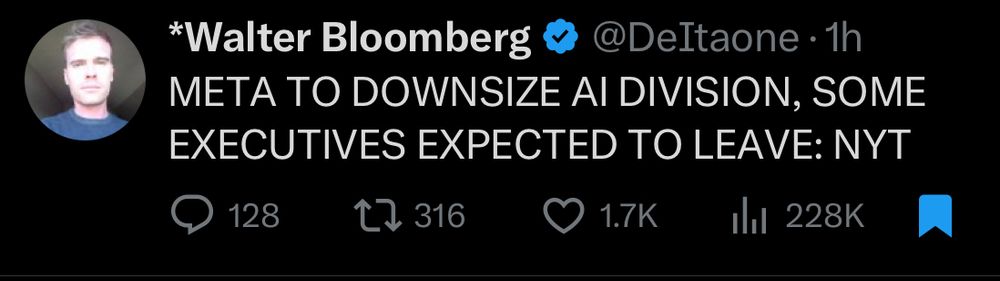
  • Meta, which was recently shelling out $100 million signing bonuses for AI talent, has instituted a hiring freeze and is reportedly looking at downsizing its AI division.
  • Sam Altman, the CEO of OpenAI and the industry’s biggest hype man, is floating the word “bubble” in media interviews.
  • ChatGPT-5, billed by OpenAI as a PhD-level game-changer, is a flop.
  • Coreweave, a cloud computing company backed by Nvidia, has shed nearly 40% of its value in just over a week.
  • Researchers at MIT published a report showing that 95% of the generative AI programs launched by companies failed to do the main thing they were intended for — ginning up more revenue.
  • Anthropic and OpenAI have struck deals to give their products to the US government for next to nothing — even as they are burning through cash and lack demonstrable paths to profitability.

All of that has sent traders rushing to buy “disaster puts” — options that act as a kind of insurance for when the market drops — in case we’re about to relive the late-90s dot-com bust. Per Bloomberg, investors aren’t just preparing for a pullback, they’re bracing for a nosedive.

“I suspect this will lead to a larger correction,” Mike O’Rourke, chief market strategist at JonesTrading, told me, noting that Meta dangling NFL-like compensation packages to attract AI engineers was “a sign the spending was going over the top.” 


Friday, August 22, 2025

The people who are surprised by the rise of the Silicon Valley alt-right are the people who weren't paying attention to Silicon Valley

The presence of the far right in tech culture predated Trump by at least a couple of decades, going back to the very beginning of the dot-com bubble. 

Becca Lewis writing for the Guardian [emphasis added]:  

At the height of the dotcom mania in the 1990s, many critics warned of a creeping reactionary fervor. “Forget digital utopia,” wrote the longtime technology journalist Michael Malone, “we could be headed for techno-fascism.” Elsewhere, the writer Paulina Borsook called the valley’s worship of male power “a little reminiscent of the early celebrants of Eurofascism from the 1930s”.

Their voices were largely drowned out by the techno-enthusiasts of the time, but Malone and Borsook were pointing to a vision of Silicon Valley built around a reverence for unlimited male power – and a major pushback when that power was challenged. At the root of this reactionary thinking was a writer and public intellectual named George Gilder. Gilder was one of Silicon Valley’s most vocal evangelists, as well as a popular “futurist” who forecasted coming technological trends. In 1996, he started an investment newsletter that became so popular that it generated rushes on stocks from his readers, in a process that became known as the “Gilder effect”.

Gilder was also a longtime social conservative who brought his politics to Silicon Valley. He had first made his name in the 1970s as an anti-feminist provocateur and a mentee of the conservative stalwart William F Buckley. At a time when women were entering the workforce in unprecedented numbers, he wrote books that argued that traditional gender roles needed to be restored, and he blamed social issues such as poverty on the breakdown of the nuclear family. (He also blamed federal welfare programs, especially those that funded single mothers, claiming they turned men into “cuckolds of the state”). In 1974, the National Organization for Women named him “Male Chauvinist Pig of the Year”; Gilder wore it as a badge of pride.

At the turn of the 1980s, Gilder celebrated the links between capitalism, entrepreneurship and the nuclear family. He claimed that entrepreneurs were the most moral and benevolent people in society, because they put products into the world without a guarantee of return – and then reinvested the profit back into the economy.

...

But at a time when American industrialism was in decline, Gilder helped revitalize a fervor for entrepreneurship and a belief in the moral power of entrepreneurs over industrial workers and company men. Increasingly, Gilder claimed that entrepreneurs were better suited to lead the country into the future than the “experts” found in academia or government.

As we've mentioned before and will come back to again, the antagonism toward experts is an explicitly stated fundamental tenet of techno-optimism and a defining trait of men like Mark Andreessen, Elon Musk, and Larry Ellison. It also played a key role in the rise of dangerous medical pseudoscience during the pandemic. Look up the history of ivermectin and hydroxychloroquine and you'll find names like Ellison and Musk. 

Gilder’s 1981 book Wealth and Poverty became known as the Bible of the Reagan administration, and Reagan began incorporating praise of entrepreneurship into his own speeches. (“If I didn’t know better,” Reagan once stated, “I would be tempted to say that ‘entrepreneur’ is another word for ‘America’.”) Throughout the decade, Reagan used the mythology of entrepreneurship to justify trickle-down economics and cuts to federal welfare programs.

As Gilder became swept up in his own ideas about entrepreneurship, he turned his attention to Silicon Valley. The bourgeoning hi-tech industry, he began claiming, was the purest expression of entrepreneurship in the world. It’s not surprising that Gilder would be drawn to the tech industry in Santa Clara county, California. The state had its own powerful mythologies of masculinity and power. It was the end of the vast frontier, the end of manifest destiny. And it was the place of the former gold rush, where (white) men had struck it rich in the 19th century. It was also, counterintuitively, the birthplace of much of the modern conservative movement, including Reagan’s political career.

On the Media (which has been doing superb work recently) had a highly recommended interview with Lewis. Something else we'll be coming back to. 


Thursday, August 21, 2025

If the AI Boom turns out to be a bubble, how loud will the pop be?

We talk a lot about AI here at the blog, but so much of our time is spent down in the weeds that it's easy to lose sight of just how massive and multifaceted this story is, to the extent that it might be better to think of it as a collection of major narratives sharing a common link. In terms of impact, the biggest of these narratives is probably the AI boom—or, viewed from another set of assumptions, the AI bubble.

It is difficult to wrap one's head around just how big this story is. 

Robert Armstrong writing for FT


There are loads of interesting narratives in that chart (look at the decline of GE, in light grey, for example). But it is worth noting that 30 years ago the industries of the biggest companies were, in descending order, industrials, energy, consumer staples, tech, pharma, consumer staples, tech, retail, tech, consumer staples. Today, the list goes tech, tech, tech, tech, tech, tech, tech, tech, finance, finance. In 2000, there were five tech companies in the top 10. But five years later, three of them were gone; another slightly disconcerting precedent.

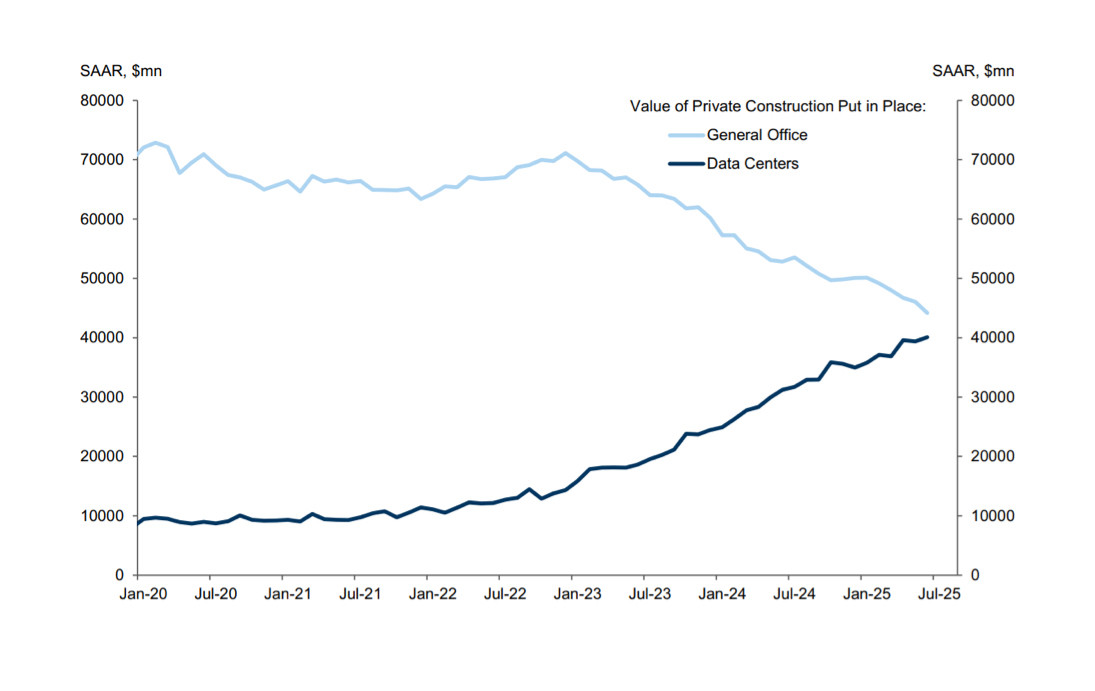
The industry represents around a third of the S&P 500. AI spending contributed more to the economy's growth than did the U.S. consumer. Data center construction has exceeded office construction. "But [AI] increasingly looks like the only game in town for growth. Housing, consumption and government spending — nearly 90% of the economy — are now stagnant at best.” 


Hiltzik for the LA Times:

That’s the principle undergirding the AI industry’s vast expenditures on data centers and high-performance chips. The demand for more data and more data-crunching capabilities will require about $3 trillion in capital just by 2028, in the estimation of Morgan Stanley. That would outstrip the capacity of the global credit and derivative securities markets. But if AI won’t scale up, most if not all that money will be wasted.
 

The hype has been almost unprecedented, but for now, real world performance has been underwhelming and people are starting to get nervous.


Meta freezes AI hiring, WSJ reports reut.rs/4fPDc1x

[image or embed]

— Reuters (@reuters.com) August 20, 2025 at 6:30 PM


Today feels different, in part because the narrative appears to be seeping into the markets, which have been resistant to the dour "are we in a bubble?" vibes. NVIDIA earnings end of month may bring their smiles up, but there's a lot of days of trading between now and then.

[image or embed]

— Ed Zitron (@edzitron.com) August 19, 2025 at 1:41 P


In addition to the scale. there are a number of other reasons to be more concerned about the AI bubble than the dot-com bubble, not the least of which is the state of the larger economy. Observers are pointing out indicators of stagflation that haven't been around for almost 50 years. Add to that a federal government that is increasingly run by the corrupt and the incompetent—the very last people you would want in charge during an economic crisis. 


Wednesday, August 20, 2025

This is why women love the Three Stooges

[I wrote this twelve years ago then apparently got distracted and forgot to post it. Since we're still having the same silly conversations on the topic, I decided better late than never.]


I'll admit my first my first thought at reading this piece by Yahoo's Beth Greenfield was that the combination of tiny slivers of the lunatic fringe calling themselves movements and lazy journalists looking to make something out of nothing is bound to turn out badly, but then I gave it some more thought:

There’s a controversial new ad that’s gone viral this week, and a vocal group of men are up in arms about it, calling it “sexist.”

Yep, that’s right. This time it’s men who are being belittled to make people buy something: Samsung’s Evolution Kit, which transforms any Samsung television into a smart TV (though the specific product is really beside the point here).

The commercial was introduced last week on YouTube, where it had neared 10 million hits by Thursday afternoon. In it, a woman strolls into the living room to find her husband/boyfriend lying on the couch and watching TV. He’s a slovenly Neanderthal who’s burping, chewing food with his mouth open, grunting, and watching a moronic cartoon. Said wife sighs in disappointment, plugs the new Evolution Kit into the back of the TV, and then fantasizes about what a similar kit could do for her man—which is to turn him into a multitasking (though lobotomized) savior who bakes, cares for baby, paints the kitchen, waters plants, cleans, serves champagne, and plays the flute. But after the fantasy, we're brought back to the real husband sitting and farting on the couch.

Sound funny? Yeah, it is—even if it does rely on every tired male-female trope in the stereotype dictionary. Maybe it’s just always a relief to see men, rather than women (and their butts), as the butt of an advertising joke.

But plenty of guys are angry and offended, and have been sounding off online to let everyone know.

“Probably one of the most vile adverts I've ever seen. This isn't the normal IV drip of laughing at men; this is simply mainlining outright contempt,” wrote one critic in a Reddit “Men’s Rights” page thread on the ad. Another chimed in, “Pure filth. I've seen my fair share of 'men are morons' advertisements, but this one isn't even remotely subtle. The fact that the evolved husband is a brain dead slave to a woman just tops it off.” One man wondered if Samsung was “trying to alienate their primary consumer base,” while others called it “disgusting,” and “sexist,” and promised to boycott the company’s products altogether.

Fed-up men also took to Twitter, and made up much of the 1,500-plus commenters on YouTube. One wondered which “misanthropic, rabid feminist” came up with the concept, while another said he was, “tired of the double standard and depicting men as idiots in advertising.”
A Reddit “Men’s Rights” page isn't just some site for losers with too much time on their hands; it really is a great place to get a representative view of what men are thinking, particularly in this case.

I think I speak for all men when I say that we're tired of having feminists shove images images of loutish men down our throats. We've all been there. The moment the wife or girlfriend gets her hands on the remote, it's Three Stooges marathon for the rest of the night.

Men hate this sort of thing: guys acting like idiots, farting, taking shots to the groin. If you see a man in a movie theater watching Jackass III or the latest Adam Sandler picture, you can bet some feminist dragged him there.


Tuesday, August 19, 2025

In completely unrelated news, Tesla closed yesterday with a P/E ratio of 194

I have a scene for/from a horror film in my head (I have no idea whether I’m making this up or remembering it). It’s a group of people in a strange room with a large table in the middle covered with an enormous number of pieces from a jigsaw puzzle. As the picture starts to come together, they realize it’s a nightmarish Gothic painting. Then they realize it’s a painting of the room they are in.

I have a feeling that a lot of economists have the same expressions on their faces these days that I’m picturing in that movie scene, with each day revealing a new piece in a very disturbing picture.

Lots of people have been trying to figure out why the market keeps climbing in the face of more and more ominous news. I’ve done a couple of posts approaching this in terms of market psychology, suggesting that traders were in a state of denial about the steady flow of troubling developments we’ve seen over the past six months, but there may be another explanation. It is possible that a large number of traders have made the rational choice and moved their investments somewhere safer, but in the mrkets some of the smart money has been replaced with dumb money.

Retail Traders now account for more than 20% of total equity options volume, the most in history 🚨🚨

[image or embed]

— Barchart (@barchart.com) August 15, 2025 at 7:16 AM

With a handful of exceptions, most retail investors shouldn’t be investing in individual stocks, period. This has been true at least since the invention of the index fund, but it is arguably more so today. 2025 traders came of age during the asset bubble when stupidity was often rewarded and the dominant investor culture was HODL. With the possible exception of SoftBank and the Saudi sovereign wealth fund, this is the dumbest of dumb money, and in the long term, dumb money is a bad indicator.


Monday, August 18, 2025

My mind makes strange connections

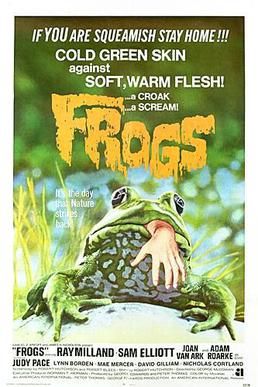
When I read this headline...

 Invasive bullfrogs are spreading in the West. Here’s why scientists are so alarmed.

... this was literally my first thought.  


I don't remember much about the movie — I'm not even sure I saw the whole thing — so I can't really recommend it (except in the sense that I'll recommend anything that has Sam Elliott in it), but I can vouch for the Vox article, which is quite good.

American bullfrogs are not native to the Western US. Humans brought them to the region more than a century ago, largely as a food source. And in the years since, the frogs — which are forest green and the size of a small house cat — have multiplied dramatically, spreading to countless ponds and gobbling up everything that fits in their mouths, including federally threatened and endangered species. Conservation scientists now consider them among the most dangerous invasive species in the Western US, and in the 40-plus other countries worldwide where they’ve been introduced.

That leaves bullfrogs in an unusual position. Invasive species are typically brought in from other countries — Burmese pythons in Florida and spotted lanternflies in New York City come from Asia, for example — but American bullfrogs are, as their name suggests, American. They’re both native and invasive in the same country. And the difference of just a few states determines whether we treat them like pests or as an important part of the ecosystem.

Benji Jones deserves credit for his in-depth reporting here, and for giving us the disturbing image of frogs eating "Mice, birds, turtles, snakes, rocks, other bullfrogs."


Friday, August 15, 2025

Elon Musk takes one out of the Sheriff Bart playbook

[I know we just did a Patrick Boyle video, but he really is the man for this one.]

Tesla just gave Musk the biggest executive payout ever in exchange for him not wiping out his own fortune. 

 Elon Musk, despite being Tesla's largest shareholder, has repeatedly demanded additional equity-based compensation, even threatening to leave the company if not granted more control. His $29 billion pay package stands out not just for its size, but for its departure from founder norms. Tesla's board has described this package as being a critical first step to energize and focus Musk. Now, I'm not sure what the following steps will be, but the award increases Musk's stake in Tesla from under 13% to about 16% of the company. The only requirement it puts on him is that he has to stay in a senior leadership role at Tesla for two more years. There's no requirement that he devote any more time to the company — he just can't quit.

Musk's overturned 2018 compensation package had entitled him to 20% of the company, and he has said that he needs to own at least 25% if he's going to advance Tesla's artificial intelligence and robotics capabilities — the most important buzzwords of 2025. He says that 25% would be enough control to prevent an activist investor from ousting him, as he did to the management of Twitter a few years ago.

Despite his claim that he's not interested in wealth and only wants control of Tesla to save humanity, in recent years Musk has sold billions of dollars’ worth of Tesla stock. He managed to sell $7.5 billion worth of Tesla shares near its all-time high in late 2022, right before a sales report that sent the stock price plunging.

His new pay package is being pitched to Tesla investors as a contingency plan: if the $56 billion award from 2018 — which was struck down by a Delaware court for being excessive and poorly disclosed — is reinstated upon appeal, he'll forego the new shares. But if the court rejects Tesla's appeal, Musk will still walk away with the largest pay package in corporate history as a “critical first step.”

It's worth noting that Elon Musk's overturned $56 billion compensation package is worth more than Tesla's entire accumulated net income since inception. As of early 2025, Tesla had earned approximately $38.66 billion in total net profit since going public, meaning that Musk's $56 billion pay package would have represented about 1.45 times the company's lifetime earnings. The more modest $29 billion pay package is less than 80% of Tesla's total net profit since going public, meaning that something is left over for the other shareholders.

The logic behind Musk's award is unconventional. As The Economist puts it, under the Elon Musk theory of pay, the worse Tesla performs, the more its boss ought to earn.

 Just for context, this comes on the heels of Musk destroying the brand, cratering sales, and generally screwing up his job. 

Musk does have some leverage here, albeit for terrible reasons. 

If the goal were to maximize the profitability of Tesla, getting rid of Musk would be a great first step. Even if the objective were to make it the leader in autonomous driving or robotics, you could still find far more qualified and competent executives, none of whom would insist on holding a gun to the company's head.

But the time for talking about the potential earnings or market share of Tesla has long since passed. The company is so insanely overvalued that there's simply no way that it will ever justify its stock price.

For the people invested in the company, the best possible outcome, the only one that avoids catastrophic losses, is for the markets to stay irrational and the bubble to remain inflated long enough for investors to unload their shares on another generation of suckers.

While Musk is probably bad for the company’s financial health, he is absolutely essential for its market cap. Tesla has always traded on the belief that Elon Musk was some sort of superhuman genius who was about to release some wonderful new technology on the world. We've referred to this as flying exoskeletons. Boyle refers to it as “pixie dust.”

What's different now is that the more conventional justifications for buying and holding Tesla stock have all fallen away. This is a small and shrinking 20-plus-year-old car company with a toxic brand, and no real product in the pipeline, coming off of a worse vehicle launch than the Edsel. Exoskeletons and pixie dust are now the only justification for being bullish, and only Elon Musk can hold on to the true believers. 


Boyle ends the video with link to his segment on John Keely, though he never says why.  

Thursday, August 14, 2025

Dr. Elara Voss -- LLMs' own Jungian archetypal memory?


 If this were happening with human beings, if a number of people were independently coming up with the same character name for a fictional character with remarkably similar traits and backstory, it would feel like the premise of a particularly creepy science fiction/horror story. In fact, it is remarkably similar to one of my favorite Doctor Who episodes with perhaps my favorite cliffhanger climax.

It’s not quite so inexplicable in the world of large language models, though it is an interesting and informative example. We will be coming back to this one.


From Who is Elara Voss?

by Max Read

 There are, as of this writing, 62 books credited to an “Elara Voss” available on Amazon: ... What’s more, there are hundreds of books on Amazon and other self-publishing platforms that feature a character named “Elara Voss,” among them Veil of the Bloodwight Syndicate, Gynarchy’s Collar, and Starlight Nexus by Kylian Quinn:


 ...

What’s so odd about this is that--for a name now so common across the megaplatforms--before 2023, “Elara Voss” did not exist. There is no person named Elara Voss in the United States. No birth certificate has ever been issued under that name; if you search for it in public records databases, you’ll turn up no results. There aren’t even any characters named “Elara Voss” in any book published before 2023. Until two years ago, the two words didn’t ever appear next to each other even by accident.

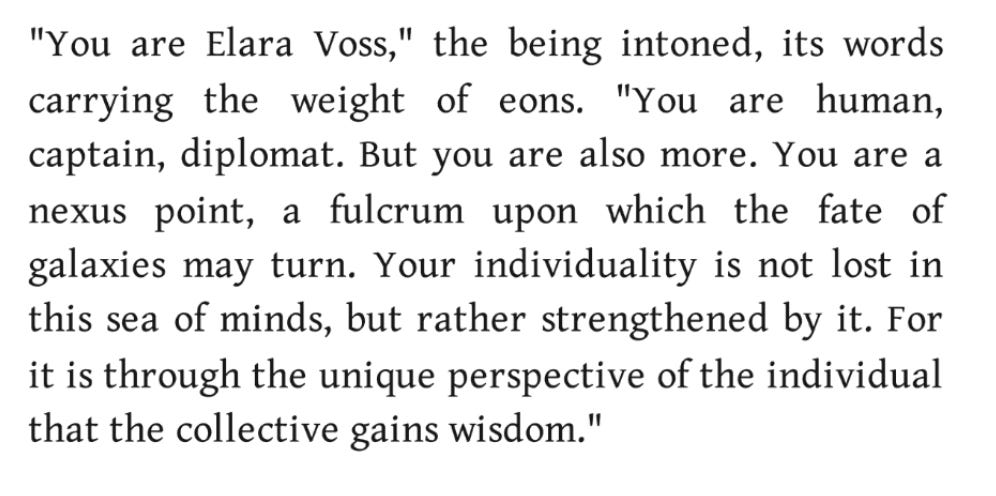
But if you direct almost any L.L.M. to generate a sci-fi story or narrative for you, it will name the main character “Elara Voss”--or a similar variation like “Elara Vex,” “Elena Voss,” or “Elias Vance”--with an alarming degree of frequency.

...

When, exactly, “Elara Voss” and its cognates emerged from the latent space to dominate the Kindle Unlimited store is hard to say. I’ve seen some people on Twitter hazily suggest that Elara and kin--let’s call them promptonyms, to coin a phrase--were present in GPT 3.5 (released in November 2022), but the earliest instance of the names I can find online dates back to August 2023, when an account “exploring realms through #AIStorytelling & #AIConceptArt” posted a character sketch of a “visionary physicist and AI researcher” named “Dr. Elara Voss.” (A “Dr. Elara Finch” and a “Dr. Elara Solis” each appear a few months earlier.) Voss appears a handful more times on Twitter in similar contexts over the next few months, and pops up on a fan-authored Warhammer 40k wiki as the name of the “highly respected leader of the Inanis 23rd Voidstalkers.”

But by the same time next year, Elara, Elena, and Elias Voss, Vex, and Vance had become inescapable, to the point that frequent users and A.I.-powered writing apps began to develop specific prompts to avoid them. The promptonyms reportedly appear in every major L.L.M.: GPT, Claude, Gemini, LLaMA, DeepSeek, and Grok. An A.I. tinkerer on Reddit playing around with L.L.M. benchmarks last August found that Google’s lightweight Gemma model used the name Elara “39 times in 3 separate stories,” and Elias “29 times in 4 separate stories.” None of the commenters were surprised: “every time I try using any models for creative writing, doesn't matter whether it's gpt-4, mistral, llama, etc, always the same names come up like Elara or Whispering Woods, etc.,” one wrote. (Alongside “Whispering Woods,” you can file “Eldora” as the name of a magic kingdom.) Elara Voss seems to be the promptonym generated most often, others like “Aris Thorne” (“Why is Dr. Aris Thorne everywhere?” one Redditor wondered) and “Elias Vance” are found frequently too:

 In fact, a whole host of tropes and concepts seem to accompany Dr. Elara wherever she’s found. The prototypical “Elara Voss,” as described by a text generator, is a doctor, usually a physicist but sometimes a linguist or biologist. (Other times, she’s a spaceship captain.) She’s generally on the verge of a major breakthrough or discovery (often cosmic or even metaphysical in nature), or is researching some kind of “anomaly,” but is isolated, troubled, and sometimes “haunted” by what she’s learning. She’s often found “trembling” or her heart is racing; instruments near her are usually “pulsing.” The name “Erebus” often appears in Dr. Elara stories: a “Project Erebus” on which Dr. Elena Vex is working, or a mining colony named “Erebus-IX” to which Dr. Elias Vance must travel, or even a “rogue A.I.” called Erebus, “neutralized” by Dr. Elara Voss.

 ...

Admittedly, I too have a hard time not giving in to the spooky pleasures of imagining a pantheon of A.I. tulpas emerging from the latent space, a new mythos derived from the hidden structures of our culture. But there are also less occult ways of accounting for the frequency with which Elara and her fellow promptonyms appear. As many people have pointed out, there’s a significant character in World of Warcraft named “Lilian Voss,” and the volume of text publicly available online about the WoW universe in the form of wikis, walk-throughs, and YouTube transcriptions likely gives the lore a gravitational pull in most models. If you trace back, e.g., Gemma’s decision-making process you can see that “character names,” as well as “science fiction” and “fantasy,” are all closely linked in the model to a “text about World of Warcraft” neuron, as Abram Jackson shows here and a user called beowulf shows here. (Similarly, there’s a character named “Elara Dorne” in Star Wars: The Old Republic, a voluminously covered M.M.O.R.P.G. like WoW. It’s a good reminder that L.L.M.s reflect “culture” in the narrow sense of “the culture of text publicly available on the internet in great volume.”)

As for her ubiquity across models, that’s almost to be expected. All the largest models are trained on effectively the same corpus--i.e., “almost all publicly available text”--and the processes by which they are made smooth and sanitary for public release sand down particular differences even further. (They’re also likely training on each other’s responses, which should lead to additional convergence.)

So you might say that Dr. Elara Voss is an emergent legend whose qualities reflect a deep mathematical structure underlying our culture. You might also say she’s a statistical agglomeration of science-fiction cliché borne of oversampling video-game wikis. I’m not sure that either of those views is wrong, precisely! What I do know is that we should enjoy her while she lasts: By the next generation of models, she’ll almost certainly have been eliminated. As much as we might enjoy the idea of A.I. lore, the companies selling the tech (as fiction-writing software, among other things!) don’t like the kind of consistency that points to something other than total magic occurring under the hood.