Friday, November 21, 2025

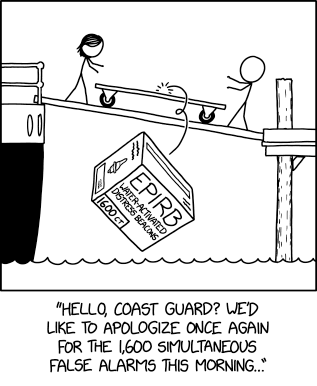
The funniest part of the latest XKCD cartoon isn't on XKCD

Don't get me wrong, it's a funny gag... 

... but not as funny as this detail about the strip revealed in the Explain XKCD blog.
  

A search for "total number of simultaneous EPIRB signals" on Google the day after this comic returned an AI Overview bullet point of "System-wide: The overall system is designed to handle thousands of beacons globally. One source suggests a scenario of up to 1,600 simultaneous signals at the same geographic location, which authorities can manage and verify." which implies that Google's AI algorithm was reading this comic explanation page and including it in search results as a source for how EPIRBs operate. 

For more unexpected XKCD connections, check this out.

Thursday, November 20, 2025

Cacti, Goats, Charcoal -- we do it all

There are lots of questions about scalability and the best way to take advantage of this, but at the very least, if you live in the Southwest, replacing your lawn with native plants is a win-win-win. 

 From the Arizona Republic:

Professor Laurence A.J. Garvie of Arizona State University’s School of Earth and Space Exploration noticed something interesting while walking in the desert.

Garvie saw gritty, light-colored tailings within fallen, decaying saguaros. It turned out to be calcium carbonate – the same material that makes up chalk and caliche.

When a saguaro dies, it essentially makes a chalk line around its own body.

So what?

The significance is atmospheric.

All plants sequester – or trap – atmospheric carbon (CO2) as they grow. After they die, most of that carbon goes back into the atmosphere as the plant decays.

But when a saguaro dies, much of that carbon is transformed into an inorganic mineral that is sequestered for geologic time in the ground.

...

And it isn’t just saguaros – although they are the most iconic example.

Garvie says all common species of cacti remove carbon from the atmosphere and sequester it in the earth as calcium carbonate.

You may have come across some of it when gardening. It’s called caliche and the desert plants have been producing it for millions of years.

“Our desert cacti are just like a coral reef,” says William Peachey, a saguaro researcher who discussed Garvie’s research during the annual meeting of the Tucson Cactus and Succulent Society earlier this year.

Coral reefs are known to transform atmospheric carbon into limestone, “our desert has a terrestrial equivalent,” says Peachey.


Wednesday, November 19, 2025

After you've cleaned your room, you can go outside and play with Foamy.

Christina Cauterucci writing for Slate:

But opposition to pet vaccines seems to have risen since the COVID-19 pandemic. Experts say that since contemporary pet owners view their animal companions as family members, attitudes toward veterinary treatments mirror attitudes toward human medical interventions. The Vaccine journal study found that people with negative views of human vaccines were likelier to have negative opinions of animal vaccines—and COVID-19 had a lasting impact on the way people feel about preventative shots. In a series of Gallup polls, the percentage of Americans who said it was extremely or very important for parents to vaccinate their children dropped 15 points between 2020 and 2024, a decline the poll attributed almost entirely to right-leaning Americans. A survey conducted in Brazil found that pet owners were six times more likely to refrain from vaccinating their animals if they themselves were not fully vaccinated against COVID-19.

Anti-vaccine advocates save their strongest rebukes for mRNA pet vaccines, the first of which were approved by the U.S. Department of Agriculture for canine influenza and feline leukemia last year. The menu of veterinary mRNA vaccines may soon expand; in Canada, pets can already get one for rabies. Because the two most famous and effective COVID-19 vaccines—Pfizer’s and Moderna’s—were the first-ever mRNA products to receive Food and Drug Administration approval, mRNA technology has become a primary villain of the anti-vaccine movement in both human and animal medicine.

Just as the alleged connection between human vaccines and autism has been thoroughly, repeatedly debunked, there is no evidence that pet vaccines are responsible for the ills with which anti-vaccine advocates credit them, from early-onset cancers to a suite of cognitive and behavioral problems that some half-jokingly call “pawtism.” Like autism in humans, “pawtism” is allegedly characterized by repetitive behaviors, sensitivity to sensory stimuli, and difficulty in social situations.

The lack of scientific backing for these vaccine concerns hasn’t stopped a multitude of influencers, care providers, and activists from raising alarm about veterinary shots. There are peddlers of tonics that claim to heal pets from the effects of “toxic preventatives and pharmaceuticals.” There are podcasters trumpeting “the risks of over-vaccination.” There are social media personalities posting scary videos about pet vaccines “shedding” onto humans.

...

Like more than a dozen other states, Colorado offered a loophole for medical exemptions. If she could argue that a pet was not healthy in any way, Jasek would write up a note excusing the animal from the rabies vaccine. Most of the time it worked fine, but she says she was twice contacted by the state board because people had filed complaints against her. (The complaints never led to any disciplinary proceedings.) Once, it was another veterinarian who didn’t believe an exemption was justified. Another time, a client’s unvaccinated dog bit someone.

“She kind of threw me under the bus, basically, and said, ‘Well, Dr. Judy said I don’t need the vaccines,’ ” Jasek told me. “That isn’t true. I mean, I tell people that the vaccines can cause health concerns. However, when it comes to the laws and the rules, people still have to be accountable.”

Rabies outbreaks in wildlife populations are on the rise across the U.S., due in part to human incursion on natural habitats. Though the people who have died from rabies exposure in the last year have gotten the disease from wild animals, veterinarians worry that distrust of pet vaccinations could lead to a resurgence among domestic animals of a virus that is nearly 100 percent fatal in both animals and people.


Tuesday, November 18, 2025

Edison on the power grid of the future

Edison (who never learned to drive) loved riding in fast cars but hated the fuel that powered them. 

From a 1910 interview.

… said Edison as we sat at lunch… “Some day some fellow will invent a way of concentrating and storing up sunshine to use instead of this old, absurd Prometheus scheme of fire. I’ll do the trick myself if some one else doesn’t get at it. Why, that is all there is about my work in electricity–you know, I never claimed to have invented electricity–that is a campaign lie–nail it!”

“Sunshine is spread out thin and so is electricity. Perhaps they are the same, but we will take that up later. Now the trick was, you see, to concentrate the juice and liberate it as you needed it. The old-fashioned way inaugurated by Jove, of letting it off in a clap of thunder, is dangerous, disconcerting and wasteful. It doesn’t fetch up anywhere. My task was to subdivide the current and use it in a great number of little lights, and to do this I had to store it. And we haven’t really found out how to store it yet and let it off real easy-like and cheap. Why, we have just begun to commence to get ready to find out about electricity. This scheme of combustion to get power makes me sick to think of–it is so wasteful. It is just the old, foolish Prometheus idea, and the father of Prometheus was a baboon.”

“When we learn how to store electricity, we will cease being apes ourselves; until then we are tailless orangutans. You see, we should utilize natural forces and thus get all of our power. Sunshine is a form of energy, and the winds and the tides are manifestations of energy.”

“Do we use them? Oh, no! We burn up wood and coal, as renters burn up the front fence for fuel. We live like squatters, not as if we owned the property.

“There must surely come a time when heat and power will be stored in unlimited quantities in every community, all gathered by natural forces. Electricity ought to be as cheap as oxygen, for it can not be destroyed.

“Now, I am not sure but that my new storage-battery is the thing. I’d tell you about that, but I don’t want to bore you…” 

Lots of researchers at the time were interested in wind and solar, but Edison characteristically identified the main challenge not as generation but as storage.

Monday, November 17, 2025

Actually a P/E ratio of 200 would be an enormous improvement


 As we've said before, anyone with even a passing interest in business, finance, or the economy should sign up for Allison Morrow's newsletter. She has become one of my must-reads.

Here, she does a great job laying out the absurdity of Tesla's valuation and capturing the frustration felt by rational observers watching an irrational market.

Consider Tesla, a stock so detached from the company’s actual business some analysts call it the “OG meme stock.”


Its core product, electric cars, is quickly growing stale and losing market share to rivals. But don’t worry, it’s not a car company anymore, Elon Musk has said (despite cars being the only commercially viable, revenue-generating product Tesla offers). No, Tesla is an AI and robotics company now, its future staked to robotaxis (still in development, buggy, years behind Alphabet’s Waymo) and $20,000 humanoid robots (also still in development, and still require a human operator to do the household chores it’s billed to one day do autonomously.)


This week, Bank of America analysts said Tesla’s core automotive business represents just 12% of the company’s total value. Robotaxi is 45% and “full self Driving” — Tesla’s autonomous driving software that doesn’t reliably work and customers don’t reliably want to pay for — is 17%.


In short: Well over half of the stock’s value lies in products that either don’t yet exist or don’t exist at scale.


...


Sensible investors might say “hey, there’s clearly value here but a stock that trades at 200 times earnings is overhyped and I’m going to sit this one out.” And they’d be right, in the Warren Buffett sense of right.


But they’re not Warren Buffett.


...


Being a naysayer in this market doesn’t pay the bills. Buying the dip does. All those crypto trolls who taunted skeptics to “have fun staying poor” were not, sadly, incorrect (though we can all agree they were jerks). Crypto has not only stayed alive, it’s practically gone mainstream. Even Jamie Dimon, the JPMorgan Chase boss Jamie Dimon, a longtime critic, has sort of come around, saying earlier this month that blockchain – crypto’s underlying technology — “is real.”


There is almost no “bad” news that can rattle Wall Street anymore, as investors have learned that buying the dip almost always pays off.


That is, of course, until it doesn’t. And no one knows when, or even whether, we’ll hear the record scratch.


Friday, November 14, 2025

Finally, a piece of data visualization that truly captures the moment.


 Given that this is from the Financial Times, it’s very probable the intent here is satiric. Unfortunately, these are very strange times, and I can’t be entirely sure—especially since the Financial Times has an extremely formidable paywall.

Either way, I felt this was one I should share with everyone.


Thursday, November 13, 2025

We really should set aside more time for cool math

One of the disadvantages of having so much to talk about (literally thousands of items in the draft folder waiting for completion) is that so much fun stuff gets pushed aside. Case in point: this post from John D. Cook.


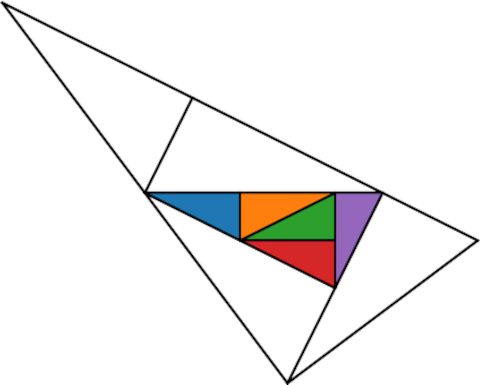
John Conway discovered a right triangle that can be partitioned into five similar triangles. The sides are in proportion 1 : 2 : √5.


You can make a larger similar triangle by making the entire triangle the central (green) triangle of a new triangle.


Cook later points out that repeating this gives us an aperiodic tiling of the plane and has a cool animation. 

 If I were still teaching high school geometry (and wasn't being Common-Cored into submission), I'd make the following assignment.

Prove these five smaller triangles are similar to the large one.

Prove these five smaller triangles are congruent to each other.

Find the ratio of the corresponding sides of the small triangles to the corresponding sides of the large triangle. 

Prove that this partitioning of a right triangle would only work for sides in proportion 1 : 2 : √5.. 


Wednesday, November 12, 2025

Reason 53 Why Wikipedia Is Better Than Mainstream Media: They Actually Fix Their Mistakes

A few days ago, we did a post about an absolute train wreck (spaceship wreck? Hyperloop wreck?) of a book review/essay in The New Yorker that somehow managed to connect the late–19th-century interest in Martian life with the press’s handling of the Epstein files — all while including a stunningly ill-informed take on Elon Musk.

As bad as the piece was, one line managed to stand out from the rest in terms of sheer awfulness:

"Musk, of course, named his car company after Tesla"

Elon Musk has spent the past 20 years trying to retcon himself as the founder of Tesla, but the facts are a matter of historical record: Tesla was named by the two real engineers who founded the company six months before Musk had any involvement whatsoever. This is not a point of dispute — even Musk apologists will concede it if directly challenged. Even the most cursory research would have uncovered this mistake. Nonetheless, it made it past the writer, the editor, and the magazine's vaunted fact-checking department.

Longtime readers will know that this isn’t the first time we’ve caught the New Yorker being sloppy with details and slow with corrections.

For years now, various experts on Buster Keaton and/or the legendary comic strip Pogo (“We have met the enemy and he is us”) — including the Keaton biographer who was their primary source — have been trying to get The New Yorker to correct its claim that Walt Kelly, the cartoonist, was the brother-in-law of the great filmmaker. (It turns out there was more than one Walt Kelly.)

Years before that, we fact-checked an article on the music of 1960s spy shows that was so riddled with errors it took an entire post — plus a post script — to catch them all, including the misattribution of some of the most famous pieces by legends like Jerry Goldsmith. As with the other two examples, these mistakes went uncorrected for years and, as far as I know, are still there.

Now let’s talk about an experience I had recently with Wikipedia.

A couple of weeks ago, I finished Nothing to Lose, one of the Jack Reacher novels (weaker than Echo Burning as a mystery, generally stronger as a thriller, in case you’re considering picking up a copy). I’ve gotten in the habit of checking Wikipedia after finishing a book or movie — sometimes for interesting trivia, sometimes for follow-up suggestions.

In this case, what was supposed to be a quick glance at the plot summary turned into multiple rereads as I tried to figure out what the hell they were talking about.

It wasn’t that the description was incoherent; it just seemed to be about an entirely different book. The locations and character names were the same, and the first paragraph sort of matched the opening 50 pages. After that, it was like the writer had lost their copy and decided to make up their own version from memory.

If I had to guess, I’d say it was done by something like ChatGPT — partly because of the way it read, and partly because I can’t imagine why anyone would put that much time into writing a plot summary for a book they clearly hadn’t read.

I’m not registered to edit Wikipedia, so I made a fairly detailed list of the factual errors — enough to show this wasn’t just a case of getting a few details wrong — and posted it to the talk page. The next day, I checked back and found the old summary had already been replaced with a much more accurate capsule version from Sherryl Connelly of the New York Daily News.

Then I clicked on the talk page and found the following:


The timestamp showed that, despite this being a very minor Wikipedia page, the editors had addressed the problem and removed the original contributor’s edits from this and several other pages — all within less than five hours.

Next time you see journalists writing long, pretentious think pieces about why the public has lost faith in them, feel free to send them a copy of this post. 


Tuesday, November 11, 2025

More from the vaunted fact-checkers of the New Yorker

[See here and here for previous examples of us watching the New Yorker watchmen.]

Calling to mind the great Dianne Wiest line from Parenthood, there is so much to dislike about this recent New Yorker book review by Jon Allsop that it’s difficult to pick just one thing. There’s the general lack of knowledge about the subject, the misinformed treatment of Elon Musk (which cites the disastrous GQ interview), an attempted comparison between the turn-of-the-century interest in Martians and the Epstein case—an analogy so tortured the writer might as well have attached electrodes to its testicles.

Time permitting, I may come back and address some or all of these, but for now I’m just going to focus on one example which, though relatively small, is both egregious and indicative of a larger journalistic failure that has caused no end of harm.

"Musk, of course, named his car company after Tesla"

I probably don’t have to tell this to anyone reading the blog. I certainly shouldn’t have to tell it to anyone writing about Tesla in a major publication. But Elon Musk not only did not name the company—he had nothing to do with it until it was about six months old, at which point he brought in a substantial chunk of money, entrenched himself in the operation, and began working to get himself named retroactive founder (because in the 21st century, that’s a thing).

This isn’t just printing the legend; it’s printing the lie. And while this detail is minor, it’s part of a myth that has done extraordinary damage over the past 25 years: the myth of the Silicon Valley Visionary, the Tech Messiah.

It’s a myth that has justified God knows how many crimes. It has elevated some of the most reprehensible people imaginable to positions of unprecedented wealth and power while convincing most of the media that they should be treated as sages and modern-day prophets.

In particular, the legend of Elon Musk is virtually the sole justification for a market cap that made him the richest and one of the most powerful men in the world—and is about to make him considerably richer still. That valuation is inflated by well over one and quite possibly two orders of magnitude for a shrinking niche car company with a toxic brand and nothing but sci-fi vaporware in the product pipeline.

If journalists can’t catch even the most basic, widely debunked lie about Elon Musk, how can they possibly dig through the layered falsehoods and impossible claims on which he has built his fortune?

Monday, November 10, 2025

One of the most challenging parts of living in profoundly abnormal times is avoiding a false sense of normalcy.


We’ve said before that it’s essential to take note of these Dr. Tarr and Professor Fether moments—not only because of their real significance, but because making a habit of acknowledging them keeps us aware of just how insane these times are. We’ve mentioned, for instance, the federal government taking the position that vaccines are potentially dangerous and that climate change is a hoax, while holding up toxic chemtrails and secret weather-control machines as areas requiring serious investigation.

The most recent example may not be quite as surreal as that, but it’s still bizarre—and even more significant—having a huge impact on government, the economy, and the lives of every American.

Put bluntly: the United States is now down to two and a half branches of government.

Assuming the House of Representatives actually follows its proposed schedule (something many political observers are highly skeptical of), it will have gone just a couple of days short of three months without being in session.

As we’ve advised before, this is one of those moments when you have to stop and give yourself a minute to absorb both the magnitude and the absurdity of what you’re seeing.


Friday, November 7, 2025

Having robots follow criminals around to prevent all crime sounds like a perfectly workable plan that's not at all dystopian

One of these days, we need to have a long, hard discussion about the extent to which the establishment press (The New York Times, The Atlantic, and too many others to count) enabled this mess—first by building up the mythology of the Tech Messiah, and more recently by going all-in on the sane-washing of techno-optimism as “abundance.” 

Tesla says shareholders approve Musk's $1 trillion pay plan with over 75% voting in favor
Lora Kolodny

Tesla said shareholders voted in favor of CEO Elon Musk’s almost $1 trillion pay plan, with 75% support among voting shares.

Board members recommended shareholders approve the pay plan, which they introduced in September. Top proxy advisors Glass Lewis and ISS recommended voting against it.

Results of the vote were announced on Thursday at the company’s annual shareholders meeting in Austin, Texas.


A few points we’ve made before, but which bear repeating:

It is impossible to justify Tesla’s current market cap—let alone the proposed compensation package—based on the company’s existing lines of business. The only plausible arguments rest on the assumption that Tesla will achieve monopoly or near-monopoly control over multiple new technologies that will prove profitable beyond precedent.

Two of these—autonomous vehicles and humanoid robots—would each have to exceed even the most optimistic serious estimates of their potential market. The case for large-language-model generative AI is somewhat more controversial, but even that doesn’t matter because…

Tesla is far behind its competitors in all of these fields, with no credible plan for catching up. It is, at best, a distant second to Waymo in the robo-taxi market and continues to fall further behind. It’s probably in fourth or fifth place in generative AI (unless you count pornography, where it does seem to have taken the lead). In robotics, it’s arguably even lower in the rankings. Across all of these sectors, its competitors have a considerable lead in both technology and talent.

Despite all this, Musk’s claims have grown even more grandiose—now constantly tipping into the delusional. He is explicitly promising to end all human want, to satisfy all of our material desires and physical needs, up to and including having robot housekeepers that can also perform delicate surgeries—presumably between cooking dinner and vacuuming the living room.

As commentators have (perhaps too) eagerly pointed out, receiving that full trillion-dollar payout requires meeting a number of highly unlikely conditions. But it’s important not to forget that Elon’s current compensation package is obscene; the company’s valuation—which is the source of most of his wealth—defies all rules of business, logic, and mathematics. And perhaps most importantly, even meeting some of those conditions will unlock mind-boggling amounts of money.

Ed Niedermeyer (who literally wrote the book on Tesla) was there and taking notes.


Most of the Tesla shareholder proposals are like "Tesla is an incredible company, but maybe we should make sure we have some basic accountability or make sure we aren't exploiting child labor" and the board recommends against all of them

— e.w. niedermeyer (@niedermeyer.online) November 6, 2025 at 1:40 PM


Thursday, November 6, 2025

"But believe it or not, you won't find it so hot If you ain't got the do re mi. "

Giving the devil his due, good story from the New York Times on how Silicon Valley used the narrative that promised unlimited opportunities for those who learned coding to create an oversupply of potential tech workers. As always, with their reporting on these types of stories, there is a huge hot dog suit guy element -- the NYT very much played a role in this -- but that doesn't take anything away from Natasha Singer's work here.

The underlying strategy of creating the false impression of unlimited demand to generate an oversupply of labor isn't exactly new, nor is it the first time it centered on the Golden State.


Wednesday, November 5, 2025

"Indefensible on any artistic level but..."

 Picking back up on our film criticism thread—specifically, critics versus reviewers. As previously discussed, the defining difference between criticism and reviews is the intended audience. Criticism is (or at least should be) directed at people who are, to some degree, familiar with the subject. Reviews, on the other hand, are primarily intended to provide information for those who are considering watching, reading, or listening to a work of art. I previously mentioned that the best movie reviews came from the team behind the Leonard Maltin’s Movie Guide—back when that was still a thing. Here's one of my favorite examples, which also ties into our earlier discussion about art versus good trash.


With Eraser, a critic has little to work with. There's nothing to talk about here thematically or aesthetically. There's no attempt to push the medium, no psychological insights, no social commentary. To the extent that important issues are touched upon, it's strictly for the purpose of providing convenient situations and stock villains. Everyone in front of and behind the camera turns in solid, professional work, but, with the possible exception of the stunt choreographers, there are no interesting or unexpected artistic choices.

We could always play film school dropout and analyze what does or does not make a given scene effective -- if we wanted to go down that road, we could probably kill half an hour just on the airplane sequence -- but in terms of criticizing this movie as a work of art, there's simply nothing to say—and that's okay.

So how about the other side? Is there something a reviewer should say about Eraser?

Yes. Exactly what they wrote. Not a word more, not a word less. This is a perfect review. It tells potential viewers exactly what they're in for—and not in for—and gives them a clear sense of whether or not they'll enjoy the film.

 And I love that closing sentence.

Tuesday, November 4, 2025

If Mamdani wins, please keep your think pieces to yourself


Another big endorsement for Andrew Cuomo. And it only cost $959 million in tax breaks.

[image or embed]

— Zohran Kwame Mamdani (@zohrankmamdani.bsky.social) November 3, 2025 at 2:23 PM


When trying to make sense of complicated events, we have to accept that we’ll probably never know exactly what caused what—or to what degree. The data will always be murky. That said, we can make reasonable assumptions about causality based on common sense, particularly if we’re wary of politicians and pundits trying to force their personal hobby horses into the race. Though not foolproof, you’ll generally do well to limit your speculation to the simple and obvious—if those things are enough to explain what you’re seeing.

The primary focus of discussion around the race has been ideological. Based on various headlines and opinion pieces, you might get the impression that free bus rides and some modest rent control represent the final stages of the great Marxist revolution. The second-biggest theme has been ethnic and demographic, despite little evidence showing those factors as major drivers. Commentary has also spent a great deal of time insisting that Mamdani tells us something important about national political trends—despite New York City’s long history of being a beast of its own.

As with so many major political stories, the NYC mayor’s race has mainly been an excuse for people to make arguments they already wanted to make. We’ve seen this from both the left and the right. We’ve also seen—almost entirely from the pro–Andrew Cuomo crowd—a lot of “it’s not really about the hunting, is it?” think pieces. These almost inevitably come from pro-establishment types (with The New York Times, of course, looming large) who are desperate to talk about anything other than the establishment’s responsibility for pushing this walking embarrassment onto the voters of the country’s largest city.
(I am contractually obliged at this point to remind everyone that there are more Angelenos than New Yorkers, but since we’re specifically talking about cities here, NYC does hold the crown.)

If we put aside the hobby horses and the disingenuous arguments and limit ourselves to things that are almost certainly hurting Andrew Cuomo, what do we come up with?


It says Cuomo went to a senior center but apparently they don’t know how many casualties there were yet

[image or embed]

— Point Blank Sandwich Hat (@kenwhite.bsky.social) October 29, 2025 at 7:32 AM

He’s a disgraced and scandal-ridden former governor. His death toll during COVID would normally be enough to end a political career. His history of sexual harassment is so long and well-documented it has its own Wikipedia page. His qualifications for both governor and mayor seem largely limited to being the son of a famous father. (Question for current and former New Yorkers in the audience: how well-loved or even remembered is Mario Cuomo? As far as I recall, he was best known for teasing the press about presidential runs, but back in Arkansas we didn’t follow New York State politics all that closely.)

His campaign strategy seems modeled after the scene with Sideshow Bob in the field of rakes.


His displays of entitlement...


and incompetence

Omg 😭

[image or embed]

— starmanjr.bsky.social (@starmanjr.bsky.social) October 31, 2025 at 3:28 PM


have been stunning even by nepo-baby standards.

Plus, he just comes off as a racist asshole.

Andrew Cuomo’s campaign just posted — and quickly deleted — this AI-generated ad depicting “criminals for Zohran Mamdani.” Features a Black man in a keffiyeh shoplifting, an abuser, a trespasser, a trafficker, a drug dealer, and a drunk driver all declaring support for Mamdani.

[image or embed]

— Prem Thakker ツ (@premthakker.bsky.social) October 22, 2025 at 5:08 PM


By comparison, Mamdani is charming, personable, and has run a strong, sure-footed campaign. There’s nothing mysterious about him being ahead in the polls, nothing that requires convoluted explanations or close readings of the political and analytical tea leaves, no need for 10,000 words on what this says about Americans' attitudes toward socialism or youth or even Trump. Just the opposite.

As mentioned in a previous post: 

There's an exaggerated (but not all that exaggerated) account of the death of Rasputin that goes something like this: the controversial monk was, within the space of a few hours, poisoned, shot, bludgeoned, shot again, and then dumped into an icy Russian River where he drowned. 

There’s a corollary to the famous definition of news as “man bites dog”: unusual events merit coverage. 

The same can be said for unexpected or seemingly unlikely events. We might say it’s not news that Rasputin died; it would’ve been news if he had survived. Same goes for Cuomo.


Monday, November 3, 2025

I don't think the administration is going to try to suppress the vote in L.A. (because I don’t think they can).


L.A. County is home to more than nine million people, spread over 4,000 square miles. Registered voters received their ballots a month ago. As soon as they arrived, voters could drop them in the mail or deposit them at one of more than 400 secure, 24-hour drop boxes located across the county. Within a couple of days of being received, voters with email accounts were notified that their ballots had been properly counted. According to the city, more than half of residents vote by mail in a typical election,  and there are reasons to expect early voting to be higher this time. 

For those who preferred or needed to show up in person, early voting centers have been open for some time. The state has also maintained a strong presence to ensure no one interferes with the process.

I doubt even this administration could be so stunningly ignorant of the facts on the ground as to believe it could have any real impact — at least not in its favor — on the vote (though that may be a weak spot in my argument). It's possible that this is an attempt to drum evidence of "irregularities" or it might be nothing more than another attempted display of dominance, reacting to a real counterblow with empty bluster.

This ties into a couple of larger points that don’t get the attention they should:

First, as Krugman and Marshall have pointed out, the playbook Trump is using is largely modeled on that of strongmen like Putin and Orbán, who were riding high in popularity and overseeing rapidly recovering economies. There’s no reason to believe these techniques will be as effective under current circumstances — and considerable reason to think they might backfire.

Second — and this is the one no one talks about — the United States is a big country, both geographically and demographically. Despite the impression given by movies like Red Dawn, it would be extraordinarily difficult to impose anything resembling sustained martial law over even just the blue states, especially when the majority in those regions oppose the government.

A group that controls all three branches of the federal government and has abandoned any pretense of following the Constitution or the rule of law can, and likely will, do horrifying things — but it can’t do everything it wants. It’s essential to remember, when fighting back, that though the side in power may have huge advantages, it still faces real constraints.

The worst mistake the opposition can make is imagining them as omnipotent.