Wednesday, June 25, 2025

A Temu Waymo

Before we get started, take a minute a watch this. 

What the Tesla pumpers don't want you to see.

[image or embed]

— Tayray 🇦🇺 (@tayray.bsky.social) June 22, 2025 at 5:17 PM

 Apologies to regular readers who have heard this all before, but just to review: Elon Musk is unique among the centibillionaires not just because of the size of his fortune, but because of its precariousness. His peers such as Jeff Bezos, Mark Zuckerberg, Bill Gates, and Warren Buffett hold enormous assets and have run tremendously profitable companies. Musk's wealth is almost entirely due to the most successful stock pump in history. By any reasonable standard, Tesla—and to a degree, SpaceX—should be worth one to two orders of magnitude less than they are currently valued at. Add to that the fact that he has used some of that highly inflated stock to secure loans and, while we don't know the exact terms, we do know that if the stock falls far enough, he will be facing some very ugly margin calls.

Imagine the world's largest castle—not just now, but largest ever—was actually nothing more than a huge bouncy house, and that the moment you stopped pumping air in, the magnificent walls and towering spires would start to lose their shape and collapse. That's Tesla.

You keep a stock inflated through stories. The original narrative that kept things going was that, having established a large early lead in the small but growing field of electric vehicles, Tesla would somehow manage to maintain that market share as EVs became the dominant form of automobile. But that story has since tipped into fantasy due to increased competition, a disappointing second generation of vehicles, Elon Musk's increasingly toxic brand, and—most of all—the fact that no car company could justify the valuation that Tesla now holds.

There are three stories now that keep the castle upright: robotaxis, humanoid robots, and the idea that the Trump administration would pump tens upon tens of billions of dollars into the company somehow. Just to be clear: to justify a market cap of over a trillion dollars, it's not enough that all three of these come true to some degree; they all have to come through at an extraordinary level. It is like a business plan that requires you to hit the lottery three times in a row.

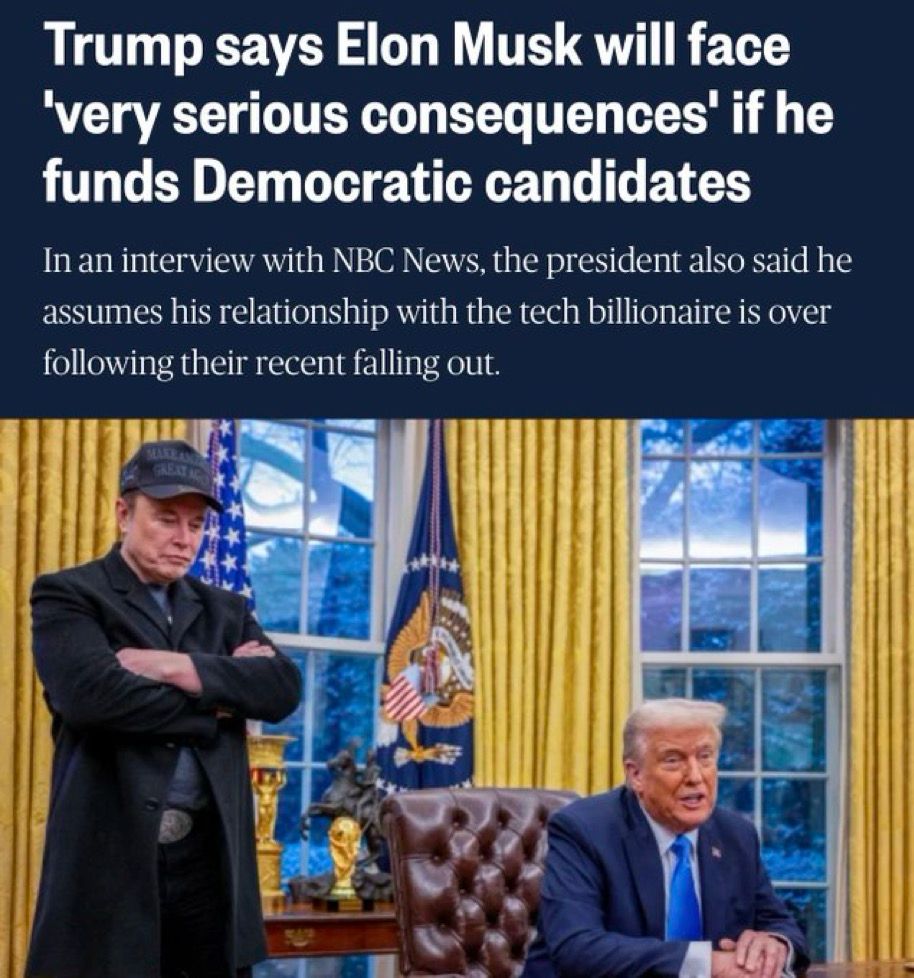
With respect to those government contracts, it is safe to assume that Elon now regrets having called the president a pedophile. This loss of standing puts even more pressure on Musk to make increasingly incredible promises around the remaining two narratives that are still pumping in air.

Musk had to put on some kind of a show, and he especially needed to do something with robotaxis. This was a product he'd been promising for years, and his last event around the it had impressed no one. He needed something that could, by even the broadest stretch of the imagination, qualify as a product launch.

He did have some things working in his favor. Both investors and journalists have shown a tremendous willingness to give him the benefit of the doubt. As long as he came through with the bare minimum, they'd be inclined to even the past—and that's exactly what he did.

 It is difficult to overstate the extent to which the training wheels were on during this demo.

A tiny number of rides in a single, geofenced neighborhood that Tesla had been training on for weeks. Daytime rides —Teslas, being strictly camera-based (unlike Waymo), don't do well at night—with a carefully selected, invite-only crowd of hardcore boosters, an algorithm that avoided difficult routes, a safety monitor sitting in the passenger seat with their hand on the kill switch, and a remote operator ready to grab the controls for teleoperation if something went wrong.

And something certainly did go wrong. The question is will it be enough.


 Chris Isidore writing for CNN.

A small number of company-owned cars were used and they were existing Model Y vehicles — not Cybercabs, which are not yet allowed on roads, let alone produced on a mass scale. It was not even the most extensive robotaxi service in Austin — a joint effort between Uber and Waymo, the self-driving car unit of Google parent Alphabet, has been up and running in Austin since March.

But the Austin test pressed on regardless.

The rides were made available to a select group of Tesla fans, according to Dan Ives, a tech analyst with Wedbush Securities and an effusive Tesla bull, [If Dan Ives were to be trapped in a burning Tesla, his last words would be a "buy" recommendation. -- MP] and Joey Klender, who writes for the site Teslarati.com. Klender and a member of Ives’ team took multiple rides in a Tesla Model Y robotaxi on Sunday.

...

But it was not all smooth sailing, with multiple videos showing the car making mistakes. In one YouTube video, the robotaxi drove on the wrong side of the road after it attempted and abandoned a left turn, only to continue traveling down the street on the opposite side of a double yellow line before making the left turn on the following block. Fortunately, there were no vehicles driving on the other side of the road.

A separate YouTuber posted a video in which the robotaxi kept driving past its destination for several minutes as he tried to get it to pull over so he could get out.

“Please exit safely,” a screen in the rear seat of the car said, as it continued driving down the road. 

...

But the EV maker is playing a game of catch up. Waymo, a unit of Google parent Alphabet, has been providing paid rides since 2020, and now provides more than 250,000 rides a week to paying riders in Austin, Phoenix, Los Angeles and San Francisco. It soon plans to expand the service to Atlanta, Miami and Washington, DC.  


Tesla robotaxi incidents, caught on camera in Austin, draw regulators' attention - @cnbc.com www.cnbc.com/2025/06/23/t... Full statement from the federal vehicle safety regulator, NHTSA, below...

[image or embed]

— Lora Kolodny (@lorak.bsky.social) June 23, 2025 at 4:45 PM

signs of life from NHTSA, in response to video of Tesla's "robotaxi" launch day coming out of Austin today (including mine, apparently) not getting my hopes up, but you love to see it!

[image or embed]

— e.w. niedermeyer (@niedermeyer.online) June 23, 2025 at 5:00 PM

scariest data point out of Austin so far comes from a source familiar with Tesla's team, who says they've been working insane hours (no surprise) and "can't wait to be done so they can go home to California" white-knuckling 10 cars w/"safety riders" in a tiny geofence and talking about being "done"

— e.w. niedermeyer (@niedermeyer.online) June 23, 2025 at 7:28 AM
Given the ratio of support staff to robotaxi, Musk's claim that "Tesla will have hundreds of thousands of self-driving cars in the U.S. by the end of 2026," seems a bit dubious.

Tesla's Potemkin robotaxis out here in Austin giving fake rides to nobody. Just driving into a neighborhood, stopping for a fake pickup, driving 5 minutes, and stopping for a fake drop-off. The "driverless" fleet is no more than 20 cars max, and they can't keep them busy. Winning!

— e.w. niedermeyer (@niedermeyer.online) June 23, 2025 at 8:38 AM

the overriding impression from Austin yesterday is of how insanely far behind Tesla is on robotaxis... Austin is swarming with Waymos, whipping around the place fully driverlessly, covering a much bigger geographical area comparison map via r/selfdrivingcars www.reddit.com/r/SelfDrivin...

[image or embed]

— e.w. niedermeyer (@niedermeyer.online) June 23, 2025 at 6:07 AM

Tesla's robotaxi fleet is tiny, no more than 10-20 vehicles. This one is the exact same vehicle that another influencer rode in (or at least has the same Tesla employee riding along). It still takes a full two minutes to get remote customer assistance to respond! www.youtube.com/live/VtVhlP2...

[image or embed]

— e.w. niedermeyer (@niedermeyer.online) June 23, 2025 at 6:49 AM

Here's video from earlier today, when I caught one of Tesla's "robotaxi" Model Ys braking hard twice on a 35 mph road. Not what you want to see with nobody behind the wheel! youtu.be/GpARr8DVU2M?...

[image or embed]

— e.w. niedermeyer (@niedermeyer.online) June 22, 2025 at 3:16 PM


We need to discuss the concept of "beta"

New Robotaxi influencer clip dropped

[image or embed]

— Rude Law Dog (@esghound.com) June 24, 2025 at 2:53 PM


4) This also happened to Tesla influencer Farzad, who was "dropped off" by his Supervised Robotaxi in the middle of an intersection. Farzad's Supervised Robotaxi then became stuck and blocked the intersection.

[image or embed]

— Dan O'Dowd (@realdanodowd.bsky.social) June 24, 2025 at 10:11 AM

Tuesday, June 24, 2025

Gods or Ashes

Maybe it's the age of the blog, or maybe it's the age of the blogger, but increasingly I find myself going back to revisit or share an old post, only to discover that I never got around to finishing it—or, worse yet, never even got to the draft stage.

Case in point: I could have sworn that I'd written at least a few pieces on the "gods and ashes" trope, but I can't seem to find anything in either the published or draft folders. What's really annoying is that I plainly remember appropriate art and videos I'd put aside for the topic, and now I have no idea where they are.

So, starting from scratch—around 150 years ago, you start finding references in places like Scientific American to the idea that technological progress was not only following an exponential curve, but that we were far enough along the curve that change would soon be coming at an unimaginable rate. From there, it followed that we were approaching some kind of tipping point that could lead either to humanity evolving to a higher level or destroying itself—especially through war.

Sometime in our children's lifetimes, we would be gods or ashes.

You can find examples in the late 19th and early 20th centuries, but the notion didn't really capture the popular imagination until the atomic age. That was when the template was set, and it has been followed ever since. Even as we go from one existential crisis du jour to another—nuclear war, climate change, malevolent AI—each is shoehorned to fit the same story, like remakes that change the cast but stick slavishly to the same plot.

The notion is also inextricably intertwined with the idea to the tech messiah.

Star Trek used it countless times, but the definitive treatment of the post-war era remains Forbidden Planet, a film that holds up remarkably well to this day.


Monday, June 23, 2025

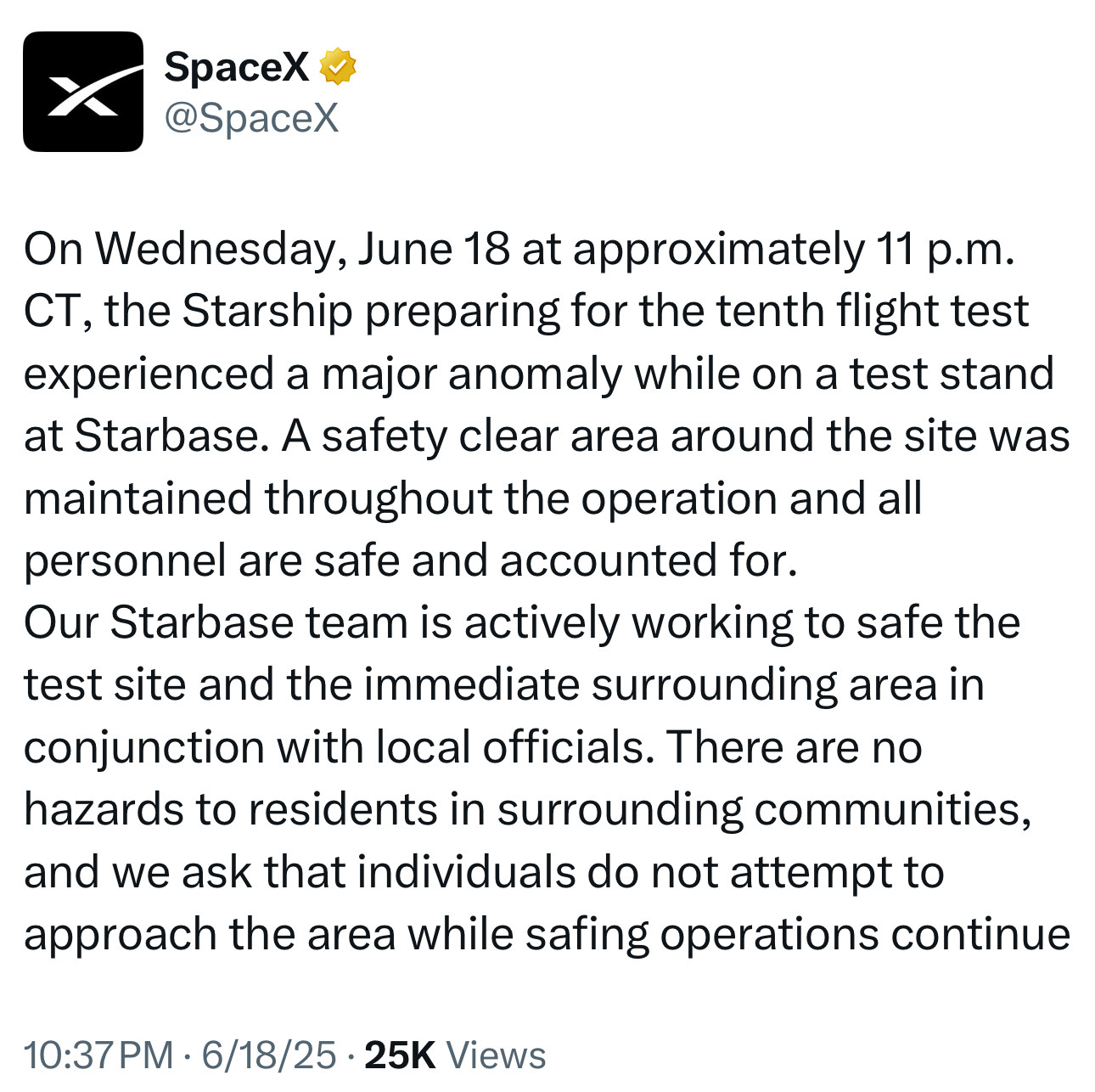
We haven't talked about SpaceX lately


Important note: there would be about 50x as much fuel loaded for a fully stacked launch on the pad, and that SpaceX repeatedly downplayed the chances and size of an on pad failure in order to categorize the project as "insignificant" under NEPA and that @petebuttigieg.bsky.social helped them do this

[image or embed]

— Rude Law Dog (@esghound.com) June 18, 2025 at 10:51 PM


The abundance crowd has been telling us that excessive environmental regulations are holding back innovators like Musk. You have to wonder what lax regulations would look like.

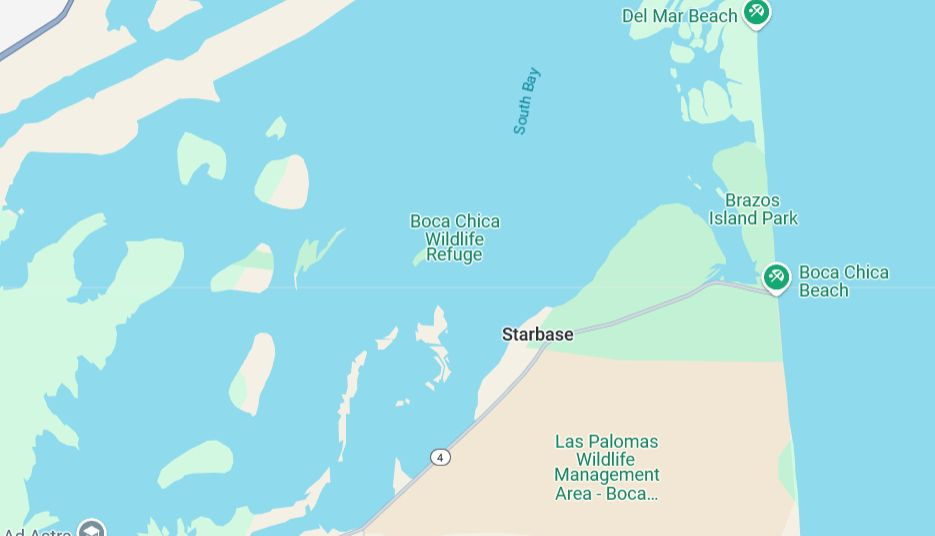
The consequences of actions like these are real, environmental groups say. SpaceX’s launch site is surrounded by a state park and federal wildlife refuge home to hundreds of of thousands of shorebirds, sea turtles and other species. Biologists say the company’s Starship launches are having a measurable impact. A recent report documented how SpaceX’s last launch destroyed nests of a vulnerable population of shorebirds


That's a high price to pay for a type of launch vehicle that's looking more and more like a dead end.

More than two weeks before the latest explosion, engineer turned journalist Will Lockett wrote a withering post on the state of the program. 

Okay, but I can already hear the Musk fans pearl-clutching and screaming, “We learn from failure!” Fair enough. Let’s look at the lessons we can glean from these results.

Firstly, why did SpaceX try a new landing path for Super Heavy, even though they have successfully landed it multiple times? Well, weight. Starship weighs far too much, meaning its possible payload is vanishingly small, and its engines are being overstressed (hence the constant engine failures). SpaceX must make Starship lighter for it to even have a chance of being functional. The heaviest component of a rocket, particularly a self-landing one, is fuel. In fact, there is a double weight-saving opportunity there, but we don’t have time to go into that today. Super Heavy Booster’s previous landing relied almost entirely on retrorockets, making it predictable but incredibly fuel-hungry. This new path attempted to replace the bulk of that fuel requirement with atmospheric drag by allowing the rocket to fall to Earth in a belly flop position, which is far less predictable but much more fuel-efficient. This reduced the fuel requirement and caused the rocket to be significantly lighter.

That was, until the rocket broke up, meaning that it could not handle the stress of this belly flop manoeuvre. Furthermore, it broke apart after its retrorockets reignited, which also suggests that they may have failed, implying that these engines might be pushed too hard to be reliably reused. So the lesson we can take away from this teachable moment is that Super Heavy Booster and its engines need to be heavily reinforced to survive such a landing (especially if it is to be reused, as planned), but doing so would add enough weight to render the entire exercise moot. So, really, the lesson here is that you meet a dead end when you try to make the first stage lighter.

...

SpaceX still has a long way to go before Starship becomes a viable launch vehicle. It still has to successfully land the upper stage, reuse an upper stage, reach orbit, deliver a payload to orbit, reach a useable payload capacity, conduct a cryogenic fuel transfer between two starships in space (which has never been done before), perform a successful long-duration flight test, conduct a successful uncrewed lunar landing and conduct a crewed lunar landing. All of which, for context, was meant to be achieved by January 2025! Nearly all of Starship’s paid contracts are for human spaceflight to the Moon, which requires repeated orbital refuelling and human spaceflight certification. Orbit refuelling is incredibly difficult, and in order to become human spaceflight certified, SpaceX needs to prove that they can successfully land the upper stage almost 100% of the time. It has taken them nine failed attempts and almost $10 billion for Starship to not reach orbit with a fraction of its promised payload and to never land an upper stage or successfully reuse a first stage. How many test flights, dollars and years will it take to actually get this hunk of junk working?

I know I always say this, but it is an important comparison. After nine launches, Saturn V only had one partial, non-destructive failure and had taken three crews to the lunar surface. Sure, it was a less complex rocket than Starship, but NASA achieved this using technology from the 1960s that was much less reliable and accurate. However, here’s the thing: Musk is currently claiming that Starship will somehow reach a payload of 45 tonnes (which is three times what Flight 9 failed to deliver to orbit and less than half of what was promised). That means a lunar starship would need refuelling 33 times in orbit before it can go to the Moon. Even if we assume Starship can be fully reused, that would put the price of a Starship lunar launch at $2.38 billion. Yet, the Saturn V launched 50 tonnes to the Moon for only $1.8 billion in today’s dollars, and that includes development costs spread over its 13 launches (read more here).

Recently, Musk has been talking about skipping the moon and focusing on Mars. As far as I can tell, he has not, however, been talking about giving back the money he took for Artemis. 


Friday, June 20, 2025

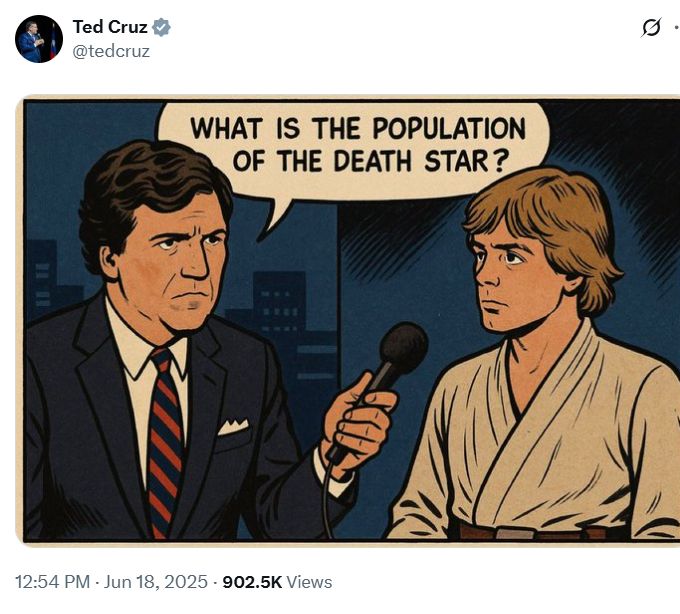
If you were wondering why liberals have been reluctantly saying nice things about Tucker Carlson

I highly recommend that you watch these clips, no matter how you feel about either of these men.

Carlson runs circles around Cruz in these clips—which shouldn’t be easy. Though Ted Cruz is famously one of the most despised men in Washington, even in his own party, virtually everyone admits he is a brilliant debater. And yet, he walked into this interview completely unprepared. While, for all we know, this could be a story of distractions at home or a reaction to cold medicine, the smart money so far has been speculating that he did not realize the buzzsaw he was walking into.

Tucker Carlson and Ted Cruz on Israel and theology.

[image or embed]

— Yashar Ali 🐘 (@yasharali.bsky.social) June 18, 2025 at 9:53 AM

WATCH: “You’re a U.S. senator and you don’t know anything about the country you want to topple.” Tucker Carlson embarrasses @sentedcruz as he pushes for war with Iran

[image or embed]

— The Tennessee Holler (@thetnholler.bsky.social) June 17, 2025 at 6:17 PM


For about as long as we've had this blog, I've been meaning to write a post arguing for a moratorium on social science research using the idea of a left–right political spectrum. If you sat down and tried to come up with a metric that was badly defined, uninformative, and created an illusion of understanding, you'd be hard-pressed to come up with anything worse—and if you were looking for the worst possible place to apply this metric, it would be on the issue of war.

Over the past century, we've gone through pretty much every possible permutation involving conservatives, liberals, and the left—including my personal favorite in the late ’30s, when liberals were pro-war, and leftists and conservatives were isolationists.

If that weren't enough, you frequently have periods where the divisions are remarkably bitter but are primarily found within ideological groups.

Especially since the Iraq War, the naïve tendency to equate anti-war with “liberal” has led to some often disastrous results—giving figures like Ron Paul and Tulsi Gabbard an illusion of being something special, and obscuring the role that the anti-war movement played in the rise of Trump.

Trump’s anti-war positions were always more opportunistic than anything else, as Josh Marshall points out here:

The idea that Trump or MAGA is in any sense “anti-war” is something between an absurdity and a misunderstanding. Kate and I had a good discussion of it in this week’s podcast. At one level it’s a simple fraud. Trump claimed he’d always been against the Iraq War at a time when the U.S. had been bogged down in Iraq and Afghanistan for years. It was a helpful attack line and it was completely false. Trump wasn’t in politics in 2002 or 2003 and to the extent he said anything, like a lot of people, he was for it when it was popular and against it when it wasn’t.

During his presidency he signed off on the assassination/targeted attack that killed Qasem Soleimani; he heavily involved the U.S. in the Saudi war in Yemen; he maintained or expanded the U.S. fight against ISIS in Iraq/Syria. Those are at least a continuity with the Obama years and in key respects an expansion of it. The one arguable exception is the deal Trump made with the Taliban to leave Afghanistan — a bad deal which Joe Biden was saddled with and followed through on and was endlessly criticized for, by Trump more than anyone else. Afghanistan captures Trump perfectly — his one notionally “anti-war” position was continuity by definition. And he turned against it as soon as he was unpopular. Trump has gotten “anti-war” mileage out of his opposition to Ukraine aid. But that’s pro-Russia rather than anti-war.

So the entirety of Trump’s anti-war-ness is a fiction and one he’s been remarkably adept at selling to a huge swath of the political and journalistic community. He came into politics at a moment of profound public fatigue with unending military commitments in Afghanistan and Iraq and simply passed himself off as against what everyone was sick of. That’s just a subset of most of the rest of Trump’s politics: he’s the diehard against whatever is unpopular and vice versa, rinse and repeat ad finitum, or until the public mood changes.


But that doesn’t mean that the anti-war movement on the right isn’t real, or that it’s trivial or easily dismissed.

One of the many complications here is the extent to which Putin has come to influence MAGA and the Republican Party of 2025, with a significant segment feeling considerable personal loyalty to the Russian dictator. While the situation is enormously complex and opaque, it’s probably worth noting that two of Putin’s most reliable hand puppets—Carlson and Gabbard—have both been on the "leave Iran alone" side.

Does this make it more or less likely that Trump will get us into another war?

Yes.

Thursday, June 19, 2025

Protests and Parades: The Dog That Did Not Bark

We've been going at this thread for a little while, and I'm afraid that if I were reading it rather than writing it, I might be starting to lose patience. At the very least, I'd be asking: What's the point?

That's a difficult question to answer. I certainly don't want to have this interpreted as a broad and simplistic statement about where the country is now. There's nothing simple about this, and it would be a huge mistake to use these protests—however historic—as the basis for some theory about where the country is and where it's headed. By the same token, however, it would be a possibly even worse mistake to formulate theories that ignore the events happening outside your own window.

What are some of the things that a comprehensive theory would take into account? As previously discussed, there's the fact that much of the national press—led by The New York Times and The Washington Post—largely ignored what may be the largest peaceful protest in American history. If you're trying to understand the relationship between establishment media and the rise of MAGA, this is certainly a significant data point. Likewise, your explanations need to allow for both the magnitude and the distribution of the protests. If you're going to tell a Country Mouse, City Mouse tale, it needs to allow for a surprisingly large number of country mice on an unexpected side.

There's one more thing we should add to this list. In addition to what happened and where it happened, we also need to pay attention to what didn't happen. Even in the most solidly red districts, there does not appear to have been significant, organic counter-protests. There were the usual paramilitary groups like the Proud Boys and Patriot Front trucked in (in some cases literally). There were, based on published accounts and from what I've heard from friends, one or two disgruntled Trump supporters in places like Atlanta, either grumbling or trying to shout down the crowds. There were lone wolves carrying firearms, and in some cases committing acts of violence.

But I haven't found any accounts of large groups of local Trump supporters forming any kind of substantial counter-demonstrations, even in the reddest of red districts. Did they happen at all? Quite probably. But we can say with some confidence that they were rare.

What does it all mean? I have no idea. I'm not even prepared to advance any theories. All I'm willing to say at this point is that it's surprising and notable—and when the dust settles and we all start telling ourselves stories about what happened back in 2025, we need to make sure those stories include all the significant events and, in this case, non-events—even if they didn't make the front page of The New York Times.


Wednesday, June 18, 2025

Protests and Parades: What do you expect from hotbeds of liberalism like Mississippi, Arkansas, and Oklahoma?

Most of the national media has, at best, a barely concealed disinterest in rural and small-town America. There are exceptions—James Fallows is superb, Marketplace does a very good job, and NPR, partially due to its reliance on member stations to help with reporting, is well above average in general. But you can usually count on places like The New York Times to miss the nuances.

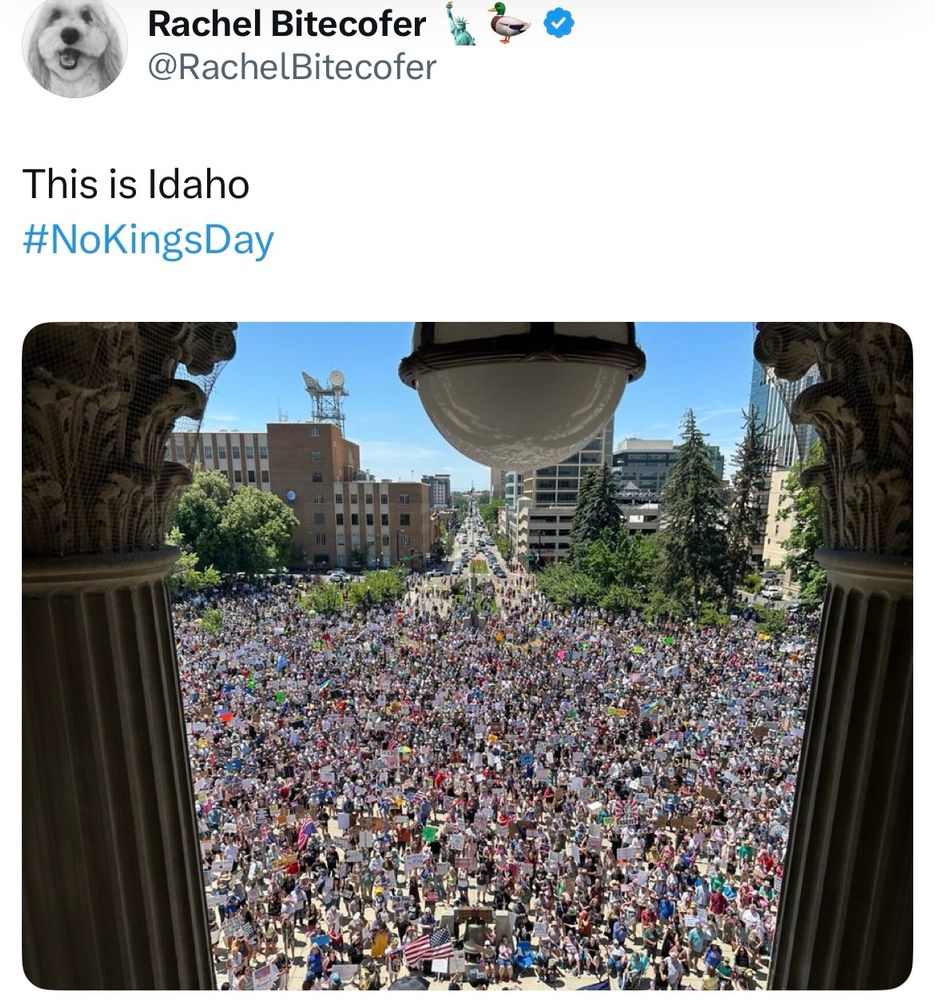
Just knowing the state doesn’t tell you much. There are some reliably Democratic parts of Texas and some extremely red parts of California. You have to go more granular, and look at urban density, demographics, and particularly voting records. With all that in mind, if you look over the map of protests, the most striking thing might well be how well represented they are in unexpected places.

Big cities in red state might tend to run left of the median.

The #NoKings march in Dallas, Texas is HUGE!

[image or embed]

— Dr. Lucky Tran (@luckytran.com) June 14, 2025 at 1:14 PM

Nashville. #NoKings

[image or embed]

— Rikard Vilhelm (@rikardvilhelm.bsky.social) June 14, 2025 at 8:54 AM

Shortly after the Atlanta #nokings event kicked off at 10, organizers said Liberty Plaza near the state Capitol had already reached maximum capacity of 5,000.

[image or embed]

— journalistross.bsky.social (@journalistross.bsky.social) June 14, 2025 at 7:10 AM
But we're seeing a lot of protests where you very much would not expect them.

Why protest on Saturday? www.headsupnews.org/p/no-kings-p...

[image or embed]

— Dan Froomkin/Press Watch/Heads Up News (@froomkin.bsky.social) June 12, 2025 at 7:31 AM


Photos: Protests break out across Arkansas as part of 'No Kings' movement #NoKings www.5newsonline.com/article/news...

[image or embed]

— Saigonbond (@ogsaigonbond.bsky.social) June 14, 2025 at 4:34 PM

Little Rock's #NoKings march and rally has wrapped up. A few thousand demonstrators lined up before 10 a.m. to walk across the Broadway Bridget to North Little and back for a rally in a riverside park behind the Old State House. One of 15 planned in Arkansas today. @ainsleyplatt.bsky.social

[image or embed]

— Arkansas Advocate (@arkansasadvocate.com) June 14, 2025 at 11:31 AM

Thousands march in Fayetteville, Arkansas, for preserving our Democratic Republic and ensuring No Kings. fayettevilleflyer.com/2025/06/14/n...

[image or embed]

— Lucy Burns (@lucyburns.bsky.social) June 14, 2025 at 5:15 PM


While counter protesters may have shown up where you'd expect them, their numbers have mostly been tiny.

Huge turnout at the #NoKings rally in Hattiesburg, Missisisppi today, wrapping up and down both sides of the streets around City Hall. I'd estimate that about 300 people showed up, along with 2 pro-Trump counter-protesters.

[image or embed]

— Ashton Pittman (@ashtonpittman.bsky.social) June 14, 2025 at 10:38 AM

Our little East Texas town had about 200 "No Kings" protestors and across the street, wrapped in their Trump flags, 2! It was fabulous!

— Marcia Thill (@marcia46.bsky.social) June 14, 2025 at 12:49 PM

If you're not familiar with California, you probably have no idea how red the Central Valley is (a mistake I've seen the NYT make numerous times). 

The "No Kings" protest has mostly wrapped up in Bakersfield as of Saturday afternoon, many protesters staying to march together after the event ended at around 1 p.m.

[image or embed]

— KGET 17 News (@kgetnews.bsky.social) June 14, 2025 at 2:50 PM

Oklahoma (where I went to graduate school) got surprisingly large crowds despite thunder storms.

As did Arizona despite triple digit temperatures. 

Some paramilitary Trump supporters tried to crash the parties but they weren't prepared for the size and enthusiasm of the crowds.

About 660 attended the No Kings rally here in Kingwood, Texas, that lasted for three hours this morning. About a dozen masked Patriot Front members held a counter protest for 15-20 minutes.

— Mike Fast (@fastballs.bsky.social) June 14, 2025 at 1:40 PM

Nazi's, I mean Patriot Front, showed up at Springfield's Ozarks PrideFest/No Kings Protest. Locals and security kept these cowards out of the event. Probably saved their lives by doing that because we aren't here to play games.

[image or embed]

— Angela Crawford (@angeloftheozarks.bsky.social) June 15, 2025 at 7:50 AM


The support for the BLM protests was surprisingly broad, but this takes things to another level. And no place illustrates that better than Harrison, Arkansas—often called the most racist town in America.

(Harrison was also the center of anti-Confederate sentiment in the Civil War, but that's another stor and another thread.)

In one notorious incident, a filmmaker from L.A. stood in Harrison with a Black Lives Matter sign for 10 hours, during which he received a constant stream of abuse, profanity, and threats. That should give you some context for this.

Same town. Harrison, AR, a town that has a White Power radio station, had 200 people show up for No Kings. This is town is ground zero for the Klan. More blown away by this than I ever will be by the millions turning out anywhere else.

[image or embed]

— Angela Crawford (@angeloftheozarks.bsky.social) June 15, 2025 at 11:50 AM

Same for small Harrison, Arkansas! About 250-300 “No Kings” protesters with maybe five pro-Trump! Made me so proud! Now if people would vote like their lives depended on it because it does!💚

— Kerri (@arkiemycohiker.bsky.social) June 14, 2025 at 2:43 PM

For the record, I'm not saying that white supremacist enclaves have suddenly rejected MAGA. What's going on here is complicated and worthy of study. I'm not going to speculate too deeply on what it is, except to say that at this point, opposition to Trump—be it on the grounds of democracy, immigration, or the slashing of the social safety net—can be found pretty much anywhere you look in the summer of 2025.


Tuesday, June 17, 2025

Protests and Parades: just a reminder that the NYT gave more coverage than this to a literal dog-bites-man story

[First installment on our promised thread.] 

 When I was an undergrad back in Arkansas, a journalism professor who also happened to be a retired veteran newsman told the story about an incident in the northern part of the state. This would have been in the 50s or 60s, back when every decent-sized town had one or two daily papers. The sheriff and the mayor had gotten into an altercation that had led to one shooting the other in the middle of the day on the main street of town.

The following day, the paper mentioned the shooting briefly on the third page.

This was very probably the biggest thing that had ever happened in this town. Everybody knew both the killer and the victim. It was certainly discussed throughout the region for ages, but it was not something the editor wanted to talk about. It was unquestionably news; it just wasn't news the editor wanted to talk about.

I can vouch for my source here, but this is still an unverified anecdote, so you should feel free to take it with a grain of salt. Fortunately, I have a wealth of supporting evidence for an example of something very similar and quite recent.

There is no longer ONE WORD about yesterday's MASSIVE protests on the NYT home page. But a whole section about the miserable, misbegotten parade. SHAME!

[image or embed]

— Dan Froomkin/Press Watch/Heads Up News (@froomkin.bsky.social) June 15, 2025 at 10:49 AM

The Tea Party protests in April 2009 had about a third of a million people involved, and the political media treated it like a game changer for the Obama presidency. The No Kings rallies were AT LEAST ten times bigger than the Tea Party protests. Will the press keep pretending Trump is popular?

[image or embed]

— Kevin M. Kruse (@kevinmkruse.bsky.social) June 15, 2025 at 7:44 AM

Originally, even CNN made a point of stressing they were a Fox News stunt and then just absorbed their self serving stories bsky.app/profile/csha...

[image or embed]

— Kevin M. Kruse (@kevinmkruse.bsky.social) June 15, 2025 at 8:05 AM


I count 49 news headlines on the NYT mobile app home page right now, not including opinion, sports or cooking. None of them are about the massive protests yesterday.

— Joseph Menn (@joemenn.bsky.social) June 15, 2025 at 10:30 AM


 Though written days before the No Kings event, this column is remarkably relevant. 

When hundreds of thousands of Americans gathered across the US on 5 April for the “Hands Off” events protesting Donald Trump and Elon Musk’s governmental wrecking ball, much of the news media seemed to yawn.

The next day, the New York Times put a photograph, but no story, on its print front page. The Wall Street Journal’s digital homepage had it as only the 20th-most-prominent story when I checked. Fox News was dismissive; I stopped counting after I scanned 40 articles on its homepage, though there was a video with this dismissive headline: “Liberals rally against President Trump.”

The Guardian, CNN and some local news outlets paid more heed. The cable network offered live video from many American cities and a banner headline: “Millions of people protest against Trump & Musk.”

But overall, there was something of a shrug about the media coverage. It got much more attention from global news outlets than in the US.

The US media will get a chance to atone for these sins of omission this coming weekend when Americans once again get together, this time for Saturday’s “No Kings” day, which organizers describe as “a nationwide day of defiance”.

About that atonement.

Why is this piddly-ass parade a two-day story when the most massive protest of the Trump era is a one-day story? (WaPo for instance has 5 parade items on home page, 0 about NO KINGS)

— Dan Froomkin/Press Watch/Heads Up News (@froomkin.bsky.social) June 15, 2025 at 6:53 PM

 Back to Sullivan.

However, if journalists consistently look the other way, the power of peaceful citizen protests can fade.

In my American Crisis newsletter two days after the 5 April protests, I offered a few theories for why the media may seem so blasé.

First, I posited, much of the mainstream media tend to view this much as Fox News does. The protesters are just the usual suspects – “liberals” – doing the predictable thing.

Second, many large media companies are afraid that prominent protest coverage will be criticized by the political right as partisan, and they can’t bear that label.

Third, corporate media decision-makers, always focused the bottom line, are fearful of losing right-leaning readers and viewers; yes, we’ll cover this, they seem to say, but quietly, since we don’t want to antagonize anyone. In an era in which Trump has attempted to bully the press into submission, through denying access and through lawsuits, cowardice and capitulation are all too common.

 Coming up...


What do you expect from left-wing hotbeds like Mississippi, Arkansas, and Oklahoma?

About that 3.5% rule.

The Dog that Didn't Bark.

The Schadenfreude Parade


Monday, June 16, 2025

Protests and Parades: Overview of a Thread

Started working on this Saturday evening and soon realized I was going to have way more than a single post’s worth. We’ll be dividing this up into bite-sized chunks over the next few days, but to get it started, here is an overview along with a few articles, quotes, images, general points, and whatever the hell you call tweets on Bluesky.

 The 3.5% Rule

This one's been making the rounds for a little while now. It basically says that once you pass a threshold of three and a half percent of the population engaged in non-violent protest, the government in question will fall. Loads of problems with this from a statistical and poli sci standpoint. If you want to get up to speed on the research, this BBC report is recommended.

From a new interview with @chenoweth.bsky.social, who coined the "3.5% rule": "Most of the movements in our database never got to that threshold and still won with like 1.8% or something like that." podcasts.apple.com/us/podcast/t...

[image or embed]

— Joshua J. Friedman (@joshuajfriedman.com) June 15, 2025 at 10:04 AM

While we can go back and forth about the rule itself, Margaret Sullivan's take on the journalistic ethics of downplaying these protests is characteristically solid.


Sullivan wrote her piece a few days ago, before things got really embarrassing for The New York Times, The Washington Post, and the rest. More posts coming on this, but TL;DR:

Genie: ok what do you want for your birthday Trump: a military parade, oh, and also millions of people on the street chanting my name Genie: okie dokie

— Pwnallthethings (@pwnallthethings.bsky.social) June 14, 2025 at 4:40 PM

The protests were historic. The parade was humiliating.

Elliott Morris—who was always good and seems to have gotten even better now that he doesn't have ABC executives looking over his shoulder—has been working with the No Kings numbers and has come to some striking conclusions.

Our unofficial crowdsourced estimate of yesterday’s protest turnout is rising to 4.2-7 million as we gather more data. At this point potentially the second-largest single day of protest in U.S. history! www.gelliottmorris.com/p/no-kings-d...

[image or embed]

— G Elliott Morris (@gelliottmorris.com) June 15, 2025 at 10:07 AM


Morris is one of the best people in the field, and I'm inclined to trust his numbers. But even if he's wrong, we can be fairly certain he did a better job than the paper of record.

(I suppose they didn’t say how many thousands.)

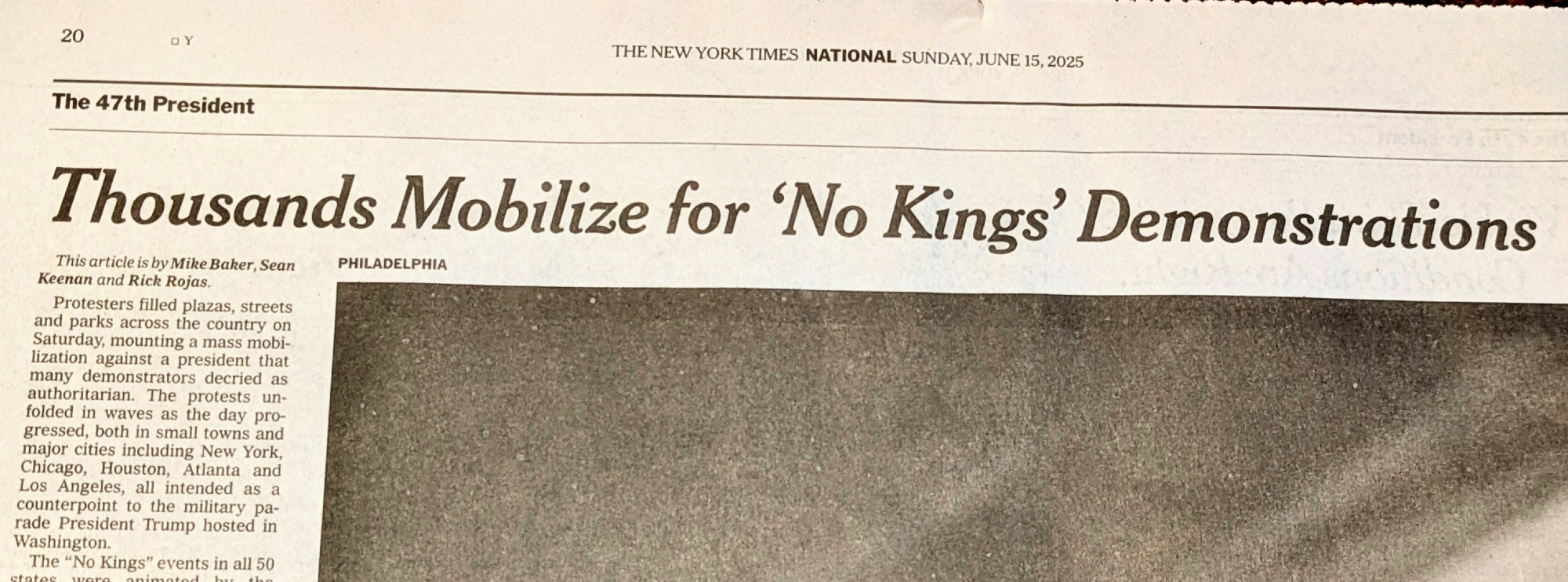
The coverage of the No Kings demonstrations—particularly compared to the far smaller and almost entirely astroturfed Tea Party protests of a few years ago—reveals a double standard that even I find surprising, and this is by no means my first rodeo.

There is no longer ONE WORD about yesterday's MASSIVE protests on the NYT home page. But a whole section about the miserable, misbegotten parade. SHAME!

[image or embed]

— Dan Froomkin/Press Watch/Heads Up News (@froomkin.bsky.social) June 15, 2025 at 10:49 AM

The Tea Party protests in April 2009 had about a third of a million people involved, and the political media treated it like a game changer for the Obama presidency. The No Kings rallies were AT LEAST ten times bigger than the Tea Party protests. Will the press keep pretending Trump is popular?

[image or embed]

— Kevin M. Kruse (@kevinmkruse.bsky.social) June 15, 2025 at 7:44 AM

Originally, even CNN made a point of stressing they were a Fox News stunt and then just absorbed their self serving stories bsky.app/profile/csha...

[image or embed]

— Kevin M. Kruse (@kevinmkruse.bsky.social) June 15, 2025 at 8:05 AM


Why is this piddly-ass parade a two-day story when the most massive protest of the Trump era is a one-day story? (WaPo for instance has 5 parade items on home page, 0 about NO KINGS)

— Dan Froomkin/Press Watch/Heads Up News (@froomkin.bsky.social) June 15, 2025 at 6:53 PM


The New York Times and The Washington Post have also been bending themselves into Gordian knots trying to avoid saying the obvious about Donald Trump's birthday party.

Our military deserves better than this empty charade. Yikes. The tank squeaking over silence is incredible.

[image or embed]

— The Tennessee Holler (@thetnholler.bsky.social) June 14, 2025 at 5:37 PM

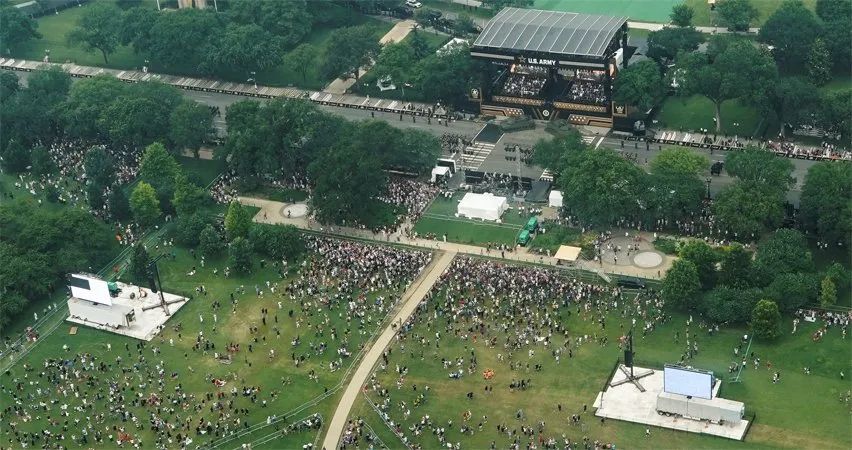
You can see my thread on Bluesky comparing the techniques used by The Washington Post to make the parade look well-attened to the low-budget filmmaking tricks of Roger Corman protégés trying to make a dozen extras look like a crowd of thousands.

(NPR had a huge advantage here, since they didn’t actually have to find pictures and could simply misrepresent through audio.) 

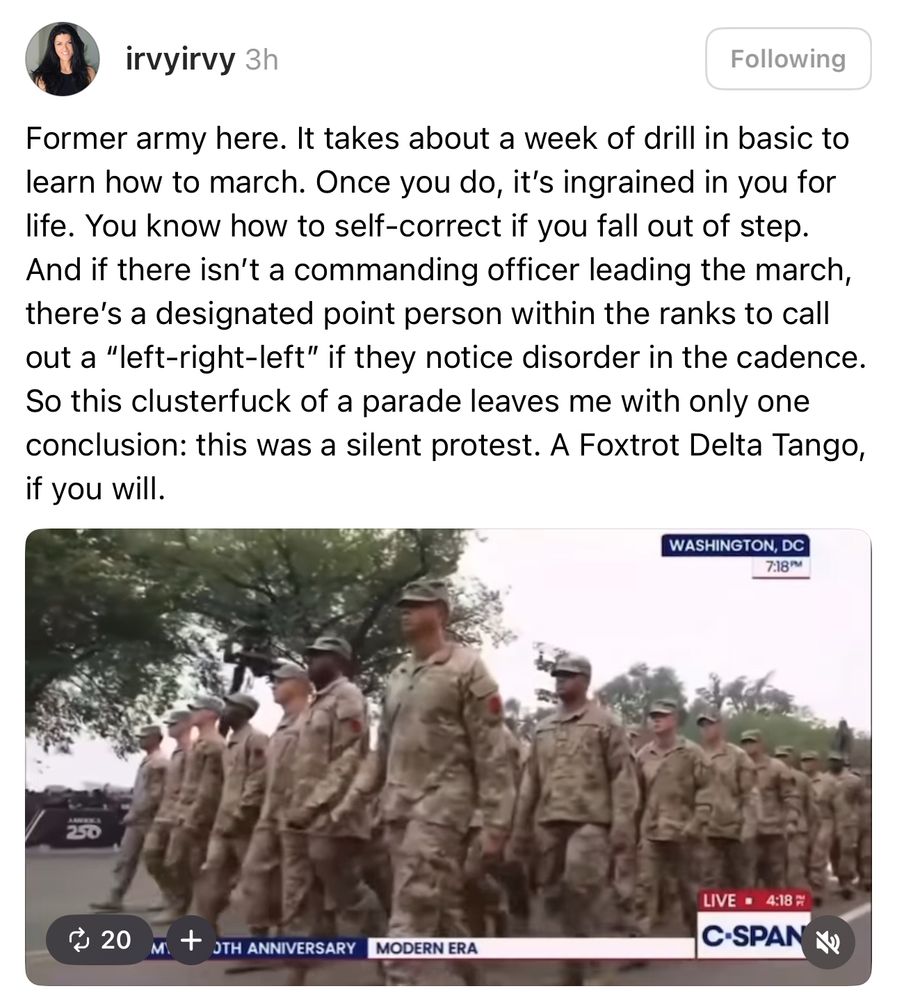
Perhaps my favorite “Who you gonna believe, me or your lying eyes?” moment came when the news showed clips of soldiers making almost no effort to stay in step. While the voice-overs talked about impressive military displays, the actual visuals suggested soldiers who were either disinterested or were actively looking to show their disapproval.

 Rolling Stone, on the other hand, seems to be getting back to its anti-establishment roots.

Corporate America did its part. “Special thanks to our sponsor Lockheed Martin,” the MC said around 6:30 p.m., shouting out America’s biggest defense contractor. The MC later thanked “our special sponsor Coinbase,” the cryptocurrency exchange. President Trump sure loves crypto — he reported in his financial disclosure Friday that he made $57 million in the final months of 2024 after he and his family launched their own crypto exchange, World Liberty Financial. (That was before he launched his own $TRUMP meme coin.) 

Around 7 p.m., the big screens onstage that displayed the American flags turned to logos for UFC, the mixed martial arts business. Later, the MC thanked “special sponsor Palantir,” a contractor hired to help Trump compile data on Americans across federal agencies. 

More to talk about later, but this should keep you busy for now.


Friday, June 13, 2025

Giving Patrick Boyle the last word on Musk v. Trump


As always, I feel slightly guilty about posting excepts from these transcripts (they're never as good without Boyle's delivery), but here are a few highlights.

[Proofed and reformatted by ChatGPT]


The biggest sign that things would not last of course was the  Jim Cramer tweet.  Once Cramer said he was bullish on the friendship, you could basically set your  watch to it knowing that disaster was looming.


Now, I hate to say this – but if Musk is right in saying that he made Trump – Trump should probably be a little bit nervous – as it has become somewhat noticeable over the years that everything Elon Musk makes – burns to the ground.


Judged on sales alone, the Cybertruck has been more of a flop than the Edsel – and that is a big deal, because the Edsel has gone down in history as an enduring icon of failure in the automobile industry. According to Encyclopedia Britannica, ineffective marketing, flawed design, a high purchase price, and poor workmanship led to “consumer blowback” when the Edsel was released in 1957. While Ford had planned to sell 200,000 Edsels a year, they only managed to sell 63,000 cars and had to scrap the new brand entirely two years later.

Elon Musk predicted that he would sell 250,000 Cybertrucks in the first year – after all, he had taken a million deposits – but Tesla ended up selling just under 50,000 Cybertrucks. The failure could possibly be blamed on ineffective marketing, a flawed design, a high purchase price, poor workmanship, and general fugliness – but none of this actually mattered – as, despite the decline in sales, Tesla stock rose 62.5% and hit an all-time high in 2024.

I asked Grok – Elon Musk’s chatbot – why the stock had gone up so much despite all of the bad news and the corporate underperformance. I figured Grok would be the best person – or graphics card – or whatever it is – to ask, as Elon Musk has described it as being “scary smart.” Grok explained to me that despite a decline in Tesla's vehicle deliveries, Tesla stock surged because of Elon Musk's political influence and because of optimism about Musk's close ties to Donald Trump and his advisory role within the U.S. government.

Grok said that investors were betting that Musk’s influence in government could lead to favorable regulatory changes for his businesses.

Now, I had to ask Grok if it thought that the investors had been foolish in their optimism, and it told me that “their enthusiasm looks like it was riding more on hope than on grounded reasoning.”

I wasn’t really sure about the ethics of the whole situation either, so I asked Grok if it thought that this was an example of crony capitalism – and it replied yes…

I’ll tell you – life has gotten a lot easier now that I can outsource my morality to a graphics card.


Thursday, June 12, 2025

Yes, you can also count this as a recommendation

 I recently read (and took notes and reread numerous passages from) Edmund Morris’s biography of Edison, so you will be hearing quite a lot about it here on the blog over the next few weeks.


Though it got very good reviews, one aspect of the book that threw a number of critics was the reverse chronology. The prologue to the book was a short chapter on the death of Edison. The next chapter discussed the final decade of his life, with the title Botany (every chapter was titled after the field of science that Edison was focused on at the time).

One of the things I liked about this backwards telling of Edison's story is that we are introduced to the man not through his early and spectacular successes, but through arguably the greatest failures of his career: the disastrous mining operation that cost him his fortune, the attempt to be the first to create a viable system of talking pictures, his plan to bring military research into the 20th century, and his search for a viable native alternative for rubber production.

What's notable is that, though deeply flawed, all of these ideas were good—even great—and often remarkably prescient.

His innovations in automating mining did have an effect on the industry, and the advances he made in the production of cement had a huge impact on the construction industry, including providing much of the raw materials for Yankee Stadium. The only problem was that no level of innovation could overcome the cheap and superior ore recently discovered in the West.

When it worked, his talking picture system was, if anything, superior in sound quality to what came a decade later. Unfortunately, it didn't work that often. As with Langley's steam-powered planes, the work was impressive, but it was simply the wrong approach.

While the specific technology (all defensive—that was his one rule) that he and his team came up with during World War I was clever and often anticipated major advances of the next two or three decades, it was his plans for a massive, civilian-controlled research and development lab—in many ways DARPA decades before DARPA—that are truly remarkable and represent an incredible missed opportunity. It turned out the navy wasn't all that eager to be reformed.

Edison's last great project had him move into the entirely new field of botany, throwing himself in with characteristic energy and focus despite advanced age and failing health. His research was top-notch, showing that even in an area as far removed as could be imagined from electrical or mechanical engineering, he could set up top tier R&D teams. As with mining, however, Edison ran into the hard truth that no amount of innovation can overcome competitors with a better supply of a cheaper product. In this case, it was the one-two punch of the rubber cartels never making their anticipated production cuts, followed a few years after Edison’s death by the development of synthetic rubber, that doomed the idea of American-based production. Somewhat ironically, Edison himself was on record for decades having predicted that synthetic materials and fibers would soon replace most natural materials.

Wednesday, June 11, 2025

"A company for laying out plans to ship 100 million AI “companions” that will become a part of everyday life, but nobody to know what they are"

From Ed Zitron's newsletter:

So, now that we've got that out the way, here's what we actually know — and that’s a very load-bearing “know” — about this device, according to the Wall Street Journal:

OpenAI Chief Executive Sam Altman gave his staff a preview Wednesday of the devices he is developing to build with the former Apple designer Jony Ive, laying out plans to ship 100 million AI “companions” that he hopes will become a part of everyday life.

...

Altman and Ive offered a few hints at the secret project they have been working on. The product will be capable of being fully aware of a user’s surroundings and life, will be unobtrusive, able to rest in one’s pocket or on one’s desk, and will be a third core device a person would put on a desk after a MacBook Pro and an iPhone.

The Journal earlier reported that the device won’t be a phone, and that Ive and Altman’s intent is to help wean users from screens. Altman said that the device isn’t a pair of glasses, and that Ive had been skeptical about building something to wear on the body. laying out plans to ship 100 million AI “companions” that he hopes will become a part of everyday life.

And from the blog eight years ago.

Wednesday, July 26, 2017

"A company for carrying on an undertaking of great advantage, but nobody to know what it is."

Another excerpt from Charles Mackay's  Extraordinary Popular Delusions and the Madness of Crowds. I believe "a company for carrying on an undertaking of great advantage, but nobody to know what it is" was an initial business plan for Groupon.


Some of these schemes were plausible enough, and, had they been undertaken at a time when the public mind was unexcited, might have been pursued with advantage to all concerned. But they were established merely with the view of raising the shares in the market. The projectors took the first opportunity of a rise to sell out, and next morning the scheme was at an end. Maitland, in his History of London, gravely informs us, that one of the projects which received great encouragement, was for the establishment of a company "to make deal-boards out of saw-dust." This is, no doubt, intended as a joke; but there is abundance of evidence to show that dozens of schemes hardly a whir more reasonable, lived their little day, ruining hundreds ere they fell. One of them was for a wheel for perpetual motion—capital, one million; another was "for encouraging the breed of horses in England, and improving of glebe and church lands, and repairing and rebuilding parsonage and vicarage houses." Why the clergy, who were so mainly interested in the latter clause, should have taken so much interest in the first, is only to be explained on the supposition that the scheme was projected by a knot of the foxhunting parsons, once so common in England. The shares of this company were rapidly subscribed for. But the most absurd and preposterous of all, and which showed, more completely than any other, the utter madness of the people, was one, started by an unknown adventurer, entitled "company for carrying on an undertaking of great advantage, but nobody to know what it is." Were not the fact stated by scores of credible witnesses, it would be impossible to believe that any person could have been duped by such a project. The man of genius who essayed this bold and successful inroad upon public credulity, merely stated in his prospectus that the required capital was half a million, in five thousand shares of 100 pounds each, deposit 2 pounds per share. Each subscriber, paying his deposit, would be entitled to 100 pounds per annum per share. How this immense profit was to be obtained, he did not condescend to inform them at that time, but promised, that in a month full particulars should be duly announced, and a call made for the remaining 98 pounds of the subscription. Next morning, at nine o'clock, this great man opened an office in Cornhill. Crowds of people beset his door, and when he shut up at three o'clock, he found that no less than one thousand shares had been subscribed for, and the deposits paid. He was thus, in five hours, the winner of 2,000 pounds. He was philosopher enough to be contented with his venture, and set off the same evening for the Continent. He was never heard of again


Tuesday, June 10, 2025

Closing thoughts on Trump vs. Musk

This exchange with Andrew Gelman in the comment section for Friday's post is already pretty much a post. After seeing my reply, Andrew directed me to his post from earlier this year which discusses a similar dynamic. 

“They had it all but they wanted more”: Left-wing radicals in the 1960s and right-wingers now 

From Friday:

I'm not saying that Trump and Musk don't have real disagreements, but . . . is part of this just straight-up game theory, kind of like what happens when labor and management attack each other when there are contract negotiations? Strikes, lockouts, and lawsuits are not good for business--they're negative-sum actions--but sometimes the union needs to strike, management needs to lock out, and both sides need to sue, just to demonstrate their seriousness. Basic negotiation strategies.

So, Musk can unleash the social-media attacks, not because it helps him but because it demonstrates his willingness to do so, which brings Trump to the negotiating table, and then Musk can walk it all back.

Another part of this is Musk's apparent confidence that, between he and his allies, and Trump and his allies, they control the news media discourse to the extent that if Musk says X, Y, and Z, and then he later unsays them, the original saying-of-it will be politically unimportant.

I'm not saying that this behavior is entirely strategic or that Trump and Musk don't have anger issues, just that this conflict fits in just fine into a negotiation pattern. Maybe Musk really felt the need to escalate to be taken seriously. And, as is often the case, emotional and rational behavior can go together; indeed, rational strategies can be most effective when they align with emotions.

Andrew 

 _______________

Andrew, 

It's true that these steps are entirely consistent with, and might be highly effective as, negotiating strategies. The problem is, there's no negotiation here. Unless we are talking about some sort of incredibly convoluted, 11th-dimensional chess where there's no way of knowing what the true objectives are, Musk had nothing to gain and virtually everything to lose by going rogue.

Musk was already getting about as much preferential treatment as the Trump administration could manage. They were throwing him government contracts and strong-arming other countries to adopt Starlink. They were killing investigations into his companies and letting him shut down regulatory departments that were supposed to keep him in line. The promise of even bigger graft to come had pumped his companies’ market cap above the trillion-dollar mark.

The only thing they hadn't given him was the continued EV subsidies, but he had to know those were going away—and even if he didn't, by focusing on the spending in the budget, he made it next to impossible to push for even more spending on electric vehicles. He even went so far as to explicitly rule out asking for them as part of his flame war.

Musk did have complaints, probably about the way he was shown the door (though even there, he absolutely had to leave in order to convince stockholders and investors he was focused on his companies). He didn't want to stay, but he might have felt upset over being encouraged to leave.

The key concept here is insult versus injury. Virtually nothing Trump and the administration had done had hurt Musk professionally or financially, but a great deal had been done to hurt his feelings—from passing over his guy for NASA to that humiliating exposé in The New York Times. You can't negotiate away insults. All you can do is get even.

As for the ability to make statements X, Y, and Z go away, some bells are very difficult to unring. Trump is currently trying to pass arguably the most unpopular budget in living memory. This is already a heavy lift, and having Musk attack it from the right does not make it any easier. Should this legislation fail, it would be an extraordinary blow, the ramifications of which would echo for a long time.

Though not of the same magnitude, bringing up Epstein and priming his followers to expect an economic downturn due to tariffs are two more genies that will be difficult to get back in their bottles. (It's worth noting that Musk has continued to double down on the Epstein thread.)

It is essential to remember that while Musk is, by most standards, the richest man in the world, that position is extremely precarious. Unlike Bezos or Gates or Buffett or any of the other men in the top five or ten, Elon’s fortune is almost entirely based on a bubble—the belief that companies, both over 20 years old, will, sometime in the near future, suddenly become massively profitable. If Tesla and SpaceX were valued based on even the most generous rational criteria, Musk's net worth would drop by a factor of at least 20 or 30. Balloon men, as a rule, should avoid knife fights—but that's exactly what Musk is engaged in.

(I'll probably rework this into a post next week.)

Mark

ps One other point I should have emphasized was just how insanely self-destructive the choice of targets was on Elon's part. Supposedly, this all started over excessive government spending, which is a strange place to plant your flag if your entire fortune is dependent on government money. At one point, in the heat of the exchange, Musk even basically came out and said, "I don't want your stupid old subsidies."

Now, as we enter the hangover stage of this whole ugly but amusing affair, Musk appears to have remembered—or been reminded—that he does, in fact, want those stupid old subsidies; that it was those taxpayer-funded checks that finally tipped Tesla into profitability and have barely kept it there.

As Patrick Boyle recently put it. "If you take the crony out of crony capitalism, what's the point?"


As of Monday, Musk appears to have entirely and unilaterally backed down.

A few days ago, Musk called for Trump to be impeached and suggested he was involved in pedophilia. Then Trump threatened to terminate Musk's federal contracts. Now Musk is back to promoting Trump.

[image or embed]

— Judd Legum (@juddlegum.bsky.social) June 9, 2025 at 7:53 AM


Musk has deleted his tweet accusing Trump of being in the Epstein files: x.com/elonmusk/sta... He also deleted a follow-up that said "Mark this post for the future. The truth will come out."

[image or embed]

— Matt Novak (@paleofuture.bsky.social) June 7, 2025 at 8:20 AM

Exclusive: Officials at NASA and the Pentagon are urging SpaceX competitors to quickly develop alternative rockets and spacecraft after President Trump threatened to cancel Space X’s contracts and Elon Musk’s defiant response.

[image or embed]

— The Washington Post (@washingtonpost.com) June 7, 2025 at 10:27 AM

The Washington Post has a good post mortem. 

WASH POST: Trump called Musk “a big time drug addict” — and Musk and Bessent came to blows after Bessent called Musk a fraud. A damn circus. 🎪 www.washingtonpost.com/politics/202...

[image or embed]

— The Tennessee Holler (@thetnholler.bsky.social) June 7, 2025 at 9:50 AM
 

And just a reminder.

“About a third of Tesla’s $35 billion in profits since 2014 has come from selling federal and state regulatory credits to other automakers.” www.washingtonpost.com/opinions/202...

[image or embed]

— Max Boot (@maxboot.bsky.social) June 8, 2025 at 5:57 AM