Comments, observations and thoughts from two bloggers on applied statistics, higher education and epidemiology. Joseph is an associate professor. Mark is a professional statistician and former math teacher.
Tuesday, September 1, 2020
It's a fun show (Tom Ellis is is great) but...
Keep in mind that the justification of the company's market cap rests on two pillars, sustaining dominance moving toward monopoly and building a content library that surpasses Disney/Fox, WB, and all the other majors.
It is difficult to reconcile that second goal with the ongoing practice of spending serious money producing and promoting shows that Netflix has little to no ownership of. It's a list that extends from House of Cards and Orange is the New Black to She-Ra and Avatar. A recent promoted tweet reminded me I've forgotten one.
Monday, August 31, 2020
Musk also promised you could use it to mentally summon your Tesla
Neuralink: Elon Musk unveils pig he claims has computer implant in brain
The tech entrepreneur Elon Musk on Friday showed off a pig whose brain he says has been implanted with a small computer.
“We have a healthy and happy pig, initially shy but obviously high energy and, you know, kind of loving life, and she’s had the implant for two months,” Musk said of Gertrude, the pig.
The billionaire entrepreneur, whose other companies include Tesla and SpaceX, presented during a live-stream event to recruit employees for his neuroscience startup Neuralink. He described Gertrude’s coin-sized implant as “a Fitbit in your skull with tiny wires”.
...
Musk did not present any scientific data to support his claims about the pigs or the devices.
I talked about this three years ago though I didn't realize how far this would go. Check out number 7.
Tuesday, July 25, 2017
A few points to keep in mind when reading any upcoming story about Elon Musk
First, a quick update from the good people at Gizmodo, specifically Ryan Felton:Elon Musk awoke on Thursday with the intention of sending Twitter into a frenzy by declaring that he received “verbal govt approval” to build a Hyperloop in the densest part of the United States, between New York City, Philadelphia, Baltimore, and Washington D.C. This is dumb, it’s not how things work, and requires, uh, actual government approval.
Felton goes on to contact the government agencies that would absolutely have to sign on to such a project. Where he was able to get comments, they generally boiled down to "this is the first we're hearing of it." The closest he came to an exception was the federal Department of Transportation, which replied
We have had promising conversations to date, are committed to transformative infrastructure projects, and believe our greatest solutions have often come from the ingenuity and drive of the private sector.
This is a good time to reiterate a few basic points to keep in mind when covering Elon Musk:
1. Other than the ability to make a large sum of money through some good investments, Elon Musk has demonstrated exceptional talent in three (and only three) areas: raising capital for enterprises; creating effective, fast-moving, true-believer corporate cultures; generating hype.
2. Though SpaceX appears to be doing all right, Musk does not overall have a good track record running profitable businesses. Furthermore, his companies (and this will come as a big slap in the face of conventional wisdom) have never been associated with big radical technological advances. SpaceX is doing impressive work, but it is fundamentally conventional impressive work. Before the company was founded, had you spoken with people in the aerospace community and asked them "what is closest to being Mars ready, who has it, and who are the top people in the field?", the answers would have been the type of engine SpaceX currently uses, TRW (which sued SpaceX for stealing their intellectual property), and the chief rocket scientist SpaceX lured away from TRW. By the same token, Tesla is pretty much doing what all of the other major players in the auto industry are doing in terms of technology.
3. From the beginning, Musk has always had a tendency to exaggerate and overpromise. Smart, skeptical journalist like Michael Hiltzik and the reporters at the Gawker remnants have taken any claim from Elon Musk with a grain or two (or 20) of salt.
4. That said, in recent years things have gotten much, much worse. Musk has gone from overselling feasible technology and possibly viable business plans to pitching proposals that are incredibly unlikely then supporting them with absurdly unrealistic estimates and sometimes mere handwaving.
5. The downward spiral here seems to have started with the Hyperloop. This also seems to be the point where Musk started trying to do his own engineering rather than simply taking credit for the work of those under him. On a related note, it is becoming increasingly obvious that Elon Musk has no talent for engineering.
6. Musk’s increasingly incredible claims have started to strain the credulity of most of the mainstream press, but the consequences have been too inconsistent and too slow-coming to have had much of a restraining influence on him. Even with this latest story, you can find news accounts breathlessly announcing that supersonic travel between New York and DC is just around the corner.
7. Finally, it is essential to remember that maintaining this “real-life Tony Stark” persona is tremendously valuable to Musk. In addition to the ego gratification (and we have every reason to believe that Musk has a huge ego), this persona is worth hundreds of millions of dollars to Musk. More than any other factor, Musk’s mystique and his ability to generate hype have pumped the valuation of Tesla to its current stratospheric levels. Bloomberg put his total compensation from Tesla at just under $100 million a year. When Musk gets tons of coverage for claiming he's about to develop telepathy chips for your brain or build a giant subterranean slot car race track under Los Angeles, he keeps that mystique going. Eventually groundless proposals and questionable-to-false boasts will wear away at his reputation, but unless the vast majority of journalists become less credulous and more professional in the very near future, that damage won’t come soon enough to prevent Musk from earning another billion dollars or so from the hype.
Friday, August 28, 2020
The perils of aggregation in complex systems
This is Joseph
I want to follow up on Mark's great cigarettes and cocaine post. I think the key to the post is the danger of aggregation of complex relationships into a simple pool and then cherry picking a component that might not be representative.
He brought up one of my favorite examples: is it environmentally friendly to switch to a plant based diet. Please note, that we are talking the environmental issues and not the ethical ones, which are a different and may lead to different conclusions . . . for entirely independent reasons.
It is like the social security and medicare debate. If you want social security gone because it allows experienced workers to retire from your airplane factory that is an argument. But it doesn't necessarily follow that the economic sustainability argument (social security and medicare costs are out of control, we need to cut social security) is going to hold up.
But if you look at where rice ends up relative to chicken, it is actually more environmentally costly to produce rice than chicken. Now, to be fair, if you consider post-production costs then chicken looks worse, but this is not the huge difference that beef results in. It is also the case that post-production is very modifiable -- it makes the potato look bad because of how we use it but it could be used quite differently. Similarly, cheese is very expensive to produce environmentally, but milk and yogurt are much less impactful than rice in either model.
What I am getting at is that complex models are often badly represented as aggregates. Furthermore, understanding the underlying dynamics can result in odd guidance. Beef looks terrible but milk is quite benign. But what is the counterfactual to more milk, less meat -- do we keep all of the male animals alive? Do we not consume them? What you really have is a beef ecosystem that is very hard to break apart.
Similarly, it is easy to observe that rice is environmentally costly but the guidance can be challenging. It is also true that good farmers do crop rotation and winter wheat is a common rotation crop. It would be worse to deplete farmland completely and there is a complicated environmental cost to having more farmland to produce the same output in terms of eliminating animal habitat.
So I guess my point is that simple solutions to complex solutions are concerning. It may be the case that it really is as a simple as cigarettes and cocaine. But in a lot cases there is important structure all of the way down and simple arguments often miss the complexity of the system. It is also the case that the counterfactual needs to be properly developed. If we get rid of beef are we getting rid of milk too? This is not to say that you can't ask questions like "should there even be pure slaughter based beef herds?" and such.
But it takes real effort to make thoughtful improvements in complex systems.
Thursday, August 27, 2020
Would "North Dakota" have been funnier than "Wyoming"?
I've seen lots of "young college-educated professionals will flee NYC and SF!" takes, many citing dubious evidence, but haven't seen anyone write the "flight of college-educated professionals from NYC and SF will narrow the Electoral College-popular vote gap" take yet.— Nate Silver (@NateSilver538) August 25, 2020
The issue here is by no means limited to Silver. The majority of NYC based journalists have a shockingly weak understanding of the nation's most populous state (and are somehow even more ignorant of the states in between).
A great deal of the misinformation revolves around a fascination with San Francisco. The New York idea of SF as the only acceptable California city dates back at least as far as All About Eve and Addison De Witt This SF-centric view of the state has led to a number of mistaken assumptions implicit in most coverage from the East, such as:
While LA is bigger, the population of California is almost evenly divided between Northern and Southern California;
[Greater LA is more than twice as big as the greater Bay Area. There are other ways of dividing things up but they all pretty much tell the same story.]
In Northern California, the big city is San Francisco;
[That would be San Jose, which is itself smaller than both LA and San Diego.]
Silicon Valley is right next door.
[It's about an hour's drive.]
Unless the majority of San Francisco residents move to Wyoming (with its three electoral votes), it's hard to imagine the city having a noticeable impact on the EC. Even considering the entire Bay Area, the numbers aren't all that big.
There's a more important story here about regional bias, provincialism herd mentality and the danger of conventional narratives, but it's late and I'm tired.
We'll come back to this. In the meantime, read more James Fallows, When I complain abut these things, Fallows is always the exception.
Wednesday, August 26, 2020
Another old post that's feeling newly relevant
Tuesday, June 13, 2017
Ponzi Thresholds
Another post based on Reeves Wiedeman's Uber article in New York magazine. This one sets up a concept I've been meaning to discuss with the tentative name of a Ponzi threshold. The basic idea is that sometimes overhyped companies that start out with viable business plans see their valuation become so inflated that, in order to meet and sustain investor expectations, they have to come up with new and increasingly fantastic longshot schemes, anything that sounds like it might possibly pay off with lottery ticket odds.Like I said, this is been bouncing around for quite a while. I may have even slipped in a previous reference that I've forgotten about. There are plenty of potential examples, but the following is the first time I've seen the phenomenon spelled out in such naked terms [emphasis added]:
Meanwhile, in an effort to show potential investors in an IPO that it has multiple revenue streams, Uber has expanded into a variety of industries tangentially related to its core business. In 2015, the company launched Uber Everything, an initiative to figure out how it could move things in addition to people, and when I visited Uber headquarters, the guest Wi-Fi password was a reference to Uber Freight, the company’s attempt to get into trucking. (A former employee said the password often seemed to be a subliminal message encouraging employees to focus on the company’s newest initiatives.) But moving things had its own complications. One former Uber Everything manager said the company had looked at transporting flowers or prescription drugs or laundry but found that the demographic of people who, for example, couldn’t afford a washer and dryer but would pay to have their laundry delivered was a small one. Uber Rush, a delivery service in New York, had become “a nice little business,” the manager said, “but at Uber, you’re looking for a billion-dollar business, not a nice little business.”
It turned out that food delivery was the only area that made much sense, though even that was difficult. In the past year, food-delivery companies SpoonRocket, TinyOwl, Take Eat Easy, and Maple have all ceased operations. Postmates said in 2015 that it could be profitable in 2016, at which point it pushed the date to 2017. Its target is now 2018. “It absolutely does not work as a one-to-one business — picking up a burrito from Chipotle and delivering it,” a former Uber Eats manager said. “It has to be ‘I’m picking up ten orders from Chipotle, and I’m picking up this person next to Chipotle, and I’m gonna drop the burritos off along the way.’ ” Uber Eats has grown significantly, but getting the business up and running had required considerable subsidies, and the manager said it was rumored that a significant portion of the company’s domestic losses were coming from Uber Everything.
Uber’s expansion into an ever-widening gyre of business interests makes sense for a company looking to justify a huge valuation, but it has drawn criticism from some who wonder why the company is moving into so many different markets without becoming profitable in its first one. “It’s a Ponzi scheme of ambition,” Anand Sanwal, a venture-capital analyst, told me. “ ‘We’re gonna raise money on the promise of dominating an industry to come in order to pay for this thing that doesn’t make us money right now.’ ” He had recently conducted an unscientific poll of subscribers to his newsletter asking how many would invest in Uber today, even at a discounted valuation, and 77 percent said they wouldn’t. But the new initiatives have the benefit of keeping everyone excited about the future: In April, Uber held a conference in Dallas to explain why it planned to one day get into flying cars.
That phrase "looking to justify a huge valuation" is one that you need to contemplate for a few moments, let the logical implications wash over you. As I suggested before, like most New York magazine tech writers, Wiedeman does a good job capturing the telling detail, but is reluctant to draw that final Dr.-Tarr-and-Prof.-Feather conclusion, particularly when it threatens a cherished narrative.
There are at least two layers of crazy here. First, hype and next-big-thingism push Uber's value far beyond any defensible level, then, as reality sets in and investors realize that the original business model, though sound, can never possibly justify the money that's been put into the company, Uber's management responds with a series of more and more improbable proposals in order to keep the buzz going.
The phenomenon is not unique to this company but I can't think of another case this big or this blatant. (And they actually used the term "Ponzi scheme.")
Tuesday, August 25, 2020
Tuesday Tweets
Here's an example of local TV (@WNEP, an ABC affiliate in Scranton, PA) getting duped into covering a QAnon event as a "just folks" demonstration against human trafficking. These events happened all over the country today.https://t.co/Rp309w3AkM— Jay Rosen (@jayrosen_nyu) August 23, 2020
If you have been looking for a good solid explainer so you "get" the basics of what QAnon is, I recommend this one. https://t.co/ElAU7lyIrQ— Jay Rosen (@jayrosen_nyu) August 21, 2020
Cool.
How our perception of the Iguanodon had changed over the years!— Extinct Animals 🦖🦕 (@Extinct_AnimaIs) August 23, 2020
(Credit: YourDinosaursAreWrong) pic.twitter.com/kWJJNIF9lN
Elon Musk now has a net worth of almost $100 billion.
In January, PlainSite sent Elon Musk, Zach Kirkhorn and the $TSLA Board of Directors e-mails inquiring as to the definition of "deliveries." Tesla has never fully defined the term. It's a company with many figurative and literal moving parts, but this is the core issue.— PlainSite (@PlainSite) April 28, 2020
I think “factory gated” and “financially delivered” are the tops.— Keubiko (@Keubiko) August 23, 2020
Anonymous (but legit, if you know the space you'd recognize the name) AV developer encapsulates the sector's take on Tesla's approach to autonomous driving tech pic.twitter.com/5ZbffNrgej— E.W. Niedermeyer (@Tweetermeyer) August 21, 2020
Imagine if the E was real https://t.co/FDV6g2W5Wl— TC (@TESLAcharts) August 23, 2020
Maybe the devil pumps up Tesla to test the faith of efficient markets believers, just like dinosaur bones and creationists— Arpit Gupta (@arpitrage) August 20, 2020
Impenetrable pseudonyms like ADAlthousePhD.
This passage is too incredible not to mention: pic.twitter.com/FU3fFnjv5T— Andrew Althouse (@ADAlthousePhD) August 21, 2020
It's not so much that she wanted them to do it; it's that she thought it was a good idea to say it out loud.
Feed a cold, starve a supporter https://t.co/EzER9ywjqN— Charles P. Pierce (@CharlesPPierce) August 22, 2020
What would some "Missy" know about... oh, never mind.
YAWN...sorry but not a major moment, there were too many caveats behind this for it to be a watershed moment, dogfighting is equivalent to cooking, if you follow the recipe exactly with perfect information - you win. Not a major moment, just one more overhyped AI demonstration— Missy Cummings (@missy_cummings) August 21, 2020
Two Economies
There are two economies right now: a buoyant recovery resting atop a possible depression. https://t.co/qNyeOPb7Yg pic.twitter.com/4fdDwPjEgM— Catherine Rampell (@crampell) August 21, 2020
I would have gone with a Goodfellas reference, but it's nice to have some variety.
The floodgates are beginning to open. Apple wants a 30% cut from everyone who signs up for hosting of their Wordpress blog on an iPhone. Their app has been blocked from making updates until they make the change.— Dare Obasanjo (@Carnage4Life) August 21, 2020
Apple is strong arming the entire app ecosystem like Tony Soprano. https://t.co/u9BZD5YTUe
Excellent report on the USPS crisis.
‘Like Armageddon’: Rotting food, dead animals and chaos at postal facilities amid cutbacks https://t.co/ffb7fqaQlU— Mark Palko (@MarkPalko1) August 21, 2020
Pretty much sums it up.
Still can't believe a major political party punted on the incredibly basic task of drawing up a party platform and instead just issued a statement that's basically an "I'm With Stupid" T-shirt.— Kevin M. Kruse (@KevinMKruse) August 24, 2020
Kids, Kids and Dogs
Not sure this bodes well for the child's future. https://t.co/Bzv4mJ2bU1 via @YouTube— Mark Palko (@MarkPalko1) August 22, 2020
— Rex Chapman🏇🏼 (@RexChapman) August 20, 2020
Monday, August 24, 2020
A cigarettes and cocaine argument
Our household spending is out of control.
Between your cigarettes and my cocaine habit, we're spending hundreds of dollars a week.
You definitely need to cut back on your cigarettes.
The key to the approach is to take two things, related but of wildly different magnitudes, and conveniently aggregate then disaggregate them to reach the desired conclusion.
For years (post Reagan and pre-Obamacare), pundits and politicians pushing for entitlement reform relied largely, perhaps primarily on C and C arguments. Dire projections for the combined finances of Social Security and Medicare were presented to justify severe and immediate cuts in Social Security. Of course, the horrifying shortfalls were coming from the Medicare side of the ledger, but that pea was inevitably lost among the shells.
More recently we've seen a number of articles making the case that everyone going vegan is essential for saving the planet from global warming. For the record, there are a lot of solid arguments for switching to a plant-based diet in terms of the environment, health, food security (there are a lot of arguments for quitting smoking, too), but the ones here have almost all relied on jumping from cocaine to cigarettes.
[So we're absolutely clear, the following refers only to claims about the impact of agriculture on climate change. There are enormous environmental concerns about hog farming and the poultry industry. They are outside of the scope of this post, but they are very much part of the larger discussion.]
Take this article from the Guardian, "Why you should go animal-free" by Damian Carrington. While the framing is vegan vs. non-vegan, the specifics are almost all limited to beef or beef/lamb with virtually no mention of pork or poultry. What happens to the numbers when we start looking at other animal protein sources?
Not eating beef is a bit of a no brainer. But the carbon impact of cheese … wow. That hurts. Worse than pork! Thanks Chartr and @SoberLook— Adam Tooze (@adam_tooze) July 29, 2020
For ruining my day. ;)https://t.co/s0cX0Omj8S pic.twitter.com/MEoexoeXqf
Holding protein consumption constant. the improvement caused by substituting pork for beef (a fairly small lifestyle change) is far greater than the improvement caused by going from pork to tofu, and the diminishing returns really kick in after that.
At the risk of repeating myself, there are any number of excellent reasons for going vegan, but when people argue that your chicken sandwich is causing global warming, they aren't being analytically honest.
Does anyone out there have their favorite cocaine and cigarette examples to share?
Friday, August 21, 2020
Thursday, August 20, 2020
Franchises for Netflix are like full self driving for Tesla. Big, companies-saving breakthroughs that are always around the corner. The key difference is, with Netflix when a car crashes and burst into flames, it’s all CGI.
Netflix is also betting big on franchises, which may help its library compete with Disney, NBCUniversal, WarnerMedia, and ViacomCBS’s incredible well of IP. Four of Netflix’s most popular movies are either actively developing sequels or end with enough room for a sequel: Chris Hemsworth’s Extraction, Mark Wahlberg’s Spenser Confidential, Sandra Bullock’s Bird Box, and Ryan Reynolds’ 6 Underground. Today, Netflix announced a new $200 million spy movie from Avengers: Endgame directors Joe and Anthony Russo that is designed as a franchise builder.
Blockbuster movies and franchise plays, which also include shows like Stranger Things, Money Heist, and The Witcher, not only bring in subscribers, but they keep people engaged. Extraction and Spenser Confidential were watched by 99 million and 85 million accounts, respectively, within their first four weeks of release, according to Bloomberg. Having access to big IP and building franchises is key to Netflix’s future, and even though some may flop, Hastings said he’s “excited that we’re taking those risks.”
“Ted has big plans to spend future billions on movies and [TV] series and animation,” Hastings said. “We got lots of places to put the money. We’re definitely focused on creating franchises.”
Netflix has been producing big budget scripted original content for more than seven years now and for most of that time they’ve been promising that big movie franchises were just around the corner. They actually seemed to clear the hurdle in 2017 when they announced a sequel to the Will Smith vehicle Bright. It seemed perfect. Huge numbers. Big star. The kind of concept that could support endless sequels, prequels, and spinoffs. The announcement of the sequel came within days of the debut.
Then came the slow walk. Despite being exactly what the company desperately needed, no one seemed all that eager to actually make the next installment. Long development schedules were proposed then followed up by silence until the deadlines were missed. The process was repeated until the pandemic finally gave everyone an excuse to drop the pretense.
How about since then? Consider the three films that Alexander holds up as examples of potential franchises. Two of them already appear to be dead in the water. Only Hemsworth‘s Extraction is moving ahead, and even then in a slow and tentative way.
It’s worth stopping to note here that when a studio really has faith in a franchise, they will often greenlight more than one film at a time. The cost savings from combining production can be enormous and it is the safest way to lock in talent. The technique has been successfully applied to huge budgeted blockbusters and shoestring exploitation films. It is no coincidence that the cheapest man in Hollywood, Roger Corman, successfully used the approach for decades.
No one has ever accused the executives at Netflix of being stupid or of being timid when it came to committing to projects. All of this makes it very difficult to reconcile the claims the company has made about its focus on franchises and its excitement over current projects with its apparent reluctance to actually move ahead with any of them.
The stock price of Netflix depends on convincing investors that it's pursuing a long game.Somewhat perversely, creating that impression is often easier if you focus on the short term at the expense of the long, doing things like spending hundreds of millions producing and promoting shows when other companies hold the rights or setting aside large chunks of your resources for shows of little lasting IP value. If you're going to judge a company's management solely by the stock price, it's not even clear if this is wrong.
But if you're a reporter covering a story stock, you have an obligation to point out the plot holes.
Wednesday, August 19, 2020
Getting into Match King territory
Ivan Kreuger
In 1929, at the peak of his career, the Kreuger fortune was thought to be worth 30 billion Swedish kronor, equivalent to approximately US$100 billion in 2000, and consisting of more than 200 companies
Elon Musk
The outspoken entrepreneur is now the world’s fourth-richest person after Tesla Inc. shares surged 11% on Monday, closing at a record high and boosting Musk’s net worth by $7.8 billion.Absolutely insane. This is a scandal-ridden company known for terrible quality control that's about to enter the competitive landscape equivalent of a wood chipper.
The rise vaulted the Tesla co-founder past French luxury tycoon Bernard Arnault, the wealthiest non-American on the Bloomberg Billionaires Index. Musk’s $84.8 billion fortune puts him within $15 billion of Mark Zuckerberg, No. 3 on the ranking of the world’s 500 richest people.
It's trading at P/E of 971.
As we've said before...
A bubble in the middle of an economic collapse in the middle of a pandemic.
Tuesday, August 18, 2020
Tuesday Tweets
A Godzilla museum just opened in Japan. Very soon they will open phase two that includes a ZIP LINE that lets you fly INTO Godzilla's GOD DAMNED mouth.— David Scott Jaffe (@davidscottjaffe) August 13, 2020
This is now the greatest thing in the world. pic.twitter.com/0BjOsdylcX
God help, I'm running out of sarcatic things to say about Silicon Valley.
It’s tough because a culture of “move fast and break things” is how you drive rapid iteration and innovation in many settings, but it just clashes in industries where the acceptable level of mistakes is zero. “Move slowly with the appropriate risk analyses” isn’t as catchy.— Tim Latimer (@TimMLatimer) August 13, 2020
V-shaped.
It was shocking in 2008-10, it's mind-boggling now. https://t.co/3wIBOp7ACt— Kai Ryssdal (@kairyssdal) August 12, 2020
Like a lot of people, I originally saw Elon Musk as a snake oil salesman, but one who had his heart in the right place. I've been revising this opinion.
This is messed up. Is this true @elonmusk?pic.twitter.com/JrORRxCtUn— Jabroni Capital (@TheBenSchmark) August 16, 2020
1/ What’s it like starting an anonymous Twitter account in an effort to expose a powerful billionaire of malfeasance? The simple answer is this: Don’t do it. On the occasion of today’s new all-time high in Tesla stock, I felt it might be instructive to share my story. $TSLAQ— TC (@TESLAcharts) August 17, 2020
Not The Onion$TSLAQhttps://t.co/H3NFbIMXhA— Shill LeBeau (@Lebeaucarnew) August 12, 2020
As with reproductive rights, the GOP has been quietly undermining USPS for decades but has shied away from unpopular direct assaults. Things have changed.
The @USPS is very popular, per new @MorningConsult weekly tracking.— Eli Yokley (@eyokley) August 17, 2020
ALL ADULTS --
80% favorable
10% unfavorable
DEMOCRATS --
86% favorable
7% unfavorable
REPUBLICANS --
83% favorable
10% unfavorablehttps://t.co/cHS266cdlD pic.twitter.com/S5PUtiZeqy
Agree w every detail @billmckibben mentions in piece on *indispensable* role of USPS in rural Americahttps://t.co/TSvEhDZQsj— James Fallows (@JamesFallows) August 13, 2020
That GOP Sens and Reps are rolling over for USPS-gutting is hugely dangerous for country as a whole + *especially* for places many of them represent pic.twitter.com/NzH0x57Eqm
Man, did Carnegie Mellon soil its reputation!— Norman Ornstein (@NormOrnstein) August 16, 2020
exactly. most Dem issues, he just rides as cautiously and tepidly as possible. He's jumping in here with no life preserver.— Josh Marshall (@joshtpm) August 15, 2020
"Her 73-year-old husband, Bill, went three days without medication to treat his diabetes as the couple waited nearly two weeks for it to arrive in the mail from the Department of Veterans Affairs." https://t.co/EAFD2V7qqJ— Brian Beutler (@brianbeutler) August 16, 2020
It should have been but on NPR it wasn't. https://t.co/E8IETQ2EUg— Mark Palko (@MarkPalko1) August 14, 2020
Chait nails it.
Trump's process of escalating "jokes" about staying in office beyond his term is basically analogous to "grooming" by pedophiles and other predators. Only he does it with a country. https://t.co/LM6TKfUDr7— Josh Marshall (@joshtpm) August 18, 2020
"It's a wonder I can think at all"
The level of corruption that surrounds every element of the Trump administration knows no depths. The Kodak scandal is another element of this. Read this Mother Jones piece. Who knows how many insider trading examples there are. https://t.co/yMycz6oYMX— Norman Ornstein (@NormOrnstein) August 15, 2020
Wages of Strauss.
GOP lawmaker @RepKinzinger has a message about QAnon: It is a fabrication that must be denounced by leaders in his party.— Brian Stelter (@brianstelter) August 16, 2020
He's pairing that message with one that's equally important: "If you know someone who buys into these theories, don't hate them." https://t.co/tYGzOTYwZg
Is there a sadder case of intellectual corruption than Dr. Carson?
President Trump eyes new unproven virus "cure" promoted by Ben Carson and the CEO of MyPillow https://t.co/As17B1EaKd— Jonathan Swan (@jonathanvswan) August 17, 2020
Or as Krugman would put it, likely boaters
lovely and remarkable that he remains seriously amped about this boat thing https://t.co/KhCzlwK3dp— Josh Marshall (@joshtpm) August 15, 2020
A really incompetent Ministry of Truth.https://t.co/2btoKJHb22— Mark Palko (@MarkPalko1) August 16, 2020
In 2020, when brain surgeons are punchlines; we turn to pop stars for thoughtful commentary.
i have to say this is a pretty decent summation. https://t.co/NwKv9l09S3— Josh Marshall (@joshtpm) August 15, 2020
"Inland hurricane" is another phrase I'd rather never hear again.
— Mark Palko (@MarkPalko1) August 15, 2020
Misc.
The most important step for making elite college admissions fairer is to abolish legacy admissions.— Noah Smith 🐇 (@Noahpinion) August 14, 2020
But because these universities rely so heavily on alumni dollars, doing this would impact their revenue. https://t.co/C5yYuuneZE
Voting is a liberal thing. Authoritarianism is a GOP thing— Jennifer Rubin (@JRubinBlogger) August 13, 2020
And on a more hopeful note.
Anthony fell on hard times — and became homeless, but he always had his good boy “Bobo” by his side. When Bobo disappeared, Anthony searched for him to no avail for weeks. But eventually found him at the local shelter. Here’s the reunion.— Rex Chapman🏇🏼 (@RexChapman) August 15, 2020
Dogs, bruh...pic.twitter.com/f1uMpSss9H
Monday, August 17, 2020
He basically came out and admitted they're playing a short term game and no one noticed (Damn, Netflix is good at this)
For those coming late to the party...
The standard case for Netflix is a long game of dominance through content. It is an argument that has launched countless business articles but when it comes to what are effectively the three questions journalists and investors need answered, there has been relatively little attention paid to the first and vanishingly little to the other two.
1. How many people are watching the service’s original content?
2. Who owns that content?
3. Does it have legs and broad, preferably international appeal?
Shows with legs are programs that retain their value as IP for decades, in some many cases more than a half century. Here are a few of the over 50 crowd that can still attract an audience: I Love Lucy, Perry Mason, The Twilight Zone, The Andy Griffith Show, The Adams Family/the Munsters, Mission Impossible, Star Trek. You can find similar examples with movies, but with a cable channel or a streaming service where you want to provide as many hours of diversion as possible, quantity has a quality all its own.
The ROI on the almost 700 episodes of the Simpsons is stunning but, in a sense, shows like Leave It to Beaver and the Brady Bunch are even more impressive, non-hits that actually grew in popularity after going off the air. At the other end of the spectrum are reality and talk, which pull in big numbers on first run (and are incredibly cheap to produce) but generate almost no interest after aging a year or two.
Keep all of this in mind while reading this except from Julia Alexander's article in the Verge. [emphasis added]
That includes content that executives like Sarandos weren’t interested in developing even five years ago. In 2015, Sarandos spoke about “the kind of disposable nature of reality” programming at an investor conference, as reported by Bloomberg. He added at the time that it “basically doesn’t have much of a long shelf life,” noting “it hasn’t been a great category for us.” Now, Sarandos has changed his tune. Netflix is all in on unscripted programming and reality television — and numbers cited by Sarandos seem to back it up. (Netflix doesn’t release public numbers for all of its programming, so it’s hard to say for certain.)But two of Netflix’s most recent reality TV shows, Floor is Lava and Too Hot to Handle are some of its “biggest hits ever,” Sarandos said on the call. Prior to Floor is Lava and Too Hot to Handle, shows like Love is Blind and The Circle dominated pop culture conversation; Netflix renewed both for two more seasons right out the gate. Sarandos added that Too Hot to Handle was just as popular in Japan as it was in the United States, and as Netflix tries to find content that’s received well around the world, it’s a good sign of what to expect. Sarandos said as much on the call, arguing that “the biggest motivation to invest in reality and unscripted is not that it’s a cost saving production,” but rather “how important it becomes in people’s lives.”
But that's not the story Netflix wants told.
Friday, August 14, 2020
Analog recording without analogs
Two examples of artists who manually created their works on media normally used for analog recording.
Conlon Nancarrow
Nevertheless, it was in Mexico that Nancarrow did the work he is best known for today. He had already written some music in the United States, but the extreme technical demands his compositions required meant that satisfactory performances were very rare. That situation did not improve in Mexico's musical environment, also with few musicians available who could perform his works, so the need to find an alternative way of having his pieces performed became even more pressing. Taking a suggestion from Henry Cowell's book New Musical Resources, which he bought in New York in 1939, Nancarrow found the answer in the player piano, with its ability to produce extremely complex rhythmic patterns at a speed far beyond the abilities of humans.
Cowell had suggested that just as there is a scale of pitch frequencies, there might also be a scale of tempi. Nancarrow undertook to create music which would superimpose tempi in cogent pieces and, by his twenty-first composition for player piano, had begun "sliding" (increasing and decreasing) tempi within strata. (See William Duckworth, Talking Music.) Nancarrow later said he had been interested in exploring electronic resources but that the piano rolls ultimately gave him more temporal control over his music.[6]
Temporarily buoyed by an inheritance, Nancarrow traveled to New York City in 1947 and bought a custom-built manual punching machine to enable him to punch the piano rolls. The machine was an adaptation of one used in the commercial production of rolls, and using it was very hard work and very slow. He also adapted the player pianos, increasing their dynamic range by tinkering with their mechanism and covering the hammers with leather (in one player piano) and metal (in the other) so as to produce a more percussive sound. On this trip to New York, he met Cowell and heard a performance of John Cage's Sonatas and Interludes for prepared piano (also influenced by Cowell's aesthetics), which would later lead to Nancarrow modestly experimenting with prepared piano in his Study No. 30.
Nancarrow's first pieces combined the harmonic language and melodic motifs of early jazz pianists like Art Tatum with extraordinarily complicated metrical schemes. The first five rolls he made are called the Boogie-Woogie Suite (later assigned the name Study No. 3 a-e). His later works were abstract, with no obvious references to any music apart from his own.
Many of these later pieces (which he generally called studies) are canons in augmentation or diminution (i.e. prolation canons). While most canons using this device, such as those by Johann Sebastian Bach, have the tempos of the various parts in quite simple ratios, such as 2:1, Nancarrow's canons are in far more complicated ratios. The Study No. 40, for example, has its parts in the ratio e:pi, while the Study No. 37 has twelve individual melodic lines, each one moving at a different tempo.
Norman McLaren
McLaren was born in Stirling, Scotland and studied set design at the Glasgow School of Art.[1] His early experiments with film and animation included actually scratching and painting the film stock itself, as he did not have ready access to a camera. His earliest extant film, Seven Till Five (1933), a "day in the life of an art school" was influenced by Eisenstein and displays a strongly formalist attitude.
That included painting on the optical sound track.
In the 1950s, National Film Board of Canada animators Norman McLaren and Evelyn Lambart, and film composer Maurice Blackburn, began their own experiments with graphical sound, adapting the techniques of Pfenninger and Russian artist Nikolai Voinov.[2] McLaren created a short 1951 film Pen Point Percussion, demonstrating his work.[3] The next year, McLaren completed his most acclaimed work, his Academy Award-winning anti-war film Neighbours, which combined stop-motion pixilation with a graphical soundtrack. Blinkity Blank is a 1955 animated short film by Norman McLaren, engraved directly onto black film leader, combining improvisational jazz along with graphical sounds. In 1971, McLaren created his final graphical sound film Synchromy.[4]
Thursday, August 13, 2020
Yes, more on Netflix, Avatar and the New Yorker.-- controlling the narrative
A big part of that manipulation is controlling the framing. In this case making the story about Avatar and Netflix rather than Avatar and ViacomCBS.
Avatar was part of a spectacularly successful and profitable run of original animated shows produced by Viacom's Nickelodeon including Blues Clues, Dora the Explorer, Doug, Rugrats, The Ren & Stimpy Show, Rocko's Modern Life, Hey Arnold!, The Angry Beavers, Invader Zim, The Fairly OddParents, The Adventures of Jimmy Neutron, Boy Genius, Danny Phantom, and the wonderfully strange SpongeBob (which has brought in over $13 billion in merchandising revenue alone).
Avatar remains an active part of ViacomCBS with graphic novels, Blu-Rays, video games, merchandising, even streaming. Netflix shares rights with CBS All Access, but in the article by the New Yorker's Alex Barasch, the focus is elsewhere.
"And yet when “Avatar: The Last Airbender” arrived on Netflix, in May, it rose through the ranks to become the platform’s No. 1 offering" [As mentioned before, "rose through the ranks" completely misrepresents what happened. -- MP]
"The show is beloved by political commentators ranging from the Times’ Jamelle Bouie to The Atlantic’s Adam Serwer, who pledged, following its arrival on Netflix, to “just do tweets about Avatar until November.""
"Last year, Netflix announced a new live-action adaptation."
"This year, as a showrunner in her own right, she succeeded in advocating for a more demonstrative queer relationship in “She-Ra and the Princesses of Power,” which now sits alongside “Avatar” on Netflix."
"The series first ran from 2005 to 2008 on Nickelodeon"
"When Korra and Asami officially became a couple, in the series finale, Nickelodeon ruled that the two were allowed only to hold hands—but the hard-fought moment made bigger strides seem possible to those watching"
For those keeping count:
Netflix references: 4
Nickelodeon references: 2
Viacom and CBS All Access references 0
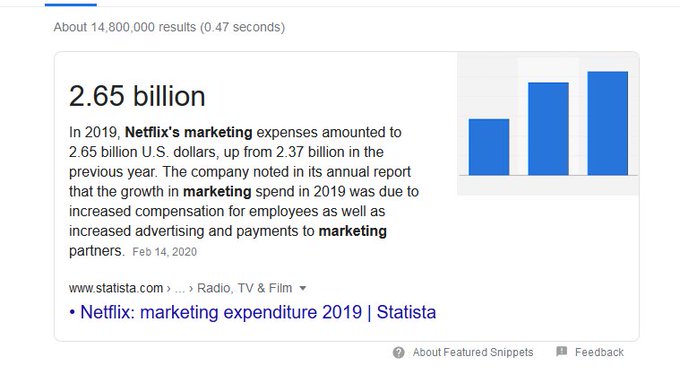
Remember, Netflix has spends a tremendous amount of money on marketing and PR,
and based on the recent wave of Avatar/Netflix stories, a nice chunk of that is going to a show that Netflix neither owns nor has exclusive streaming rights to (somewhat similar to the situation with She-Ra). This is a great deal for ViacomCBS which gets big checks and sees its IP revitalized. It's also a not bad deal for Netflix, which associates itself with a cult favorite, gets great bang for its buck in terms of hype, and builds interest in its upcoming live action reboot.
For the rest of us, it's a useful reminder of how much of the news we read is both initiated and shaped by the people being covered.
Wednesday, August 12, 2020
Whatever-day-of-the-week-it-is Tweets
A day at the beach in 1896 #FrèresLumière pic.twitter.com/SHzZGS6Wdg— Giles Paley-Phillips (@eliistender10) August 8, 2020
Even with a visionary CEO?So maybe disrupting an existing industry by ignoring all precedent, repeatedly breaking the law and losing billions to gain market share is somewhat more problematic than we've been led to believe. $uber $lyft https://t.co/i24GmiNqH5— Machine Planet (@Paul91701736) August 11, 2020
Interesting what strikes a nerve.
Lawyer up, Sluggo. https://t.co/Na36v4jqnq— Charles P. Pierce (@CharlesPPierce) August 9, 2020
Ben Garrison’s brain will be studied by scientists after he passes on. pic.twitter.com/CDftjSSth6— Maggie Serota (@maggieserota) August 10, 2020
This can't be healthy for a society.
Can a Mark Hamill action-figure with a mini action-figure of Luke Skywalker in his pocket (surrounded by still more Luke Skywalker action-figures of various sizes) get any more meta than it already is? I'm gonna go out on a limb here & say... not much. #SoManyMultiMiniMes pic.twitter.com/TCy510C9WI— Mark Hamill (@HamillHimself) August 9, 2020
Everyone does get what's going on, right? One political party has decided the only way to hold power and avoid responsibility is to openly and aggressively sabotage democracy.
They want each county to be limited to a single dropbox, at the county board of elections. One dropbox for all ~1.1M voters in Philadelphia, one for all 900K voters in Allegheny. https://t.co/yRufITmxCt— Adam Bonin (@adambonin) August 9, 2020
Trump is already suing to prevent the expanded use of drop boxes in PA-which makes the goal of voter suppression that much more overt-but they would seem to be the best solution to concerns about the Post Office returning ballots in time. https://t.co/R8BMJdJLNN— Ronald Brownstein (@RonBrownstein) August 9, 2020
I’ve been trying to make people care about the privatization/destruction of the USPS for a decade now. Never occurred to me to use the argument that it’s one of the last defenses against American fascism, but here we are.— Sam Sacks (@SamSacks) August 8, 2020
Trump’s Postmaster General Louis DeJoy and his wife, Aldona Wos, nominated to become our ambassador to Canada, own between $30 million and $75 million of assets in competitors to the US Postal Service. No problem there, right?— Laurence Tribe (@tribelaw) August 8, 2020
Tesla, of course.
This is at least the third incident I’ve seen on Twitter about a seatbelt not being bolted into the car with a Tesla. Shameful and pathetic. https://t.co/Vz6XQVA1Yt https://t.co/BvzgXWQuSx— ben k (@Benshooter) August 9, 2020
It's easy to get a really big sample size if you're flexible on other things.
I want to comment briefly on why I find this particular website so infuriating and why I am confident in calling it disinformation.— Carl T. Bergstrom (@CT_Bergstrom) August 8, 2020
Dr. Fauci and many other health officials have stressed the importance of randomized controlled trials as the gold standard. https://t.co/ivpXFpwinM
One of these days, I'm going to start a long thread on the infantilization of the far right
This anti-masker in Ohio refuses to leave the DMV despite having no reason for going inside.— Rex Chapman🏇🏼 (@RexChapman) August 6, 2020
Bless all of the people in this building for attempting to reason with this unreasonable woman.
Wear a mask. Don’t be a bad teammate... pic.twitter.com/h1Uv6qW0Uc
There is something wrong with Twitter when this joke doesn't go viral.
Maybe just do the opposite of what this guy says? https://t.co/oC3aM0nxzu pic.twitter.com/QFUDeJYSJC— Jonathan Chait (@jonathanchait) August 3, 2020
And finally.
Nothing to see here, just walk in and nothing to see here... just walking in, nothing to see here... chips chips chips chips chips chips chips chips pic.twitter.com/ur7YIVB6bz— Evac (@evacuationboy) August 9, 2020