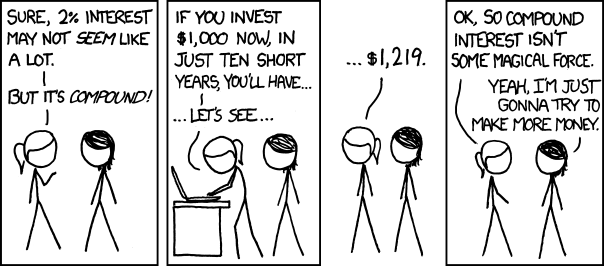
What's sad is how frequently a guy with a calculator and basic math skills can take down large chunks of conventional wisdom.
Think about it (no time for full links); by reading that section you could have learned, either from the editorial page proper or from the paper’s favorite op-ed guys, that
Clinton’s tax hike would cause a recession and send stocks plunging
Dow 36,000!
American households are saving plenty thanks to capital gains on their houses
Interest rates will soar thanks to Obama’s deficits
And much, much more.
What’s remarkable is that the Journal does not seem to pay a price for this record of awesome wrongness. Maybe subscribers buy the paper for the reporting (although if you ask me, that’s been going downhill since the Murdoch takeover). But as far as I can tell, lots of people still take the editorial page’s pronouncements seriously, even though it seems likely that you could have made a lot of money by betting against whatever that page predicts.

Dubbeling also insists that the Dutch need a new big engineering project.
“Since we stopped reclaiming land from the sea, we Dutch are in some kind of identity crisis. And in the last decades we could export our ideas. But now, with this economic crisis, we really have to think of something different. ”
A mountain, Dubbeling says, definitely qualifies on that score.
Learning is cheaper and easier than ever. And yet getting a degree is more expensive. How’s that? Something’s off, in a big way. Now of course you can push this too far: “Does Yglesias think we don’t need colleges because people can just look things up on Wikipedia instead?” No, I don’t. But I do remember hearing a lot of bluster from old-line media outlets once upon a time that proved to be completely wrong.
The schools sometimes push these students into high-cost private loans that they can never hope to repay, even when they are eligible for affordable federal loans. Because the private loans have fewer consumer accommodations like hardship deferments, the borrowers often have little choice but to default.
Worse yet, these loans and the bad credit history follow the debtors for the rest of their lives. Even filing for bankruptcy doesn’t clean the slate.
We researched the 100 U.S. corporations that shelled out the most last year in CEO compensation. At 25 of these corporate giants, we found, the bill for chief executive compensation actually ran higher than the company's entire federal corporate income tax bill.
Accounting games like "transfer pricing" have sent the corporate share of federal revenues plummeting. In 1945, U.S. corporate income taxes added up to 35 percent of all federal government revenue. This year, corporate income taxes will make up just 9 percent of federal receipts. In 1952, the year Republican President Dwight Eisenhower was elected, the effective income tax rate for corporations was 52.8 percent. Last year it was just 10.5 percent.
Among the nation's top firms, the S&P 500, CEO pay last year averaged $10,762,304, up 27.8 percent over 2009. Average worker pay in 2010? That finished up at $33,121, up just 3.3 percent over the year before.
Yet, Germany is a prosperous and pleasant nation to live in; one of the best in the world. Germany manages to have lower unemployment than the US, despite all their unions and socialistic regulations for hiring and firing: laws which Harvard economist ding a lings will insist would be the ruination of the American economy. How did the Germans manage this?
Since the introduction of the ultrasound in Asia, in the early 1980s, it's often been used to determine the gender of a fetus -- and, if it's female -- have an abortion. In a part of the world with big populations, these sex selection abortions have had a big, unintended consequence.The hypothesis that increasing the ratio of men to women would produce "more sex-trafficking, more AIDS, and a higher crime rate" is entirely reasonable, but like so much observational data there's a big self-selection factor here. Families and women not involved in the sex trade tend to avoid rough neighborhoods and red light districts. There's also a question about outliers -- a few very bad areas with very high male to female ratios.Hvistendahl: I mean there are over 160 million females missing from the population in Asia, and to put that in perspective, it's more than the entire female population of the United States.
So, what happens in a world with too many men? For starters, there's more sex-trafficking, more AIDS, and a higher crime rate. In fact, if you want to know the crime rate in a given part of India, one surefire indicator is the gender ratio. The more men, the more crime. Now, the ultrasound machine didn't create these problems, but it did enable them. So, you have to wonder. What's next?
Yeah, it was in southwestern Florida a few years ago, and I was minding my own business, cruising along, and I saw this open-back truck, and it looked like it was loaded, as you said, with green apples.And then I thought to myself wait, wait, apples don't grow in Florida. And as I pulled up behind it, I saw they were tomatoes, a whole truckload mounded over with perfectly green tomatoes, not a shade of pink or red in sight. As we were going along, we came to a construction site, the truck hit a bump, and three or four of these things flew off the truck.
They narrowly missed my windshield, but they did hit the pavement. They bounced a few times, and then they rolled onto the shoulder. None of them splattered. None of them even showed cracks. I mean, a modern-day industrial tomato has no problem with falling off a truck at 60 miles an hour on an interstate highway.
In addition to being tasteless, Estabrook also points out that compared to tomatoes from other sources or from a few decades ago, the modern Florida variety have fewer nutrients, more pesticides (particularly compared to those from California), and are picked with what has been described as 'slave labor' (and given the use of shackles this doesn't seem like much of an exaggeration).
The larger flaw in Carey’s analysis, though, is that it mistakes saying for doing. If Governor Perry really wanted to remake Texas’ higher education system into something more teaching-focused and less research-focused -- a debatable goal, but not an absurd one -- I’d expect to see him beef up the teaching-focusd institutions that already exist. If he shifted state funding from, say, Texas A&M to the state and community colleges, then yes, I could start to buy the argument that he actually means it. If he decided that other parts of the country have the whole “research” thing well in hand, and he wanted to focus Texas on teaching, I’d expect to see him divert money from UT-Austin and send it to the K-12 districts and the community colleges. One could argue the wisdom of that, but at least it would be a vision.
No. He’s endorsing an attack on universities for not being high schools, an attack on community colleges for being high schools, and an attack on K-12 for, well, being there. Yes, some isolated bits of rhetoric could make sense in another context, but that’s not what’s happening. I agree with Carey on the oft-noted paradox that academics who are otherwise liberal become dogmatically, idiotically conservative when discussing their own profession, but their skepticism about Perry is fairer than that. Some of Perry’s rhetoric may be interesting, but at the end of the day, his only vision for higher education is hostility.
Lack of jobs is why everyone feels bad, not because they have less or are poorer or the country isn’t producing or consuming as much. And, not to get to meta – in what I hope is an easily readable post – but an economy that makes lots of people feel bad is by definition a bad economy.
Moreover, the feeling that you have now about the economy is not the feeling of lack of value creation. Its not the feeling of socialism.
I wish I had more time to go into this because “what socialism feels like” is an important concept. However, my more conservative readers will may readily get the following example.
Have you ever been pissed off at the fact that your neighborhood school doesn’t teach any of the stuff you want and it feels like your kid is just wasting her valuable time going to all of these pointless classes for no reason. THAT, is what socialism feels like. That is what the lack of value creation feels like.
Its not that you are afraid of losing what you have or that budget constraints are pinching. Its that the stuff which is available to you sucks. It – in extreme cases – is a world where everyone has a job but where no grocery store has fresh milk. It’s a world where everyone gets a pay check but no one can find shoes that fit.
That is what socialism feels like. That is what government getting in the way of the market feels like. In many ways it’s the exact opposite of the way this feels.
Because you know I can’t resist: When you are waiting in your doctor’s office and she is 50mins late and proceeds to be rude to you and not give you “permission” to go buy the drug that you are dying to buy because its finally been “approved.” That’s what socialism feels like.
All told, the cost to the system of raising the Medicare age to 67 would be $11.4 billion in 2014, which is a high price to pay for $5.7 billion in federal savings. It’s exactly a factor of two too high. That’s a massive cost shift. Let’s put it this way, how much would you want to pay for the federal government to save $5.7 billion? I hope your answer is no greater than $5.7 billion. (If not, I’ve got a business proposition for you.) Paying $11.4 billion is a rip off.
The Center On Budget and Policy Priorities’ (CBPP) Paul N. Van de Water is out with a new report warning lawmakers on the Super Committee against considering proposals that would gradually raise the Medicare eligibility age from 65 to 67 . . .
Van de Water argues that raising the age would actually increase overall system costs and only save the federal government money “by shifting costs to most of the 65- and 66-year-olds who would lose Medicare coverage, to employers that provide health coverage for their retirees, to Medicare beneficiaries, to younger people who buy insurance through the new health insurance exchanges, and to states”
