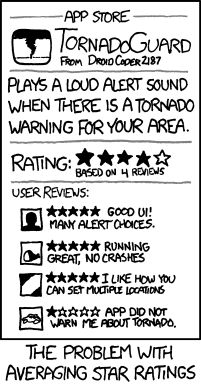
Unfortunately, this problem goes a bit further than star ratings in the App store.(insert comment about happiness research here.)
The wealth that has accrued to those in the top 1 per cent of the US income distribution is so massive that any serious policy program must begin by clawing it back.
If their 25 per cent, or the great bulk of it, is off-limits, then it’s impossible to see any good resolution of the current US crisis. It’s unsurprising that lots of voters are unwilling to pay higher taxes, even to prevent the complete collapse of public sector services. Median household income has been static or declining for the past decade, household wealth has fallen by something like 50 per cent (at least for ordinary households whose wealth, if they have any, is dominated by home equity) and the easy credit that made the whole process tolerable for decades has disappeared. In these circumstances, welshing on obligations to retired teachers, police officers and firefighters looks only fair.
In both policy and political terms, nothing can be achieved under these circumstances, except at the expense of the top 1 per cent. This is a contingent, but inescapable fact about massively unequal, and economically stagnant, societies like the US in 2010. By contrast, in a society like that of the 1950s and 1960s, where most people could plausibly regard themselves as middle class and where middle class incomes were steadily rising, the big questions could be put in terms of the mix of public goods and private income that was best for the representative middle class citizen. The question of how much (more) to tax the very rich was secondary – their share of national income was already at an all time low.
This final note today, in which S&P beats up on Warren Buffet. The billionaire went on CNBC this morning, said he wasn’t worried at all about the debt downgrade and said, in fact, that the downgrade changed his opinion of S&P — not his opinion of U.S. Treasuries.Funnily enough, couple of hours later, S&P put Buffett’s company Berkshire Hathaway on notice for a possible downgrade.
Hmmm.
Also, we should note here: Berkshire Hathaway’s the single biggest shareholder in S&P’s competitor, Moody’s.
Well, let me sketch out the logic of Robert Nozick's argument for his version of catallaxy as the only just order. It takes only fourteen steps:
1. Nobody is allowed to make utilitarian or consequentialist arguments. Nobody.
2. I mean it: utilitarian or consequentialist arguments--appeals to the greatest good of the greatest number or such--are out-of-order, completely. Don't even think of making one.
3. The only criterion for justice is: what's mine is mine, and nobody can rightly take or tax it from me.
4. Something becomes mine if I make it.
5. Something becomes mine if I trade for it with you if it is yours and if you are a responsible adult.
6. Something is mine if I take it from the common stock of nature as long as I leave enough for latecomers to also take what they want from the common stock of nature.
7. But now everything is owned: the latecomers can't take what they want.
8. It gets worse: everything that is mine is to some degree derived from previous acts of original appropriation--and those were all illegitimate, since they did not leave enough for the latecomers to take what they want from the common stock of nature.
9. So none of my property is legitimate, and nobody I trade with has legitimate title to anything.
10. Oops.
11. I know: I will say that the latecomers would be poorer under a system of propertyless anarchy in which nobody has a right to anything than they are under my system--even though others have gotten to appropriate from nature and they haven't.
12.Therefore they don't have a legitimate beef: they are advantaged rather than disadvantaged by my version of catallaxy, and have no standing to complain.
13. Therefore everything mine is mine, and everything yours is yours, and how dare anybody claim that taxing anything of mine is legitimate!
14. Consequentialist utilitarian argument? What consequentialist utilitarian argument?
To be able to successfully explain Nozickian political philosophy is to face the reality that it is self-parody, or perhaps CALVINBALL!
I think Palko's point is pretty obviously just wordplay, but I suppose I didn't express myself as well as I could have.Normally I'd let it rest there (it was one of the more trivial objections I've raised about Chait's position on education), but we really ought to note that this is not the first time we've seen this line:
But being "treated like professionals" has to mean both the opportunity to earn a good living if you do well and the potential to be fired if you fail.You can find the full context of that line and my reaction to it here.
I think Palko's point is pretty obviously just wordplay, but I suppose I didn't express myself as well as I could have. Being a professional, to most people, means having the opportunity to gain higher pay and recognition with greater success. Such a system also, almost inevitably, entails the possibility of having some consequences for failure. Teaching is very different than most career paths open to college graduates in that it protects its members from firing even in the case of gross incompetence, and it largely denies them the possibility to rise quickly if they demonstrate superior performance.
Obviously the realistic possibility of being fired for gross incompetence would not in and of itself do much to attract more highly qualified teachers, but the opportunity to receive performance-differentiated pay would.
Fifteen years ago, I wrote RPGs for 3 cents a word. In these more modern times, though, the pay rate is... wait, it's still 3 cents a word. Come to think of it, the pay hasn't changed much from the golden age of pulps and early sci-fi. The pay is the same as from the 1950s? What's wrong with this picture?
One argument is 'that is all the market will bear'. Okay, but in that same timeframe, other forms of writing (particularly journalism and non-fiction) moved on to dollar-a-word. Sure, we're in a dip for that sort of writing too, with rates often dropped to half that. But a pair o' quarters per word is still a damn site better than RPGing's 3-cents-per.
But in any case, this is never an appropriate way to argue — least of all at a time like this, when events have strongly suggested that a lot of work in economics these past few decades, very much including the work on which these guys’ reputations are based, was on the wrong track.
Do I do this myself? Probably on occasion, when I don’t catch myself. But I try not to. I would say that commenters who begin with “I can’t believe that a Nobel prize winner doesn’t understand that …” might want to think a bit harder; mostly, though not always, I have actually thought whatever you’re saying through, and the obvious fallacy you think you’ve found, isn’t. But “Me big famous economist, you nobody” is not a valid argument.
(See John Quiggin and Noah Smith for more on the incident that prompted this)
You Know, If You Had Told Me a Year Ago That on August 5, 2011 S&P Would Downgrade the U.S, and the 10-Yr Treasury Would Yield 2.5%... I would have laughed at you. I would have said that while there were possible futures in which each of those things happened, they were disjoint futures.
As a result of the balanced diet provided by rationing, children's health improved and on average they were taller and heavier than before the war.
The incidence of anaemia and tooth decay dropped - while the average age at which people died from natural causes increased, despite the stresses and strains of war.
The principles behind rationing sound surprisingly similar to today's health messages: reduced consumption of meat, fats and sugar and more of the sort of foods, such as vegetables, which provide essential vitamins and minerals.
A war-time regiment would also help reduce your risk of heart disease, Type 2 diabetes and high blood pressure, as well as cancers such as post-menopausal breast cancer, kidney and colon cancer.
The government feared that rationing would result in deterioration in health on the home front but, in fact, the outcome was positive. Rationing resulted in a decline in diet related problems like obesity, diabetes and heart disease.
