Two stat relevant segments on today's show, one on Obama email marketing and another on mining online data. Good stuff.
Friday, November 30, 2012

Thursday, November 29, 2012
Tsunamis and Scientologists
Since this last post seems to have gotten some interest, here are some more thoughts (or at least some previous thoughts spelled out in greater detail).
If you remember this started with a humor piece about the horrors of living in LA. It's an old and pretty much mined out genre. It was already tired when Harlan Ellison wrote the definitive rebuttal ("Face Down in Gloria Swanson's Swimming Pool") thirty-four years ago and time has not made it any fresher. Ellison could make a meal out of this latest piece, picking through the literary flaws or the dubious cultural observations but I have to admit, it wasn't those that really caught my attention; it was the sampling methodology.
Of course, we don't expect writers to base their work on random samples but we can hope for representative ones and one way to accomplish that is by sampling broadly. Here we have any incredibly narrow sample, both geographically and culturally. When the author tries to generalize from the sample, he (not entirely sure of the gender) ends up applying traits to the entire area that are only found in a tiny portion of either Hollywood or Venice Beach, specifically the most touristy parts (Not that there's anything wrong with being touristy, but it should make you nervous when an expert on a region doesn't seem to be familiar with anything you can't see from a tour bus).
Take the Tsunami signs. When you walk down to the beach in LA you almost always really do walk down. This is a rocky coast and most of the beach towns are fairly elevated (more than New York, for instance). The notable exception is Venice (which actually has canals, by the way). Venice is the only neighborhood I know of that's close to sea level. Thus it's the only place I've seen Tsunami warning signs.
Then there's the fear of Scientology the author claims all Angelenos have. In the tiny area of Hollywood the author is focusing on, signs of the church and its founder are everywhere. Literally within a two mile radius, you have multiple buildings, displays, festivals, people offering free personality tests, even an L. Ron Hubbard drive. Outside of that radius, virtually nothing and the subject of Scientology seldom comes up.
For reason that aren't entirely coincidental, the Groundlings, Second City LA and the Upright Citizen's Brigade are also in that same two mile radius, hence the author's belief that all Angelenos are fans of improv.
It's like this through the entire piece. The author latches onto some characteristic found only in four or so square miles of LA and assumes it holds for the remaining four thousand. The result is that old story, if you take your data from an unrepresentative subpopulation and try to generalize, you're likely to come out looking like an idiot.
Now if I could just figure out how a link to this got into Felix Salmon's blog.
Wednesday, November 28, 2012
Horribly pretentious person seeks out horribly pretentious people so she can be horrified at their pretentions
There's a certain type of humorous writing (and you have no idea how badly I wanted to use quotation marks there) where an out-of-towner moves to a city/state/region, seeks out the most stereotypical aspects and complains about them ("The trouble with Houston is, if you don't like cowboy hats and line dancing..."). These pieces are also sometimes accompanied with impressive-sounding sociological terms, in which case they qualify as serious journalism.
The LA subgenre invariably focuses on a tiny sliver of the more than four thousand square miles of LA County (when people talk about LA, they generally mean the county). It's a tiny strip that runs through (but doesn't encompass) Silver Lake, Hollywood, Beverly Hills, and Santa Monica. When you read one of these pieces bitching about cliche LA, you can be reasonably sure the writer didn't make it to Watts or East LA (if you want to read someone who actually did explore the area, check out Dana Goldstein).
Perhaps the worst example inexplicably come recommended by Counterparties. In it the writer, with a couple of notable exceptions, picks things that are so close they are actually in walking distance of each other, largely in a neighborhood that most Angelenos tend to avoid, leaving it to the tourists. As a result, she spends most of her time complaining about things that are only of concern to people who live in a tiny neighborhood dominated by Scientology buildings, improv theatres and tourist attractions. The writer is the only resident of LA I have ever encountered who actually talks about the stars on the sidewalk.
The only non-Hollywood area she refers to is Venice, specifically the boardwalk (once again, more of a tourist spot than a place for locals) and the Tsunami warning signs. She goes on about these at length in a way that makes me wonder if she has actually seen any of the coast other than Venice and Santa Monica (Venice is exceptionally low lying. Most of LA's coast is not).
Finally, as for the writer's depiction of LA being a town full of waiters calling themselves actors and directors, my experience here has actually been the opposite. Most people I meet are sensitive to the cliche and tend to overcompensate. I've never had a conversation with an aspiring entertainment type who overstated his or her resume. I have, however, had acquaintances I've known for a while before I happened to look them up on IMDB or Wikipedia and discovered they had done something pretty impressive. If the writer of this piece keeps running into people trying to impress her with exaggerated accomplishments, perhaps it's because they think she's shallow enough to be impressed by them.
The LA subgenre invariably focuses on a tiny sliver of the more than four thousand square miles of LA County (when people talk about LA, they generally mean the county). It's a tiny strip that runs through (but doesn't encompass) Silver Lake, Hollywood, Beverly Hills, and Santa Monica. When you read one of these pieces bitching about cliche LA, you can be reasonably sure the writer didn't make it to Watts or East LA (if you want to read someone who actually did explore the area, check out Dana Goldstein).
Perhaps the worst example inexplicably come recommended by Counterparties. In it the writer, with a couple of notable exceptions, picks things that are so close they are actually in walking distance of each other, largely in a neighborhood that most Angelenos tend to avoid, leaving it to the tourists. As a result, she spends most of her time complaining about things that are only of concern to people who live in a tiny neighborhood dominated by Scientology buildings, improv theatres and tourist attractions. The writer is the only resident of LA I have ever encountered who actually talks about the stars on the sidewalk.
The only non-Hollywood area she refers to is Venice, specifically the boardwalk (once again, more of a tourist spot than a place for locals) and the Tsunami warning signs. She goes on about these at length in a way that makes me wonder if she has actually seen any of the coast other than Venice and Santa Monica (Venice is exceptionally low lying. Most of LA's coast is not).
Finally, as for the writer's depiction of LA being a town full of waiters calling themselves actors and directors, my experience here has actually been the opposite. Most people I meet are sensitive to the cliche and tend to overcompensate. I've never had a conversation with an aspiring entertainment type who overstated his or her resume. I have, however, had acquaintances I've known for a while before I happened to look them up on IMDB or Wikipedia and discovered they had done something pretty impressive. If the writer of this piece keeps running into people trying to impress her with exaggerated accomplishments, perhaps it's because they think she's shallow enough to be impressed by them.
Monday, November 26, 2012
Walmart and Unions
Matt Yglesias points out that Megan McArdle is actually making a pretty solid pro-Union arguement for Walmart (while trying to argue the opposite). Consider:
How large? The average wage for a Walmart employee is tricky as many are not full time and the mean hourly wage is a subject of debate. However, this is a high end estimate (both in hourly wages and in the assumption of full time employment):
The other argument Megan advances, that Amazon is coming, is admittedly more subtle. But here is the thing, Matt is absolutely correct that Amazon is unstoppable so long as its current business model is permitted to exist. It has no margin . . . at all, and is thus a bet on the future of e-commerce. Now the United States has been aggressively subsidizing e-commerce in a number of ways, ranging from failing to collect sales taxes for online items, providing a reliable postal service everywhere to make the shipping model work, and Wall Street being willing to pour cash into the company despite no profits.
But that issue doesn't affect Walmart more than any other retailer. Nobody is immune to this problem and it remains to be seen how this will all shake out.
This is a great case study in rhetorical strategies. But the analysis is admirably clear. Wal-Mart's profit margins, though by no means enormous, are larger than those of its main competitors. Given the weak national labor market, Wal-Mart has no reason to cough up extra money to its workforce. But a strong labor union could coerce them into coughing up higher pay and bringing their margins in line with Costco and Macy's. As a result, each Wal-Mart employee might get a bit less than $3,000 more a year. Whether that's "life-changing" or not is an interesting question, but since we're talking about low-wage workers here, I think the intuitions of highly paid professionals may be a bit off. It seems very plausible that the marginal hedonic value of a thousand bucks or three to Wal-Mart's workforce would be very large.
How large? The average wage for a Walmart employee is tricky as many are not full time and the mean hourly wage is a subject of debate. However, this is a high end estimate (both in hourly wages and in the assumption of full time employment):
The average Walmart "associate," Wake Up Walmart reports, makes $11.75 an hour. That's $20,744 per year. Those wages are slightly below the national average for retail employees, which is $12.04 an hour. They also produce annual earnings that, in a one-earner household, are below the $22,000 poverty line.So a $3,000/year hike in wages would, conservatively, be a 15% increase in pay. That would leave prices unchanged and reset the margins at Walmart to that of Macy's (hardly a disaster in the making to have margins at this level). If the average employee makes more like $14,000 (another plausible estimate) then the pay rise is even steeper. At these pay levels, a few thousand a year can be a life changing event, given the number of fixed expenses in life.
The other argument Megan advances, that Amazon is coming, is admittedly more subtle. But here is the thing, Matt is absolutely correct that Amazon is unstoppable so long as its current business model is permitted to exist. It has no margin . . . at all, and is thus a bet on the future of e-commerce. Now the United States has been aggressively subsidizing e-commerce in a number of ways, ranging from failing to collect sales taxes for online items, providing a reliable postal service everywhere to make the shipping model work, and Wall Street being willing to pour cash into the company despite no profits.
But that issue doesn't affect Walmart more than any other retailer. Nobody is immune to this problem and it remains to be seen how this will all shake out.
Profile of a businessman I admire
I was working on a longer post about what a well run business looks like and I remembered the following Malcolm Gladwell piece for the New Yorker. When you read the first paragraph, you'll think the title of this post is a joke; when you get to the end, you'll know it's not.
Sunday, November 25, 2012
Hostess and salaries
Mark pointed out that, in my Hostess and wages post, I only put in the previous wage cuts and not the new one that management was proposing. The relevant passage:
In some ways this links to a broader trend of firms being reluctant to actually pay workers. This is linked to a reluctance to train workers, as well, but that only makes sense. But here is where the whole story gets surreal to me. Employees are assets as well as expenses. We all seem to get that when we pay CEOs a lot of money -- we argue that it is not just an expense but also an investment in talent. It is true that the modern world of corporate America has been very good at breaking down trust (few employees an informal promise at all anymore).
That is part of the issue with Hostess. Not only were they trying to drop wages but the pattern of action on the part of the management team was to focus entirely on the easy target of salaries and ignore the hard targets of actually using information to reform the company into a more competitive shape. Now maybe that was impossible (it seems unlikely but who knows). But then we'd expect all of the bakers to be going under.
Nor is it impossible for firms to make highly creative moves to try and survive. Notice how McDonald's and Starbucks (two companies that I consider well run) have quietly tried to sneak into each other's space. Suddenly there is an egg sandwich at Starbucks (why go to two drive-thrus in the morning?). And there are Latte's at McDonalds (why pay $5 for a Latte if you can't tell the difference). Both firms are tougher, as a result, and -- as a pleasant side effect -- customers are better off.
But I want to go back to Mark's piece -- if you want to give management credit for a well run business strategy then you should be suspicious when failure is entirely blamed on the employees (who, t the union level, typically do not craft strategy).
Again, the 14-year Hostess bakery veteran: “Remember how I said I made $48,000 in 2005 and $34,000 last year? I would make $25,000 in five years if I took their offer. It will be hard to replace the job I had, but it will be easy to replace the job they were trying to give me.”One thing that is easy to overlook in the discussion of did Unions show inflexibility is that a 50% wage cut over less than 10 years is an amazing drop in nominal wage (and the initial drop from 30,000 to 19,000 employees). Mark's piece has pointed out that management was not doing any of the obvious moves to try save the business. While the actual pattern of executive compensation is slightly more complicated than early reports indicated, it is pretty clear that huge (long term) wage cuts were not envisioned in the executive suite.
In some ways this links to a broader trend of firms being reluctant to actually pay workers. This is linked to a reluctance to train workers, as well, but that only makes sense. But here is where the whole story gets surreal to me. Employees are assets as well as expenses. We all seem to get that when we pay CEOs a lot of money -- we argue that it is not just an expense but also an investment in talent. It is true that the modern world of corporate America has been very good at breaking down trust (few employees an informal promise at all anymore).
That is part of the issue with Hostess. Not only were they trying to drop wages but the pattern of action on the part of the management team was to focus entirely on the easy target of salaries and ignore the hard targets of actually using information to reform the company into a more competitive shape. Now maybe that was impossible (it seems unlikely but who knows). But then we'd expect all of the bakers to be going under.
Nor is it impossible for firms to make highly creative moves to try and survive. Notice how McDonald's and Starbucks (two companies that I consider well run) have quietly tried to sneak into each other's space. Suddenly there is an egg sandwich at Starbucks (why go to two drive-thrus in the morning?). And there are Latte's at McDonalds (why pay $5 for a Latte if you can't tell the difference). Both firms are tougher, as a result, and -- as a pleasant side effect -- customers are better off.
But I want to go back to Mark's piece -- if you want to give management credit for a well run business strategy then you should be suspicious when failure is entirely blamed on the employees (who, t the union level, typically do not craft strategy).
For those of you who are still working their way through the leftovers

Thanksgiving, 1905 from the incomparable Windsor McCay
from Mippyville.
update: the hash was very good, thanks for asking
Saturday, November 24, 2012
The real reason for almost all big business failures
The commonly voiced view of business, red in tooth and claw, a Darwinian landscape where only the fit survive may hold for small to mid-sized operations, but with big business, survival is surprisingly easy. As a rule it is only the remarkably unfit that die. When you see a big company go under you can generally find a history of incompetent management and stupid or shortsighted decisions.
Though as narrative-obsessed as their political brethren, business journalists tend to be notably averse to stories built around the question "what happens when you give the keys to an idiot?" That's a shame because some of the most entertaining accounts start with that premise. It's understandable though. Business journalists, once again like their political brethren, tend to have overly cozy relationships with their subjects and, (compared to reporters thirty or forty) tend to sympathize more with management than labor.
The decline of professional standards also plays a part. A surprising number of "news" stories are actually press releases in only slightly rewritten form and PR department go to great lengths to avoid statements that make their bosses look like morons.
Given these factors and the uncomfortable cognitive dissonance that journalists often feel when forced to report that a major corporation's management is incompetent, they will almost always pass over the obvious narrative and opt instead for one of these three standards:
1. the company was made obsolete by new technology;
2. it was doomed by changing markets;
3. it just couldn't get good help.
Of course, in theory, these things can doom a company, in practice though, when you hear one of these explanations given for a collapse, you will almost always find that managerial malpractice played at least as large a role. For example, ebooks had much less to do with Borders demise than did an ill-conceived expansion into the ridiculously over-served British market.*
Here the LA Times invaluable Michael Hiltzik takes apart the standard narratives (numbers 2 and 3) of the troubles at Hostess (via Thoma, as usual)
UPDATE * I meant to include a link to this growth fetish post that gives my take on what the people at Borders might have been thinking.
Though as narrative-obsessed as their political brethren, business journalists tend to be notably averse to stories built around the question "what happens when you give the keys to an idiot?" That's a shame because some of the most entertaining accounts start with that premise. It's understandable though. Business journalists, once again like their political brethren, tend to have overly cozy relationships with their subjects and, (compared to reporters thirty or forty) tend to sympathize more with management than labor.
The decline of professional standards also plays a part. A surprising number of "news" stories are actually press releases in only slightly rewritten form and PR department go to great lengths to avoid statements that make their bosses look like morons.
Given these factors and the uncomfortable cognitive dissonance that journalists often feel when forced to report that a major corporation's management is incompetent, they will almost always pass over the obvious narrative and opt instead for one of these three standards:
1. the company was made obsolete by new technology;
2. it was doomed by changing markets;
3. it just couldn't get good help.
Of course, in theory, these things can doom a company, in practice though, when you hear one of these explanations given for a collapse, you will almost always find that managerial malpractice played at least as large a role. For example, ebooks had much less to do with Borders demise than did an ill-conceived expansion into the ridiculously over-served British market.*
Here the LA Times invaluable Michael Hiltzik takes apart the standard narratives (numbers 2 and 3) of the troubles at Hostess (via Thoma, as usual)
Let's get a few things clear. Hostess didn't fail for any of the reasons you've been fed. It didn't fail because Americans demanded more healthful food than its Twinkies and Ho-Hos snack cakes. It didn't fail because its unions wanted it to die.
It failed because the people that ran it had no idea what they were doing. Every other excuse is just an attempt by the guilty to blame someone else.
...
Hostess management's efforts to blame union intransigence for the company's collapse persisted right through to the Thanksgiving eve press release announcing Hostess' liquidation, when it cited a nationwide strike by bakery workers that "crippled its operations."
That overlooks the years of union givebacks and management bad faith. Example: Just before declaring bankruptcy for the second time in eight years Jan. 11, Hostess trebled the compensation of then-Chief Executive Brian Driscoll and raised other executives' pay up to twofold. At the same time, the company was demanding lower wages from workers and stiffing employee pension funds of $8 million a month in payment obligations.
Hostess management hasn't been able entirely to erase the paper trail pointing to its own derelictions. Consider a 163-page affidavit filed as part of the second bankruptcy petition.
There Driscoll outlined a "Turnaround Plan" to get the firm back on its feet. The steps included closing outmoded plants and improving the efficiency of those that remain; upgrading the company's "aging vehicle fleet" and merging its distribution warehouses for efficiency; installing software at the warehouses to allow it to track inventory; and closing unprofitable retail stores. It also proposed to restore its advertising budget and establish an R&D program to develop new products to "maintain existing customers and attract new ones."
None of these steps, Driscoll attested, required consultation with the unions. That raises the following question: You mean to tell me that as of January 2012, Hostess still hadn't gotten around to any of this?
The company had known for a decade or more that its market was changing, but had done nothing to modernize its product line or distribution system. Its trucks were breaking down. It was keeping unprofitable stores open and having trouble figuring out how to move inventory to customers and when. It had cut back advertising and marketing to the point where it was barely communicating with customers. It had gotten hundreds of millions of dollars in concessions from its unions, and spent none of it on these essential improvements.
The true recent history of Hostess can be excavated from piles of public filings from its two bankruptcy cases. To start with, the company has had six CEOs in the last 10 years, which is not exactly a precondition for consistent and effective corporate strategizing.
...
Hostess first entered bankruptcy in 2004, when it was known as Interstate Bakeries. During its five years in Chapter 11, the firm obtained concessions from its unions worth $110 million a year. The unions accepted layoffs that brought the workforce down to about 19,000 from more than 30,000. There were cuts in wages, pension and health benefits. The Teamsters committed to negotiations over changes in antiquated work rules. The givebacks helped reduce Hostess' labor costs to the point where they were roughly equal to or even lower than some of its major competitors'.
But the firm emerged from bankruptcy with more debt than when it went in — in with $575 million, out with $774 million, all secured by company assets. That's pretty much the opposite of what's supposed to happen in bankruptcy. By the end, there was barely a spare distributor cap in the motor pool that wasn't mortgaged to the private equity firms and hedge funds holding the notes (and also appointing management).
...
The post-bankruptcy leadership never executed a growth strategy. It failed to introduce a significant new product or acquire a single new brand. It lagged on bakery automation and product R&D, while rivals such as Bimbo Bakeries USA built research facilities and hired food scientists to keep their product lines fresh. At the time of the 2004 bankruptcy, Hostess was three times the size of Bimbo. Today it's less than half Bimbo's size. (Bimbo, which has been acquiring bakeries such as Sara Lee and Entenmann's right and left, might well end up with Hostess' brands.)
UPDATE * I meant to include a link to this growth fetish post that gives my take on what the people at Borders might have been thinking.
"Lance Armstrong And The Business Of Doping"
This Planet Money story is the first (and will probably be the last) account of the Armstrong scandal that has held my interest. It also changed my what's-the-big-deal attitude.
To have one $8 billion dollar writedown, Ms. Whitman, may be regarded as a misfortune. To have two looks like carelessness.
Ryan McCarthy in Counterparties:
HP has become the place where synergies go to die. In its earnings release today, HP said it has taken an $8.8 billion writedown, caused by what it calls “serious accounting improprieties” at Autonomy, a software company it acquired for $11 billion in August 2011. This, as David Benoit notes, is HP’s second acquisition-related $8 billion writedown of the year.I love the phrase "flexible definition."
HP is furiously pointing fingers: in a statement, the company said there was a “willful effort on behalf of certain former Autonomy employees to inflate the underlying financial metrics”. And CEO Meg Whitman told analysts that Deloitte had signed off on Autonomy’s accounts, with KPMG signing off on Deloitte. Still, only $5 billion of this quarter’s write down came from Autonomy’s accounting; the rest came from those pesky “headwinds against anticipated synergies and marketplace performance”.
There’s a strong case that HP should have smelled a rat. Bryce Elder points to “a decade’s worth of research questioning Autonomy’s revenue recognition, organic growth and seemingly flexible definition of a contract sale”. Then there’s the scathing statement which came about a month after the HP sale, in which Oracle revealed that it too had looked at Autonomy, but considered the company’s $6 billion market value to be “extremely over-priced”. Lynch, for his part, says that he was “ambushed” by the allegations.
Friday, November 23, 2012
Introducing "You Do the Math"
As Joseph mentioned earlier, I have a new blog up called You Do the Math focusing on ideas for teaching primary and secondary math. There's going to be a fair amount of cross-posting with this blog but I wanted a second outlet because:
1. I have a decade's worth of tips, exercises, lesson plans, test ideas, games, and puzzles for math teachers, much of which wouldn't be of much interest to most of the readers of this site.
2. I couldn't see the typical fifth grade teacher slogging through posts on the economics of health care and the potential for selection effects in polling and the rest of the analytic esoterica you'll find here.
3. I had some ideas I wanted to play around with. Since so many of the teaching posts aren't time sensitive, I'm using the scheduling function to keep a steady stream of content flowing. Many of the posts will be short and or recycled but I've already scheduled at least one a week for the next five months. When I get to six months I plan to go back to the beginning and start putting up a second post for each week. It will be interesting to so what the effect is on traffic, page rank, etc.
4. Pauline Kael talked about the way writing a regular column helped her discipline and organize her thinking about movies. I believe a blog can serve much the same function in other areas.
I've already got one up that talks about using codes to introduce numberlines and tables and another that shows how you can estimate pi by seeing how many times randomly selected points fall within a given radius and I have about two dozen more posts sitting in the queue. If this sort of thing sounds interesting to you, check it out and if you know of anyone who might have use for this, please pass it on.
Thanks,
Mark
1. I have a decade's worth of tips, exercises, lesson plans, test ideas, games, and puzzles for math teachers, much of which wouldn't be of much interest to most of the readers of this site.
2. I couldn't see the typical fifth grade teacher slogging through posts on the economics of health care and the potential for selection effects in polling and the rest of the analytic esoterica you'll find here.
3. I had some ideas I wanted to play around with. Since so many of the teaching posts aren't time sensitive, I'm using the scheduling function to keep a steady stream of content flowing. Many of the posts will be short and or recycled but I've already scheduled at least one a week for the next five months. When I get to six months I plan to go back to the beginning and start putting up a second post for each week. It will be interesting to so what the effect is on traffic, page rank, etc.
4. Pauline Kael talked about the way writing a regular column helped her discipline and organize her thinking about movies. I believe a blog can serve much the same function in other areas.
I've already got one up that talks about using codes to introduce numberlines and tables and another that shows how you can estimate pi by seeing how many times randomly selected points fall within a given radius and I have about two dozen more posts sitting in the queue. If this sort of thing sounds interesting to you, check it out and if you know of anyone who might have use for this, please pass it on.
Thanks,
Mark
Thursday, November 22, 2012
Blog list updated
The blog roll has had a fall cleaning. I removed a few blogs that were really interesting but which had not been updated for months or years. I added two new blogs: Mark Palko's new math teaching blog (which may occasionally cross post) and Mark Thoma's Economist's View (for which it is past time we added it).
Happy Thanksgiving, all!
Toys for Tots -- reprinted, slightly revised
A good Christmas can do a lot to take the edge off of a bad year both for children and their parents (and a lot of families are having a bad year). It's the season to pick up a few toys, drop them by the fire station and make some people feel good about themselves during what can be one of the toughest times of the year.
If you're new to the Toys-for-Tots concept, here are the rules I normally use when shopping:
The gifts should be nice enough to sit alone under a tree. The child who gets nothing else should still feel that he or she had a special Christmas. A large stuffed animal, a big metal truck, a large can of Legos with enough pieces to keep up with an active imagination. You can get any of these for around twenty or thirty bucks at Wal-Mart or Costco;*
Shop smart. The better the deals the more toys can go in your cart;
No batteries. (I'm a strong believer in kid power);**
Speaking of kid power, it's impossible to be sedentary while playing with a basketball;
No toys that need lots of accessories;
For games, you're generally better off going with a classic;
No movie or TV show tie-ins. (This one's kind of a personal quirk and I will make some exceptions like Sesame Street);
Look for something durable. These will have to last;
For smaller children, you really can't beat Fisher Price and PlaySkool. Both companies have mastered the art of coming up with cleverly designed toys that children love and that will stand up to generations of energetic and creative play.
*I previously used Target here, but their selection has been dropping over the past few years and it's gotten more difficult to find toys that meet my criteria.
** I'd like to soften this position just bit. It's okay for a toy to use batteries, just not to need them. Fisher Price and PlaySkool have both gotten into the habit of adding lights and sounds to classic toys, but when the batteries die, the toys live on, still powered by the energy of children at play.
Wednesday, November 21, 2012
Bitter Harvest
Just in time for Thanksgiving.
From Marketplace:
From Marketplace:
Michael Hogan, CEO of A.D. Makepeace, a large cranberry grower based in Wareham, says for now cranberries are still a viable crop in Massachusetts. But climate change is making it much tougher to grow there.I know we've been over this before, but it gets harder and harder to see how a cost/benefit analysis of climate change don't support immediate implementation of a carbon tax.or something similar.
"We're having warmer springs, we're having higher incidences of pests and fungus and we're having warmer falls when we need to have cooler nights," Hogan says.
Those changing conditions are costing growers like Makepeace money. The company has to use more water to irrigate in the hotter summers, and to cover the berries in spring and fall to protect them from frosts.
They're also spending more on fuel to run irrigation pumps, and have invested heavily in technology to monitor the bogs more closely. It's also meant more fungicides and fruit rot.
"Because of the percentage of rot that was delivered to Ocean Spray, they paid us $2 a barrel less," Hogan says. "We delivered 370,000 barrels last year. So you're talking about millions of dollars."
Cranberries also need a certain number of "chilling hours" to ensure that deep red color. Glen Reid, assistant manager of cranberry operations for A.D. Makepeace, says that's a problem as well.
"The berries actually need cold nights to color up," Reid says. "Last year we had a big problem with coloring up the berries. We had a lot more white berries."
Some growers in the Northeast have already moved some cranberry production to chillier climates, like eastern Canada. Ocean Spray has started growing cranberries on a new farm in the province of New Brunswick.
Makepeace's Hogan is even considering Chile, which apparently has a favorable climate for growing the North American berry.
Economics: a new definition?
Is it fair to quote the definition of economics from the blurb for a book? If so, consider this definition in the blurb for Emily Oster's new book:
None of this mean that Emily shouldn't write this book. My own read on the alcohol and pregnancy angle is that the current advice does seem to be based on an excess of caution. But it seems odd to argue that being an economist is the key piece here. Jumping fields is fine and can often lead to amazing insights, but maybe we should call this shifting of fields what it is rather than expanding the definition of economics to make it less meaningful?
When Oster was expecting her first child, she felt powerless to make the right decisions for her pregnancy. How doctors think and what patients need are two very different things. So Oster drew on her own experience and went in search of the real facts about pregnancy using an economist’s tools. Economics is not just a study of finance. It’s the science of determining value and making informed decisions. To make a good decision, you need to understand the information available to you and to know what it means to you as an individual.So, when applied to a medical topic (like pregnancy) how does this differ from evidence based medicine? Should I be calling myself an economist?
None of this mean that Emily shouldn't write this book. My own read on the alcohol and pregnancy angle is that the current advice does seem to be based on an excess of caution. But it seems odd to argue that being an economist is the key piece here. Jumping fields is fine and can often lead to amazing insights, but maybe we should call this shifting of fields what it is rather than expanding the definition of economics to make it less meaningful?
Tuesday, November 20, 2012
Depressing education chart of the day
Mike the Mad Biologist points us to this one.
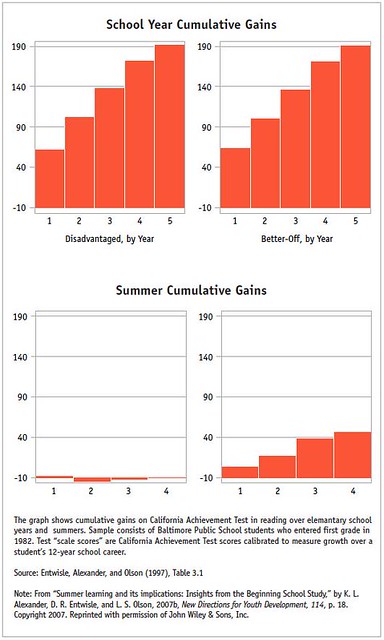
From Karl Alexander (John Dewey Professor of Sociology at Johns Hopkins University):
UPDATE:
This seems like a good time to remind everyone about some of the other previously mentioned challenges these kids face:We discovered that about two-thirds of the ninth-grade academic achievement gap between disadvantaged youngsters and their more advantaged peers can be explained by what happens over the summer during the elementary school years.Mike goes on to point out the obvious question this raises about the fire-the-teachers approach to education reform.
I also want to point out that the higher performing group isn’t necessarily high income, but simply better off. In the context of the Baltimore City school system, that usually means solidly middle class, with parents who are likely to have gone to college versus dropping out.
Statistically, lower income children begin school with lower achievement scores, but during the school year, they progress at about the same rate as their peers. Over the summer, it’s a dramatically different story. During the summer months, disadvantaged children tread water at best or even fall behind. It’s what we call “summer slide” or “summer setback.” But better off children build their skills steadily over the summer months. The pattern was definite and dramatic. It was quite a revelation.
Hart and Risley also found that, in the first four years after birth, the average child from a professional family receives 560,000 more instances of encouraging feedback than discouraging feedback; a working- class child receives merely 100,000 more encouragements than discouragements; a welfare child receives 125,000 more discouragements than encouragements.
More on Hostess
There is a rumor that Mark is preparing a nice post on the whole Hostess bankruptcy story. So, to continue to generate context, consider this story from an actual employee:
Maybe the company was in an impossible situation. That is definitely one interpretation of the situation but the narrative is odd for this outcome. The argument that unions were to blame is hardly the case unless this account (above) is wracked with falsehoods. If the situation was hopeless then why did the high paid executives not call it over before raiding the pension? Was it because a longer tenure of salaries and job experience would be of personal benefit to them and they were no liable for the consequences of their decisions?
There are no easy answers, but a simple narrative of union greed or dysfunctional bargaining is clearly omitting lots of nuance. If nothing else, reneging on the repayment of the pension fund borrowing was hardly the ideal prelude to asking the union to trust future management promises.
In 2005 it was another contract year and this time there was no way out of concessions. The Union negotiated a deal that would save the company $150 million a year in labor. It was a tough internal battle to get people to vote for it. We turned it down twice. Finally the Union told us it was in our best interest and something had to give. So many of us, including myself, changed our votes and took the offer. Remember that next time you see CEO Rayburn on tv stating that we haven't sacrificed for this company. The company then emerged from bankruptcy. In 2005 before concessions I made $48,000, last year I made $34,000. My pay changed dramatically but at least I was still contributing to my self-funded pension.
In July of 2011 we received a letter from the company. It said that the $3+ per hour that we as a Union contribute to the pension was going to be 'borrowed' by the company until they could be profitable again. Then they would pay it all back. The Union was notified of this the same time and method as the individual members. No contact from the company to the Union on a national level.
This money will never be paid back. The company filed for bankruptcy and the judge ruled that the $3+ per hour was a debt the company couldn't repay. The Union continued to work despite this theft of our self-funded pension contributions for over a year. I consider this money stolen. No other word in the English language describes what they have done to this money.This illustrates a couple of things. One is that defined contribution pensions (i.e. the 401(k) and other such vehicles) are not necessarily a safe harbor from corporate games if something like this can happen without the union proactively agreeing. Two, the concessions made by the unions were pretty significant. They took pretty large pay cuts (29%) and lost additional money from the pension fund. No manager who made the decision to borrow this money was held liable.
Maybe the company was in an impossible situation. That is definitely one interpretation of the situation but the narrative is odd for this outcome. The argument that unions were to blame is hardly the case unless this account (above) is wracked with falsehoods. If the situation was hopeless then why did the high paid executives not call it over before raiding the pension? Was it because a longer tenure of salaries and job experience would be of personal benefit to them and they were no liable for the consequences of their decisions?
There are no easy answers, but a simple narrative of union greed or dysfunctional bargaining is clearly omitting lots of nuance. If nothing else, reneging on the repayment of the pension fund borrowing was hardly the ideal prelude to asking the union to trust future management promises.
Monday, November 19, 2012
Hoisted from the comments
A rather nice point from commenter Bill Trudo that I thought was worth emphasizing:
The problems at Hostess have been decades in the making. The company went into bankruptcy in 2004 and left in 2009 with numerous labor concessions, but without major reform to the pension system. Some people liked to blame that on the unions, but it is up to management to decide what is profitable or unprofitable. Now three years later, management has deemed their old agreements aren't profitable and that would be correct given how much money Hostess has been bleeding. And people still wonder why some union leaders were skeptical of management.
Skepticism is warranted, especially in light of Hostess having left bankruptcy in 2009 with more debt than it had in 2004 with falling sales. 2011 sales were down 28% from 2004. Of course, this is the union's fault that sales have dropped and not a failure of the company's leadership.
On top of that, management comes to the labor unions demanding 8% pay cuts and slashes to the pension, while the top executives increase their own pay--what a nice goodwill gesture. Some unsecured creditors actually filed suit over the pay raises.
Yes, pensions and work issues needed to be addressed. The unions had to make concessions, but it's difficult in light of what has happened for anyone to have any faith in what management has been doing at Hostess.
Now, enter two hedge funds, who hold the majority of secured debt, and they're likely looking to get out. After all, the business model isn't working; it's time for a showdown.
The Teamsters actually finally agreed to the wage and benefit concessions. Some of the other unions, including the Bakers' Union, didn't. Of course, I have a suspicion that some of the unions were acting in the best interest of all their union workers and not the union workers who were working at Hostess. Though, I also have suspicions that even if the unions capitulated to the hedge fund demands (they're the ones driving the show), Hostess would have likely been sold or have been back in bankruptcy in a few years.
This really gets to the core of the union/management dilemma -- it is hard to take things on faith. I remember many of my co-workers (including myself) putting in huge amounts of work for promises that never materialized. The classic "if you take a hit now we will remember you once this bad period is over". Curiously, it almost never works that way.
I also note that the narrative is "bad union wouldn't accept huge cuts" and not incompetent management was unable to make a top brand into a successful business. This is especially true of pension cuts. Underfunded pensions happen for a lot of reasons but they are usually much more of a management decision than a union decision. Maybe it was a bad decision for management to agree to the pension plan in the first place -- that is certainly possible. But it is always concerning to see no ethical qualms about removing obligations to workers (breaking agreements for work already done) while increasing your own wages.
What's with the (non)weird name?
Hi,
The regulars may have noticed something different about the top of the page. Observational Epidemiology is now West Coast Stat Views. This doesn't represent a change in content, rather a nod to truth in advertising. When this blog started, about two thousand posts ago, the name was both accurate and descriptive, but it soon morphed into a general statistics blog with a focus on topics that interested both of us and which connected (at least indirectly) with some relevant experience of one or both of us.
Both Joseph and I started out as corporate statisticians, so not surprisingly we're both mildly obsessed with business and economics. We both spent a great deal of time in academia so we're interested in education. As you'd expect from a blog originally called Observational Epidemiology, health care remains a big issue. As for politics and journalism, everybody needs a hobby.
Besides, I was getting tired of explaining what observational epidemiology meant.
Happy Holidays,
Mark
The regulars may have noticed something different about the top of the page. Observational Epidemiology is now West Coast Stat Views. This doesn't represent a change in content, rather a nod to truth in advertising. When this blog started, about two thousand posts ago, the name was both accurate and descriptive, but it soon morphed into a general statistics blog with a focus on topics that interested both of us and which connected (at least indirectly) with some relevant experience of one or both of us.
Both Joseph and I started out as corporate statisticians, so not surprisingly we're both mildly obsessed with business and economics. We both spent a great deal of time in academia so we're interested in education. As you'd expect from a blog originally called Observational Epidemiology, health care remains a big issue. As for politics and journalism, everybody needs a hobby.
Besides, I was getting tired of explaining what observational epidemiology meant.
Happy Holidays,
Mark
Sunday, November 18, 2012
"Peggy" "Noonan's" Life on Mars
Apparently Martians are also using the analytic and marketing methods we've been using since the late 20th Century.
From the Wall Street Journal (via DeLong via Kos)
The temptation is to start letting them slide, but there's an issue here of reputation and metadata. Noonan is recognized as a authority on politics and her reputation is backed by the reputations of the major news outlets that publish her writing and put her in front of the camera. All of this contributes to the metadata that tells us how much weight to give Noonan's statements.
For the system to work, information sources that are consistently unreliable have to take a reputational hit, but Noonan either knows nothing about how politics works today (which is, remember, her area of expertise) or, worse yet, she has such a low opinion of her readers' intelligence that she believes she can scare them by dropping a few technical terms.
If Noonan's reputation doesn't take the hit here then the reputations of those who publish and broadcast her will. Every time the Wall Street Journal prints one of these columns, the trust we can place in the paper diminishes just a little bit. It's a small effect but it's cumulative. Give it long enough and it can eat away the standing of even the Journal.
From the Wall Street Journal (via DeLong via Kos)
The other day a Republican political veteran forwarded me a hiring notice from the Obama 2012 campaign. It read like politics as done by Martians. The "Analytics Department" is looking for "predictive Modeling/Data Mining" specialists to join the campaign's "multi-disciplinary team of statisticians," which will use "predictive modeling" to anticipate the behavior of the electorate.It might seem that, after the last thousand or so Noonan columns, pointing out flaws in the latest entry is coals-to-Newcastle. This is, after all, the pundit who told us the day before the election that Romney was on track to win because "all the vibrations are right." (She said a lot of other memorable things in that column. You really ought to check it out.)
The temptation is to start letting them slide, but there's an issue here of reputation and metadata. Noonan is recognized as a authority on politics and her reputation is backed by the reputations of the major news outlets that publish her writing and put her in front of the camera. All of this contributes to the metadata that tells us how much weight to give Noonan's statements.
For the system to work, information sources that are consistently unreliable have to take a reputational hit, but Noonan either knows nothing about how politics works today (which is, remember, her area of expertise) or, worse yet, she has such a low opinion of her readers' intelligence that she believes she can scare them by dropping a few technical terms.
If Noonan's reputation doesn't take the hit here then the reputations of those who publish and broadcast her will. Every time the Wall Street Journal prints one of these columns, the trust we can place in the paper diminishes just a little bit. It's a small effect but it's cumulative. Give it long enough and it can eat away the standing of even the Journal.
Saturday, November 17, 2012
Go read Noah Smith
Today's post is really good:
Once again I notice that Canada has very tough drug patent protections (which might do a lot to improve innovation in the drug arena) and still manages to have much lower costs for medical care (as a percentage of GDP). Canadian Healthcare has some major downsides and I would never endorse it as the best possible system (I actually prefer the British NHS for a lot of reasons, that I really need to blog about).
Sicko is about America's health care system, and the alternatives. Before I saw Sicko, I believed the common line that, for all its flaws, America's health care system was "the best in the world". After I saw the movie, I did not believe anything of the kind. Sicko opened my eyes to the existence of Britain's National Health Service; after watching the movie, I looked into the NHS, and found that it achieves better results than the U.S. on almost any outcome measure, for far fewer costs. Importantly, it does this using a rational incentive system - doctors are paid for improving the health of their patients, not for recommending large numbers of expensive services.This really highlights the central dilemma facing US medical care. It is really expensive and it has very mediocre outcomes at a population level. It is possible that some people get exceptional medical care beyond that available elsewhere. And it is true that putting a lot of resources into a sector does tend to drive advances in that sector. My own person question is whether this is the best way to drive medical innovation; could targeted research money do more good on innovation than paying more for physician office visits?
I'm not sure, but around the same time that I stopped believing that America had the best health system in the world, I noticed that other people stopped saying it (and in fact started saying the opposite!). Around the same time I started thinking that Britain's NHS is the best alternative, I noticed a lot of policy-wonkish people praising that system in the press. Around the same time I started realizing the insanity of the "fee for service" incentive system, everyone started talking about it. So I wonder if Sicko, rather than just changing my mind, actually changed the whole national conversation
Once again I notice that Canada has very tough drug patent protections (which might do a lot to improve innovation in the drug arena) and still manages to have much lower costs for medical care (as a percentage of GDP). Canadian Healthcare has some major downsides and I would never endorse it as the best possible system (I actually prefer the British NHS for a lot of reasons, that I really need to blog about).
Jon Stewart opens up a big ol' can of historical context on Bill O'Reilly
An absolutely beautiful piece of satiric commentary.
Follow-up to yesterday's post
The discovery that Hostess tripled CEO pay (and boosted the pay of other senior executives) while blaming overpaid unions for the end of the company is a great example for yesterday's point. It would be fine to blame everyone involved. But some of the issues, like under-funded pension obligations, strike me as more of a management issue than a worker issue. But, regardless, it is striking that the narrative is all about the striking bakers and not the huge cash grab at the executive level.
EDIT: See Thoreau as well.
EDIT: See Thoreau as well.
Free Market Wages
I often get frustrated by defenses of extremely high pay as needed to be able to attract the incredibly small pool of high skill workers. This comment is pitch-perfect:
Why do we not have the same sort of bidding war for mid-level talent? I have the same question in a different way: why are managers getting high wages is seen as a sign of paying for talent but union workers are seen as using sleazy tactics to work the system? Do we see corporate boards setting salaries for CEOs as being fundamentally different than governments setting wages for government workers? In both cases a group of experts are setting wages based on expert opinion and not on free market principles.
The claim that high pay is necessary to attract and motivate good workers is not merely an economic postulate. If it were, it could apply across the wage distribution. Instead, it functions as a defence of inequality - used to justify higher pay for the rich, rather than for any job. For grunt workers, wages are a cost to be minimized regardless of consequence.This is a really good point; if wages for managers were treated like an expense for the company (instead of as an investment in talent) then would we have seen manger salaries rise so far in recent years?
Why do we not have the same sort of bidding war for mid-level talent? I have the same question in a different way: why are managers getting high wages is seen as a sign of paying for talent but union workers are seen as using sleazy tactics to work the system? Do we see corporate boards setting salaries for CEOs as being fundamentally different than governments setting wages for government workers? In both cases a group of experts are setting wages based on expert opinion and not on free market principles.
Friday, November 16, 2012
Today's tuition discussion
From Counterparties:
There was a period where this blog used to use the word "Canada" a lot. The reason is that Canada has a lot of interesting existence proofs for US policy. They have universal health care, acceptable health outcomes, and a much lower percentage of GDP spent on health care. Their system has flaws and trade-offs, but it shows that a diverse, multi-ethnic and geographically large country could control health care costs.
In the same sense they seem to have much lower tuition and very high quality Universities. They may not be the absolute best, but they are surprisingly competetive for a small country. I am not sure we'd want to adopt all of the problems of Canadian education, but it is worth noting that they seem to be able to deliver high quality education at a much lower price point. And this should have alerted the clever reader to the problem of Ms McArdle's argument -- why doesn't it happen in other countries, which also have a high return to education?
Megan McArdle argues that surging costs are as much a consequence as they are a cause of unprecedented levels of student debt, spurred on by government subsidies. But Mike Konczal flags a Department of Education study that shows that the government earns $1.14 back for every dollar it loans to students and asks, “What’s a good word for the opposite of a subsidy? Whatever it is, student loans are that”.This really seems to be a major problem with the modern discourse on education. We are all convinced that there has to be some sort of amazing (clever, counter-intuitive) theory about why tuition is going up. Bad policy, on the other hand, seems to be completely ignored. But if the government is making a net profit off of student loans, that seems to be rather concerning. Not because I object to profit, but because the loans are so high.
There was a period where this blog used to use the word "Canada" a lot. The reason is that Canada has a lot of interesting existence proofs for US policy. They have universal health care, acceptable health outcomes, and a much lower percentage of GDP spent on health care. Their system has flaws and trade-offs, but it shows that a diverse, multi-ethnic and geographically large country could control health care costs.
In the same sense they seem to have much lower tuition and very high quality Universities. They may not be the absolute best, but they are surprisingly competetive for a small country. I am not sure we'd want to adopt all of the problems of Canadian education, but it is worth noting that they seem to be able to deliver high quality education at a much lower price point. And this should have alerted the clever reader to the problem of Ms McArdle's argument -- why doesn't it happen in other countries, which also have a high return to education?
Wednesday, November 14, 2012
Social Security: really, what is going on here?
I keep asking the same question as the commenter on The Incidental Economist asks:
Social security is a popular benefit and something like 80-90% of the population will eventually have it as an important piece of their income. Just what is going on here?
In fact, Social Security is NOT in crisis. If we hiked payroll taxes by two percentage points we would probably take care of the payroll tax deficit. Yes, that’s a regressive tax and we should be cautious about doing it. But our long-run budget problems are mostly in health care. Why the unearthly fascination with cutting Social Security?I mean, seriously, why is it such conventional wisdom that it needs to be reformed? It is true that a private alternative would be a great revenue center for finance types. But a lot of things would be great revenue sources that we don't privatize for good reason (Police, Military), either because it would be inefficient or because only the government can guarentee long term contracts like those required for retirement in 45 years.
Social security is a popular benefit and something like 80-90% of the population will eventually have it as an important piece of their income. Just what is going on here?
Sunday, November 11, 2012
The biggest political story you probably haven't heard
(At least if you're not on Pacific Time) were California propositions 30, 32, and 36. I don't have time to give this the write-up it deserves, but the LA Times voting guide is a good starting point. The short version is this: under long odds (including the worst piece of vanity politics since Nader hung it up and a special cameo appearance from the Koch brothers) and by significant margins, the largest state in the union has just made a sharp turn to the left on taxes, education, unions and mass incarceration.
What's more, I suspect that the interest in these issues may have pumped up voter turn out and, as a result, helped Obama's popular vote totals. Add to that a potential supermajority in both houses.
None of this may be as interesting as genetically modified food and condoms for porn stars but it's a damned sight more important.
What's more, I suspect that the interest in these issues may have pumped up voter turn out and, as a result, helped Obama's popular vote totals. Add to that a potential supermajority in both houses.
None of this may be as interesting as genetically modified food and condoms for porn stars but it's a damned sight more important.
Saturday, November 10, 2012
You really should be reading Andrew Gelman's blog
I considered this point (made by Andrew Gelman) to be really interesting:
All statisticians use prior information in their statistical analysis. Non-Bayesians express their prior information not through a probability distribution on parameters but rather through their choice of methods. I think this non-Bayesian attitude is too restrictive, but in this case a small amount of reflection would reveal the inappropriateness of this procedure for this example.I had never phrased things like this but it does seem to be a sensible description of what I (essentially a Frequentist) actually do in real life. This may be a very good teaching point and it nicely illustrates that all analysis involves priors -- just that some are more explicit than others.
More for blogger's to-do list
Really swamped this week, which invariably means that all sorts of interesting topics have been popping up. Here's a partial list. I'll try to get to as many as I can, but if any fellow bloggers want to beat me to the punch please go for it.
1. The ethics (and advisability) of psychoanalyzing your opponents
(when is it acceptable, wise and not overly sleazy to try to explain your opponents' actions using psychology and sociology and how do you avoid using those explanations to dismiss valid arguments on the other side)
Link to Pauline Kael's "Raising Kane" (no, really)
2. Implications of a submerging Republican majority
A. Scarcity and cognitive dissonance -- link to Cialdini
B. The looting phase (or Karl Rove is not your friend) -- link to Red State, Rick Perlstein, David Frum
C. Waiting for the Big Dog -- link to Ed Kilgore (at some length)
D. Nate Silver and the Sandy Hypothesis -- link to Talking Points and 538
3. The killer app for the driverless car -- it's not what you think
4. Daniel Engber doesn't seem to get the subtleties of statistics debates -- link to this and this
5. Nudge cars (I'll explain later)
6. Homemade Pi -- a classroom exercise for geometry, spreadsheets and Monte Carlo techniques
7. More Groupon -- link to Felix Salmon
8. Trivial thoughts -- athletic actors
9. The annual Toys-for-Tots post
1. The ethics (and advisability) of psychoanalyzing your opponents
(when is it acceptable, wise and not overly sleazy to try to explain your opponents' actions using psychology and sociology and how do you avoid using those explanations to dismiss valid arguments on the other side)
Link to Pauline Kael's "Raising Kane" (no, really)
2. Implications of a submerging Republican majority
A. Scarcity and cognitive dissonance -- link to Cialdini
B. The looting phase (or Karl Rove is not your friend) -- link to Red State, Rick Perlstein, David Frum
C. Waiting for the Big Dog -- link to Ed Kilgore (at some length)
D. Nate Silver and the Sandy Hypothesis -- link to Talking Points and 538
3. The killer app for the driverless car -- it's not what you think
4. Daniel Engber doesn't seem to get the subtleties of statistics debates -- link to this and this
5. Nudge cars (I'll explain later)
6. Homemade Pi -- a classroom exercise for geometry, spreadsheets and Monte Carlo techniques
7. More Groupon -- link to Felix Salmon
8. Trivial thoughts -- athletic actors
9. The annual Toys-for-Tots post
Thursday, November 8, 2012
Podhoretz mans up
Lots of pundits did shoddy work covering the past election. Very few have actually owned up to it.
From NPR:
p.s. Add Unskewed Polls' Dean Chambers to this list.:
From NPR:
FOLKENFLIK: But if Florida stays blue, Silver will have picked every state correctly, along with the president's margin of victory. Conservative columnist John Podhoretz of the New York Post and Commentary magazine had earlier argued pollsters were getting it wrong by ignoring the high turnout by Republicans in the 2010 elections that swept the GOP into control of the U.S. House. The 2012 race would be the same, Podhoretz argued, quite mistakenly, as it turned out.
JOHN PODHORETZ: That view was strengthened and amplified by what I wanted to happen, which I freely confess. People don't ordinarily cast a skeptical eye on data and information that supports their opinions. They're happy to take it.
p.s. Add Unskewed Polls' Dean Chambers to this list.:
“Most of the polls I ‘unskewed’ were based on samples that generally included about five or six or seven percent more Democrats than Republicans, and I doubted and questioned the results of those polls, and then ‘unskewed’ them based on my belief that a nearly equal percentage of Democrats and Republicans would turn out in the actual election this year,” Chambers wrote on The Examiner website. “I was wrong on that assumption and those who predicted a turnout model of five or six percent in favor of Democrats were right. Likewise, the polling numbers they produced going on that assumption turned out to be right and my ‘unskewed’ numbers were off the mark.”
Wednesday, November 7, 2012
That certainly was a close one
Neck and neck
A dead heat
Too close to call
Virtually tied
Plan on a long night
One of the things I hope people will take away from the election is a reminder of how bad journalistic group think has become. Narratives are converged upon instantly. treated as axioms no matter how many non-journalists reach a different conclusion, and defended with an appalling level of nastiness (just ask Nate Silver).
What's even more depressing is the realization that these pundits will pay no penalty for being willfully, arrogantly, childishly wrong.
A dead heat
Too close to call
Virtually tied
Plan on a long night
One of the things I hope people will take away from the election is a reminder of how bad journalistic group think has become. Narratives are converged upon instantly. treated as axioms no matter how many non-journalists reach a different conclusion, and defended with an appalling level of nastiness (just ask Nate Silver).
The Colbert Report
Get More: Colbert Report Full Episodes,Political Humor & Satire Blog,Video Archive
Get More: Colbert Report Full Episodes,Political Humor & Satire Blog,Video Archive
What's even more depressing is the realization that these pundits will pay no penalty for being willfully, arrogantly, childishly wrong.
Tuesday, November 6, 2012
When it comes to the horse race, what do the people say?
It's possible to find exceptions but the general consensus among political scientists, poll aggregators and betting markets has generally been that Obama held a small but respectable lead. Journalists, on the other hand, seem to be contractually required to describe the race with some synonym for tied (only breaking the pattern occasionally to talk about Romney's momentum).
With that in mind, this quote from Andrew Kohut of Pew is particularly interesting...
With that in mind, this quote from Andrew Kohut of Pew is particularly interesting...
RAZ: The popular vote. Yeah. Interestingly, when you asked voters who they think will win, 52 percent say Obama, just 32 percent say Romney.
KOHUT: Yes. That has been pretty consistent through this election. Obama is seen by average voters as the likely winner of the next election. That's another measure that's been a pretty good indicator of who will win the election. That is the candidate that the electorate thinks will win generally does win.
Life on 49-49
[Following up on this post, here are some more (barely) pre-election thoughts on how polls gang aft agley. I believe Jonathan Chait made some similar points. Some of Nate Silver's critics also wandered into some neighboring territory (with the important distinction that Chait understood the underlying concepts)]
Assume that there's an alternate world called Earth 49-49. This world is identical to ours in all but one respect: for almost all of the presidential campaign, 49% of the voters support Obama and 49% support Romney. There has been virtually no shift in who plans to vote for whom.
Despite this, all of the people on 49-49 believe that they're on our world, where large segments of the voters are shifting their support from Romney to Obama then from Obama to Romney. They weren't misled to this belief through fraud -- all of the polls were administered fairly and answered honestly -- nor was it a case of stupidity or bad analysis -- the political scientists on 49-49 are highly intelligent and conscientious -- rather it had to do with the nature of polling.
Pollsters had long tracked campaigns by calling random samples of potential voters. As campaign became more drawn out and journalistic focus shifted to the horse race aspects of election, these phone polls proliferated. At the same time, though, the response rates dropped sharply, going from more than one in three to less than one in ten.
A big drop in response rates always raises questions about selection bias since the change may not affect all segments of the population proportionally (more on that -- and this report -- later). It also increases the potential magnitude of these effects.
Consider these three scenarios. What would happen if you could do the following (in the first two cases, assume no polling bias):
A. Convince one percent of undecideds to support you. Your support goes to 50 while your opponent stays at 49 -- one percent poll advantage
B. Convince one percent of opponent's supporters to support you. Your support goes to 50 while your opponent drops to 48 -- two percent poll advantage
C. Convince an additional one percent of your supporters to answer the phone when a pollster calls. You go to over 51% while your opponent drops to under 47%-- around a five percent poll advantage.
Of course, no one was secretly plotting to game the polls, but poll responses are basically just people agreeing to talk to you about politics, and lots of things can affect people's willingness to talk about their candidate, including things that would almost never affect their actual votes (at least not directly but more on that later).
In 49-49, the Romney campaign hit a stretch of embarrassing news coverage while Obama was having, in general, a very good run. With a couple of exceptions, the stories were trivial, certainly not the sort of thing that would cause someone to jump the substantial ideological divide between the two candidates so, none of Romney's supporters shifted to Obama or to undecided. Many did, however, feel less and less like talking to pollsters. So Romney's numbers started to go down which only made his supporters more depressed and reluctant to talk about their choice.
This reluctance was already just starting to fade when the first debate came along. As Josh Marshall has explained eloquently and at great length since early in the primaries, the idea of Obama, faced with a strong attack and deprived of his teleprompter, collapsing in a debate was tremendously important and resonant to the GOP base. That belief was a major driver of the support for Gingrich, despite all his baggage; no one ever accused Newt of being reluctant to go for the throat.
It's not surprising that, after weeks of bad news and declining polls, the effect on the Republican base of getting what looked very much like the debate they'd hoped for was cathartic. Romney supporters who had been avoiding pollsters suddenly couldn't wait to take the calls. By the same token. Obama supporters who got their news from Ed Schultz and Chris Matthews really didn't want to talk right now.
The polls shifted in Romney's favor even though, had the election been held the week after the debate, the result would have been the same as it would have been had the election been held two weeks before -- 49% to 49%. All of the changes in the polls had come from core voters on both sides. The voters who might have been persuaded weren't that interested in the emotional aspect of the conventions and the debates and were already familiar with the substantive issues both events raised.
So response bias was amplified by these factors:
1. the effect was positively correlated with the intensity of support
2. it was accompanied by matching but opposite effects on the other side
3. there were feedback loops -- supporters of candidates moving up in the polls were happier and more likely to respond while supporters of candidates moving down had the opposite reaction.
You might wonder how the pollsters and political scientists of this world missed this. The answer that they didn't. They were concerned about selection effects and falling response rates, but the problems with the data were difficult to catch definitively thanks to some serious obscuring factors:
1. Researchers have to base their conclusions off of the historical record when the effect was not nearly so big.
2. Things are correlated in a way that's difficult to untangle. The things you would expect to make supporters less enthusiastic about talking about their candidate are often the same things you'd expect to lower support for that candidate
3. As mentioned before, there are compensatory effects. Since response rates for the two parties are inversely related, the aggregate is fairly stable.
4. The effect of embarrassment and elation tend to fade over time so that most are gone by the actual election.
5. There's a tendency to converge as the election approaches. Mainly because likely voter screens become more accurate.
6. Poll predictions can be partially self-fulfilling. If the polls indicate a sufficiently low chance of winning, supporters can become discouraged, allies can desert you and money can dry up. The result is, again, convergence.
For the record, I don't think we live on 49-49. I do, however, think that at least some of the variability we've seen in the polls can be traced back to selection effects similar to those described here and I have to believe it's likely to get worse.
Assume that there's an alternate world called Earth 49-49. This world is identical to ours in all but one respect: for almost all of the presidential campaign, 49% of the voters support Obama and 49% support Romney. There has been virtually no shift in who plans to vote for whom.
Despite this, all of the people on 49-49 believe that they're on our world, where large segments of the voters are shifting their support from Romney to Obama then from Obama to Romney. They weren't misled to this belief through fraud -- all of the polls were administered fairly and answered honestly -- nor was it a case of stupidity or bad analysis -- the political scientists on 49-49 are highly intelligent and conscientious -- rather it had to do with the nature of polling.
Pollsters had long tracked campaigns by calling random samples of potential voters. As campaign became more drawn out and journalistic focus shifted to the horse race aspects of election, these phone polls proliferated. At the same time, though, the response rates dropped sharply, going from more than one in three to less than one in ten.
A big drop in response rates always raises questions about selection bias since the change may not affect all segments of the population proportionally (more on that -- and this report -- later). It also increases the potential magnitude of these effects.
Consider these three scenarios. What would happen if you could do the following (in the first two cases, assume no polling bias):
A. Convince one percent of undecideds to support you. Your support goes to 50 while your opponent stays at 49 -- one percent poll advantage
B. Convince one percent of opponent's supporters to support you. Your support goes to 50 while your opponent drops to 48 -- two percent poll advantage
C. Convince an additional one percent of your supporters to answer the phone when a pollster calls. You go to over 51% while your opponent drops to under 47%-- around a five percent poll advantage.
Of course, no one was secretly plotting to game the polls, but poll responses are basically just people agreeing to talk to you about politics, and lots of things can affect people's willingness to talk about their candidate, including things that would almost never affect their actual votes (at least not directly but more on that later).
In 49-49, the Romney campaign hit a stretch of embarrassing news coverage while Obama was having, in general, a very good run. With a couple of exceptions, the stories were trivial, certainly not the sort of thing that would cause someone to jump the substantial ideological divide between the two candidates so, none of Romney's supporters shifted to Obama or to undecided. Many did, however, feel less and less like talking to pollsters. So Romney's numbers started to go down which only made his supporters more depressed and reluctant to talk about their choice.
This reluctance was already just starting to fade when the first debate came along. As Josh Marshall has explained eloquently and at great length since early in the primaries, the idea of Obama, faced with a strong attack and deprived of his teleprompter, collapsing in a debate was tremendously important and resonant to the GOP base. That belief was a major driver of the support for Gingrich, despite all his baggage; no one ever accused Newt of being reluctant to go for the throat.
It's not surprising that, after weeks of bad news and declining polls, the effect on the Republican base of getting what looked very much like the debate they'd hoped for was cathartic. Romney supporters who had been avoiding pollsters suddenly couldn't wait to take the calls. By the same token. Obama supporters who got their news from Ed Schultz and Chris Matthews really didn't want to talk right now.
The polls shifted in Romney's favor even though, had the election been held the week after the debate, the result would have been the same as it would have been had the election been held two weeks before -- 49% to 49%. All of the changes in the polls had come from core voters on both sides. The voters who might have been persuaded weren't that interested in the emotional aspect of the conventions and the debates and were already familiar with the substantive issues both events raised.
So response bias was amplified by these factors:
1. the effect was positively correlated with the intensity of support
2. it was accompanied by matching but opposite effects on the other side
3. there were feedback loops -- supporters of candidates moving up in the polls were happier and more likely to respond while supporters of candidates moving down had the opposite reaction.
You might wonder how the pollsters and political scientists of this world missed this. The answer that they didn't. They were concerned about selection effects and falling response rates, but the problems with the data were difficult to catch definitively thanks to some serious obscuring factors:
1. Researchers have to base their conclusions off of the historical record when the effect was not nearly so big.
2. Things are correlated in a way that's difficult to untangle. The things you would expect to make supporters less enthusiastic about talking about their candidate are often the same things you'd expect to lower support for that candidate
3. As mentioned before, there are compensatory effects. Since response rates for the two parties are inversely related, the aggregate is fairly stable.
4. The effect of embarrassment and elation tend to fade over time so that most are gone by the actual election.
5. There's a tendency to converge as the election approaches. Mainly because likely voter screens become more accurate.
6. Poll predictions can be partially self-fulfilling. If the polls indicate a sufficiently low chance of winning, supporters can become discouraged, allies can desert you and money can dry up. The result is, again, convergence.
For the record, I don't think we live on 49-49. I do, however, think that at least some of the variability we've seen in the polls can be traced back to selection effects similar to those described here and I have to believe it's likely to get worse.
Monday, November 5, 2012
Elasticity, Plasticity and Creep in polls
I've been thinking quite a bit about polls lately, about what can go wrong with them, and how they might react and even how some of Nate Silver's critics have almost stumbled onto a couple of valid points (albeit ones that Silver has acknowledged).
I'm working on a full post on the subject but in the meantime, here's some background complete with sound track. (hit play now)
One of the things I've been coming up against is what can happen when something moves a poll.
1. Elasticity
Let's say a candidate gives a rousing speech that gets base fired up. It makes supporters more likely to talk to pollsters but it doesn't really change anyone's mind. After a short period the excitement fades and the polls return to their previous position.
2. Plasticity
Another speech, but this this time with enough substance to win over some undecideds. The polls move to another position and stay there.
3. Creep
This starts with an event that would normally cause an elastic shift, but the deformation of the polls is drawn out, either because it's followed by other trivial events or because the timing of the polls makes it seem drawn out or because the media simply decides to dwell on it or (most likely) some combination. Under these circumstances we can easily get a feedback loop where bad polls create the impression of eroding support which causes supporters to become discouraged and money to dry up which causes support to actually erode.
I suspect Romney was experiencing creep in the last week of September.
I'll try to flesh this out more in the next 24. In the meantime, does anyone have any thoughts on the subject?
I'm working on a full post on the subject but in the meantime, here's some background complete with sound track. (hit play now)
One of the things I've been coming up against is what can happen when something moves a poll.
1. Elasticity
Let's say a candidate gives a rousing speech that gets base fired up. It makes supporters more likely to talk to pollsters but it doesn't really change anyone's mind. After a short period the excitement fades and the polls return to their previous position.
2. Plasticity
Another speech, but this this time with enough substance to win over some undecideds. The polls move to another position and stay there.
3. Creep
This starts with an event that would normally cause an elastic shift, but the deformation of the polls is drawn out, either because it's followed by other trivial events or because the timing of the polls makes it seem drawn out or because the media simply decides to dwell on it or (most likely) some combination. Under these circumstances we can easily get a feedback loop where bad polls create the impression of eroding support which causes supporters to become discouraged and money to dry up which causes support to actually erode.
I suspect Romney was experiencing creep in the last week of September.
I'll try to flesh this out more in the next 24. In the meantime, does anyone have any thoughts on the subject?
Sunday, November 4, 2012
A very good perspective on the latest Star Wars news
Star Wars has been sold to Disney for 4.05 billion dollars. George Lucas's high risk decision to push through the difficult task of making the first Star Wars movie appears to have paid off. While some people are worried about the new owners of the property, I think this piece has a very good perspective on the whole transaction and is definitely worth reading.
When a stag/hare hunt is not a stag/hare hunt
This speculation from a TPM reader got me to thinking...
I don't want to get bunch of emails saying I don't know anything about game theory (which is true but hopefully not relevant here), so to be clear I'm not saying this is a stag hunt, just that this raises some similar tactical questions about diverting resources from a big but unlikely pay-off (the Electoral College) to smaller ones (the popular vote, better down-ticket results).
Regarding dumping money into non-competitive states, here in Dallas nearly every other commercial is an anti-Obama ad from the superPAC, “Restore our Future.” I’m trying to figure out why they’re dumping so much money into the Texas ad market when I’d assume Texas is about as solidly red as it gets. I have two theories:
1. It’s to build up GOP enthusiasm for down-ticket races.This reminded me of the Stag Hunt game where players have to decide whether to stick with a group in hopes of a big pay-off that's dependent on cooperation or go off on their own for a smaller but more likely pay-off.
2. They need to spend some of their donations on something other than lining their own pockets to help keep people from realizing they’re nothing but grifters who have been lining their own pockets with all that political donation money.
I don't want to get bunch of emails saying I don't know anything about game theory (which is true but hopefully not relevant here), so to be clear I'm not saying this is a stag hunt, just that this raises some similar tactical questions about diverting resources from a big but unlikely pay-off (the Electoral College) to smaller ones (the popular vote, better down-ticket results).
Strauss and the war on data
The most important aspect of Randianism as currently practiced is the lies its adherents tell themselves. "When you're successful, it's because other people are inferior to you." "When you fail, it's because inferior people persecute you (call it going Roark)." "One of these days you're going to run away and everyone who's been mean to you will be sorry."
The most important aspect of Straussianism as currently practiced is the lies its adherents tell others. Having started from the assumption that traditional democracy can't work because most people aren't smart enough to handle the role of voter, the Straussians conclude that superior minds must, for the good of society, lie to and manipulate the masses.
Joseph and I have an ongoing argument about which school is worse, a question greatly complicated by the compatibility of the two systems and the overlap of believers and their tactics and objectives. Joseph generally argues that Rand is worse (without, of course, defending Strauss) while I generally take the opposite position.
This week brought news that I think bolsters my case (though I suspect Joseph could easily turn it around to support his): one of the logical consequences of assuming typical voters can't evaluate information on their own is that data sources that are recognized as reliable are a threat to society. They can't be spun and they encourage people to make their own decisions.
To coin a phrase, if the masses can't handle the truth and need instead to be fed a version crafted by the elite to keep the people happy and doing what's best for them, the public's access to accurate, objective information has to be tightly controlled. With that in mind, consider the following from Jared Bernstein:
Going back a few months, we had this from Businessweek:
The most important aspect of Straussianism as currently practiced is the lies its adherents tell others. Having started from the assumption that traditional democracy can't work because most people aren't smart enough to handle the role of voter, the Straussians conclude that superior minds must, for the good of society, lie to and manipulate the masses.
Joseph and I have an ongoing argument about which school is worse, a question greatly complicated by the compatibility of the two systems and the overlap of believers and their tactics and objectives. Joseph generally argues that Rand is worse (without, of course, defending Strauss) while I generally take the opposite position.
This week brought news that I think bolsters my case (though I suspect Joseph could easily turn it around to support his): one of the logical consequences of assuming typical voters can't evaluate information on their own is that data sources that are recognized as reliable are a threat to society. They can't be spun and they encourage people to make their own decisions.
To coin a phrase, if the masses can't handle the truth and need instead to be fed a version crafted by the elite to keep the people happy and doing what's best for them, the public's access to accurate, objective information has to be tightly controlled. With that in mind, consider the following from Jared Bernstein:
[D]ue to pressure from Republicans, the Congressional Research Service is withdrawing a report that showed the lack of correlation between high end tax cuts and economic growth.And with Sandy still on everyone's mind, here's something from Menzie Chinn:
The study, by economist Tom Hungerford, is of high quality, and is one I’ve cited here at OTE. Its findings are fairly common in the economics literature and the concerns raised by that noted econometrician Mitch McConnell are trumped up and bogus. He and his colleagues don’t like the findings because they strike at the supply-side arguments that they hold so dear.
NOAA's programs are in function 300, Natural Resources and Environment, along with the U.S. Geological Survey (USGS) and a range of conservation and natural resources programs. In the near term, function 300 would be 14.6 percent lower in 2014 in the Ryan budget according to the Washington Post. It quotes David Kendall of The Third Way as warning about the potential impact on weather forecasting: "'Our weather forecasts would be only half as accurate for four to eight years until another polar satellite is launched,' estimates Kendall. 'For many people planning a weekend outdoors, they may have to wait until Thursday for a forecast as accurate as one they now get on Monday. … Perhaps most affected would be hurricane response. Governors and mayors would have to order evacuations for areas twice as large or wait twice as long for an accurate forecast.'"There are also attempts from prominent conservatives to delegitimize objective data:
Apparently, Jack Welch, former chairman and CEO of General Electric, is accusing the Bureau of Labor Statistics of manipulating the jobs report to help President Obama. Others seem to be adding their voices to this slanderous lie. It is simply outrageous to make such a claim and echoes the worrying general distrust of facts that seems to have swept segments of our nation. The BLS employment report draws on two surveys, one (the establishment survey) of 141,000 businesses and government agencies and the other (the household survey) of 60,000 households. The household survey is done by the Census Bureau on behalf of BLS. It’s important to note that large single-month divergences between the employment numbers in these two surveys (like the divergence in September) are just not that rare. EPI’s Elise Gould has a great paper on the differences between these two surveys.We can also put many of the attacks against Nate Silver in this category.
BLS is a highly professional agency with dozens of people involved in the tabulation and analysis of these data. The idea that the data are manipulated is just completely implausible. Moreover, the data trends reported are clearly in line with previous monthly reports and other economic indicators (such as GDP). The key result was the 114,000 increase in payroll employment from the establishment survey, which was right in line with what forecasters were expecting. This was a positive growth in jobs but roughly the amount to absorb a growing labor force and maintain a stable, not falling, unemployment rate. If someone wanted to help the president, they should have doubled the job growth the report showed. The household survey was much more positive, showing unemployment falling from 8.1 percent to 7.8 percent. These numbers are more volatile month to month and it wouldn’t be surprising to see unemployment rise a bit next month. Nevertheless, there’s nothing implausible about the reported data. The household survey has shown greater job growth in the recovery than the establishment survey throughout the recovery. The labor force participation rate (the share of adults who are working or unemployed) increased to 63.6 percent, which is an improvement from the prior month but still below the 63.7 percent reported for July. All in all, there was nothing particularly strange about this month’s jobs reports—and certainly nothing to spur accusations of outright fraud.
Going back a few months, we had this from Businessweek:
The House Committee on Appropriations recently proposed cutting the Census budget to $878 million, $10 million below its current budget and $91 million less than the bureau’s request for the next fiscal year. Included in the committee number is a $20 million cut in funding for this year’s Economic Census, considered the foundation of U.S. economic statistics.And Bruce Bartlett had a whole set of examples involving Newt Gingrich:
On Nov. 21, Newt Gingrich, who is leading the race for the Republican presidential nomination in some polls, attacked the Congressional Budget Office. In a speech in New Hampshire, Mr. Gingrich said the C.B.O. "is a reactionary socialist institution which does not believe in economic growth, does not believe in innovation and does not believe in data that it has not internally generated."
Mr. Gingrich's charge is complete nonsense. The former C.B.O. director Douglas Holtz-Eakin, now a Republican policy adviser, labeled the description "ludicrous." Most policy analysts from both sides of the aisle would say the C.B.O. is one of the very few analytical institutions left in government that one can trust implicitly.
It's precisely its deep reservoir of respect that makes Mr. Gingrich hate the C.B.O., because it has long stood in the way of allowing Republicans to make up numbers to justify whatever they feel like doing.
...
Mr. Gingrich has long had special ire for the C.B.O. because it has consistently thrown cold water on his pet health schemes, from which he enriched himself after being forced out as speaker of the House in 1998. In 2005, he wrote an op-ed article in The Washington Times berating the C.B.O., then under the direction of Mr. Holtz-Eakin, saying it had improperly scored some Gingrich-backed proposals. At a debate on Nov. 5, Mr. Gingrich said, "If you are serious about real health reform, you must abolish the Congressional Budget Office because it lies."
...
Because Mr. Gingrich does know more than most politicians, the main obstacles to his grandiose schemes have always been Congress's professional staff members, many among the leading authorities anywhere in their areas of expertise.
To remove this obstacle, Mr. Gingrich did everything in his power to dismantle Congressional institutions that employed people with the knowledge, training and experience to know a harebrained idea when they saw it. When he became speaker in 1995, Mr. Gingrich moved quickly to slash the budgets and staff of the House committees, which employed thousands of professionals with long and deep institutional memories.
Of course, when party control in Congress changes, many of those employed by the previous majority party expect to lose their jobs. But the Democratic committee staff members that Mr. Gingrich fired in 1995 weren't replaced by Republicans. In essence, the positions were simply abolished, permanently crippling the committee system and depriving members of Congress of competent and informed advice on issues that they are responsible for overseeing.
Mr. Gingrich sold his committee-neutering as a money-saving measure. How could Congress cut the budgets of federal agencies if it wasn't willing to cut its own budget, he asked. In the heady days of the first Republican House since 1954, Mr. Gingrich pretty much got whatever he asked for.
In addition to decimating committee budgets, he also abolished two really useful Congressional agencies, the Office of Technology Assessment and the Advisory Commission on Intergovernmental Relations. The former brought high-level scientific expertise to bear on legislative issues and the latter gave state and local governments an important voice in Congressional deliberations.
The amount of money involved was trivial even in terms of Congress's budget. Mr. Gingrich's real purpose was to centralize power in the speaker's office, which was staffed with young right-wing zealots who followed his orders without question. Lacking the staff resources to challenge Mr. Gingrich, the committees could offer no resistance and his agenda was simply rubber-stamped.
Unfortunately, Gingrichism lives on. Republican Congressional leaders continually criticize every Congressional agency that stands in their way. In addition to the C.B.O., one often hears attacks on the Congressional Research Service, the Joint Committee on Taxation and the Government Accountability Office.
Lately, the G.A.O. has been the prime target. Appropriators are cutting its budget by $42 million, forcing furloughs and cutbacks in investigations that identify billions of dollars in savings yearly. So misguided is this effort that Senator Tom Coburn, Republican of Oklahoma and one of the most conservative members of Congress, came to the agency's defense.
In a report issued by his office on Nov. 16, Senator Coburn pointed out that the G.A.O.'s budget has been cut by 13 percent in real terms since 1992 and its work force reduced by 40 percent -- more than 2,000 people. By contrast, Congress's budget has risen at twice the rate of inflation and nearly doubled to $2.3 billion from $1.2 billion over the last decade.
Mr. Coburn's report is replete with examples of budget savings recommended by G.A.O. He estimated that cutting its budget would add $3.3 billion a year to government waste, fraud, abuse and inefficiency that will go unidentified.
For good measure, Mr. Coburn included a chapter in his report on how Congressional committees have fallen down in their responsibility to exercise oversight. The number of hearings has fallen sharply in both the House and Senate. Since the beginning of the Gingrich era, they have fallen almost in half, with the biggest decline coming in the 104th Congress (1995-96), his first as speaker.
In short, Mr. Gingrich's unprovoked attack on the C.B.O. is part of a pattern. He disdains the expertise of anyone other than himself and is willing to undercut any institution that stands in his way. Unfortunately, we are still living with the consequences of his foolish actions as speaker.
We could really use the Office of Technology Assessment at a time when Congress desperately needs scientific expertise on a variety of issues in involving health, energy, climate change, homeland security and many others. And given the enormous stress suffered by state and local governments as they are forced by Washington to do more with less, an organization like the Advisory Commission on Intergovernmental Relations would be invaluable.
Subscribe to:
Posts (Atom)